
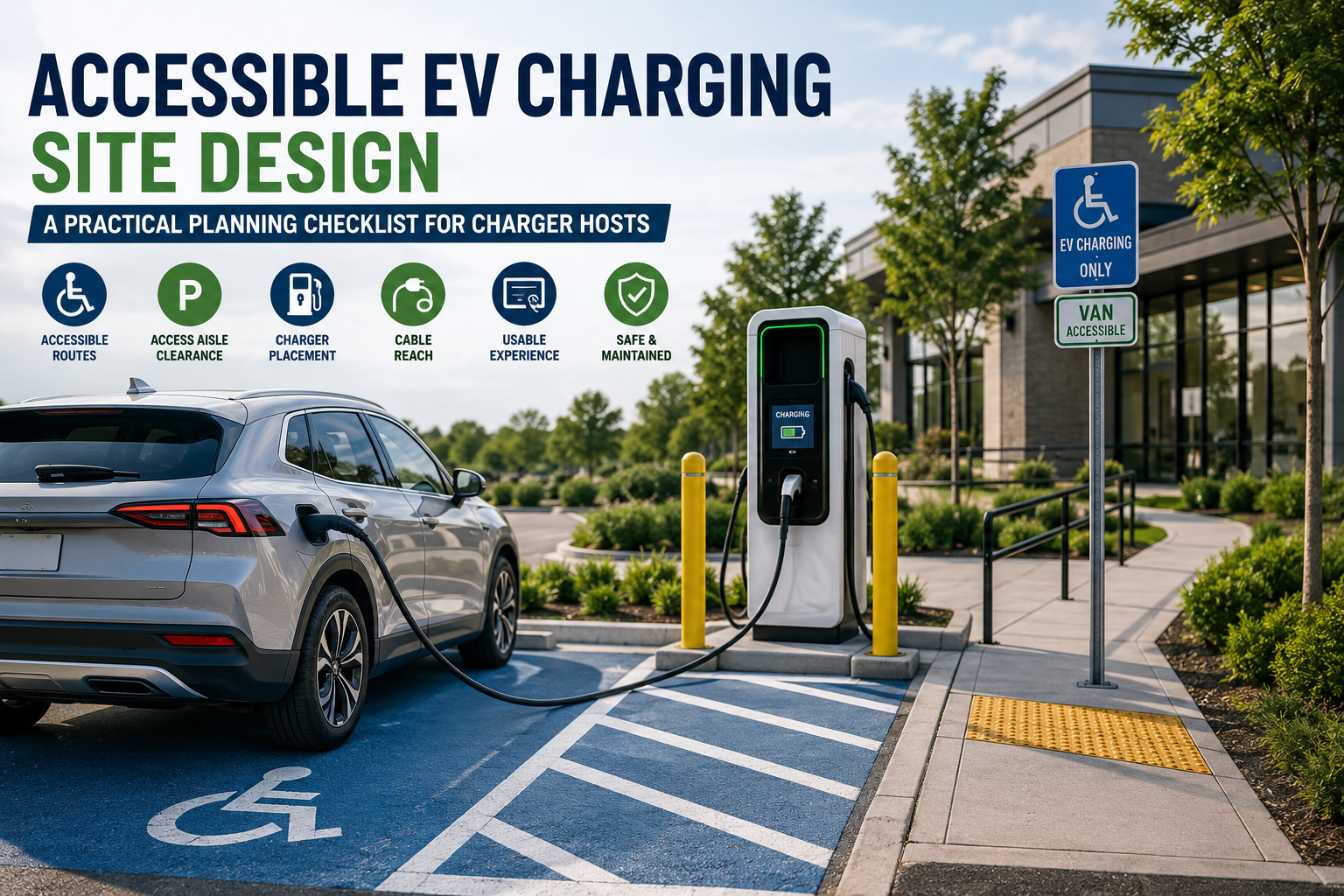
Accessible EV charging is much easier to plan before parking spaces, conduit routes, curbs, charger locations, bollards, and landscaping are finalized. At that stage, property owners and EV charger hosts can evaluate the complete charging experience instead of trying to correct accessibility problems after construction drawings are complete.
Good EV charging site design goes beyond providing enough physical space beside a charger. A driver needs to enter the property, locate the charging area, position the vehicle, exit safely, reach and operate the charger, handle the cable and connector, complete any payment or authentication steps, and leave the site safely.
A layout may appear workable on a drawing but still be difficult to use if:
- an access aisle is obstructed;
- the charging cable cannot reach the vehicle inlet;
- bollards restrict movement around the charger;
- the charger controls are difficult to reach;
- curbs or level changes interrupt the route;
- snow or temporary equipment blocks the usable area; or
- a mobile app, payment terminal, or support process creates another accessibility barrier.
For charger hosts, accessibility should therefore be treated as a site-planning, equipment-selection, construction, and operations issue rather than a final compliance check.
The U.S. Access Board's Design Recommendations for Accessible Electric Vehicle Charging Stations provide detailed technical assistance for EV charging accessibility. The document includes both existing accessibility requirements that may apply to covered facilities and additional design recommendations. The recommendations themselves are not legally binding.
In the United States, requirements can depend on the type of property, applicable ADA or ABA standards, federal funding, state and local codes, and other regulations. Outside the United States, different national, regional, or local accessibility standards may apply.
Use this article as an early EV charging accessibility planning checklist, then confirm project-specific requirements with the appropriate designer, contractor, permitting authority, accessibility professional, or authority having jurisdiction.
Why Accessible EV Charging Should Be Planned Early
Many accessibility problems become expensive once civil and electrical work has already been designed.
Early decisions can affect:
- charger placement;
- parking-space dimensions;
- access-aisle location;
- surface slopes;
- curb and sidewalk design;
- pedestrian routes;
- cable reach;
- bollard placement;
- signage and lighting;
- electrical conduit routes;
- snow storage;
- drainage;
- landscaping; and
- future charger expansion.
For example, placing chargers in the last unused corner of a parking lot may minimize electrical disruption, but that location could create longer routes, steeper grades, poor lighting, or difficult vehicle maneuvering.
Placing chargers close to a building entrance may improve convenience, but it can create other problems if the design conflicts with pedestrian circulation, accessible parking, loading zones, curbs, or building access.
Before issuing installation drawings or equipment orders, conduct a site walk using a scaled site plan.
Depending on the project, participants may include:
- the property owner or charger host;
- site or facility management;
- architect or civil designer;
- electrical contractor;
- EV charging equipment supplier;
- charging network provider;
- operations or maintenance staff;
- utility representatives; and
- local permitting or building officials.
The U.S. Department of Energy's Alternative Fuels Data Center (AFDC) recommends evaluating accessibility as part of broader EV charging site selection alongside factors such as public access, signage, lighting, vehicle types, amenities, utility capacity, connectivity, expansion opportunities, and long-term costs.
Review the DOE/Joint Office Public EV Charging Station Site Selection Checklist
Start With the Entire EV Charging Journey
One of the best ways to evaluate an accessible EV charging site is to follow the same journey a driver will take.
Do not evaluate only the rectangle containing the charger and parking space.
Start at the property entrance and continue through charging and departure.
1. Arrival and Wayfinding
Ask whether someone visiting the property for the first time can easily locate the EV chargers.
Review:
- signs at the property entrance;
- directional signs at major decision points;
- EV charging parking identification;
- visibility of chargers from the driving route;
- nighttime lighting;
- pavement markings; and
- directions shown in charging apps or station listings.
Signs should help drivers find the charging area without creating new obstacles within pedestrian routes.
2. Vehicle Approach and Parking
Next, consider how different vehicles will physically approach the charger.
Check whether drivers can:
- enter the charging area without difficult maneuvers;
- pull forward or reverse when necessary;
- open the driver's door with sufficient surrounding space;
- reach the charging inlet from the charger;
- leave without crossing an occupied access aisle; and
- avoid placing the charging cable across a pedestrian route.
Also consider how the area operates throughout the day.
Temporary conditions can matter just as much as the original design. Review whether charging access could be affected by:
- delivery vehicles;
- valet parking;
- snow piles;
- garbage collection;
- shopping carts;
- maintenance equipment;
- event traffic;
- temporary signs; or
- landscaping.
3. Route Between the Charger and Site Amenities
If drivers may use the property while charging, follow the route from the vehicle to relevant destinations.
These might include:
- building entrances;
- reception desks;
- hotel lobbies;
- restaurants;
- retail areas;
- washrooms;
- waiting areas;
- elevators;
- sidewalks; or
- other amenities.
Look for potential barriers such as curbs, abrupt level changes, narrow paths, drainage channels, gates, planters, furniture, snow-storage areas, or other objects that may reduce usable space.
The Access Board advises that charging spaces with accessible mobility features connect through an accessible route to the clear floor or ground space at the charger. It also warns that curbs, wheel stops, bollards, and charging-cable slack should not obstruct the access aisle.
Explore the Access Board's accessible EV charging design guidance.
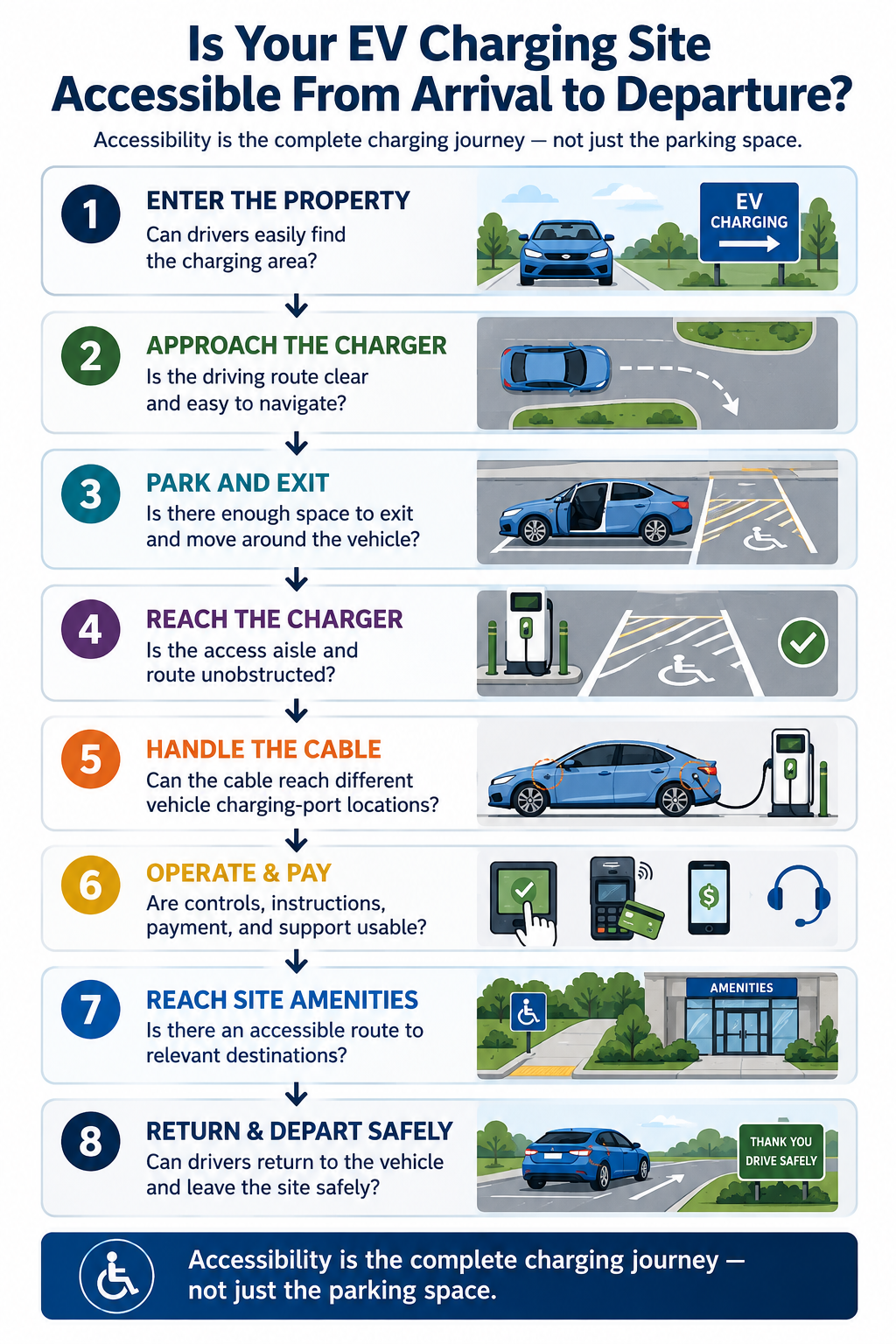
Accessibility is the complete charging journey, not just the parking space.
Design the Charging Space, Access Aisle, Charger and Bollards Together
An EV charging parking space should never be evaluated independently from the equipment surrounding it.
The usable system includes:
vehicle space + access aisle + charger + clear operating space + cable + protective equipment + accessible route
Changing one of these elements can affect the others.
As technical assistance, the U.S. Access Board recommends that an EV charging space with accessible mobility features provide:
- a vehicle charging space at least 132 inches (11 feet) wide;
- a minimum length of 240 inches (20 feet); and
- an adjacent access aisle at least 60 inches (5 feet) wide extending the full length of the charging space.
The Board also notes that larger spaces may be necessary for electric trucks and other large vehicles.
These dimensions are useful design benchmarks, but they should not be treated as a substitute for checking the requirements applicable to a specific property or jurisdiction.
See the Access Board's EV charging-space and access-aisle recommendations.
Questions to Review on the Site Plan
Before finalizing the charging area, ask:
- Is the vehicle space large enough for the vehicles expected at the site?
- Can a driver using a mobility device move around the vehicle?
- Does the access aisle remain clear for its full length?
- Does the aisle connect directly to the usable area in front of the charger?
- Are the charger controls positioned where they can be approached and operated?
- Could a bollard block the driver's position in front of the charger?
- Could a wheel stop interfere with movement around the vehicle?
- Will the charging cable cross the access aisle?
- Could stored cable slack become a tripping or mobility obstruction?
- Are curb transitions and surface changes properly coordinated?
- Could drainage features create uneven or difficult surfaces?
- Will painted markings remain understandable after multiple vehicles are parked?
Mark these usable areas directly on construction drawings rather than leaving accessibility assumptions to the installer.
Different contractors may install the conduit, charger, bollards, curbs, pavement markings, and signs. A coordinated drawing helps prevent one trade from unintentionally blocking space created by another.
Account for EV Charging-Port Location and Cable Reach
One of the biggest challenges in accessible EV charger design is that vehicle charging inlets are not standardized to one location.
Depending on the EV, the inlet might be located:
- near the front;
- on the front driver's side;
- at the rear driver's side;
- at the passenger-side rear;
- at the passenger-side front; or
- in another position.
That means the same charger placement may work well for one EV but poorly for another.
This issue is particularly important for DC fast charging, where cables can be heavier and shorter than many Level 2 charging cables.
The Access Board specifically identifies varying vehicle-inlet locations and cable reach as important accessibility considerations. It recommends considering different accessible configurations where stations are expected to serve a wide variety of vehicles.
Read the Access Board guidance on charger placement, vehicle inlets and cable reach.
Confirm Cable Specifications Before Ordering Equipment
Ask the charger manufacturer or supplier for:
- usable cable length;
- connector dimensions;
- cable weight;
- cable-management method;
- retraction or suspension system;
- connector holster position;
- required operating clearances; and
- recommended vehicle orientation.
Then test the proposed site arrangement using representative vehicle positions.
Do not assume that every vehicle will be able to reverse into the charging space or that every charging port will be located beside the charger.
Potential design responses can include:
- longer charging cables where practical;
- overhead or retractable cable-management systems;
- different charger orientations;
- chargers positioned between spaces;
- pull-through charging configurations;
- multiple accessible charging layouts;
- additional maneuvering space; or
- multiple chargers designed to accommodate different inlet locations.
Cable-management systems can also help keep cable slack away from accessible routes and may reduce some of the effort required to handle heavier charging cables.
No single charger configuration will perfectly accommodate every EV and every driver. The objective is to identify predictable limitations before construction and select a design that works for the broadest practical range of users and vehicles expected at the property.
Make Sure the EV Charger Itself Is Usable
Physical site accessibility is only part of the experience.
The charging equipment must also be considered.
A driver may need to:
- read the charger's screen;
- remove the connector;
- carry the cable;
- connect it to the vehicle;
- authenticate;
- select charging options;
- make a payment;
- interpret charging-status information;
- stop the session; and
- return the connector.
Include these interactions when evaluating equipment.
Review Charger Controls and Connector Handling
Ask equipment suppliers for detailed information about:
- control locations;
- display height and viewing angles;
- screen readability;
- physical buttons;
- connector release mechanisms;
- connector weight;
- cable weight;
- card-reader location;
- contactless payment;
- audible and visual indicators; and
- help or emergency functions.
The Access Board recommends accessible communication features and operable parts across EV charging equipment and discusses considerations such as screen visibility, tactile controls, visual and audible feedback, and connector operation.
Review the Access Board's EV charger interface and communication guidance.
Do Not Forget Apps, Payments and Digital Accessibility
Many public and shared EV chargers now depend on digital systems.
A charging session might require:
- a mobile app;
- QR code;
- RFID card;
- credit or debit card;
- contactless payment;
- account login;
- SMS;
- telephone support; or
- another authentication method.
These steps should be reviewed as part of the complete charging experience.
Ask:
- Can charging start without navigating a complicated process?
- Are instructions visible and understandable?
- Does the screen remain readable in bright sunlight?
- Is essential information communicated in more than one way?
- Is contactless payment available?
- Can a driver receive assistance without relying on a single communication channel?
- Is there a clearly visible support number?
- Does the mobile app support accessibility features?
- What happens when cellular service is unavailable?
- What happens if the QR code cannot be scanned?
- Can a session still be started when one payment method fails?
- Does the station clearly communicate when it is unavailable?
The Access Board also recommends providing mechanisms for reporting outages, obstructed chargers, equipment problems, and other issues.
Accessibility therefore extends beyond the concrete surrounding the charger. It can also include the software, payment process, station information, and customer-support experience.
Coordinate Accessibility Requirements Before Construction
Accessibility must be coordinated with the rest of the EV charger installation process.
Before construction begins, identify who is responsible for:
- confirming applicable accessibility requirements;
- reviewing local building and parking rules;
- charger-space dimensions;
- access-aisle dimensions;
- pavement markings;
- signage;
- curb and sidewalk work;
- charger orientation;
- equipment height and clearances;
- bollard placement;
- cable management;
- lighting;
- snow removal;
- drainage;
- electrical equipment placement;
- inspections; and
- final commissioning.
The DOE Alternative Fuels Data Center recommends assessing applicable codes, regulations, and permitting requirements early in an EV charging project. It also recommends coordinating with the utility and using qualified electrical contractors familiar with relevant codes and standards.
Read the DOE/AFDC guide to EV charging infrastructure procurement and installation.
Local building, zoning, parking, accessibility, electrical, or planning rules may introduce additional requirements.
Funding programmes may also impose conditions beyond the requirements normally applicable to the property.
For more complex installations, have the design professional, charger supplier, electrical contractor, and authority having jurisdiction review the same scaled site plan.
That reduces the risk of accessibility features being unintentionally compromised later by:
- transformers;
- utility cabinets;
- bollards;
- curbs;
- wheel stops;
- signs;
- landscaping; or
- other equipment.
Plan for Accessibility After the Chargers Open
Accessible EV charging does not end when construction is complete.
Conditions around a charger change over time.
Paint can fade. Signs can be damaged. Charging cables may be left on the ground. Vegetation can grow into pathways. Snow can cover pavement markings. Temporary operations can turn access aisles into storage areas.
Build accessibility checks into regular charger inspections.
Create an EV Charging Site Operating Plan
Assign responsibility for checking:
- access aisles;
- accessible routes;
- pavement markings;
- signage;
- lighting;
- charger screens and controls;
- charging cables;
- cable-management systems;
- bollards;
- curb transitions;
- landscaping;
- snow and ice;
- drainage;
- payment systems; and
- customer-support information.
Staff should also know that an access aisle is not:
- equipment storage;
- a snow-storage location;
- a loading zone;
- cart storage;
- temporary parking; or
- a convenient location for signs.
If a charger becomes unavailable or its accessible route is obstructed, the site should have a process for reporting and correcting the problem.
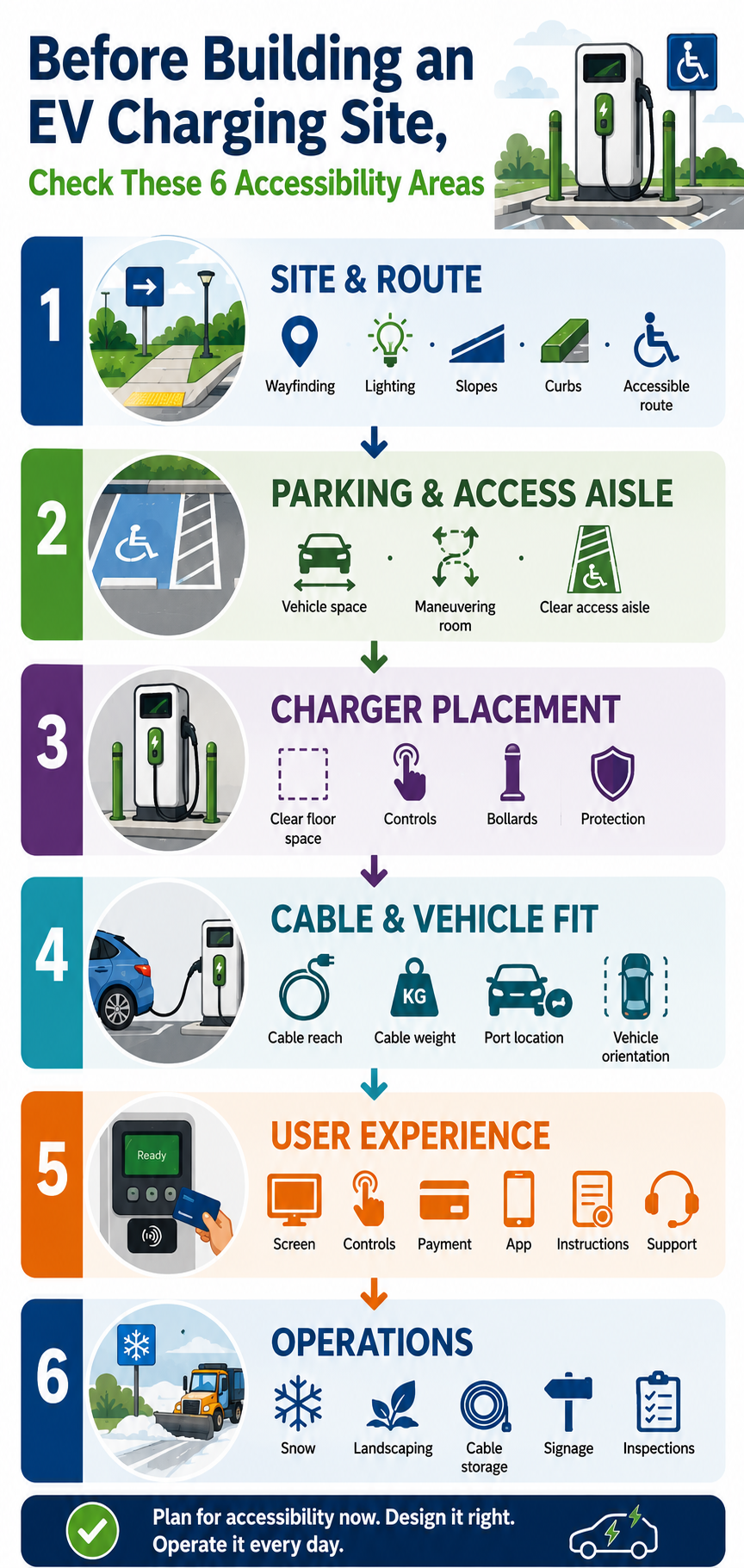
Design accessibility before construction, then protect it through daily operations.
Pre-Construction Accessible EV Charging Checklist for Hosts
Before approving an EV charging site design, review this checklist with the project team.
Site Location and Route
- Drivers can easily locate the charging area.
- Directional signage is included where needed.
- Lighting supports nighttime use.
- The charging area connects to an appropriate accessible route.
- Routes to relevant on-site amenities have been reviewed.
- Curbs, slopes, drainage, gates, and other potential barriers have been considered.
Charging Space and Access Aisle
- Applicable local dimensions and accessibility requirements have been confirmed.
- Vehicle maneuvering has been tested.
- The access aisle remains unobstructed.
- The access aisle connects to the usable space at the charger.
- Bollards and wheel stops do not interfere with movement.
- Pavement markings and signs are coordinated with applicable requirements.
Charger and Cable
- Charger operating clearances have been reviewed.
- Controls can be approached and used from the intended clear space.
- Cable length has been confirmed with the equipment supplier.
- Cable weight and connector handling have been evaluated.
- Cable-management systems do not obstruct accessible routes.
- Different EV charging-port locations have been considered.
- More than one vehicle orientation has been tested where appropriate.
Equipment and Payment
- Instructions are clear.
- Displays can be read from the intended operating position.
- Controls and payment equipment have been reviewed for usability.
- Essential information is not communicated only through color.
- Accessible digital experiences have been considered.
- Customer-support information is easy to find.
- Drivers have an alternative way to obtain assistance when possible.
Construction Coordination
- Accessibility responsibilities are assigned.
- Charger drawings match civil and electrical drawings.
- Utility equipment does not obstruct accessible areas.
- Bollard placement has been coordinated before installation.
- Permitting and inspection requirements have been confirmed.
- The installed site will be inspected against the approved plan.
Ongoing Operations
- Access aisles will be routinely checked.
- Cable-storage equipment will be maintained.
- Snow and ice removal procedures protect accessible routes.
- Landscaping will not reduce usable clearances.
- Pavement markings and signs will be maintained.
- Charger outages and obstructions have a reporting process.
Accessible EV Charging Is More Than a Parking-Space Dimension
The best accessible EV charging site is not simply one that looks correct on a construction drawing.
It is a site where a driver can realistically:
find the charger → park → exit the vehicle → reach the equipment → handle the connector → start charging → access nearby amenities → return to the vehicle → depart safely
For EV charger hosts, addressing these requirements early can also prevent expensive redesigns after curbs, electrical infrastructure, pavement, and equipment are already installed.
Start accessibility planning during site selection, evaluate the complete driver journey, test the layout against multiple vehicles, coordinate charger and cable specifications with the physical site, confirm the rules that apply to the project, and maintain those accessible features throughout the life of the charging station.
That approach produces something more valuable than a compliant-looking drawing: an EV charging site that people can actually use.
Sources
- U.S. Access Board — Design Recommendations for Accessible Electric Vehicle Charging Stations
- U.S. Department of Energy / Joint Office — Public EV Charging Station Site Selection Checklist
- Alternative Fuels Data Center — Procurement and Installation for Electric Vehicle Charging Infrastructure
- Alternative Fuels Data Center — State and Local Planning for EV Charging Infrastructure