
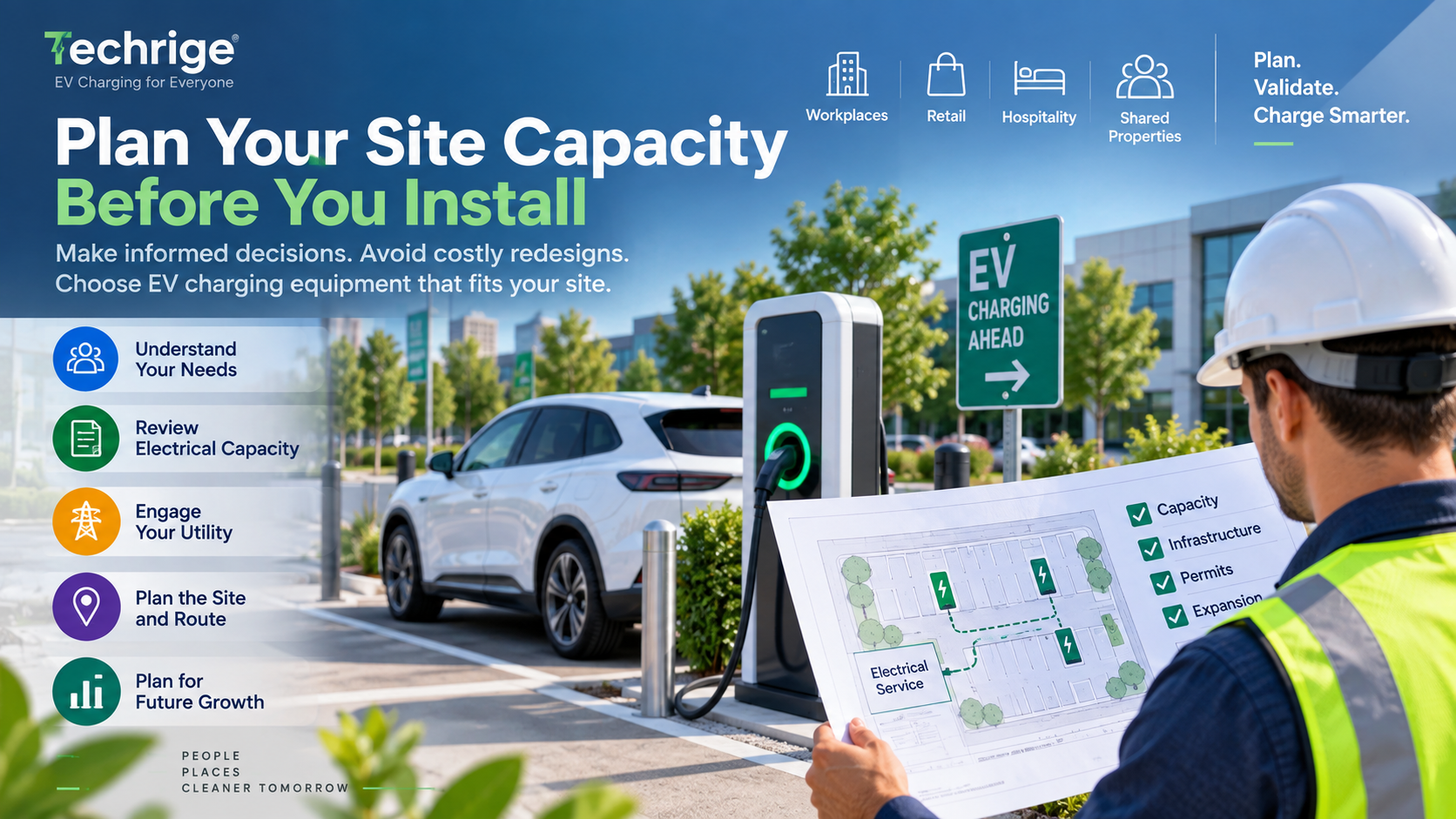
Selecting EV charging equipment before understanding a site's electrical capacity can create avoidable redesigns, delays, and added costs. For workplace, retail, hospitality, and shared-property hosts, the better sequence is to define the charging need, prepare a preliminary load concept, and validate it with the utility and qualified local professionals before making a final equipment commitment.
Electrical capacity is not simply the power rating shown on an EV charger specification sheet. A workable project depends on the site's existing electrical service, current building loads, the number of vehicles likely to charge at the same time, the distance between electrical infrastructure and parking spaces, and any upgrades or approvals the project may require.
The final electrical design should always be validated by a licensed electrical professional and, where appropriate, the local utility.
This guide is an educational planning resource, not electrical, code, permitting, accessibility, utility-rate, or legal advice.
1. Begin with the operating need, not the charger model
Start by describing how people will actually use the parking area. The goal is to match the charging approach to how long vehicles are normally parked rather than assuming that the highest available charging power is always the best choice.
Ask practical questions such as:
- Who will use the chargers: employees, customers, hotel guests, tenants, fleet vehicles, or the general public?
- How long do vehicles typically remain parked?
- How many vehicles may need to charge during the busiest period?
- Will drivers need a full charge, a partial top-up, or simply enough energy for their next trip?
- Are vehicles likely to arrive and leave at similar times?
- Could charging sessions be spread across the day or overnight?
- Is charging intended primarily as an amenity, a revenue-generating service, or operational infrastructure?
- How might charging demand increase over the next several years?
Longer parking periods may support a Level 2 charging approach, while short-stay or corridor-oriented use may lead a host to evaluate DC fast charging. The U.S. Department of Energy's EV fleet guidance similarly emphasizes matching charging equipment to vehicle use, charging time, and operational requirements.
That is an operating decision first and an electrical decision second: the selected charging approach establishes the power request that the site must ultimately support.
Avoid using a single assumed charging session as the whole business case. Consider demand patterns instead.
For example, a workplace may have many vehicles parked for most of the day, while a restaurant may have shorter and more variable visits. A hotel may have vehicles parked overnight, while a shared-property host may need to consider access rules, parking assignments, and how charging demand could change over time.
These observations do not determine the final electrical design, but they make the initial project requirements much more useful.
2. Prepare a preliminary EV charging load brief
Before calling the utility or requesting contractor proposals, create a concise load brief.
This is not a final electrical load calculation. It is a planning document that gives the utility, electrical contractor, and other project stakeholders a clearer picture of what you are considering.
Include:
- Site address and property type
- Existing electrical service information, if known
- Proposed number of charging ports
- Expected charging level: Level 2, DC fast charging, or a combination
- Approximate power rating being considered for each charger
- Expected maximum number of vehicles charging simultaneously
- Typical parking or dwell time
- Operating hours
- Whether chargers will be public, private, fleet-only, employee-only, or shared
- Whether load management or managed charging is being considered
- Expected future expansion
- A basic site plan showing the electrical service and proposed charging locations
This brief helps separate two concepts that are often confused: the maximum rating of individual charging equipment and the site's expected coincident electrical demand.
It also gives all project stakeholders a common version of the proposed scope. If the operating plan changes significantly, update the brief before treating earlier utility or design discussions as final.
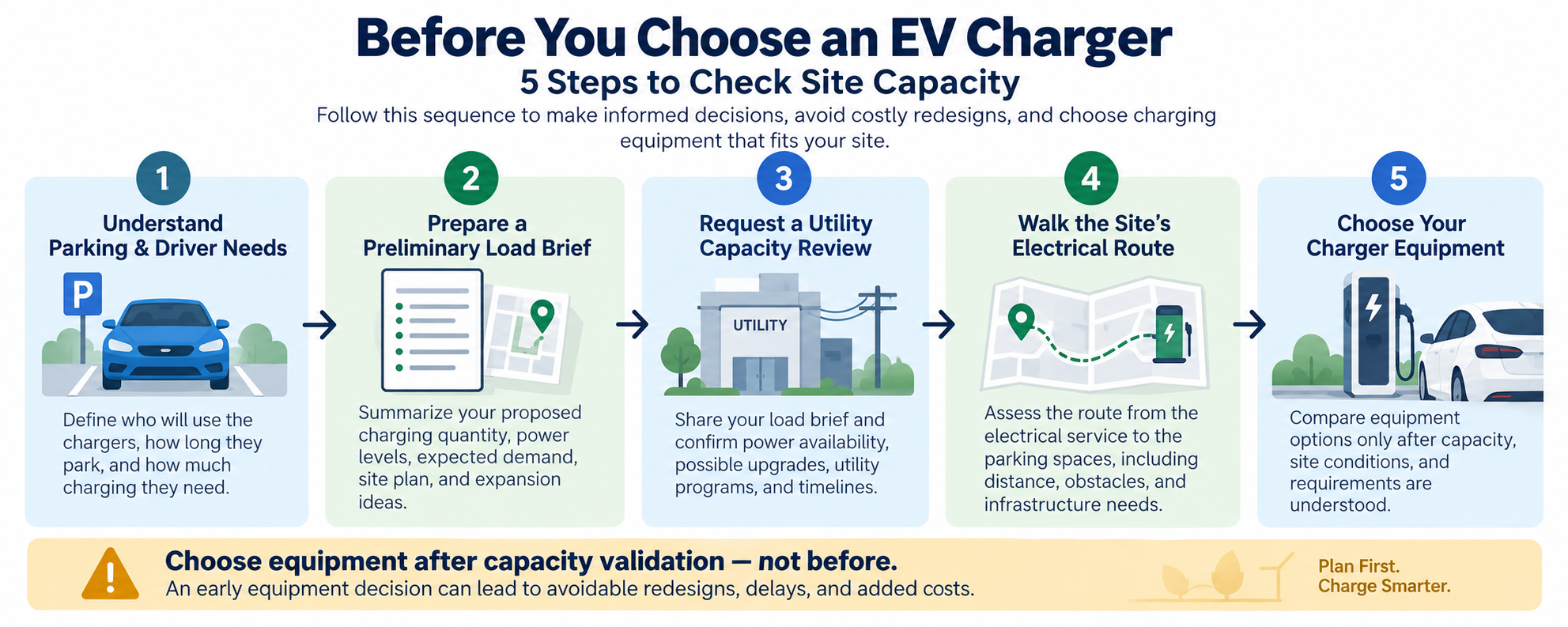
3. Request a site-level utility review early
A utility discussion should occur before the host finalizes charger quantity or power.
The U.S. Department of Energy's Alternative Fuels Data Center recommends contacting the local utility for a site-level evaluation to understand power availability and the electrical upgrades that may be required for the proposed charging capacity and expected usage. See the DOE EV Readiness guidance.
Provide the utility with the preliminary load brief and ask site-specific questions such as:
- Can the existing electrical service support the proposed charging demand?
- Are utility-side upgrades likely to be required?
- Are transformer or distribution-system upgrades potentially necessary?
- Is additional engineering review required before capacity can be confirmed?
- What information does the utility need from the project's electrical professional?
- Are there utility EV charging programs or incentives available?
- Are special EV charging rates or demand charges applicable?
- Are managed-charging programs available?
- What are the expected utility review and upgrade timelines?
- Should future charger expansion be included in the initial request?
The Joint Office of Energy and Transportation's Public EV Charging Station Site Selection Checklist similarly advises project teams to engage with the utility to understand site limitations, electricity-supply costs, grid-level constraints, and whether the utility can support the full power required by the proposed charging stations.
Do not treat a general conversation, an online service lookup, or the size of an existing electrical panel as a final project-specific capacity determination.
Ask what the utility can confirm now, what remains subject to engineering or design review, and what may require an additional study.
Timing, upgrade costs, utility programs, and technical requirements vary substantially by utility and location.
Consider managed charging
Managed charging may be worth discussing when it aligns with the site's operating requirements.
DOE notes that utilities can provide power-availability and capacity analysis and may offer managed charging, sometimes called smart charging, to help control charging demand. Utilities may also offer incentives or different equipment-ownership arrangements.
See the DOE Procurement and Installation for EV Charging Infrastructure guide.
A host should confirm the capabilities and requirements of any managed-charging approach with the utility, electrical professional, charging-network provider, and equipment manufacturer.
Managed charging should not be assumed to eliminate the need for a properly validated electrical design.
4. Walk the route from electrical service to the parking spaces
A site can appear simple on a map yet become considerably more complex once construction requirements are examined.
Walk the likely path from the existing electrical service to each proposed EV charging location with the appropriate project professionals.
Document:
- Electrical panels, transformers, and service equipment
- Approximate distance between the electrical source and charging spaces
- Potential conduit and cable routes
- Walls, landscaped areas, sidewalks, roads, and other obstacles
- Areas where trenching or directional boring may be necessary
- Existing underground infrastructure
- Drainage and areas where water may collect
- Pedestrian routes and potential trip hazards
- Accessibility requirements
- Protective bollard requirements
- Parking-space dimensions
- Equipment mounting locations
- Lighting and security
- Cellular or network connectivity for connected chargers
- Space that could support future chargers or electrical equipment
Distance matters because longer routes between electrical infrastructure and charging equipment can make installations more complicated and expensive.
DOE's Electric Vehicles for Fleets guidance specifically identifies proximity to electrical infrastructure as an important site-selection consideration and recommends considering future circuits, electrical capacity, and conduit when planning for expansion.
The walk-through is also an opportunity to identify questions rather than make assumptions.
For example: Is there a practical route that avoids disrupting a busy entrance? Is the preferred parking row unusually far from the electrical service? Could another row reduce trenching or civil work? Is there a safe and maintainable location for supporting electrical equipment?
The answers may change the preferred charger quantity, power level, or location.
5. Make EV charging expansion a deliberate choice
Many EV charging hosts expect demand to grow, but that does not mean every future charger needs to be installed during the first phase.
A phased EV charging plan can distinguish between what is installed today and what is deliberately prepared for later.
LayerPlanning questionCurrent installationWhat charging ports, equipment, circuits, and supporting infrastructure are required for the first operating phase?Expansion preparationWhat electrical capacity, conduit pathways, physical space, or documentation may be sensible to reserve now?Future decision pointWhat utilization, tenant, visitor, employee, or fleet-demand evidence would justify the next expansion phase?
Be precise about terminology during project discussions.
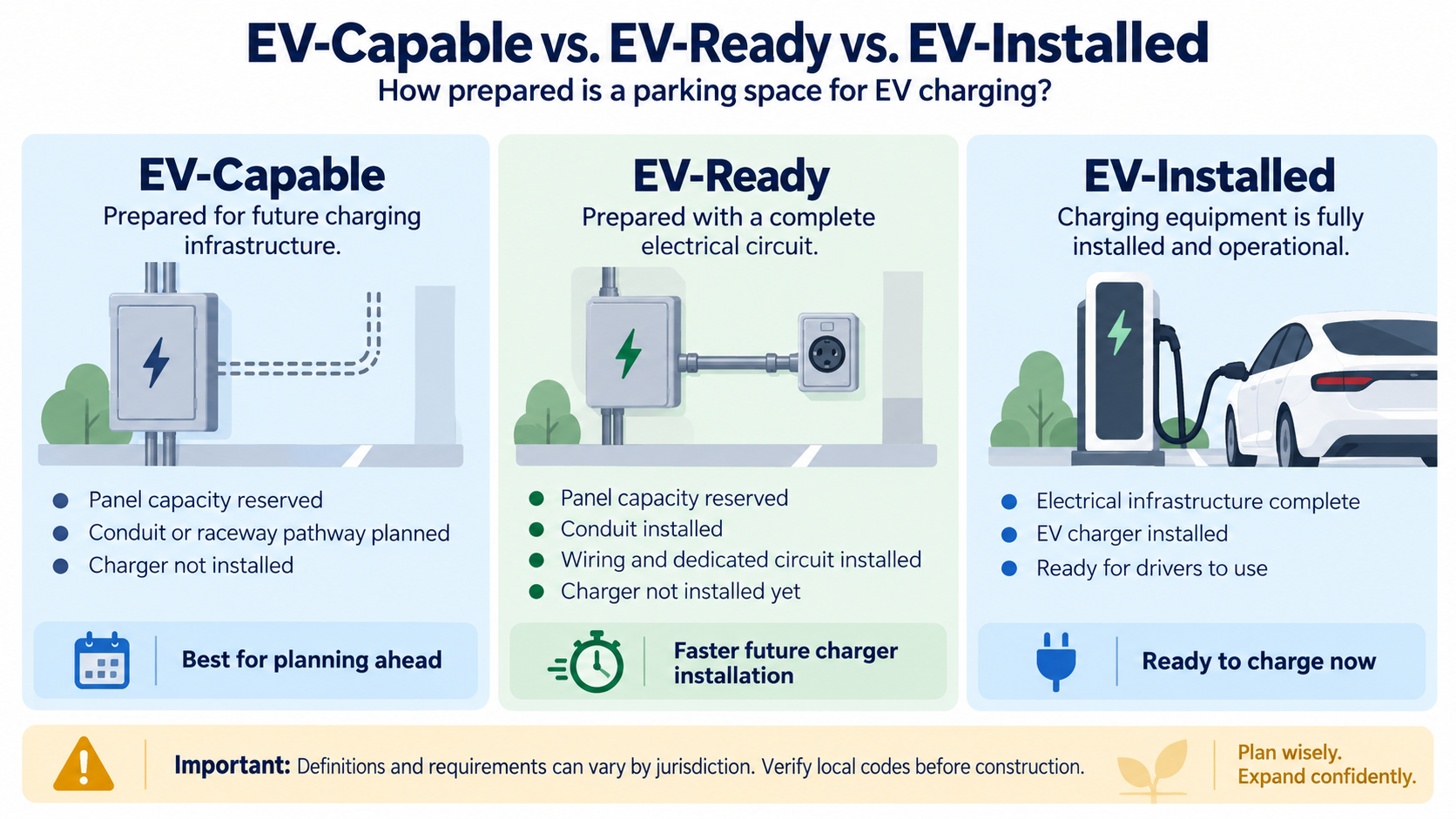
DOE describes an EV-capable parking space as having electrical panel capacity and conduit available for future charging infrastructure.
An EV-ready parking space goes further by including a complete electrical circuit.
An EV-installed space includes the EV charging equipment itself.
See the DOE overview of EV charging building codes, parking ordinances, and zoning ordinances.
Local definitions and technical requirements can differ, so always confirm terminology with the relevant authority and project professionals.
In other words, reserving conduit or panel capacity for later is not the same as having installed charging capacity.
Record exactly what the current project includes and what would still be required during a later expansion phase. This reduces the risk that future stakeholders assume a parking space described as "EV-ready" can accept any charger without further review.
6. Confirm permits and local requirements before construction
Electrical capacity is only one part of EV charging project readiness.
Before construction begins, consult qualified local professionals and the appropriate authorities about the permits, inspections, accessibility rules, and other requirements that apply to the specific location.
DOE notes that charging infrastructure projects may involve building, fire, environmental, electrical inspection, and permitting authorities and must comply with applicable local, state, and national requirements.
The DOE EV Readiness resource is a useful starting point, but it does not replace local requirements.
For a specific project, confirm requirements involving:
- Electrical permits and inspections
- Building permits
- Zoning
- Parking regulations
- Accessibility
- Fire-safety requirements
- Site development
- Signage
- Protective equipment
- Utility approvals
- Applicable electrical codes
Requirements, interpretations, review sequences, and required documentation vary by jurisdiction.
A licensed electrical professional and the local authority having jurisdiction should advise on the final design and approval process.
7. Use a documented EV charger decision gate
Once the utility review, site walk, and preliminary professional input are available, bring the findings together before purchasing charging equipment.
A simple decision gate can prevent a project from advancing based on an untested assumption.
Document:
- Proposed charger quantity and power
- Expected coincident charging demand
- Known electrical capacity constraints
- Utility feedback
- Expected utility upgrades
- Electrical service or panel upgrades
- Estimated cable and conduit route
- Major civil-work requirements
- Managed-charging assumptions
- Permitting considerations
- Expansion requirements
- Remaining technical uncertainties
- Expected project schedule and major dependencies
Then select an appropriate path:
- Proceed as planned — the proposed charging design appears practical and can move into detailed engineering and procurement.
- Reduce or redistribute charging power — the operating need can be satisfied with a different charging configuration.
- Plan an electrical upgrade — the desired project requires additional capacity or infrastructure.
- Reconsider the location or project scope — another configuration or charging location may provide a more practical solution.
This decision gate is a planning tool, not a shortcut around professional engineering, utility approval, or permitting.
Its purpose is to make the decision transparent before equipment orders establish expectations that the site may not be able to support.
A practical next step for EV charger hosts
Start with a one-page EV charging load brief and a marked-up site plan.
Use them to begin a site-level discussion with the utility and to brief your electrical and construction professionals.
Only then compare specific EV charging equipment based on what you now know about:
- Electrical capacity
- Driver demand
- Parking duration
- Utility requirements
- Construction complexity
- Managed-charging opportunities
- Expansion plans
- Local permitting requirements
That sequence does not guarantee a particular project cost, schedule, approval, or utility outcome.
It does give EV charger hosts a much stronger basis for choosing charging equipment that fits the property—rather than trying to force the property to accommodate an equipment decision made too early.
Sources
- U.S. Department of Energy Alternative Fuels Data Center — EV Readiness
- DOE AFDC — Procurement and Installation for EV Charging Infrastructure
- DOE AFDC — Electric Vehicles for Fleets
- DOE AFDC — Building Codes, Parking Ordinances, and Zoning Ordinances
- Joint Office of Energy and Transportation — Public EV Charging Station Site Selection Checklist