
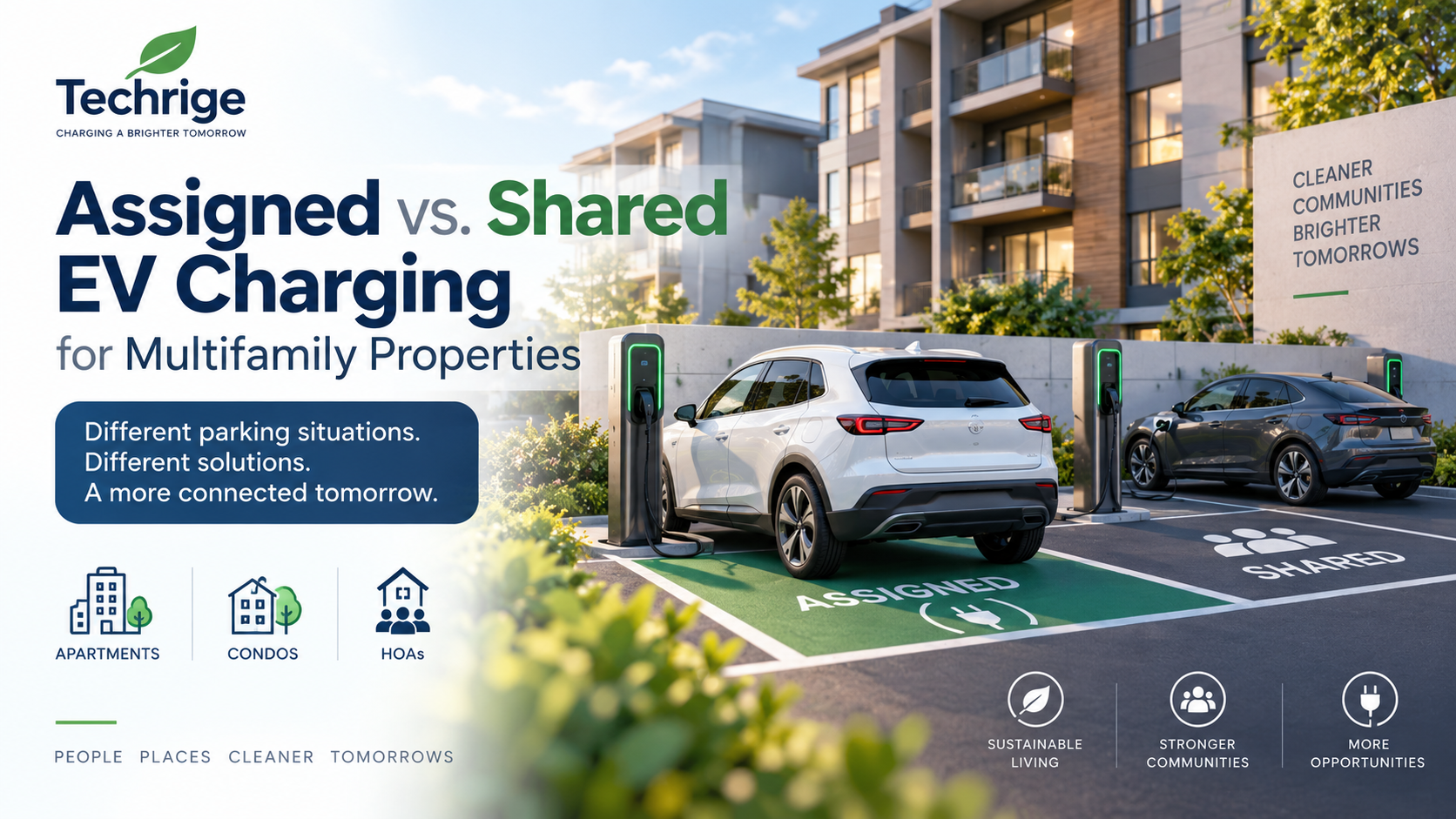
Multifamily EV charging is often framed as an equipment choice. In practice, the first decision is usually about parking: who has the right to use which space, how often that space changes hands, and who will manage access when more than one driver needs to charge.
For apartment buildings, condos, and HOAs, there is no universally best model. An assigned-space approach can suit a resident with an exclusive stall and stable parking arrangements. A shared charging pool can make better use of common parking where spaces turn over or demand is uncertain. The right choice depends on the property’s parking rights, electrical situation, resident demand, billing approach, and ability to administer clear rules.
The U.S. Department of Energy’s Alternative Fuels Data Center guidance for multifamily housing identifies parking, electrical-service access, billing, and legal issues as separate considerations. Treating those as one planning exercise—not an afterthought after selecting a charger—can help residents and property teams make a more workable decision.
Assigned-space charging: when a dedicated stall fits
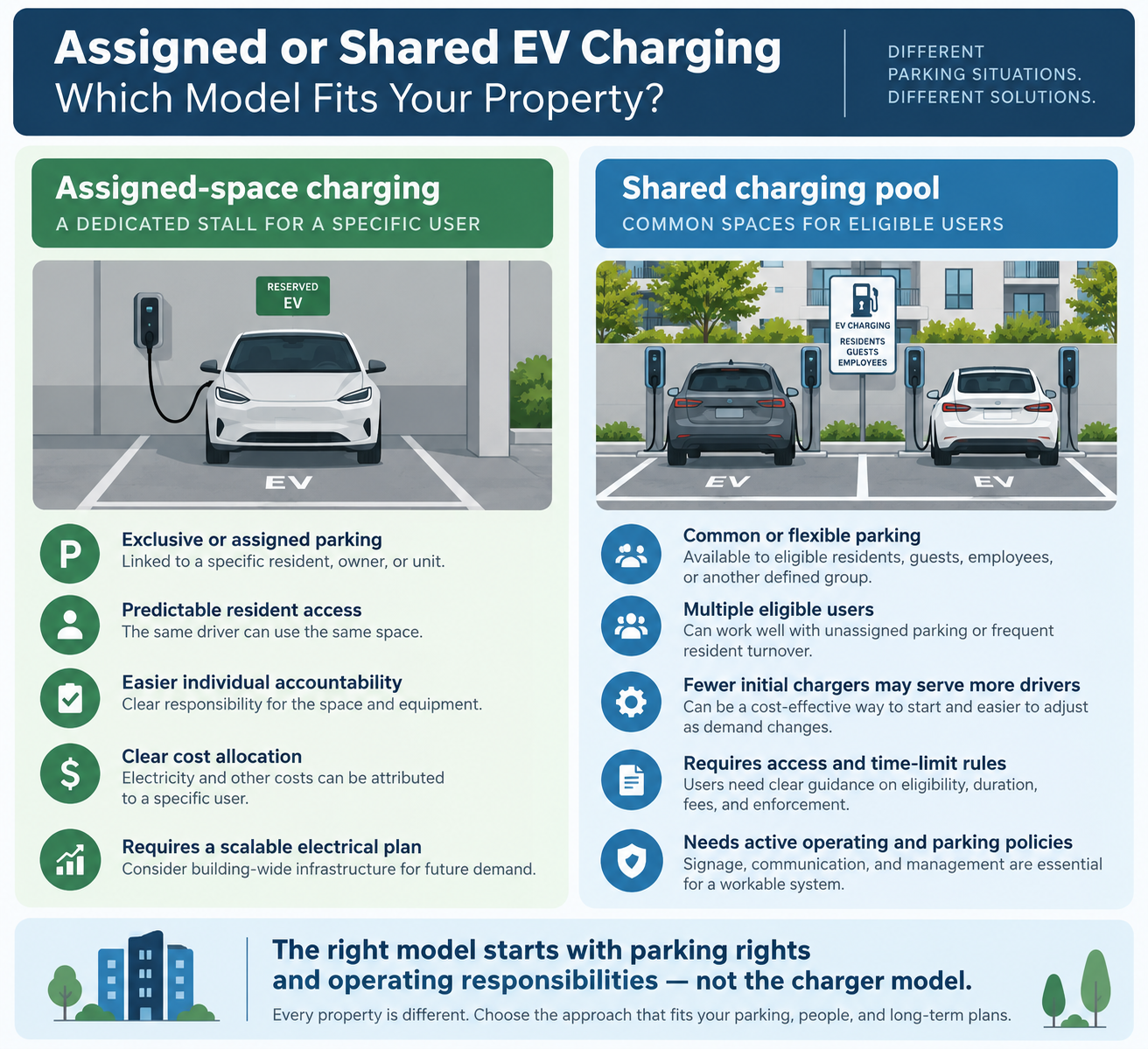
Assigned-space charging links a charging location to a particular parking stall and, usually, a particular resident, owner, or unit. It may be a useful option when all or most of the following are true:
- Residents have clearly assigned or exclusive parking spaces.
- Parking assignments are relatively stable.
- A resident can reliably access the same charging location.
- Electricity and charging costs can be attributed to the appropriate user.
- The property has a process for approving installations and future electrical expansion.
- Responsibility for the charger, repairs, and removal can be clearly documented.
The principal benefit is simplicity for the driver. They know where to park and can follow their own routine without coordinating with other residents. It can also make accountability clearer: a single user can be responsible for keeping the space available and reporting faults.
But “assigned” does not mean “set and forget.” Property managers and boards should document whether the equipment belongs to the resident, the association, or the building; how electricity costs are handled; and what happens if the parking right ends. A condo owner may have different rights and responsibilities than a renter, and a deeded space may be different from a space allocated under building policy.
Assigned charging can also become difficult to scale if requests arrive one by one. A building may want to consider a common electrical and conduit plan before approving individual installations. This is a planning question for the property, local utility, and appropriately qualified professionals—not a reason to assume that every requested installation can proceed.
Shared charging: when a common pool may fit the property
Shared charging places one or more charging locations in a common area for eligible residents, guests, employees, or another defined user group. It can suit buildings with unassigned parking, frequent resident turnover, limited initial demand, or a desire to manage charging as a common amenity.
A shared pool may let a property start with fewer charging locations than the number of interested drivers. It may also be easier to relocate, add, or revise access arrangements as resident needs change.
However, shared charging replaces a physical assignment with an operating system: people need to understand who may use the spaces, for how long, at what cost, and what happens when rules are not followed.
Before choosing shared charging, answer practical questions such as:
- Who is eligible to use the charging spaces?
- Are spaces first-come, first-served or reservable?
- Is there a maximum parking or charging duration?
- Are overnight sessions allowed?
- Must vehicles move after charging is complete?
- How will electricity or charging fees be calculated and collected?
- How will residents know when a charger becomes available?
- Who handles blocked spaces, misuse, or repeated policy violations?
- Who should residents contact when equipment is not working?
Signage is part of the operating model, not just a finishing touch. The Alternative Fuels Data Center notes that charging-station signage can communicate access rules, time limits, operating hours, and parking enforcement information. Written digital policies, lease or community-rule updates where appropriate, and on-site signs should convey the same message.
A decision framework: start with five maps
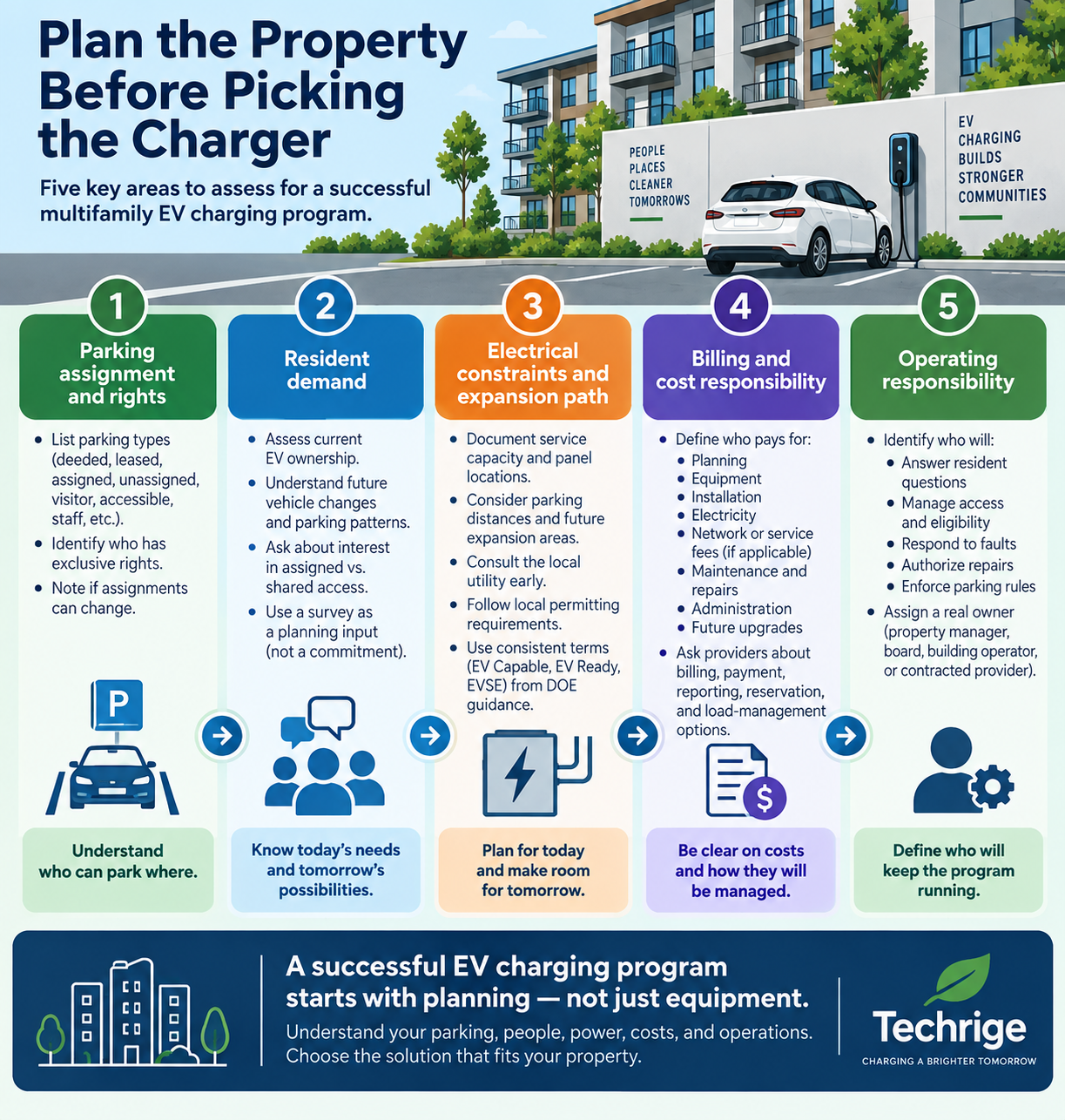
Before selecting equipment or a service provider, create a short planning record that maps five areas. It does not need to be elaborate, but it should be specific to the property.
1. Parking assignment and rights
List the parking types: deeded, leased, assigned, unassigned, visitor, accessible, staff, and loading spaces. Note whether a particular user has an exclusive right to a stall and whether that arrangement can change.
This map often points toward assigned, shared, or mixed charging.
2. Resident demand
Ask residents about present EV ownership, expected vehicle changes, parking patterns, and interest in shared versus assigned access.
A survey is a planning input, not a binding commitment. It can help distinguish a small immediate need from a broader request for future readiness.
3. Electrical constraints and expansion path
Document what is known about electrical-service access, panel locations, parking distances, and likely future expansion areas.
The U.S. Department of Transportation recommends consulting the local utility early to understand project constraints, EV-related policies or programs, and electricity pricing structures. Licensed professionals and local permitting authorities should address requirements applicable to the project.
It can also help to use consistent language for future planning. In its voluntary multifamily checklist, the Department of Energy distinguishes EV Capable, EV Ready, and EVSE spaces. It also describes an energy-management system that can adjust power supplied to charging locations within the program’s requirements.
See the DOE Efficient New Homes Multifamily EV-Ready Checklist. These labels can be useful planning terms but should not be treated as universal installation requirements.
4. Billing and cost responsibility
Decide what costs exist and who is responsible for each:
- Project planning
- Equipment
- Installation
- Electricity
- Network or service fees, if applicable
- Maintenance and repairs
- Administration
- Future electrical or charging upgrades
Ask prospective providers what billing, payment, access-control, reporting, reservation, and load-management options they offer. Do not assume a particular feature is available.
5. Operating responsibility
Name the party that will answer resident questions, update eligibility records, respond to faults, authorize repairs, and enforce parking rules.
A workable charging program has a real owner, whether that is a property manager, board-appointed committee, building operator, or contracted provider.
Questions residents can bring to a property manager or HOA
Residents can make early conversations more productive by asking focused, neutral questions:
- Are EV charging installations currently allowed?
- Is my parking space assigned, leased, deeded, or governed another way?
- Does the property already have an EV charging or electrical-expansion plan?
- Is assigned charging being considered, or will the property use shared chargers?
- Who would own the equipment?
- Who would pay for installation, electricity, maintenance, and removal?
- Are there building, association, insurance, architectural, or permitting requirements?
- If several residents request charging, how will applications be prioritized?
- Is load management or another shared electrical approach being considered?
- Who should residents contact to begin the formal review process?
Residents should also check applicable local rules and their own lease, condominium documents, or parking agreement.
The EPA advises residents in shared buildings to speak with management about charging options and check local rules. It also notes that right-to-charge laws in many states may affect residents with designated parking spaces. These laws are not nationwide, and their application depends on the jurisdiction and circumstances.
Questions property managers should answer before selecting a provider
A provider comparison should follow, rather than replace, the property’s operating decisions. Before issuing a request for proposals or approving equipment, property teams should be able to answer:
- Are chargers intended for assigned spaces, shared spaces, or both?
- Who will be eligible to use them?
- How many charging locations are needed initially?
- How could the system expand if resident demand grows?
- Who will own the charging equipment?
- Who will own or maintain the supporting electrical infrastructure?
- How will electricity and service costs be allocated?
- Is access control required?
- Are reservations necessary?
- Are charging or parking time limits necessary?
- Who will manage resident enrollment and access changes?
- Who handles faults and equipment repairs?
- What reporting does property management actually need?
- What happens if the property changes charging-network or service providers later?
- What parking rules will need to be communicated and enforced?
A mixed model may be reasonable. For example, a property might support assigned charging where parking rights are exclusive while operating a small shared pool for residents without assigned stalls.
The policy should explain why the models differ and how requests are evaluated.
Set the operating policy before launch
A charging program works best when the access and parking rules are decided before users arrive. Put the policy in plain language and make it available before enrollment.
At minimum, address the following:
- Who is eligible to charge
- Which spaces users may occupy
- Whether reservations are used
- Maximum parking or charging duration
- Overnight charging rules
- Whether vehicles must move after charging
- Charging and parking fees, if applicable
- How users receive charging notifications
- Rules for guests or visitors
- What happens when charging spaces are blocked
- How misuse or repeated violations are addressed
- How faults should be reported
- Who provides user support
- How policy changes will be communicated
Avoid writing rules that the property cannot realistically administer. For example, a strict move-when-complete rule may require reliable notifications and active parking management. If those are not available, a simpler overnight or maximum-duration policy may be easier to communicate and enforce.
A phased rollout option: use a documented pilot
For properties with uncertain demand or complex governance, a pilot can reduce the pressure to solve every future scenario at once.
A pilot should still be documented. Define its duration, participating spaces or users, costs, parking rules, support contacts, and review date before launch.
During the pilot, review practical evidence:
- How often are charging spaces used?
- At what times does demand occur?
- Do residents understand the access and parking rules?
- Do the same billing questions recur?
- How quickly are equipment faults addressed?
- Are non-charging vehicles blocking the spaces?
- Are charging vehicles remaining longer than expected?
- Is existing capacity sufficient for the observed demand?
Combine those observations with resident feedback before deciding whether to expand, change the rules, retain the pilot size, or pursue a different model.
A pilot is not a substitute for required approvals, utility consultation, or professional review. It is an operating and governance tool that can help the property learn before committing to a larger rollout.
Choose the model that fits the building
Assigned-space and shared-pool charging solve different problems.
Assigned charging may fit stable, exclusive parking rights and predictable individual routines. Shared charging may fit common parking, changing resident demand, and a property that can administer access rules. Some buildings will need both.
Start with parking rights and operational responsibility, then assess demand, electrical constraints, billing, and expansion. Consult the local utility early and seek qualified professional and jurisdiction-specific guidance where needed.
Finally, communicate the resulting rules clearly—both at the charging area and in the documents residents use.
Sources
- U.S. Department of Energy, Alternative Fuels Data Center — Electric Vehicle Charging for Multifamily Housing
- U.S. Department of Energy, Alternative Fuels Data Center — Signage for Electric Vehicle Charging Stations
- U.S. Department of Transportation — EV Infrastructure Project Planning Checklist
- U.S. Department of Energy — DOE Efficient New Homes Multifamily EV-Ready Checklist
- U.S. Environmental Protection Agency — Getting Started with Home EV Charging