
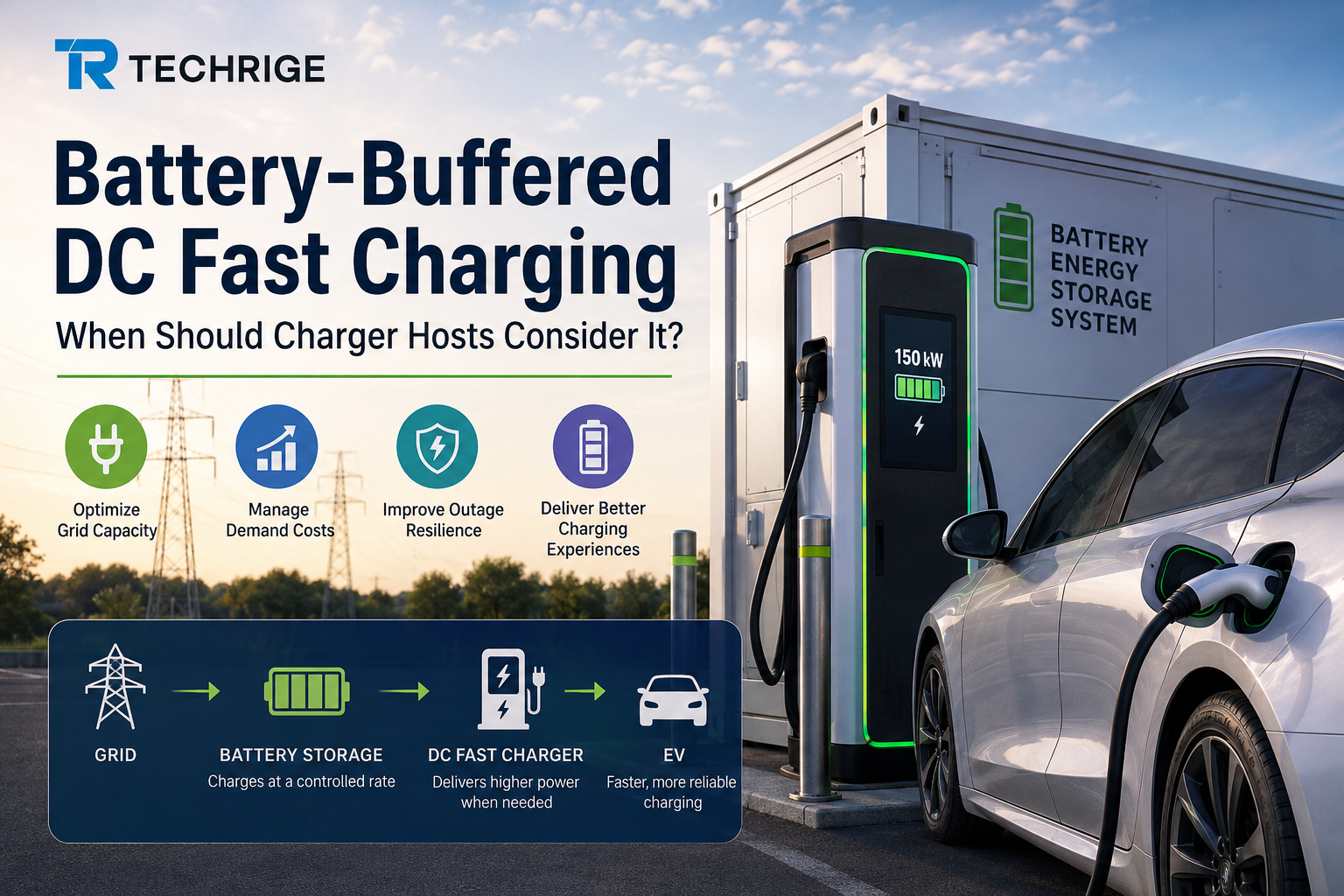
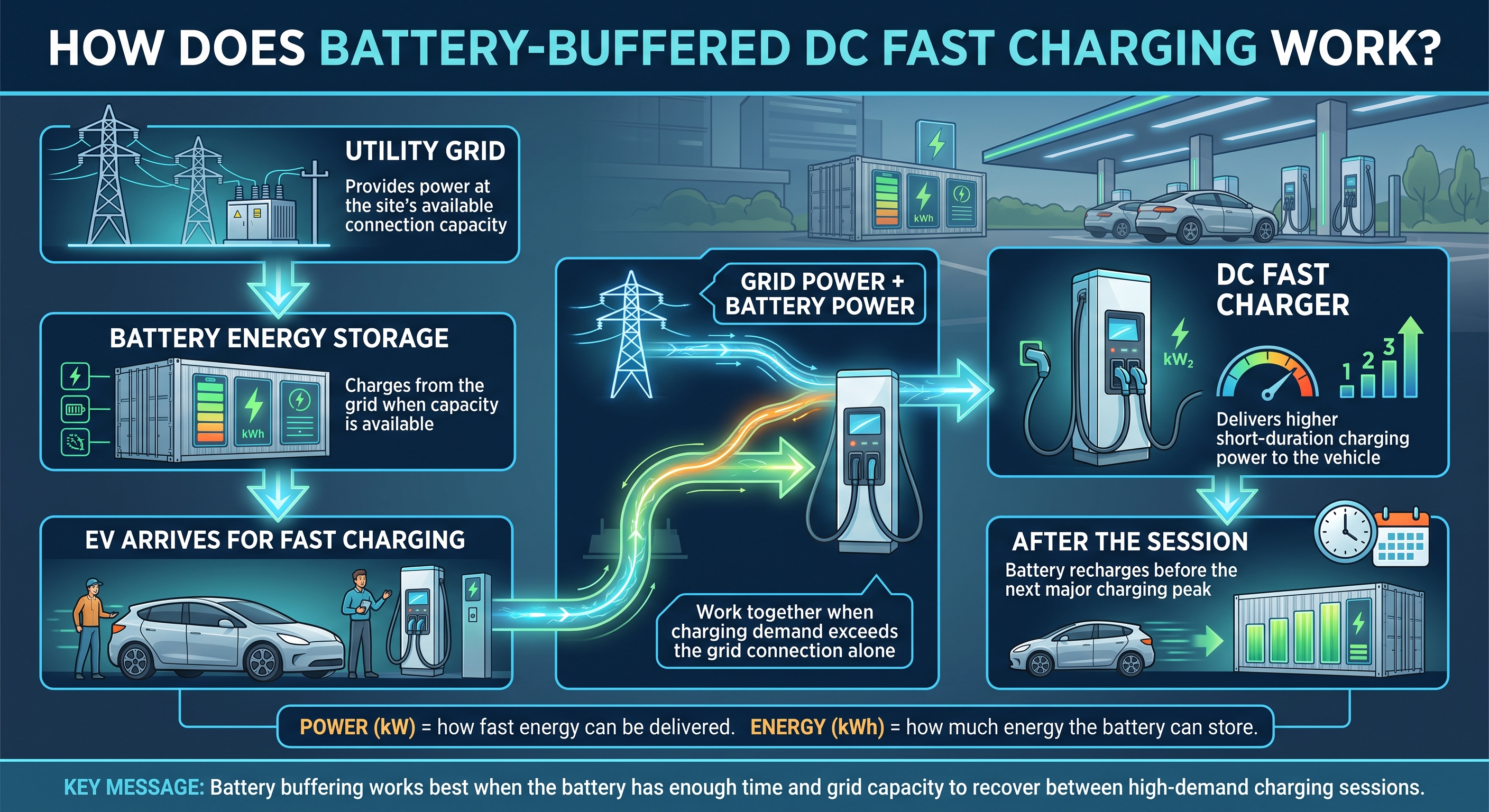
Battery-buffered DC fast charging places a stationary battery energy storage system between the utility connection and one or more DC fast chargers. The battery can charge from the grid at a controlled rate, then contribute power when a vehicle needs a higher charging rate than the grid connection alone can supply.
For charger hosts, the appeal is straightforward: a site may be able to offer higher-power charging without immediately building utility service capacity to match every short-lived charging peak. The U.S. Department of Energy Alternative Fuels Data Center (AFDC) notes that battery storage can reduce the grid service capacity needed for intermittent high-power DC charging, potentially reducing infrastructure costs and construction timelines in constrained locations.
That potential is not a promise. Battery buffering does not automatically avoid a utility upgrade, reduce electricity costs, solve an interconnection issue, or provide backup charging during an outage. Outcomes depend on the available utility supply, charging demand pattern, battery size, controls, local electricity rates, equipment design, and operating plan.
Treat battery buffering as one option to evaluate with the utility, qualified electrical and storage professionals, and prospective equipment suppliers—not as a substitute for site-specific engineering.
What battery-buffered DC fast charging is—and what it does not guarantee
In a conventional DC fast-charging project, the electrical service and upstream equipment are generally designed to support the chargers’ planned simultaneous demand.
With a buffered design, the grid connection may serve both the site’s ongoing needs and battery recharging, while the battery helps meet short periods of elevated vehicle charging demand.
This approach can be useful where charging events are intermittent and the battery has enough time and grid power to recharge between peak events. It is less compelling when charging demand is sustained for long periods, many vehicles charge at once, or the battery cannot recover between sessions.
An undersized or insufficiently recharged battery can become depleted, substantially reducing available charging power. Storage also introduces another potential equipment failure point, according to the AFDC battery-storage guide.
It is also important to separate power from energy:
- Power, measured in kilowatts (kW), describes how quickly electricity can be delivered at a given moment.
- Energy, measured in kilowatt-hours (kWh), describes how much electricity the battery can store and deliver over time.
A battery may be capable of delivering very high power without having enough stored energy to sustain that output through many consecutive charging sessions.
A proposal that appears to support a high charging-power headline may therefore still have limited ability to sustain that output through repeated or overlapping sessions. Ask suppliers to explain expected charging power across realistic arrival patterns, not just the maximum possible output under favourable conditions.
Three situations where a host may evaluate it
1. Available grid capacity is limited
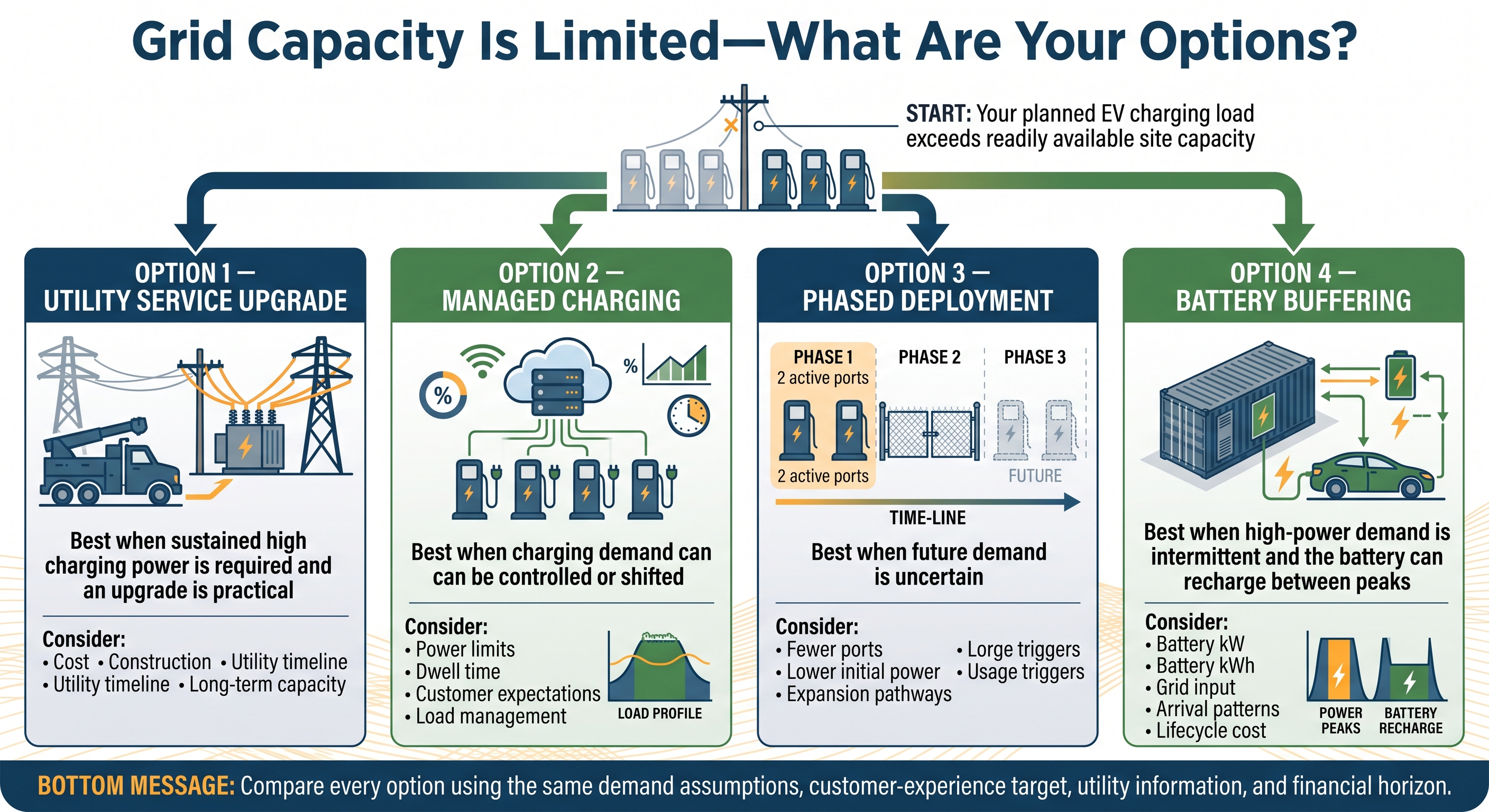
A host may encounter a site where the desired DC fast-charging load exceeds readily available utility capacity, or where a conventional service upgrade has uncertain scope or timing.
Battery buffering may be worth evaluating if the business case depends on serving occasional high-power sessions and the site can recharge storage between them.
Start with a conversation with the local utility. Public hosting-capacity maps can be a useful early screen, but they are not an interconnection decision.
The DOE's U.S. Atlas of Electric Distribution System Hosting Capacity Maps specifically cautions that hosting-capacity maps do not answer site-specific interconnection questions.
The utility remains the appropriate source for available capacity, studies, requirements, and upgrade paths.
2. Peak-demand costs could affect operating economics
In some rate structures, a short interval of high site demand can materially affect a commercial electricity bill. A battery may be managed to limit the power drawn from the grid during charging peaks.
A properly managed battery system may reduce costs where demand charges or time-of-use rates apply, but the result depends on local rates, utilization, operating strategy, and whether the savings justify battery, software, installation, and maintenance costs.
This is a tariff-analysis question, not a general rule.
Obtain current rate details and model charging loads at the applicable billing intervals. Include the battery's own charging behaviour, efficiency losses, controls, degradation assumptions, maintenance, and standby loads in the analysis.
A battery that reduces one peak may create another if its charging schedule is not coordinated with the rest of the site.
3. Short-duration outage resilience is a stated site goal
Some hosts may want limited charging availability during a grid outage—for example, to support a specific operational need.
A battery-buffered charger could be part of that discussion only if the system is expressly designed, permitted, and configured for the intended operating mode.
Do not assume that any stationary battery automatically provides backup EV charging.
The equipment, electrical isolation, controls, load priorities, battery state of charge, and applicable approvals all matter.
Define the resilience objective precisely:
- Which loads must continue operating?
- How long should they operate?
- What charging power must remain available?
- How much battery capacity must be reserved?
- What happens when the battery reaches its minimum state of charge?
Qualified local professionals and relevant authorities should assess electrical protection, fire-safety design, permitting, and interconnection requirements.
Start with the site, not the battery
A sound evaluation begins with the service, customer demand, and operating experience the site needs to support.
The AFDC EV Readiness guidance recommends utility engagement and site-level evaluation to understand available power and the electrical upgrades needed for proposed charging capacity and usage estimates.
Build a planning brief that answers the following questions.
What does the utility say about the site?
Document the existing service, known site loads, preliminary available capacity, interconnection process, study requirements, and plausible service-upgrade options. Ask what assumptions the utility needs about charger count, maximum demand, operating hours, and load management.
Who will charge, and when?
Estimate vehicle arrivals by time of day, expected session length, energy delivered per session, seasonality, and the likelihood of simultaneous charging. A destination site with long dwell times may have a different demand profile from a highway-oriented location where drivers expect short stops.
What charging experience is required?
Define a service target in operational terms. How many vehicles should be served concurrently? What charging power should be available at busy times? Is reduced power acceptable after several consecutive sessions? What happens when the battery reaches its minimum operating state of charge?
What other loads share the connection?
Consider building HVAC, kitchen equipment, refrigeration, fleet operations, solar generation, and planned expansions. The charger project should be assessed as part of the full site load profile.
What data will be available after launch?
Decide how the team will review utilization, charging peaks, battery state of charge, downtime, and customer feedback. This is an operational planning need and should be defined independently of any particular platform or vendor capability.
Compare alternatives before selecting a design
Battery buffering should be compared against credible alternatives using the same demand assumptions and financial horizon.
Conventional utility service upgrade
A conventional upgrade may provide the most direct path to sustained charging capacity where utility capacity and project timing are workable.
It can also simplify the question of how much charging power is available during consecutive high-demand sessions.
However, site-specific construction scope, cost, and timing must come from the utility and qualified project professionals.
Managed charging
Managed charging coordinates charging to stay within a defined power limit, reduce coincident peaks, or shift charging to more suitable periods.
DOE describes smart charge management as a way to enforce power ceilings, reduce coincident peaks, and potentially avoid or defer some electrical upgrades when the operating model supports it.
For public or destination DC fast charging, the customer experience is central.
A hard power ceiling may be acceptable at a workplace or fleet depot with long dwell times but less acceptable where drivers expect rapid, predictable charging.
Managed charging can also complement storage: controls may manage the grid draw while the battery serves selected peaks.
Phased deployment
A host can begin with fewer ports, lower initial power, conduit and electrical provisions for future expansion, or a defined trigger for the next phase based on utilization.
This can reduce the risk of paying for capacity before demand is demonstrated.
It also requires an honest view of whether the first phase will meet customer expectations and whether later expansion will be practical.
Battery buffering
Battery buffering may advance when it produces a credible operating case:
- The battery can recharge between expected peaks.
- The proposed charging experience remains acceptable during busy periods.
- The utility arrangement is viable.
- Battery capacity is appropriate for expected demand.
- The full lifecycle economics compare favourably with alternatives.
It should be evaluated as an integrated system that includes the charger, storage, controls, electrical infrastructure, maintenance responsibilities, monitoring, and a response plan for reduced-power operation.
Questions to put to each project stakeholder
Ask the utility
- What is the site's existing electrical-service capacity?
- How much additional load can reasonably be accommodated?
- Is a service upgrade required for the proposed charging configuration?
- What studies, applications, or interconnection reviews are required?
- What upgrade options and approximate timelines should the project evaluate?
- Are EV-specific commercial tariffs, time-of-use rates, or demand-charge structures available?
- Are there load-management programs or other options that could affect the project design?
Ask the designer and installer
- How will the battery, chargers, switchgear, controls, and existing building loads interact?
- What codes, permits, fire-safety requirements, and equipment clearances apply?
- How will the system behave if the battery reaches its minimum operating state of charge?
- How will future charger or battery expansion be accommodated?
- What metering, communication, ventilation, cooling, and protection equipment is required?
- What happens if the battery system is unavailable?
Ask the charger and storage suppliers
- What are the battery's usable energy capacity in kWh and maximum power in kW?
- How much charging power can be sustained during repeated or overlapping sessions?
- How long does the battery typically need to recover after a high-demand charging period?
- How does the system manage charging when battery energy becomes limited?
- What degradation assumptions are used in the proposed design?
- What warranties apply to the battery, charger, power electronics, and controls?
- Who is responsible for remote monitoring, maintenance, troubleshooting, and software updates?
- What operational data can the host access?
Ask the operations team
- What charging experience are customers expected to receive?
- How much temporary power reduction is acceptable?
- How will customers be informed if charging speeds are reduced?
- Who will monitor battery state of charge, charger availability, and system faults?
- What is the response process when the battery, charger, or communications system fails?
- How will utilization and charging patterns be reviewed after launch?
- What utilization level would trigger additional chargers, storage capacity, or utility upgrades?
Decision checklist: advance, defer, or rule out
Advance to detailed evaluation
Consider advancing when:
- The utility can provide a viable connection path.
- Expected demand is intermittent enough for the proposed battery and grid connection.
- The charging experience is clearly defined.
- Battery recovery between major peaks is realistic.
- The system's reduced-power behaviour is understood.
- A complete comparison includes equipment, construction, utility tariffs, maintenance, battery degradation, and operating assumptions.
Defer
Consider deferring when vehicle demand, utility information, or tariff details are too uncertain to size the system responsibly.
A phased deployment, data-gathering period, preliminary utility study, or additional charging-demand analysis may be more useful than committing to a battery configuration based on weak assumptions.
Rule out or redesign
Battery buffering may be a poor fit when:
- The site requires sustained high-power charging for long periods.
- Consecutive sessions would regularly exceed the battery's recoverable capacity.
- Reduced-power periods would undermine the intended customer experience.
- Battery recovery cannot occur within the available grid connection.
- System complexity or maintenance requirements are unacceptable.
- The complete project case compares poorly with a conventional service upgrade, managed charging, or phased deployment.
The practical goal is not to force battery storage into every grid-constrained EV charging project.
It is to identify the lowest-risk path to the charging service the site actually needs.
A disciplined site assessment, early utility engagement, realistic charging-session modelling, and side-by-side comparison of alternatives can make the trade-offs visible before equipment decisions become difficult or expensive to change.
Sources
- U.S. Department of Energy Alternative Fuels Data Center — Battery Energy Storage for Electric Vehicle Charging Stations
- U.S. Department of Energy — U.S. Atlas of Electric Distribution System Hosting Capacity Maps
- Alternative Fuels Data Center — Electric Vehicle Readiness
- U.S. Department of Energy — Smart Charge Management Applications and Benefits for Federal Fleets