
Short answer: follow your charging-cord manual
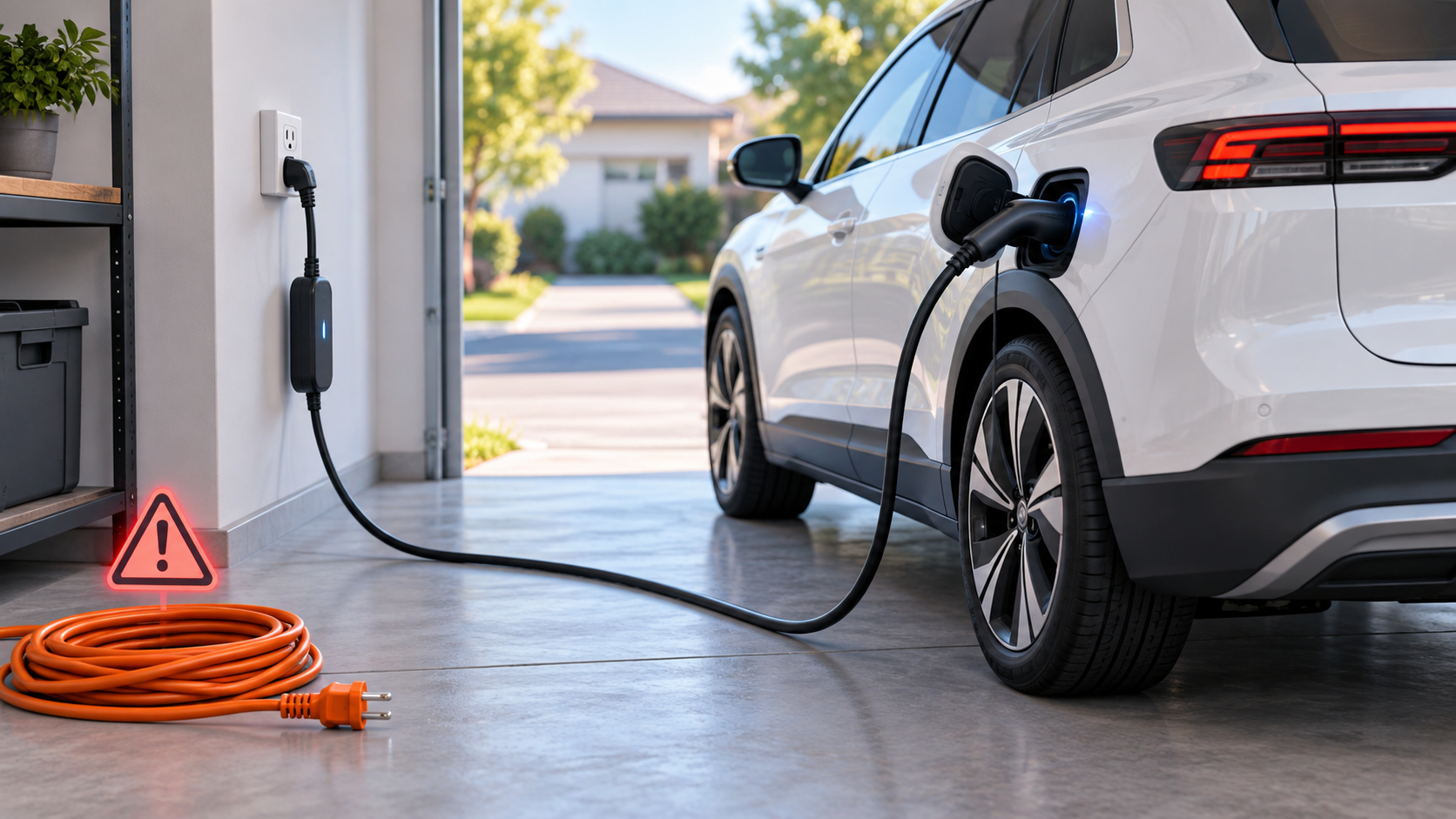
For the portable charging cord supplied with your EV, the practical answer is usually no—do not use an extension cord unless the specific vehicle and charging-equipment instructions explicitly permit it. The manufacturer’s instructions for the exact cord, connector and outlet configuration are the controlling guidance.
The manufacturer guidance reviewed for this article is clear. Chevrolet says not to use wall adapters or extension cords of any kind with its Dual Level Charge Cord . Tesla’s North American Corded Mobile Connector manual likewise says not to use an extension cord, power strip, multi-outlet adapter, multi-plug or conversion plug with the connector.
Chevy+1That can feel inconvenient when the only available outlet is a few metres away. But an extension cord is not a harmless way to make a charging lead reach farther. EV charging can run for hours, and the extension cord adds another component, another pair of connections and another potential point of failure to an electrical setup that must carry a sustained load.
The safer response is to change the plan—not to improvise around the cord’s reach. Park within reach of the supplied equipment, use another charging location, or have a qualified electrician assess the intended setup.
Why EV makers warn against extension cords
A portable Level 1 or dual-level EV charging cord is often called a mobile connector, portable EVSE or cordset. It is different from an ordinary appliance cord: it communicates with the vehicle and manages the charging connection. Depending on the equipment and power source, it may enable charging from a household outlet or a higher-capacity receptacle.
For many drivers, the appeal of an extension cord is straightforward: a standard outlet is available, but it is not close enough to where the vehicle is parked. The concern is that charging is a continuing electrical demand rather than a brief task such as plugging in a phone charger.
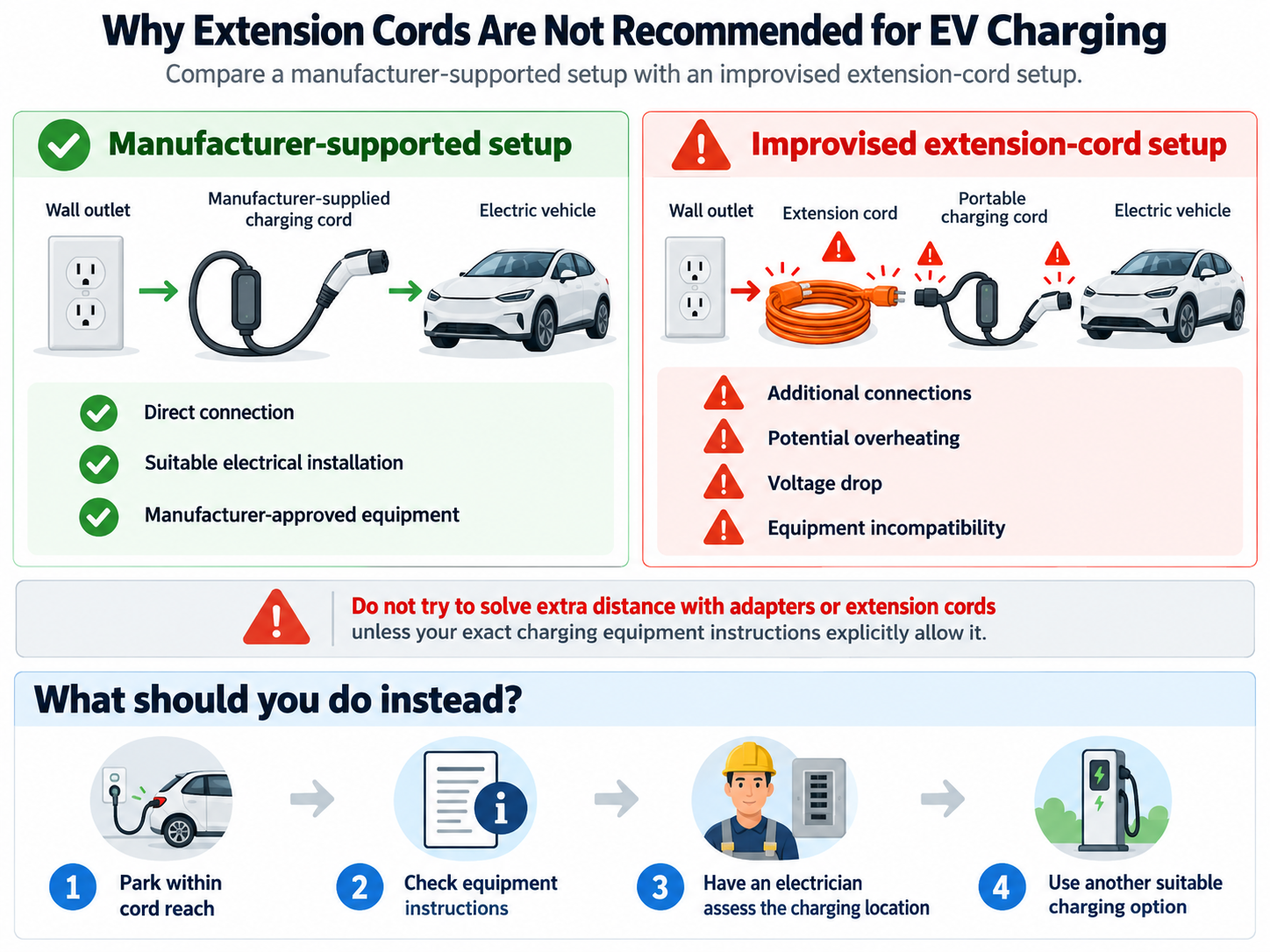
An extension cord can introduce two broad problems:
- Additional electrical connections: Every additional plug and socket creates another potential point of poor contact, resistance and heat buildup. A loose or damaged connection can become dangerous during prolonged charging.
- Equipment and circuit limitations: An extension cord may not be suitable for the sustained electrical load. Its length, construction, condition and connections can contribute to voltage drop, overheating or charging interruptions.
These are not reasons to search for a “better” extension cord or an adapter workaround. They are reasons to read the instructions for your specific charging equipment and use a setup that those instructions support.
A portable cord is not the same as a permanently installed charging station
It is also important not to treat all EV charging equipment as interchangeable. A vehicle-supplied portable cord and a permanently installed home charging station can have different instructions, connector arrangements and installation requirements.
The U.S. Department of Energy’s Alternative Fuels Data Center notes that drivers can use a vehicle-supplied Level 1 cordset with a standard 120-volt household outlet. It also recommends safety-certified charging equipment and consulting a certified electrical contractor when making home charging equipment decisions. See the agency’s home EV charging guidance .
Alternative Fuels Data CenterThat does not mean every household outlet is automatically appropriate for every charging situation. It means the equipment instructions and the condition of the electrical installation both matter.
What can go wrong with an improvised setup?
The issue is not simply whether the car begins charging. A session can start normally and still reveal a problem later, particularly if a connection is unreliable or the wiring cannot support the requested charging current.
Potential outcomes can include:
- Excessive heat at a plug, outlet or cable connection.
- Charging interruptions or repeated equipment fault warnings.
- Damage to the charging cord, receptacle or connected equipment.
- Tripped circuit breakers or other electrical protection devices.
- Increased risk of electrical shock or fire when damaged, unsuitable or improperly connected equipment is used.
The following table summarizes possible warning signs and appropriate next steps.
| Warning Sign | What It May Indicate | Recommended Response |
|---|---|---|
| Unusual heat, discoloration or a burning smell | A connection or electrical component may be overheating. | Stop charging and arrange a professional inspection. |
| Charging repeatedly stops or displays an error | A problem with the power supply, connection or charging equipment. | Follow the manufacturer's instructions and avoid repeatedly restarting a problematic setup. |
| An outlet or plug feels loose | A worn or damaged electrical connection. | Do not use the outlet for charging until it has been assessed. |
| A circuit breaker repeatedly trips | The circuit may be overloaded or have another electrical fault. | Stop using the circuit for charging and consult a qualified electrician. |
| A cable or connector is visibly damaged | The equipment may no longer be safe to operate. | Stop using the equipment and follow the manufacturer's repair or replacement guidance. |
This table is a planning guide, not a diagnostic procedure. Do not try to repair outlets, modify circuits or defeat equipment warnings yourself.
Stop rather than trying to make it work
A charging session should not depend on damaged or questionable equipment. Tesla’s mobile connector instructions specifically say not to use a damaged, loose or worn outlet and recommend using a dedicated single-socket receptacle where possible. Read the full Tesla Corded Mobile Connector Owner’s Manual for equipment-specific warnings and operating instructions.
TeslaPause charging and choose another option if you find any of the following:
- The outlet, plug or connector is loose, cracked, discolored or visibly damaged.
- You notice an unusual burning smell, smoke or signs of melting.
- The charging equipment displays repeated fault or temperature warnings.
- A circuit breaker trips repeatedly while charging.
- The charging cord has exposed wiring, damaged insulation or other visible defects.
- The charging connection is exposed to conditions outside the equipment manufacturer’s permitted operating limits.
If you notice smoke, melting or other signs of a serious electrical hazard, do not touch the affected equipment. Keep clear and seek appropriate professional or emergency assistance.
These signs do not identify the precise cause. They do, however, indicate that continuing to charge through the same arrangement is not a good substitute for resolving the underlying issue.
Safer next steps at home
For occasional or regular home charging, start with the simplest setup that follows your equipment instructions.
1. Park within the supplied cord’s intended reach
If possible, position the vehicle so the manufacturer-supplied cord reaches the outlet without an extension cord. Avoid stretching the cable tightly, routing it where it can be damaged, or creating a trip hazard. The aim is not merely to connect the car, but to preserve a straightforward, manufacturer-supported arrangement.
If your driveway, garage or parking layout makes this impossible, that is useful information for planning. It may point to the need for a better-located receptacle, a different parking arrangement or a dedicated charging solution evaluated by a qualified electrician.
2. Check the instructions for both the vehicle and charging equipment
Your vehicle manual and portable EVSE manual are the first places to look. Confirm the permitted outlet types, approved adapters, operating limits and warnings for the exact model you own. Do not assume that advice from another EV model, a forum post or a neighbour’s charger applies to yours.
For example, Chevrolet advises drivers to use the default vehicle charging setting until a professional electrician confirms that the receptacle and circuit are suitable for EV charging. That is a useful example of why the electrical circuit matters as much as the visible outlet.
 Chevy3. Ask a qualified electrician to assess a recurring charging location
If you plan to charge regularly at a particular location, an assessment by a qualified electrician is a practical next step. Describe the vehicle, the exact portable charging equipment, the outlet location and how often you expect to charge. Provide the relevant manufacturer instructions if requested.
An electrician can evaluate the intended installation and discuss appropriate options. This is not a guarantee that any existing outlet, circuit or proposed change will be suitable, approved or available. It is a way to make a decision based on the actual site and equipment rather than an improvised extension-cord arrangement.
4. Consider a purpose-planned charging solution
For drivers with predictable parking and charging needs, a permanently installed charging station may be worth discussing as part of a home electrical plan. Its requirements may differ from those of a portable cordset. Review its documentation and have the installation assessed and completed by appropriate professionals.
Charging while travelling: make a backup plan before you arrive
A portable cord can be useful when travelling, but it works best when you do not treat an unfamiliar outlet as a guaranteed charging solution. Outlet access, permission, condition and proximity to the parking space can all vary.
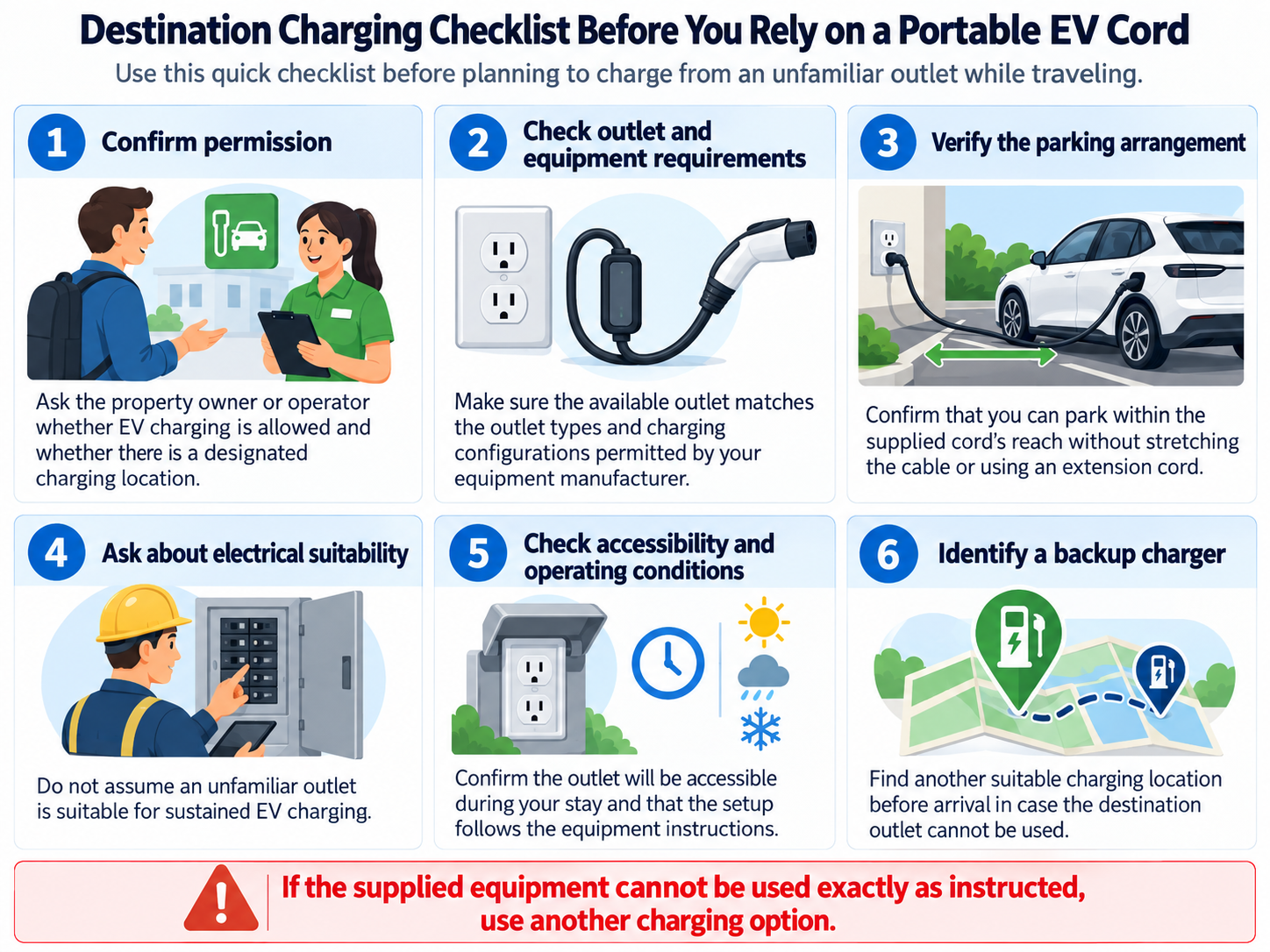
Use this checklist before relying on destination charging:
| Checklist Item | What You Should Do |
|---|---|
| Confirm permission | Ask the property owner or operator whether EV charging is permitted and whether a designated charging location is available. |
| Check outlet and equipment requirements | Confirm that the available connection matches the outlet types and charging configurations permitted by your equipment manufacturer. |
| Verify the parking arrangement | Make sure your vehicle can park within the supplied cord's intended reach without stretching the cable or using an extension cord. |
| Ask about electrical suitability | Do not assume an unfamiliar outlet is suitable for sustained EV charging. Ask whether the installation has been assessed for the intended use. |
| Check accessibility and operating conditions | Confirm that the outlet will be accessible during your stay and that the proposed arrangement complies with the equipment's operating instructions. |
| Identify a backup charger | Find another suitable charging location before arrival in case the destination outlet cannot be used safely or is unavailable. |
This approach is particularly helpful at hotels, holiday rentals, workplaces and family homes. It replaces uncertainty with a clear decision: if the supplied equipment cannot be used exactly as instructed, use another charging option.
The bottom line
Can you use an extension cord to charge an EV? For the portable charging equipment covered by the manufacturer guidance reviewed here, no. Chevrolet and Tesla explicitly warn against it for the equipment they describe. Your own manual remains the final word for your vehicle and EVSE.
If the outlet is too far away, unreliable, loose, damaged or associated with repeated charging problems, do not try to solve that with extra cords or adapters. Park within the supplied cord’s reach, use a suitable charging location, or ask a qualified electrician to assess the setup you intend to use. A simple, approved charging connection is a better plan than a workaround.
Sources
- Chevrolet — How to Use the Dual Level Charge Cord
- Tesla — Corded Mobile Connector Owner’s Manual (North America, PDF)
- Tesla — Charging and Adapter Product Guides
- U.S. Department of Energy — Alternative Fuels Data Center: Charging Electric Vehicles at Home