
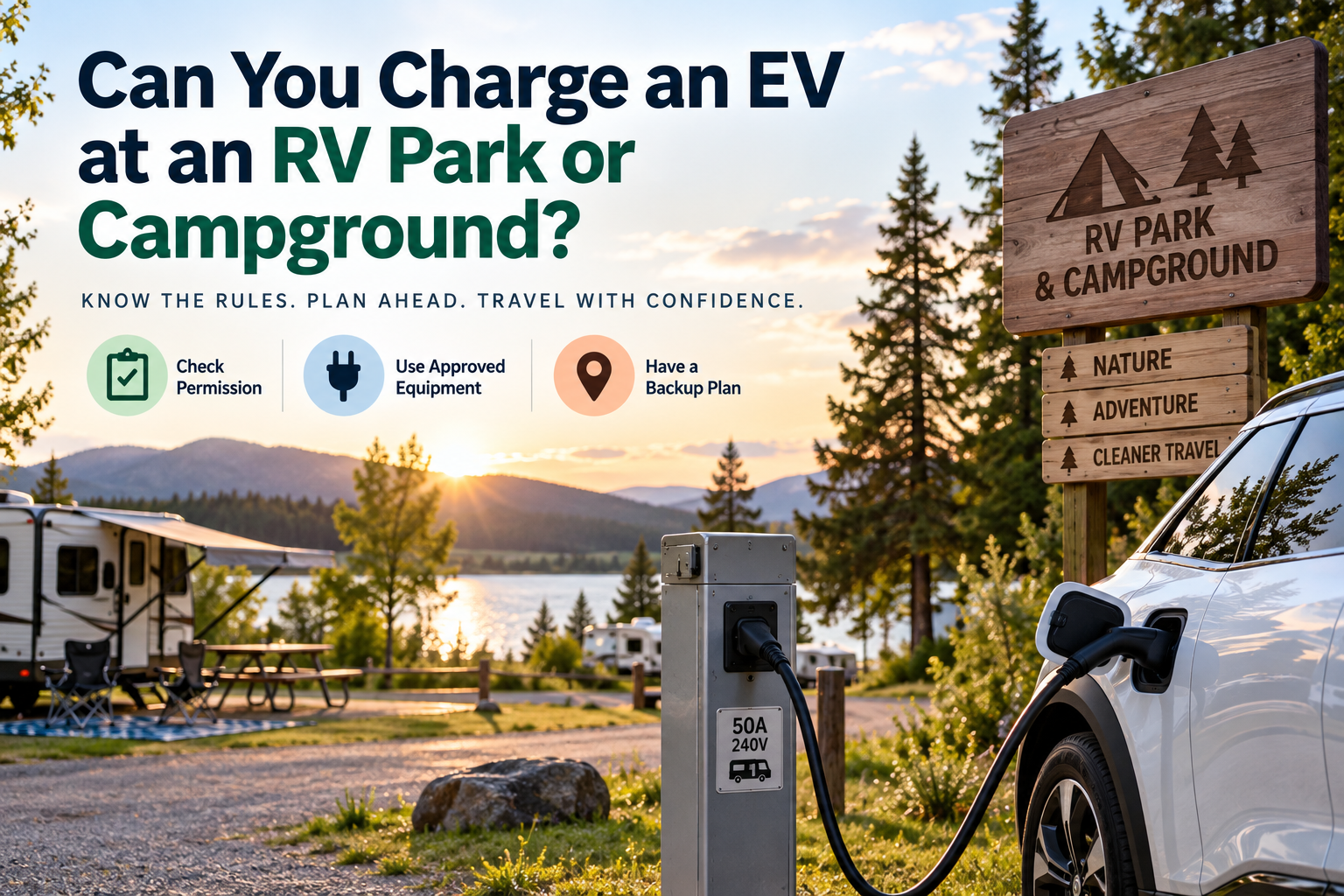
Can You Charge an EV at an RV Park or Campground?
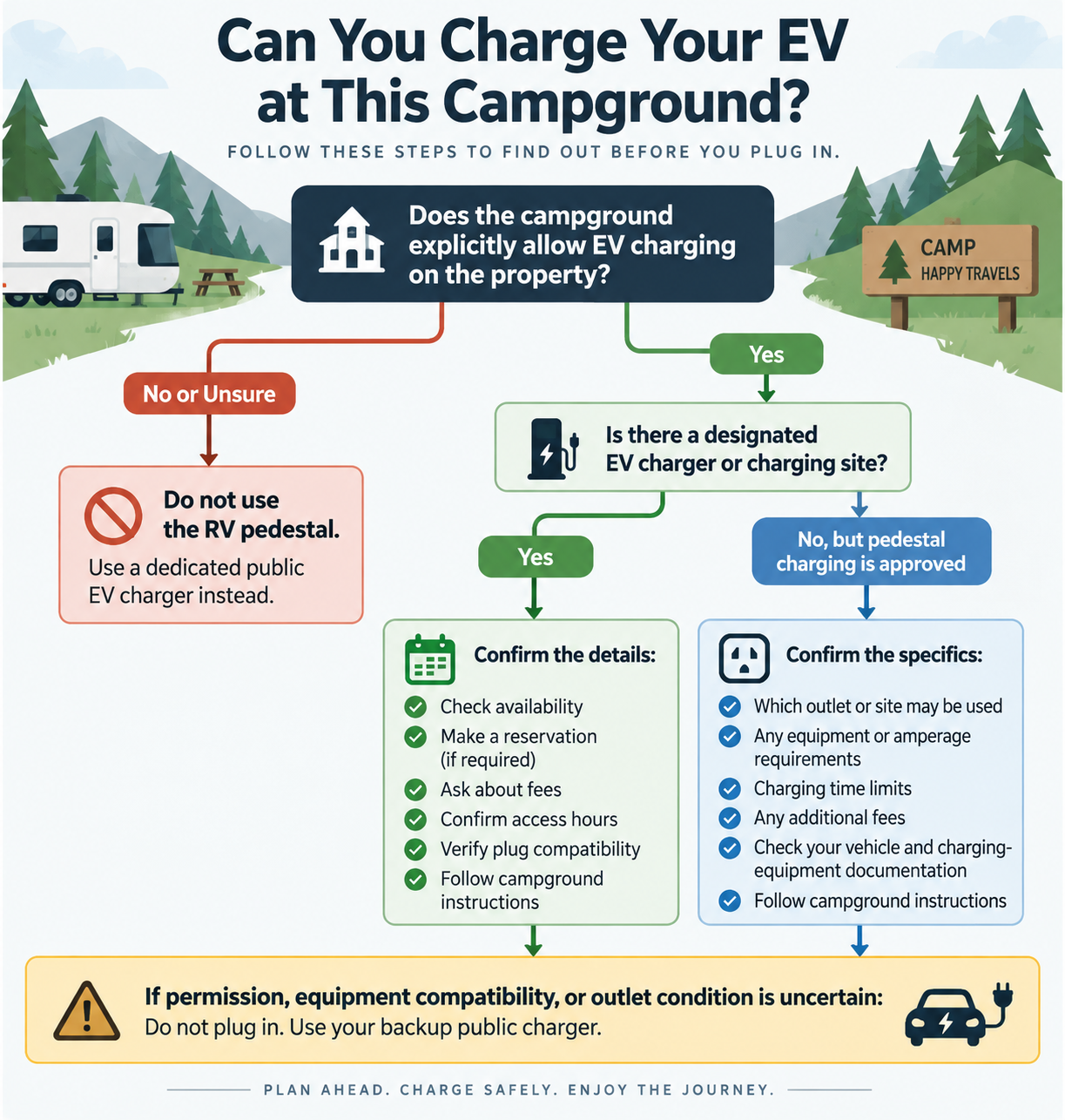
Sometimes, but only with the campground’s explicit permission and an approved charging arrangement. Do not assume that reserving an RV site gives you permission to plug in an EV, even if the pedestal has an outlet that appears to fit your portable charging equipment.
A campground may have rules about EV charging, designated locations, fees, access times, and advance booking. Its electrical setup may also be intended for RV use rather than the sustained load of vehicle charging. Kampgrounds of America (KOA) says that many of its campgrounds are not set up for EV charging and that traditional campground pedestals were designed for typical RV loads, not the continuous load associated with EV charging.
That does not mean every RV park or campground prohibits charging. It means the answer is property-specific. Confirm the arrangement before you arrive, bring only equipment approved for your vehicle, and keep a public-charging backup plan.
Why an RV pedestal is not an automatic EV charger
An RV pedestal can look like a convenient source of power, but its presence does not establish permission, capacity, pricing, or suitability for your vehicle and charging cord. Campground operators may manage electrical demand across sites, restrict certain outlets, bill electricity separately, or direct EV drivers to a particular location.
The practical issue is not whether an outlet is visible. It is whether the property has approved its use for EV charging and whether your vehicle manufacturer permits your charging equipment to be used in that configuration.
Rules can differ substantially even within the same campground brand. For example, Austin East KOA states that EV charging from ordinary RV-site pedestals is prohibited. It offers a designated charging site for registered guests, subject to availability and advance arrangement, and bills electricity based on meter readings. Treat that as an example of why a property-level confirmation matters—not as a rule for all campgrounds.
The pre-trip permission checklist
Contact the campground directly before booking if possible, and again before departure if EV charging is important to the trip. A reservation note, a general website statement, or an assumption based on a previous stay may not answer the relevant questions.
Ask these questions clearly:
- Is EV charging allowed anywhere on the property?
- Is there a designated EV charger or charging site?
- If charging from an RV pedestal is permitted, which specific outlet or site may be used?
- Do I need to reserve the charging location in advance?
- Are there restrictions on charging times or duration?
- Is there an additional charging or electricity fee?
- Are there specific equipment, adapter, or amperage requirements?
- Do I need to check in with staff before plugging in?
If the answer is unclear, conditional, or unavailable, plan as though the campground cannot provide charging. That is usually less stressful than arriving with limited range and trying to negotiate an electrical arrangement at check-in.
Match your equipment to your vehicle documentation
If the property has approved charging, the next question is whether your own portable charging equipment supports the approved outlet and expected operating conditions. Do not infer compatibility from the plug shape alone.
Review your vehicle manual and the documentation for the portable charge cord or mobile connector you will use. Check:
- Which outlet types and adapters the equipment supports
- The required circuit or breaker rating
- The maximum charging current for that adapter
- Whether charging current can or should be reduced
- Whether the equipment is approved for outdoor use
- Any warnings about extension cords or third-party adapters
- Instructions for stopping charging if the plug, outlet, or equipment becomes unusually hot
Manufacturer specifications vary. As one illustration, Tesla’s Charging & Adapter Product Guides provide current documentation for Tesla Mobile Connectors and their supported configurations. Tesla’s North American guidance identifies the specifications and operating requirements for individual outlet adapters.
That is information about Tesla’s equipment, not a general statement that every outlet of the same type can or should be used for EV charging.
Your vehicle, model year, portable cord, adapter, settings, and inlet connection may differ. Use the manual for the vehicle and equipment in front of you. If you cannot confirm that your equipment is supported for the approved outlet, use public charging instead.
What not to improvise at a campground
A camping trip is not a good setting for workarounds with unfamiliar electrical equipment. Avoid extension cords, improvised plug adapters, modified charging gear, or attempting to make an unapproved outlet fit your setup.
This is consistent with model-specific manufacturer guidance. The 2025 Cadillac OPTIQ guide says not to plug its dual-level charge cord into an extension cord. It also advises using an 8-amp setting until a qualified electrician has checked circuit capacity, or when capacity is unknown, and says to discontinue use if the outlet or plug becomes hot. Those instructions apply to that vehicle and cord; follow the instructions for your own model.
A cautious operating approach is straightforward:
- Use only the outlet and charging location approved by the campground.
- Use only charging equipment and adapters supported by your vehicle or equipment manufacturer.
- Do not use extension cords or improvised adapters unless your manufacturer specifically permits them.
- Inspect the outlet, plug, and charging equipment before use.
- Stop charging if you notice excessive heat, damage, unusual smells, discoloration, or repeated charging faults.
- Follow campground staff instructions if they ask you to disconnect or move the vehicle.
These steps may mean choosing not to charge at the campground. That is a sensible outcome when permission or equipment compatibility is uncertain.
Plan charging around the campground, not through it
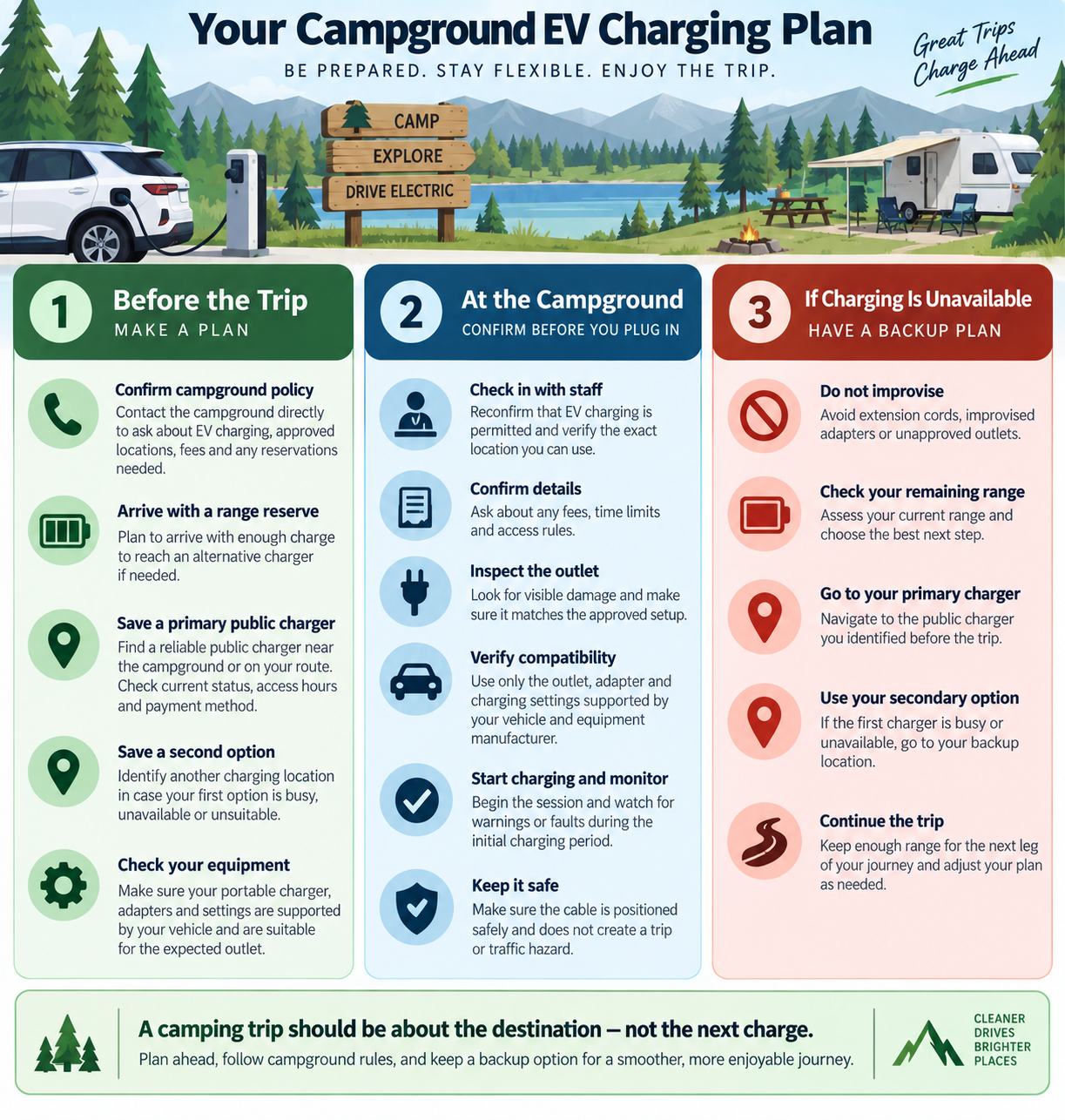
For many trips, the most reliable approach is to treat campground charging as a possible convenience rather than the only way to continue your journey. Before leaving, identify dedicated public charging near the destination and along the route home or to the next stop.
A simple backup plan can include three layers:
1. Arrive with a reserve
Choose an arrival state of charge that leaves room for ordinary detours and a drive to an alternative charging location. The appropriate reserve is a personal trip-planning decision that depends on route, weather, terrain, towing, vehicle efficiency, and the distance to your backup charger.
The key point is to avoid arriving with so little range that an unavailable campground arrangement becomes an emergency.
2. Identify a primary public-charging option
Select a dedicated public charger near the campground or on the approach route. Before relying on it, check its current status and access details in the source you normally use for trip planning. Consider practical factors such as distance from the campground, opening hours, payment method, and whether the stop fits your arrival or departure schedule.
3. Identify a second option
Choose another charging location in case the first is busy, unavailable, or unsuitable when you arrive. This does not guarantee a charger will be open, but it gives you a decision path without depending on an unauthorized pedestal.
If the campground confirms a dedicated EV charging arrangement, it can become part of the plan. Keep the public option available until you have arrived and confirmed access.
A day-of-arrival checklist
Before plugging in, take a moment to confirm that the plan you made is still valid:
- Check in with campground staff and reconfirm that EV charging is permitted.
- Verify that you are using the exact charging location or outlet they approved.
- Confirm any charging fee, time limit, or access rule.
- Inspect the outlet and your charging equipment for visible damage.
- Confirm that your adapter and charge cord match your vehicle manufacturer’s instructions.
- Make sure the cable can be positioned without creating a trip or traffic hazard.
- Monitor the beginning of the charging session for warnings or faults.
- Stop charging if the plug, outlet, adapter, or cord becomes unusually hot or shows signs of damage.
- Keep enough range available to reach your backup public charger if the campground arrangement does not work.
The practical bottom line
You may be able to charge an EV at an RV park or campground, but the decision belongs to the operator and depends on the approved setup at that particular property. An RV pedestal is not automatically EV charging infrastructure, and an outlet that appears compatible is not enough on its own.
Get explicit permission, confirm the location and cost, follow your vehicle and charging-equipment manuals, avoid improvised connections, and arrive with enough reserve to use dedicated public charging if needed. This approach respects the campground’s electrical policies while making your trip more predictable.
Sources
- Kampgrounds of America — Electric Vehicle Charging at KOA
- Austin East KOA Holiday — General Information and EV Charging Policy
- Tesla — Charging & Adapter Product Guides
- Cadillac — 2025 OPTIQ Convenience and Personalization Guide