
Can You Charge an EV From a Standard Wall Outlet? A Practical U.S. Guide to Level 1 Charging
Yes—many electric vehicles can charge from a standard U.S. 120-volt wall outlet using the portable cordset supplied with the vehicle or specified by its manufacturer. This is called Level 1 charging. The U.S. Department of Energy’s Alternative Fuels Data Center (AFDC) defines Level 1 as 120-volt AC charging and notes that most EVs include a portable Level 1 cordset.
Whether it is the right everyday solution is a separate question. Level 1 charging is comparatively slow, but a slow overnight charge may be enough if your daily driving is modest and your vehicle remains parked for long periods. It is not a universal answer for every commute, battery size, living arrangement, or outlet.
Use this guide to make a practical decision: estimate whether Level 1 can replace your normal daily driving, identify the safety boundaries that should not be improvised, and recognize when a Level 2 discussion may make sense.
What Level 1 charging means
Level 1 charging generally involves plugging a portable charging cordset into a 120-volt outlet near where the vehicle is parked. The cordset then connects to the vehicle’s charging port.
It is often the simplest way to start charging at home because it may not require new charging equipment. But “simple” should not be confused with “suitable in every situation.” A nearby outlet alone does not establish that it is appropriate for ongoing EV charging. The condition of the outlet, the electrical installation, the circuit’s other loads, the cordset instructions, and the parking arrangement all matter.
Treat the vehicle and portable-cordset manuals as the controlling instructions for your equipment. Settings, plug types, warnings, and operating limits can differ by model.
How much range can an overnight Level 1 charge add?
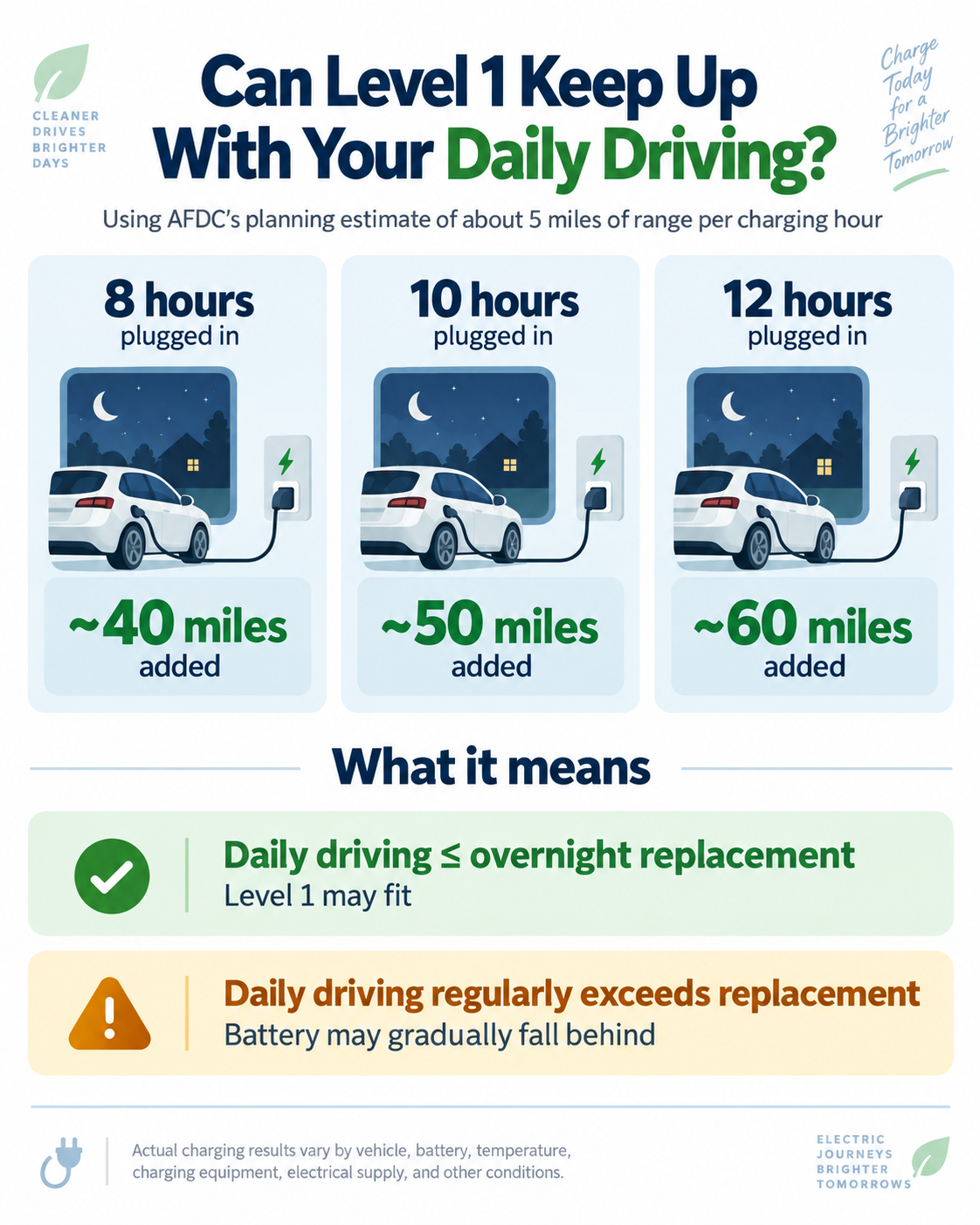
As a useful planning estimate, AFDC says Level 1 charging can add about 5 miles of range per hour at an assumed 1.9 kW charging power. Its illustrative midsize-EV example is about 40 miles added in eight hours.
That estimate is a starting point—not a promise. The real result can be higher or lower. AFDC notes that charging time and range added depend on factors including battery state of charge, battery capacity, vehicle charging capability, and equipment or electrical-service specifications.
Other real-world factors can also affect the outcome. Your vehicle’s displayed range estimate may change with driving conditions and temperature, while a portable cordset may operate at a setting lower than the planning example. For that reason, it is better to judge Level 1 by a pattern over several nights than by one ideal calculation.
A simple overnight planning example
Suppose your normal weekday driving is 25 miles and your vehicle is parked at home for 10 to 12 hours. A Level 1 setup that consistently replaces roughly that amount of driving may work well for your routine.
Now suppose you drive 65 miles most weekdays but only have eight hours at home. An estimate of 40 miles added overnight suggests that Level 1 may gradually fall behind unless you also have charging opportunities elsewhere or occasional longer charging windows.
The goal is not necessarily to fill the battery every night. The useful question is: does your usual overnight charging reliably replace the energy you use over a typical week?
A practical Level 1 fit test
Before treating a wall outlet as your regular EV charging plan, work through these four questions.
1. How many miles do you normally drive?
Look at several weeks of driving rather than a single day. Include commuting, errands, school runs, and regular weekend travel. Then compare your usual daily mileage with a conservative estimate of the range your available parking time could replace.
If your routine is usually below what an overnight Level 1 charge can restore, this approach may be workable. If you frequently drive beyond that amount, you may need more time plugged in, access to charging away from home, or faster home charging.
2. How long is the vehicle actually parked?
Overnight parking is valuable only when the vehicle can remain connected for most of that time. Consider late arrivals, early departures, shared parking, shift work, and days when the vehicle is away from home.
AFDC says that many owners can meet daily needs with overnight Level 1 charging when a nearby outlet is on a dedicated branch circuit. It also identifies longer commutes, less regular schedules, and larger-battery EVs that need more than a typical overnight dwell time as reasons to consider Level 2 equipment.
3. Is the outlet close enough for the manufacturer-supplied equipment?
Plan around the cordset supplied or approved for your vehicle, without trying to bridge a gap using improvised accessories. The cord should be able to reach without being stretched, pinched, routed where it creates a trip hazard, or exposed to vehicle traffic.
Tesla’s Mobile Connector guidance, for example, says to position the cable so it is not stepped on, driven over, tripped on, or otherwise stressed. It also warns against extension cords, multi-outlet adapters, conversion plugs, and power strips. Follow the directions for your own cordset, which may differ.
4. Do you have permission and a dependable charging location?
For a detached home, that may mean confirming the outlet’s condition and discussing any electrical uncertainty with a qualified electrician. In an apartment, condominium, workplace, or shared garage, it may also mean asking the owner, manager, homeowners’ association, or employer about permission, access, parking rules, and responsibility for electricity costs.
Do not assume an outlet in a common area is available for regular charging. Property rules and local requirements vary. If any installation or electrical changes are being considered, a qualified electrician can advise on the applicable local process.
Safe-use boundaries: do not improvise
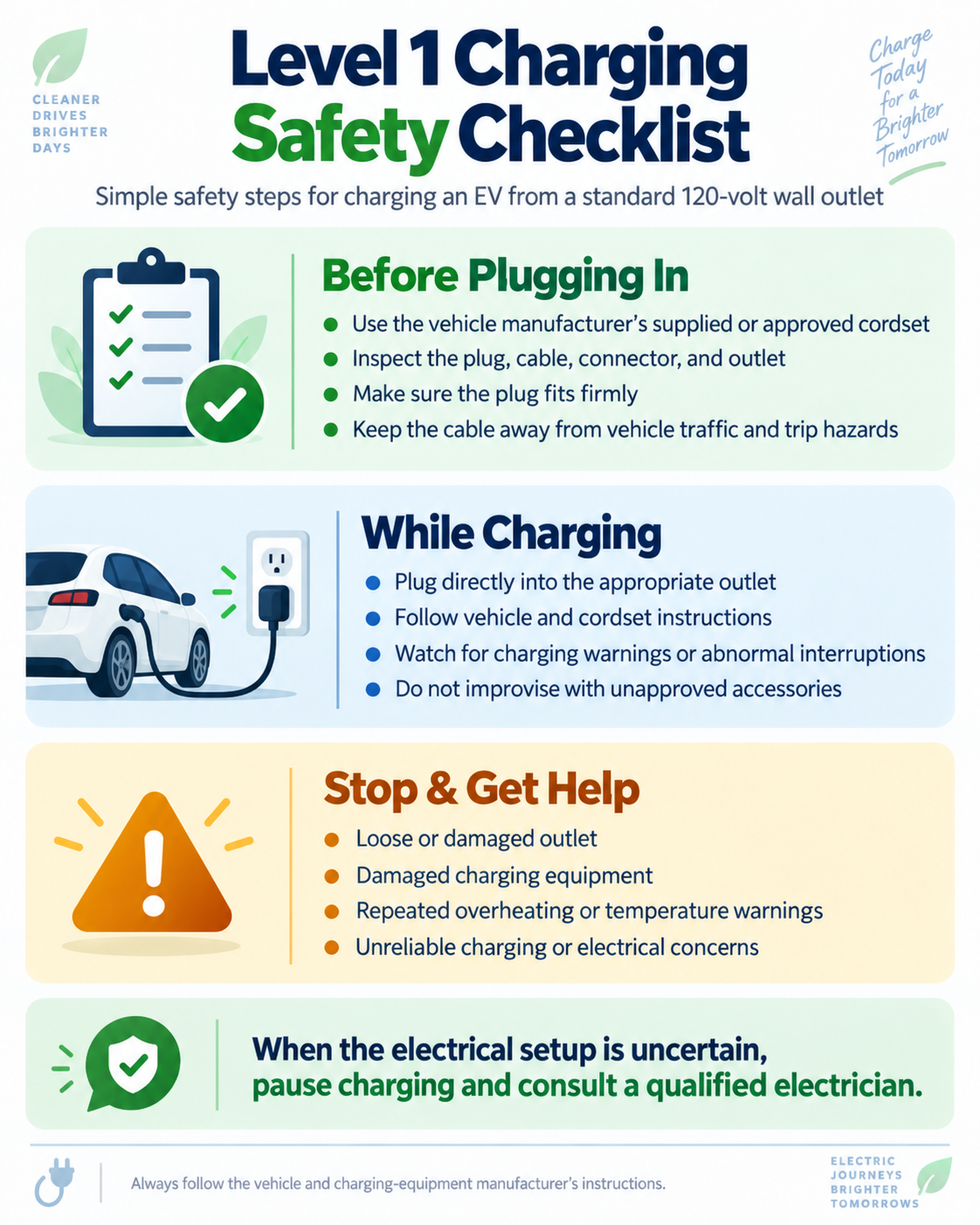
Portable EV charging equipment is designed to be used according to its manufacturer’s instructions. That means the safe path is usually straightforward: use the specified equipment, plug it directly into the appropriate outlet, inspect it, and stop if something appears abnormal.
Ford’s charging-equipment guidance warns users not to use an extension cord, surge protector, timer, or other adapter. It also says the wall plug should fit firmly in the outlet. Those warnings apply to Ford equipment, but they reinforce a sensible general principle: do not add accessories or workarounds that your own vehicle or cordset manufacturer has not approved.
Before each use, visually inspect the cordset, cable, connector, and plug for damage. Ford likewise directs drivers to inspect its charging equipment before use and not use damaged equipment.
A few practical boundaries:
These are not merely inconveniences to work around. They are reasons to pause and choose a safer setup.
When to stop charging and seek help
Stop using the outlet and arrange an assessment by a qualified electrician if the outlet is loose, worn, damaged, unreliable, or raises concerns during charging. Ford specifically advises users with a loose, worn, or damaged outlet to have it replaced by a qualified electrician.
Also take charging alerts seriously. Tesla’s troubleshooting guidance says that a repeated high-temperature alert at the wall plug can indicate an issue with the outlet or electrical installation rather than the vehicle. If the charging speed does not return to normal, Tesla recommends having the outlet and building wiring inspected by an electrician.
Your own vehicle may communicate a concern differently, so consult its manual and follow its instructions. If you are uncertain about heat, fit, damage, grounding, the circuit, or recurring charging interruptions, do not guess. Pause charging and get professional advice.
When Level 2 may be worth evaluating
Level 1 is often a practical starting point, especially for drivers with modest daily mileage and long, predictable overnight parking. Level 2 may be worth evaluating when the slow recovery rate no longer matches your routine.
Consider discussing Level 2 with a qualified electrician if you:
Level 2 is not automatically necessary because you own an EV. It is a planning choice based on driving patterns, parking time, electrical assessment, budget, and property permission. A useful first step is to track your actual mileage and Level 1 results for a few weeks, then bring that information to an electrician or property decision-maker.
Bottom line
A standard 120-volt outlet can charge an EV through Level 1 equipment, and it can be enough for drivers whose daily mileage fits within what overnight charging can replace. AFDC’s planning estimate of about 5 miles of range per hour—roughly 40 miles over eight hours in its example—helps set realistic expectations.
The right decision depends on your routine and the charging location, not just on whether an outlet is nearby. Use the manufacturer-supplied or approved cordset as instructed, avoid extension cords and adapters, stop if the outlet or equipment is damaged or unreliable, and seek a qualified electrician’s advice when the electrical setup is uncertain. If your commute or schedule routinely outpaces overnight Level 1 charging, Level 2 is the next option to evaluate.
Sources
- U.S. Department of Energy Alternative Fuels Data Center — Electric Vehicle Charging Stations
- U.S. Department of Energy Alternative Fuels Data Center — Charging Electric Vehicles at Home
- Tesla — Corded Mobile Connector Owner’s Manual
- Tesla Model 3 Owner’s Manual — Troubleshooting Alerts
- Ford Owner Manual — Charging Equipment Guidance