
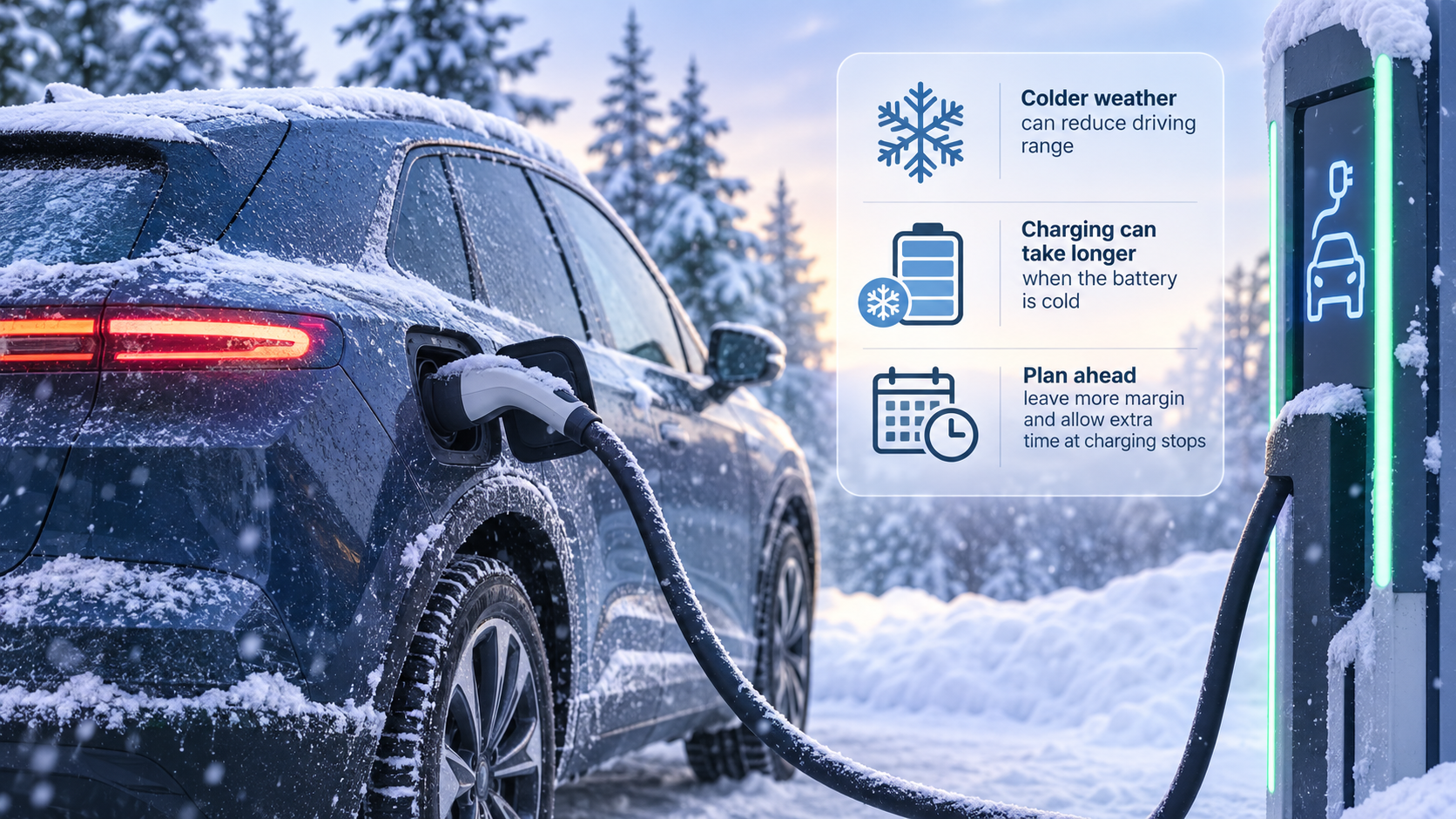
Winter does not make an EV unusable, but it does change the plan. Two common cold-weather effects are related but different: driving efficiency and available range can decrease, while charging—especially DC fast charging—can take longer when the battery is cold.
A 2025 cold-climate assessment published by the National Renewable Energy Laboratory (NREL), now called the National Laboratory of the Rockies (NLR), found that EVs and charging equipment remained functional in extreme cold conditions in Fairbanks, Alaska, while vehicle efficiency was materially affected and charging was slower. The study examined conditions as low as −40°C (−40°F). Read the cold-weather EV assessment.
That is useful evidence for planning, not a promise of the same outcome for every vehicle, trip, battery, or climate.
The practical response is to leave with more energy margin, use preconditioning while plugged in when your vehicle supports it, manage unnecessary cabin-energy use, and allow extra time at charging stops.
Why winter range and charging speed are separate problems
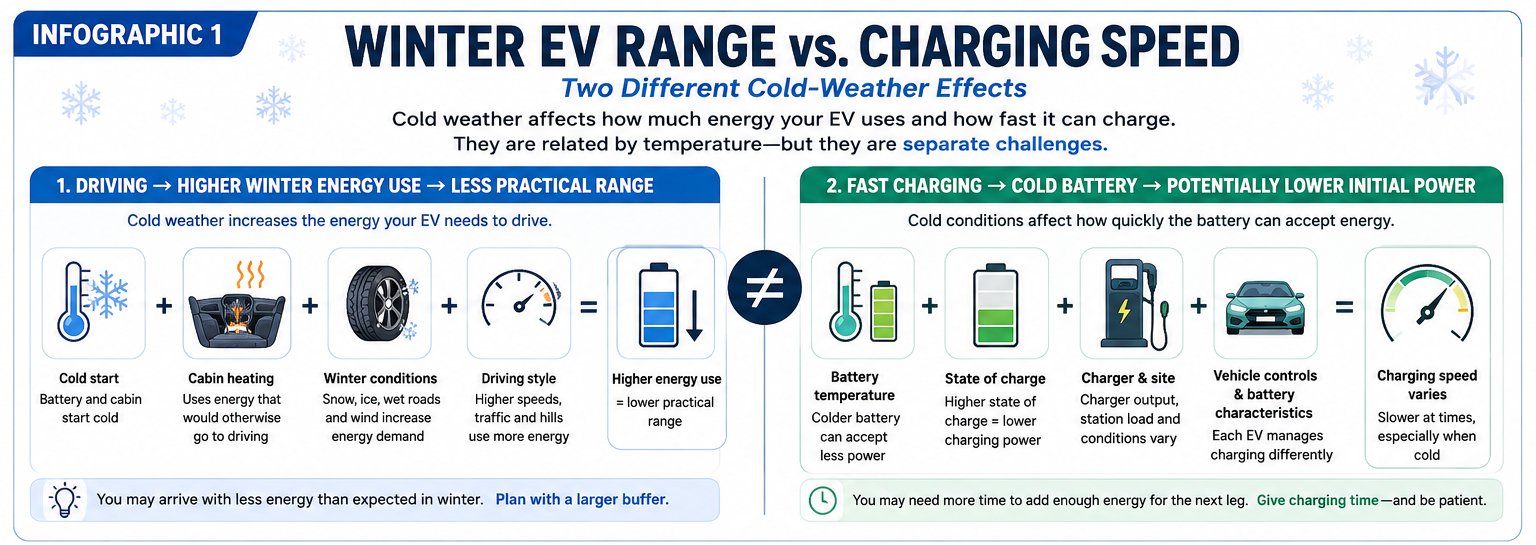
It is easy to treat a lower dashboard range estimate and a slower fast-charging session as one issue. They are not quite the same.
Driving energy use is about how much electricity the vehicle needs to move and keep occupants comfortable. A cold start and a short drive can be particularly demanding because the cabin and battery begin cold. Snow, ice, wet roads and other winter conditions can add further uncertainty to energy consumption. The NLR cold-weather assessment discusses both battery-temperature effects and operational factors such as cabin heating and winter road conditions.
Charging speed is about how quickly the vehicle can accept energy at that moment. Battery temperature, state of charge, the charger and the vehicle's charging controls all matter. Tesla, for example, says Supercharging rates can vary based on factors including battery-pack characteristics, state of charge, ambient temperature and vehicle configuration. See Tesla's Supercharging guidance.
This distinction matters on a winter trip. You may arrive with less energy than expected and need longer than expected to add enough energy for the next leg. Plan for both rather than assuming that a charger will always restore a fixed number of kilometres or miles in a fixed number of minutes.
Before leaving: build a winter charging plan
A useful winter plan begins before the car moves.
Check your vehicle's current instructions
Your owner's manual should be the first source for model-specific guidance. Check how your vehicle handles preconditioning or scheduled departure, whether it provides battery preparation before fast charging, what cold-weather charging limitations apply, and what procedure the manufacturer recommends if the charge port or connector becomes difficult to release.
Features and menus can differ between model years, trims, markets and software versions. A capability described for one EV should not be assumed to exist—or work the same way—on another.
Start with a larger energy buffer
For a winter journey, consider treating your normal arrival buffer as a minimum rather than a target. Choose a margin that accounts for the next charging opportunity, weather changes, traffic delays, road conditions and the possibility of a longer charging stop.
This is a planning decision, not a universal percentage. The right margin depends on the route, vehicle, local conditions and how much certainty you need before reaching the next charger.
On unfamiliar routes or during severe weather, identifying at least one backup charging location before departure can also reduce reliance on a single station.
Precondition while plugged in, when supported
Preconditioning generally means preparing the cabin and, depending on the vehicle, warming or otherwise preparing the battery before departure.
The U.S. Department of Energy recommends preconditioning while the EV is still charging. This allows the vehicle to prepare the cabin and battery while it remains connected to external power.
If your EV supports scheduled departure or preconditioning, follow the exact steps in its current documentation. Beginning a trip with the cabin already comfortable can reduce some of the immediate heating demand placed on the traction battery.
Preconditioning does not remove the need for a winter energy buffer.
For outdoor home charging, also make the first connection easier: keep access to the vehicle and charge port clear of snow where practical, and store the connector according to the charging-equipment manufacturer's instructions. DOE specifically advises proper connector storage because heavy snow and sleet can contribute to freezing.
At a DC fast charger: expect variation, not a flat rate
Cold-weather fast charging may be faster when the battery has been prepared for charging before arrival. How this happens depends on the vehicle.
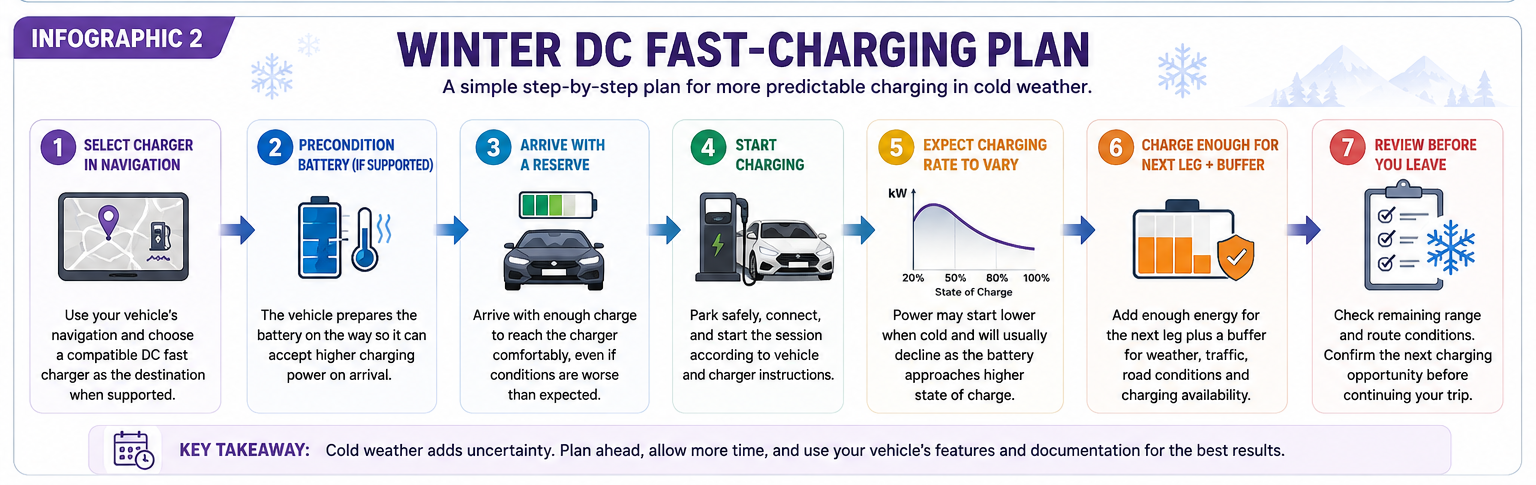
Some EVs can automatically prepare the battery when a compatible DC fast charger is selected as the destination using the vehicle's supported navigation system.
For example, Ford documents battery preconditioning for supported Mustang Mach-E vehicles when routing to a DC fast charger through compatible navigation. See Ford's Mustang Mach-E DC fast-charging preconditioning guidance.
Check your own owner's manual rather than assuming route-based battery preparation is available or operates the same way in your EV.
When you arrive, connect and begin the charging session according to the vehicle and charger instructions. Give the session time to establish before judging its performance.
A slower-than-expected initial rate does not automatically mean the charger is faulty. Battery temperature, state of charge, vehicle limitations and charging equipment can all affect the power delivered. Tesla similarly notes that charging speed can vary with battery state of charge, ambient conditions and battery characteristics.
The charging curve matters as well. Charging generally becomes slower as the battery reaches a higher state of charge. DOE's winter EV guidance notes that fast-charging power is commonly reduced in the 80%–100% range and recommends considering trip distance and weather conditions when deciding how much additional charge is worthwhile. Read DOE's winter EV guidance.
That does not mean every charging session should stop at 80%. In winter, charging beyond that point may make sense when the next leg requires additional range.
The decision is a trade-off between time spent at the current charger and the energy required to reach the next planned stop with a comfortable reserve.
If the session will not start, ends unexpectedly or displays a fault, follow the charger operator's on-screen instructions and your vehicle manufacturer's troubleshooting guidance.
Outdoor charging: keep the connection area manageable
Snow and ice around a charge port can turn a routine charging stop into an awkward one.
Before connecting, visually inspect the charge port, connector, cable and surrounding area. Carefully clear loose snow where this can be done without damaging the equipment, and make sure you have stable footing while handling the charging cable.
Use the connector and charge-port controls normally. Do not modify the connector or improvise a method for operating a frozen mechanism. Follow the vehicle and charging-equipment manufacturer's instructions if ice interferes with normal operation.
For drivers who routinely charge outdoors, a repeatable routine can help: check the forecast, allow additional time before departure, keep access to the charge port manageable and review your vehicle's cold-weather instructions before severe weather arrives.
If a cable or charge-port latch is frozen
A frozen charge-port latch is a vehicle-specific problem, so the correct procedure depends on the manufacturer.
Tesla's owner documentation, for example, explains that a charge-port latch can freeze in extremely cold or icy conditions. Depending on the vehicle, Tesla directs owners to measures such as using Defrost Car, rear defrost or the vehicle's charge-port heating functions before resorting to other documented release procedures. Review Tesla's charging instructions.
The safest general approach is to stop and consult the vehicle manufacturer's current instructions before attempting to free a frozen connector or latch. Use only the vehicle's documented warming, defrosting or release procedures rather than forcing the mechanism or improvising a thawing method.
Winter EV charging checklist
Before a winter drive:
- Check the weather and road conditions.
- Review your vehicle's cold-weather instructions.
- Start with enough charge for the route plus a reasonable winter buffer.
- Precondition while plugged in when the vehicle supports it.
- Identify the main charging stop and consider a backup on longer or unfamiliar routes.
- Use vehicle navigation for the fast charger when required for battery preconditioning.
- Expect DC fast-charging power to vary rather than assuming the advertised maximum will be available throughout the session.
- Keep snow and ice from interfering with normal access to the charge port.
- Follow manufacturer instructions if a connector, charge door or latch freezes.
- Reassess your remaining range and the next charging opportunity before leaving each stop.
Cold-weather EV travel is mostly an exercise in managing uncertainty. Exact range, preconditioning behaviour, charging speed and frozen-port procedures vary by vehicle model, battery condition, software, charger and weather.
A larger energy buffer, additional time and the correct owner documentation are more dependable than relying on a single range estimate or an expected charging rate.
Sources
National Laboratory of the Rockies / formerly NREL — Electric Vehicle and Charging Infrastructure Assessment in Cold-Weather Climates: A Case Study of Fairbanks, Alaska
https://docs.nlr.gov/docs/fy25osti/92113.pdf
U.S. Department of Energy — Winterizing Your Electric Vehicle
https://www.energy.gov/articles/winterizing-your-electric-vehicle
Tesla — Supercharging
https://www.tesla.com/support/charging/supercharging
Ford — How Do I Precondition My Mustang Mach-E Battery for DC Fast Charging?
Tesla Owner's Manual — Charging Instructions
https://www.tesla.com/ownersmanual/modelx/en_us/GUID-BEE08D47-0CE0-4BDD-83F2-9854FB3D578F.html