
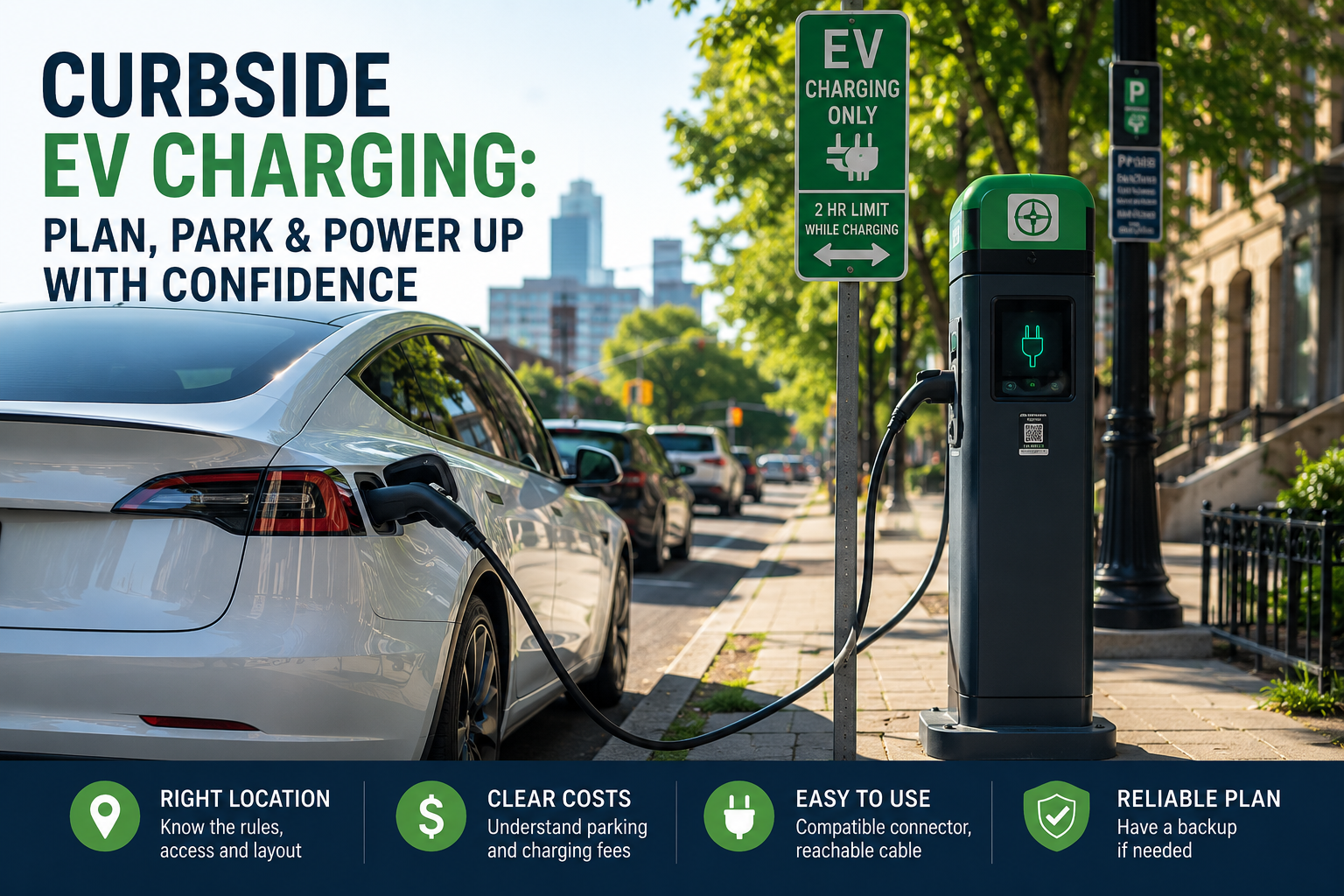
Curbside EV charging places EV charging equipment in or beside public on-street parking areas. It can be an important option for people who do not have dependable access to a private driveway, garage or off-street parking space. But it is not a simple extension of home charging: the curb is a shared public space, and a useful charging experience depends on parking rules, electrical capacity, payment, maintenance and clear communication.
For drivers, the practical question is whether a particular curbside charger can reliably support a routine—not whether a charger appears on a map. For cities, parking operators and prospective hosts, the question is whether a location can balance charging access with the many other demands placed on curb space.
What curbside EV charging is—and when it may fit a routine
Curbside charging usually refers to chargers available from a street parking space. Equipment may be located on a dedicated pedestal, integrated with a streetlight or utility pole where appropriate, or installed near the curb under another site-specific design. The Joint Office of Energy and Transportation’s community-charging white paper identifies people who rely on curbside or on-street parking as a key group for community charging solutions.
The charging speed should match the expected dwell time. The U.S. Department of Energy’s Alternative Fuels Data Center (AFDC) identifies Level 2 and DC fast charging as charging types used for general public charging, and notes that Level 1 and Level 2 charging are typically suited to locations where vehicles park for longer periods. In a curbside setting, that can make a slower charger appropriate for an overnight residential block, while a location intended for shorter stays may call for a different operating model.
Curbside charging may fit a driver’s routine when all of the following are true:
It may be less dependable as a sole solution when street parking is highly competitive, spaces are frequently restricted for deliveries or events, or the driver needs a guaranteed charge by a specific time. Those are not reasons to dismiss curbside charging; they are reasons to plan around its shared-space limitations.
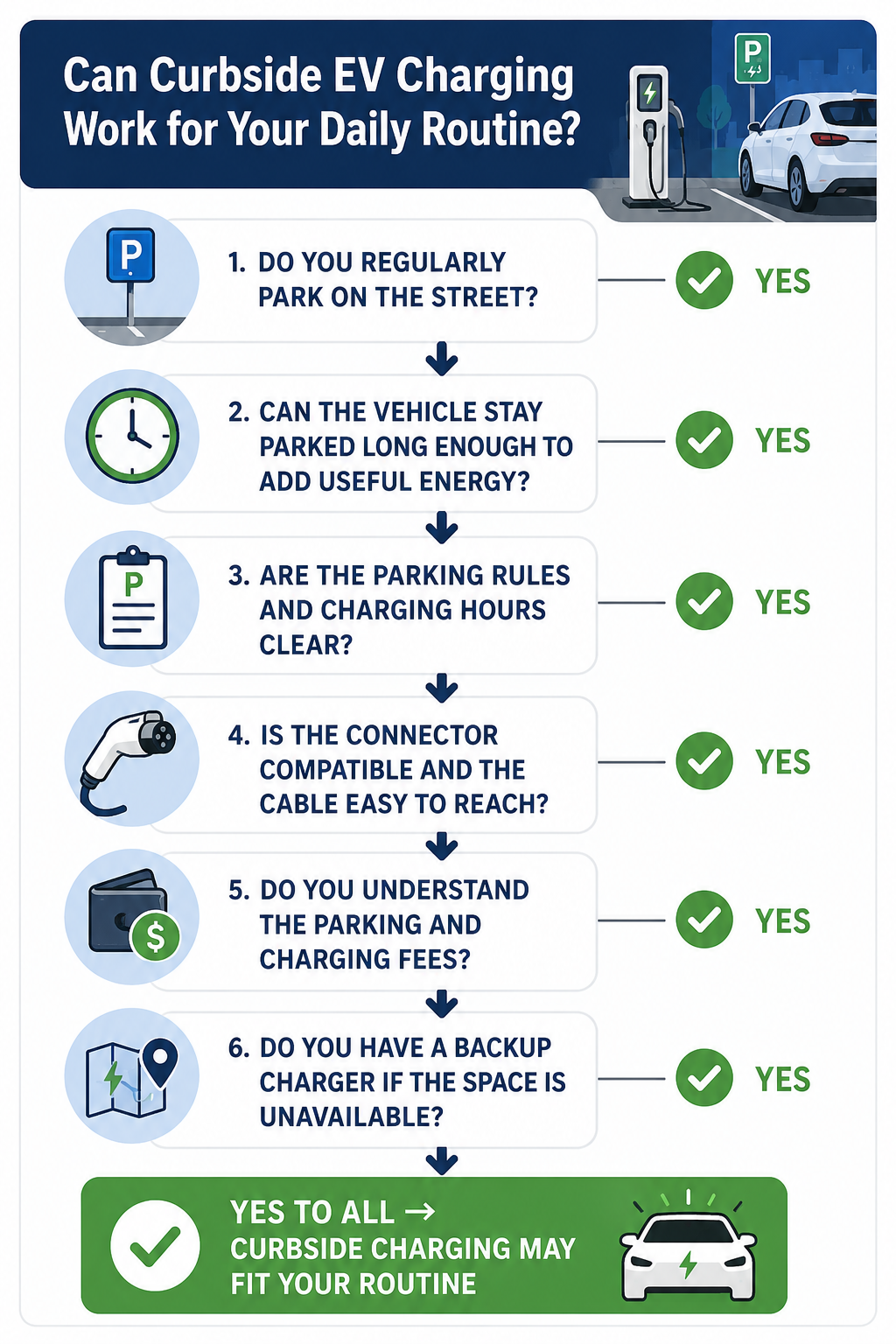
A driver checklist before relying on a curbside charger
Treat each charging stop as location-specific. A charger’s listing can be a useful starting point, but confirm the details that affect whether you can actually charge there.
1. Verify the exact location and access
Check the street address, which side of the road the charger is on, and whether access is affected by direction of travel, construction, street closures or restricted hours. Look at the location closely enough to understand where the charging port on your vehicle will sit relative to the cable.
Also consider the physical setting. Is the charger in a well-lit, easy-to-find area? Is there room to park without blocking traffic, a crossing, a driveway or another marked space? If the layout is unclear, choose a different stop rather than improvising.
2. Read parking signs before connecting
At the curb, signs and pavement markings may govern the space as much as the charger itself. Look for parking duration, paid-parking requirements, resident restrictions, loading rules, street-cleaning schedules, seasonal restrictions and any instructions specific to EV charging.
AFDC notes that parking ordinances can be used to support enforcement of parking policies at publicly accessible charging stations, including on-street locations. That means a charging cable or active session does not necessarily override other parking restrictions. Follow posted rules and local directions at the site.
3. Confirm connector access and expected charging time
Confirm that the connector is compatible with your vehicle and that the cable can reach without being stretched, routed across the pedestrian path or creating an obstruction. Check the charger’s stated power level when available, but plan with a margin: actual charging speed can vary by vehicle, battery condition and charger operation.
If you only need enough energy to get home or reach another charger, a shorter session may be more practical than trying to fill the battery at the curb. Moving promptly after charging, when required or appropriate, can also help make a scarce public space available to another driver.
4. Understand payment before you park
Public charging can involve a charging fee, a parking fee, both, or neither. Payment may be handled through an app, card terminal, network account, municipal parking system or another method. Check whether you need an account, whether the payment system is working and whether an idle or overstay charge may apply.
Do not assume that a charger is free because it is on a public street, or that paid parking includes electricity. If details are unclear, use a backup option rather than discovering a payment problem after you have parked.
5. Have a backup plan
A practical backup plan includes a second charging location, sufficient battery reserve to reach it and an understanding of where you can legally park if the first space is unavailable. This is particularly important during busy evening periods, bad weather, special events or utility and construction work.
If a charger appears damaged, inaccessible or out of service, use the operator’s published reporting route where available. A concise report with the location, charger identifier, time and visible issue can help the operator investigate. Do not attempt repairs or force a connector into the vehicle.
Why the curb is different from a private parking lot
A private lot can often dedicate spaces, manage entry and shape traffic patterns for a defined group of users. The curb serves many uses at once: resident parking, visitors, deliveries, transit, cycling, emergency access, street maintenance and pedestrian movement. A curbside charger therefore operates within a public-space system, not just an electrical installation.
This creates operational questions that a private site may not face as often:
The Joint Office community-charging paper discusses barriers that can affect community charging, including payment options, grid infrastructure, capital costs and installation timelines. It also describes approaches such as pole-mounted charging and notes that some projects may use existing electrical infrastructure. That is a site-dependent possibility, not an assumption: the local electrical service, ownership arrangements, utility process and operating model all need review.
Planning questions for municipalities and prospective hosts
A successful curbside project begins with decisions about the problem it is trying to solve. Is the goal to support residents without home charging, serve a commercial district, help municipal fleets, or test demand in a particular neighbourhood? The answer influences charger type, location, pricing and parking policy.
Start with the curb and the users
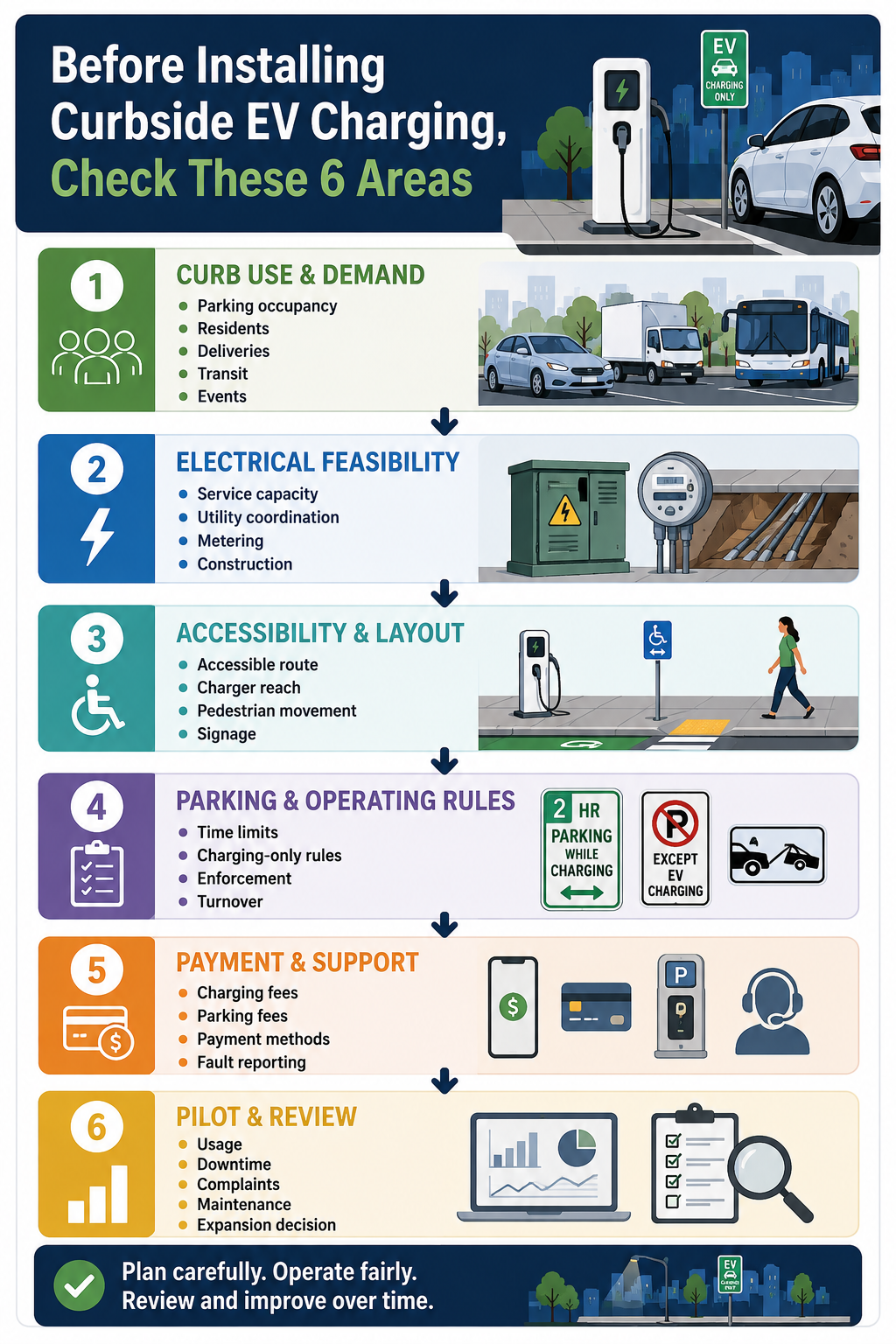
Map existing curb uses before selecting a site. Review parking occupancy at different times, loading activity, transit stops, bike infrastructure, crossings, hydrants, driveways and planned street work. Speak with nearby residents, businesses, property owners and accessibility advocates early enough for their input to influence the design.
Avoid treating a visible open space as automatically suitable. A low-use space at midday may be highly valuable overnight; a space close to a destination may be essential for deliveries; and a curb segment may have seasonal operating needs.
Assess electrical service and delivery constraints
Work with qualified electrical professionals, the utility where relevant and local permitting officials to understand service capacity, equipment siting, metering, communications needs and construction constraints. The AFDC’s planning guidance recommends involving planners, engineers, utilities, relevant boards and other stakeholders, while reviewing applicable codes, parking rules, zoning and permitting processes.
Project teams should document the practical decision points: who owns the equipment, who pays for energy, who maintains the charger, who receives fault alerts, and who can authorize a repair or a parking-policy change. These operating responsibilities are as important as the initial installation decision.
Build accessibility into early design discussions
Accessibility should be considered at site selection and layout stages, rather than treated as a late equipment choice. The U.S. Department of Transportation points project teams to the U.S. Access Board’s technical assistance on accessible EV charging stations. Teams should consult the applicable authority, qualified designers and local permitting officials for requirements that apply to their project.
Useful planning questions include whether a person can approach and use the charger, whether the connection path and parking arrangement create avoidable barriers, and whether signs, instructions and payment flows are understandable. Local conditions and governing requirements vary, so this article is not a compliance determination.
Set clear operating and communication policies
Good curbside charging policies answer routine questions before they become disputes. A project team can establish and communicate policies covering:
Use consistent signs, app or web information where offered, and plain-language instructions at the site. The goal is not to create punitive rules; it is to make shared access predictable. Policies should also be reviewed after launch. A rule that looks reasonable on paper may produce low turnover, confusion or unintended displacement once real drivers use the site.
Use a small pilot before expanding
A pilot can reduce uncertainty before a city or host commits to a larger network. Start with a limited number of sites that represent the intended use case, define a review period and decide in advance what evidence will guide the next decision.
Track operational measures such as charging sessions, duration of parking, occupancy patterns, reported downtime, maintenance response, payment issues and complaints or conflicts. Pair those records with local feedback from drivers, nearby residents, businesses, enforcement staff and people who use the street in other ways.
Then ask practical questions: Are chargers being used at the times the project intended? Are drivers able to understand the rules? Are spaces being blocked? Is the support process working? Are nearby curb uses being affected? Does the available electrical service support the expected next phase?
A pilot does not guarantee that an expanded program will perform the same way. It does provide a structured way to identify site-specific problems, adjust the operating model and make a better-informed decision about whether, where and how to grow.
The practical bottom line
Curbside EV charging can broaden access for drivers who park on the street, but it works best when it is treated as a managed public service rather than a piece of equipment alone. Drivers should verify the specific site, rules, connector, payment method and backup option every time they rely on a stop. Cities and hosts should align electrical feasibility with curb management, accessibility planning, maintenance ownership and clear public communication.
When those elements are tested in a focused pilot and improved with local feedback, curbside charging can become a more understandable and usable part of a community charging mix.
Sources
- Joint Office of Energy and Transportation — Community Charging: Emerging Multifamily, Curbside, and Multimodal Practices
- U.S. Department of Energy Alternative Fuels Data Center — Charging Electric Vehicles in Public
- U.S. Department of Energy Alternative Fuels Data Center — Initial Considerations for Planning Electric Vehicle Charging Infrastructure
- U.S. Access Board — Design Recommendations for Accessible Electric Vehicle Charging Stations