
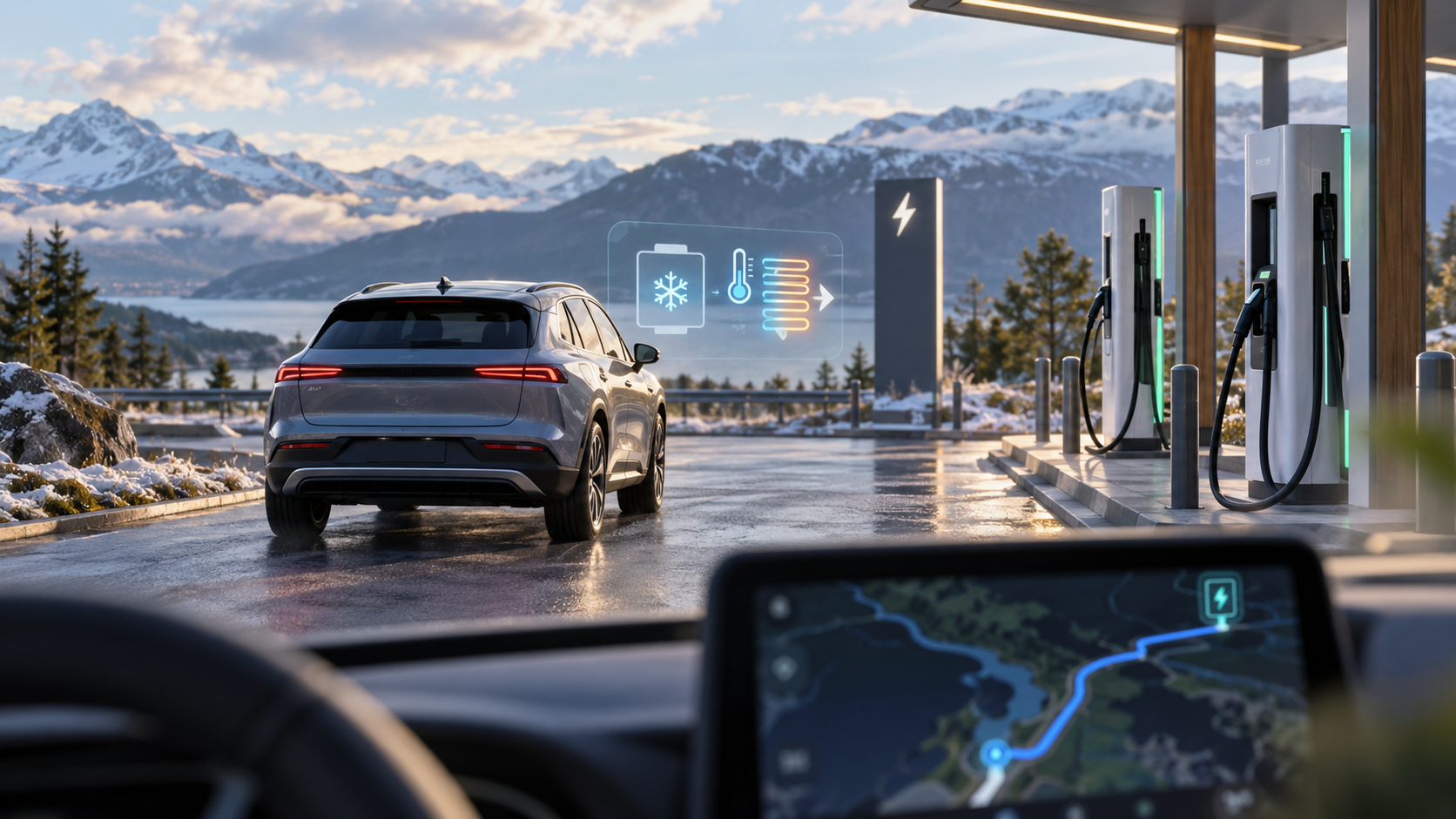
DC fast charging is most useful when it fits smoothly into a longer drive. Battery preconditioning can help prepare some electric vehicles for a planned DC fast-charging stop, particularly when battery temperatures are very cold or hot. But it is not a universal feature, and it does not guarantee a specific charging speed or session time.
The practical point is simple: if your EV supports en-route battery preconditioning, use the vehicle’s own navigation system or fast-charge-preparation process as instructed for your model. Give the vehicle enough time to prepare, arrive with a sensible amount of charge, and treat the charger’s displayed results as the outcome of several conditions—not preconditioning alone.
What is EV battery preconditioning?
Battery preconditioning is a vehicle process that manages the traction battery’s temperature ahead of a planned event, such as DC fast charging. The goal is to bring the battery closer to the temperature range the vehicle is designed to use for efficient fast charging.
This is different from cabin preconditioning. Cabin preconditioning warms or cools the passenger compartment before you leave. When done while the EV is still plugged in, it can reduce the amount of battery energy needed for climate control while driving.
The U.S. Department of Energy explains that many EVs can precondition the cabin and battery before driving, and that doing so while connected to power can preserve more battery energy for the trip.
The two features may be available in the same vehicle, and both can be useful in difficult weather. Still, warming the cabin before departure is not automatically the same as preparing the battery while driving toward a DC fast charger. Your vehicle may handle these functions separately, combine some of them, or offer only certain options depending on model year, software, market, and settings.
For a fast-charging stop, the relevant feature may be described with names such as:
- Battery preconditioning
- Fast Charge Prep
- En-route preconditioning
- Charging preparation
- Battery conditioning
Check the terminology used in your owner’s manual and on-screen menus rather than assuming a similarly named climate-control setting will prepare the battery for DC charging.
Why battery temperature can matter at a DC fast charger
Battery temperature is one of several conditions that can affect charging performance. Chevrolet, for example, identifies battery temperature as one of the factors affecting charging speed and provides Fast Charge Prep guidance for compatible vehicles.
More broadly, the U.S. Department of Energy’s Alternative Fuels Data Center explains that EV charging time varies with factors such as battery state of charge, battery capacity, vehicle capability, charging-equipment type, and charger power output.
A real-world DC fast-charging session can therefore be shaped by:
- Battery temperature — a battery that is too cold or too hot may not accept maximum charging power.
- Battery state of charge — charging power commonly changes as the battery fills.
- The EV’s maximum DC charging capability — the vehicle cannot accept more power than it is designed to handle.
- The charger’s available power — a charger rated below the vehicle’s capability can become the limiting factor.
- The vehicle’s charging curve and thermal-management strategy — peak charging power is normally available only under certain conditions and for part of a session.
- Conditions at the charging site — charger condition, power availability, or equipment limitations can also affect the experience.
Preconditioning is therefore best understood as one input to the charging process. It may help the vehicle prepare for a planned stop where supported, but it cannot override the limits of the car, battery, charger, or charging site.
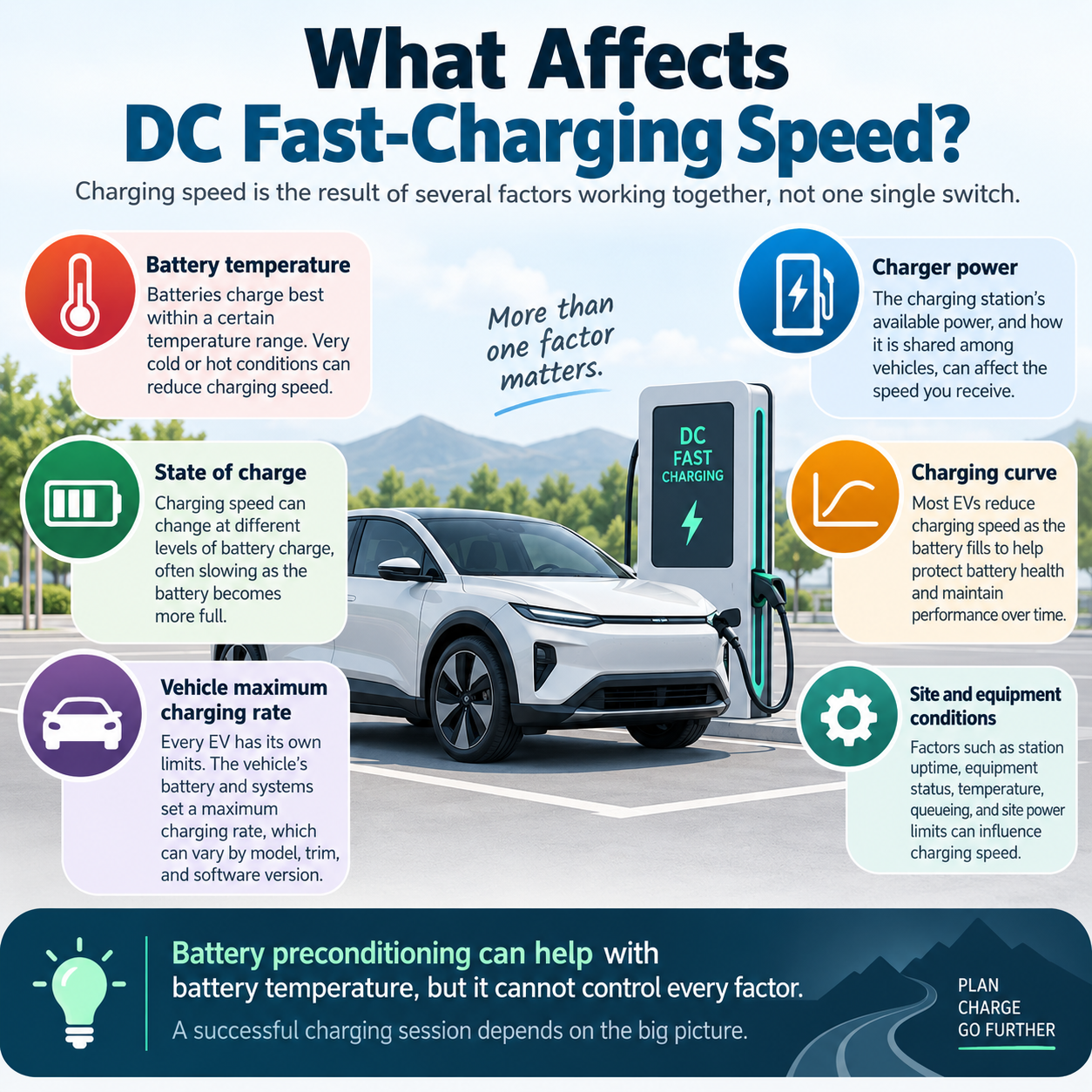
Infographic showing the main factors that affect EV DC fast-charging speed, including battery temperature, state of charge, vehicle capability, charger power, charging curve, and site conditions.
How EVs activate battery preconditioning
There is no single activation method that applies across every EV. The most important step is to use your vehicle’s current documentation and on-screen instructions.
Common approaches include the following.
1. Navigate to a charger through the vehicle’s built-in system
Many vehicles can begin battery preparation when the driver uses the built-in navigation system to route to a compatible charging station. This is often the most reliable method because the vehicle can identify the destination as a charging stop rather than an ordinary address.
Ford provides a clear example of why that distinction can matter. On supported Ford EVs with the required Connected Navigation service, selecting a DC fast charger in the built-in charging database can trigger en-route battery preconditioning.
Ford specifically states that routing to a charger’s street address as a normal destination does not activate preconditioning.
The practical lesson applies beyond any single brand: when your vehicle supports charger-aware routing, select the actual charging-station listing in the vehicle’s navigation or charging database rather than simply entering a nearby business, parking lot, or street address.
2. Use automatic preparation triggered by route guidance
Some vehicles may initiate battery preparation automatically once you create a route to a recognized DC fast charger.
Chevrolet says compatible vehicles using in-vehicle Google Maps can automatically precondition the battery when the driver routes to a fast-charging station. Its Battery Preconditioning Quick Start Guide also explains that preparation time can vary with outside temperature.
Automatic does not necessarily mean immediate. The vehicle may need part of the drive to warm or cool the battery. If you are only a few minutes from the charger, there may be less opportunity for the process to have an effect than during a longer approach.
3. Turn on a manual fast-charge-prep setting, if provided
Some EVs provide a manual setting for fast-charge preparation.
Chevrolet’s Fast Charge Prep is one manufacturer example. Its guidance recommends beginning the process while travelling toward the charger and gives model-specific timing guidance for different temperatures.
If your vehicle has a similar option, follow the instructions for your exact trim, model year, and software version.
A manual control can be useful when automatic charger-aware routing is unavailable, but it is not a reason to guess at timing or repeatedly activate the feature. Preparation itself can consume energy, so follow the manufacturer’s recommended process.
4. Confirm whether connectivity, subscriptions, and supported services apply
Feature availability can depend on more than the vehicle’s hardware.
Ford’s Connected Navigation implementation, for example, ties en-route battery preconditioning to supported vehicles and navigation-service availability. That is a manufacturer-specific example, not a universal EV requirement.
Before a trip, confirm whether your vehicle requires:
- A particular built-in navigation service
- An active connected-services account or subscription
- A current software version
- A data connection
- A supported charging-station database
- A specific battery-conditioning setting
If the feature is missing from the menus or does not behave as expected, consult the current owner’s manual or the manufacturer’s support information rather than assuming the vehicle will precondition automatically.
Before-you-go checklist for a DC fast-charging stop
Use this checklist before relying on battery preconditioning during a trip:
- Confirm that your EV supports battery preconditioning for DC fast charging.
- Check how the feature is activated on your specific model and model year.
- Select the actual DC fast charger in the vehicle’s built-in navigation system when required.
- Give the vehicle adequate driving time to prepare the battery.
- Check your expected state of charge when you arrive.
- Confirm that the charger is compatible with your EV and has suitable power capability.
- Keep a backup charging location in mind in case the first station is unavailable or unsuitable.
- Follow any messages or instructions displayed by the vehicle while approaching the charger.
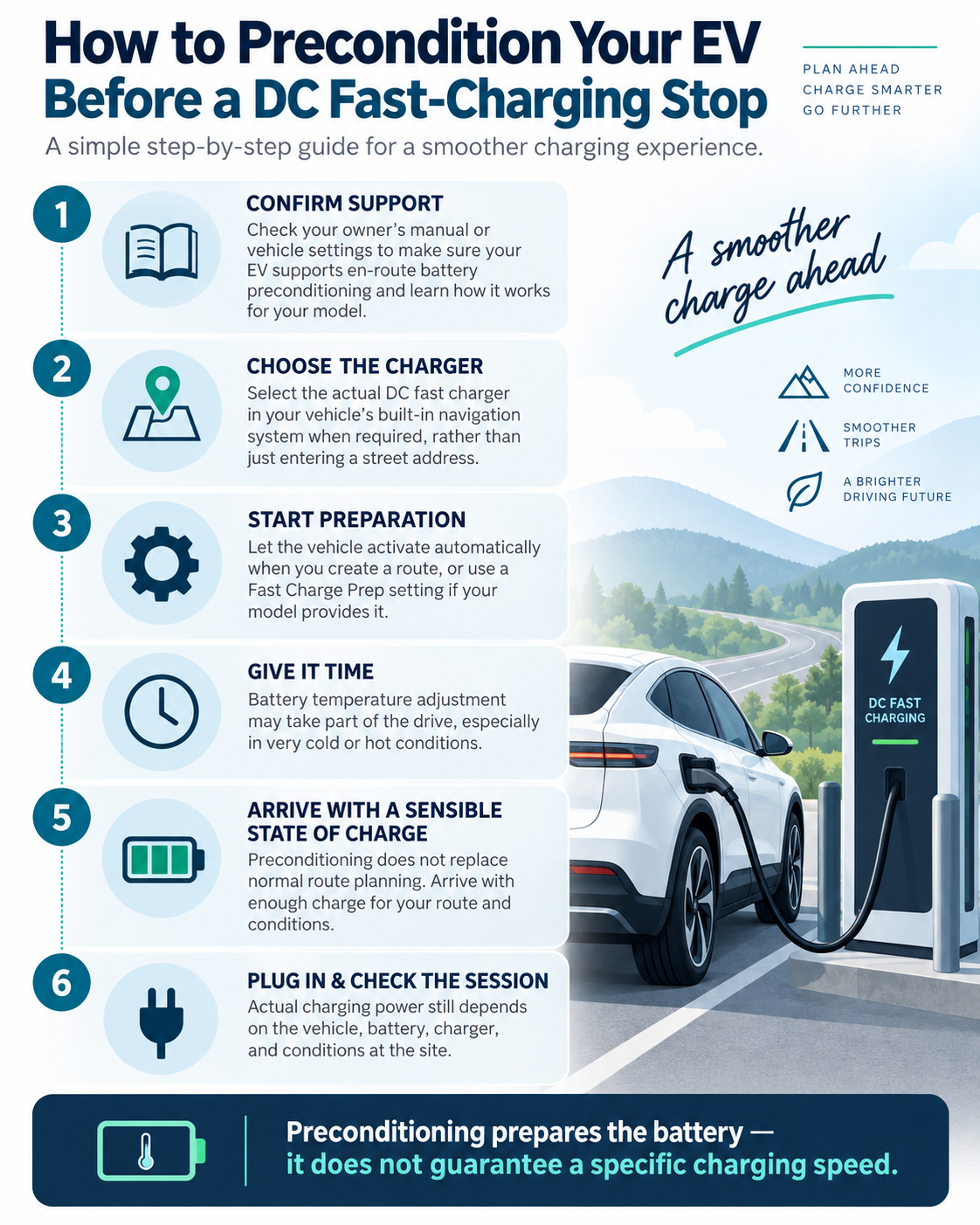
Step-by-step infographic showing how an EV driver can prepare the battery before a DC fast-charging stop using built-in navigation or the vehicle’s fast-charge-preparation feature.
What battery preconditioning does not promise
Battery preconditioning is a preparation feature, not a performance guarantee.
It may consume energy as the vehicle manages battery temperature. That energy use should be considered in your trip planning, particularly when the remaining driving range is limited or weather conditions are severe.
Preconditioning also does not guarantee:
- A particular charging power in kW
- A specific charging time
- That the charger will be available
- That a charger will deliver its advertised maximum output
- That the vehicle will remain at its peak charging rate throughout the session
The vehicle, battery temperature, state of charge, charger capability, and other operating conditions still matter.
Do not use a slower-than-expected session as proof that preconditioning failed. Instead, consider the broader picture:
- Was the correct charger selected in the built-in navigation system?
- Was there enough driving time for battery preparation?
- What was the battery’s state of charge on arrival?
- Were temperatures unusually hot or cold?
- What is the vehicle’s maximum DC charging capability?
- Was the charger capable of supplying that level of power?
- Did the vehicle or charger display a message explaining the reduced rate?
Those questions can help identify what to verify in the owner’s manual, charging-network information, or manufacturer support documentation.
A practical approach for everyday EV drivers
For most drivers, the goal is not to manually manage battery temperature on every outing.
Instead, use battery preconditioning for planned DC fast-charging stops, particularly during longer trips or challenging temperatures. Enter the charging station through the vehicle’s supported navigation system when required, drive normally, and allow the vehicle to manage battery preparation where it is designed to do so.
If your EV does not offer battery preconditioning—or if the activation method is unclear—you can still plan a successful charging stop.
Build in time flexibility, avoid arriving with less energy than your route and conditions comfortably require, verify charger compatibility, and keep an alternative charging location available.
Battery preconditioning can improve the conditions for fast charging, but a resilient road-trip plan should not depend entirely on a feature that varies by vehicle, software version, and operating conditions.
Key takeaway
Cabin preconditioning and DC fast-charge battery preparation are related but distinct.
For a supported EV, navigating to the specific DC fast-charging station through the vehicle’s built-in system may trigger battery preparation automatically. Other vehicles provide a manual Fast Charge Prep function.
Verify how your specific EV works, give the vehicle adequate time to prepare, and remember that battery temperature is only one of several factors that determine the speed of a DC fast-charging session.
Sources
- U.S. Department of Energy — Winterizing Your Electric Vehicle
- U.S. Department of Energy Alternative Fuels Data Center — Electric Vehicle Charging Stations
- Chevrolet — Battery Preconditioning Quick Start Guide
- Chevrolet — DC Fast Charging Station Rates
- Ford — Connected Navigation and EV Battery Preconditioning