
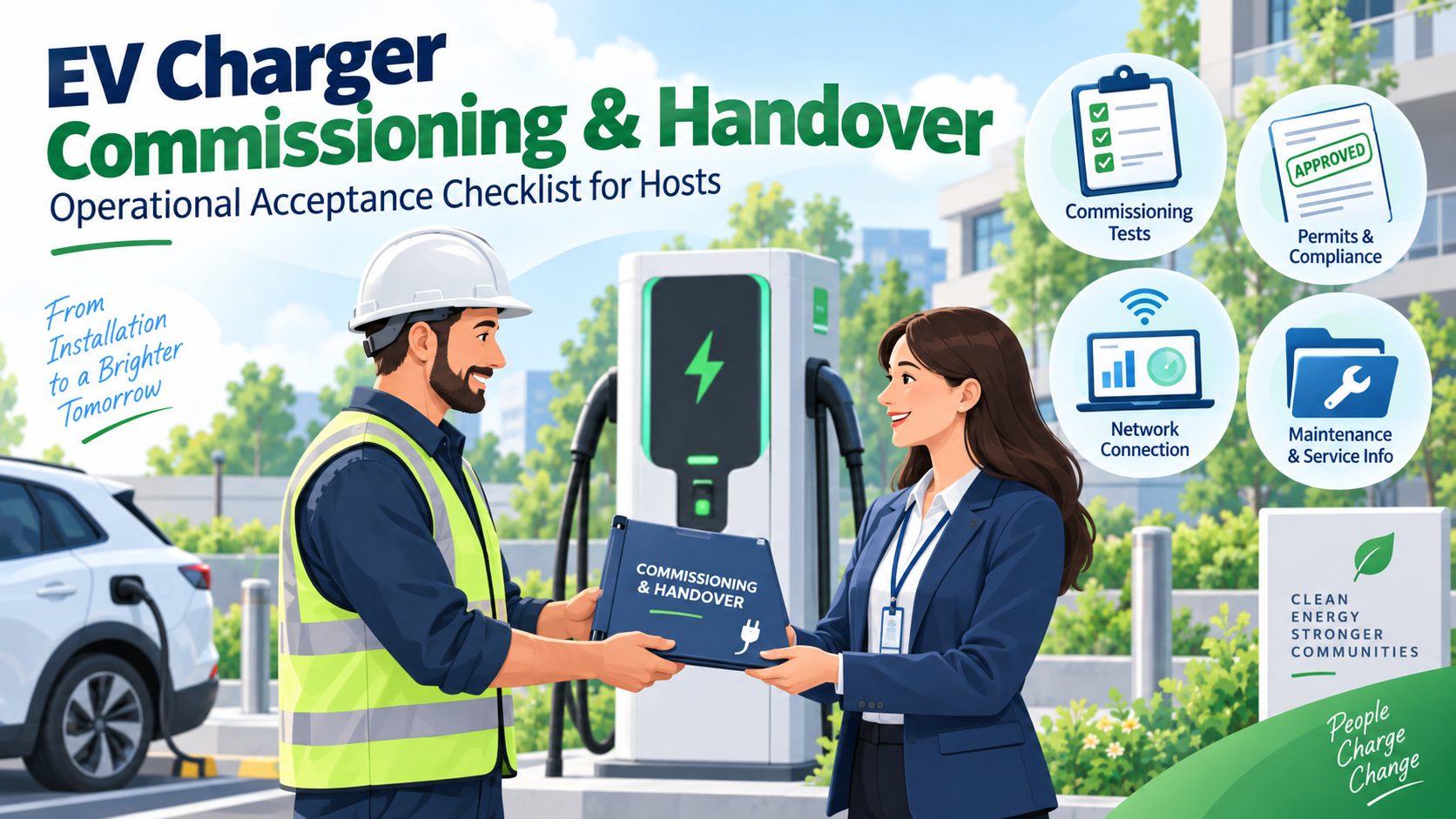
A newly energised EV charger is not necessarily ready for operational handover. Before a charger host accepts responsibility, the project team should confirm that the site works in ordinary use, the right people can access the right records and accounts, and responsibilities are clear when something goes wrong.
This is an operational acceptance checklist for hosts of newly installed Level 2 or DC fast-charging equipment. It is not electrical, permitting, accessibility, safety, warranty, or legal advice. Handover requirements vary by equipment, site, ownership model, funding conditions, utility, and jurisdiction. Confirm project-specific requirements with the installer, equipment supplier, network provider, utility, and relevant authorities.
Commissioning is more than switching the charger on
Commissioning is the structured process of verifying that installed equipment and the surrounding operating arrangements are ready to be handed over. A successful charge session matters, but it is only one part of acceptance. The host also needs a usable record of what was installed, a way to obtain support, and a plan for routine care.
The U.S. Department of Energy’s Alternative Fuels Data Center (AFDC) recommends that charging hosts address utility coordination, ownership and operating responsibilities, permits and inspections, maintenance needs and costs, and staff training during infrastructure development. Those same areas provide a useful foundation for a practical EV charging handover process.
A good handover answers practical questions such as:
Treat these as acceptance questions, not assumptions to resolve after opening day.
Build an acceptance file before sign-off
Create one controlled handover folder, whether digital, physical, or both. Give the host a clearly identified owner for the folder and a process for updating it after repairs or configuration changes. The aim is not paperwork for its own sake; it is to help the host find reliable information during an outage, support call, warranty discussion, or future expansion.
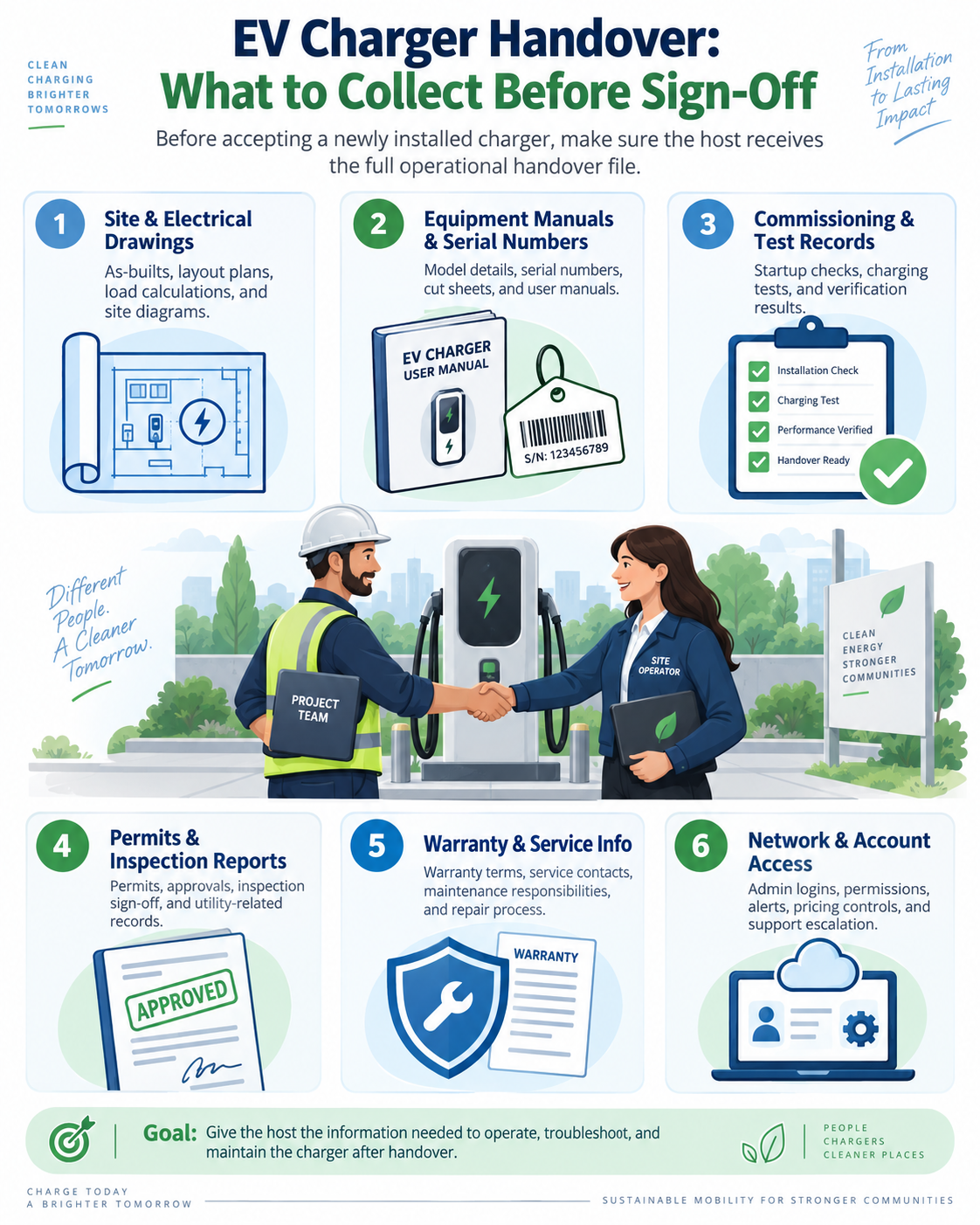
DOE guidance on charger activation identifies useful documentation categories including site and electrical drawings, as-builts, equipment cut sheets and manuals, load calculations, test and verification records, permits, and inspection reports. While that guidance was developed for electric school bus projects, these are sensible handover-document categories for many host-operated charging sites.
Suggested acceptance-file contents
Ask the project team which of the following items apply to the installation:
Do not assume the installer’s construction folder is the host’s operating file. Request a version organised for day-to-day ownership. Before acceptance, compare model and serial information on the documents with the equipment at the site.
For warranties and service agreements, clarify practical boundaries: what is covered, who determines whether a fault is warrantable, who can authorise a repair, whether labour or travel is included, and who communicates with the driver or tenant while the charger is unavailable. Record unanswered questions as open handover items rather than silently accepting them.
Walk the site with an operator’s eye
A site walk should involve someone who understands the property’s daily operation, not only the construction team. If possible, include the installer, host representative, property or facilities manager, and the person who will receive driver reports.
Use the walk to confirm the physical site matches the intended operating plan.
Physical condition and cable management
Check for visible damage, loose components, incomplete finishes, standing-water concerns, damaged labels, or areas that could make routine use difficult. Review whether charge cables can be stored securely and remain clear of normal walking and driving paths when not in use. AFDC identifies secure cable storage, periodic checks of parts, cleaning, repairs, and troubleshooting as routine elements of charger operation and maintenance.
This inspection is not a substitute for an electrical or safety inspection. It is a host’s practical review of whether staff and drivers can operate the site as intended and whether observed issues have a named owner.
Parking, signage, and access
Stand where a driver would enter the property and attempt to follow the route to the charger. Consider whether the location is understandable at arrival, whether signs match the site’s actual access policy, and whether parking spaces can be used without unnecessary confusion.
Confirm the operating rules that will appear on signs and in driver communications, such as:
If the project has federal funding or other program conditions, verify the applicable requirements separately. Federal EV charging standards address matters such as installation, operation, maintenance, interoperability, signage, network connectivity, and public information for specified federally funded projects; they are not universal requirements for every private installation. See the U.S. Department of Transportation’s NEVI standards information for that limited scope.
Communications and site readiness
Ask the project team to demonstrate the communications path used by the charger, where relevant. The host does not need to diagnose technical connectivity, but should know what “connected,” “offline,” and “faulted” look like in the operating interface and who will investigate each condition.
Also record practical dependencies that could affect the driver experience, such as site Wi-Fi policies, cellular coverage considerations identified by the provider, gate access, lighting schedules, snow or landscaping work, or construction activity. These are site-specific operating considerations, not universal commissioning tests.
Test real charging and operational workflows
A handover test should resemble real use as closely as practical. Agree in advance which tests are appropriate for the equipment, access model, and site. Have the installer or provider document outcomes and any limitations.
At a minimum, consider testing these workflows:
For networked stations, AFDC explains that network service providers can enable operators to manage access, set fees, monitor station health, and access utilisation data. That makes account ownership, permissions, alerts, and support escalation important handover topics. The exact controls available depend on the provider and service arrangement, so ask for a live demonstration of the functions included for this site.
Avoid accepting shared personal logins. Identify at least two appropriate host administrators, use organisation-controlled contact details where possible, and document the process for adding, removing, or changing access. Confirm who controls configuration changes and whether the host needs approval from another party before changing prices, access rules, or notifications.
Train the host team and assign responsibilities
Staff training should be role-based and short enough to be used. DOE charger activation guidance recommends staff training and a plan for reporting charger problems as part of activation. The host does not need every employee to become a charger technician; staff need to know the correct first action and when to escalate.
A simple responsibility table can prevent avoidable delays:
ActivitySuggested accountable partyQuestions to settle at handoverDriver’s first reportSite staff, help desk, or network supportWhat contact details are displayed? What details should be captured?Basic visual checkFacilities or designated site staffWhat may staff inspect or clean, and what should they not attempt?Remote diagnosisNetwork provider or designated operatorWho receives alerts and has account access?Physical repairInstaller, service provider, or equipment providerHow is service requested and authorised?Warranty claimOwner or named administratorWhat evidence and approvals are needed?Record updatesHost operations leadWhere are repair records and revised documents stored?
AFDC notes that maintenance agreements should state responsibilities and include expectations for response time, repair time, and uptime. Use that guidance to review the maintenance agreement before handover. Rather than assuming a particular service level, ask the parties to state the agreed targets, exclusions, business-hours coverage, and communications process in writing.
Provide a one-page quick guide for front-line staff. It can include charger locations and identifiers, the driver support route, internal escalation contacts, basic information to capture, and a clear instruction not to undertake work beyond their training or authority.
Hold a 30-day post-launch review
Initial commissioning cannot reveal every operational issue. Schedule a 30-day review when the site has seen normal use. Bring together the host, installer or service provider, equipment or network provider as appropriate, and site operations staff.
Review actual experience rather than only technical status:
This review is also a useful time to decide what information the host will track going forward, such as reported faults, service visits, recurring site issues, and utilisation information available through the selected provider. The right measures depend on the host’s objectives and the data available under its service arrangement.
Concise EV charger host acceptance checklist
Before operational acceptance, confirm that the host can answer “yes,” “received,” or “assigned” to the applicable items below:
The practical standard for handover is not a perfect site with no future issues. It is a site where the host has evidence of what was delivered, authority to operate the service as intended, and a documented path for responding when routine questions or faults arise.
Sources
- U.S. Department of Energy, Alternative Fuels Data Center — Procurement and Installation for Electric Vehicle Charging Infrastructure
- U.S. Department of Energy, Alternative Fuels Data Center — Operation and Maintenance for Electric Vehicle Charging Infrastructure
- U.S. Department of Energy, Alternative Fuels Data Center — Electric Vehicle Charging Networks
- U.S. Department of Energy, Alternative Fuels Data Center — Electric School Bus Planning Guide
- U.S. Department of Transportation — National Electric Vehicle Infrastructure Standards and Requirements