
A charging connector that will not come out of your EV can be stressful, particularly at a public charger when you need to leave. The important first step is to treat it as a lock or session-control problem—not as something to pull harder.
Many EVs intentionally hold the connector in place under certain conditions. For example, the 2024 Toyota bZ4X locks its AC charging connector when it is inserted and links locking and unlocking behaviour to the vehicle doors. Toyota’s owner guidance also notes that repeated lock and unlock actions can temporarily affect normal operation.
Start with the low-risk checks below. A manual or emergency release is a vehicle-specific last resort, not a universal driver procedure.
Safety boundary: do not force a stuck charging connector
Do not yank, twist, pry, strike, or use tools on a connector that appears locked. Do not try to take apart the vehicle charge port, the handle, or the charging station. Pulling against a locked mechanism can damage the connector, cable, latch, or charge-port components.
Also avoid using an online video, a forum post, or instructions for a different EV as a substitute for your exact owner’s manual. The location and operation of an emergency release can differ by model year, vehicle configuration, and connector type.
Stop and seek help rather than continuing your own troubleshooting if you notice:
In those situations, keep clear of the equipment and use the charging network’s support number or appropriate roadside and service support.
Quick checklist: try these normal release steps first
Work through these steps calmly, in order. Not every step applies to every vehicle or charging station.
If the connector releases, inspect it visually before the next use. If you see damage or the connector lock has begun sticking repeatedly, arrange vehicle service rather than assuming the issue is resolved.
Why a connector may be locked when nothing seems wrong
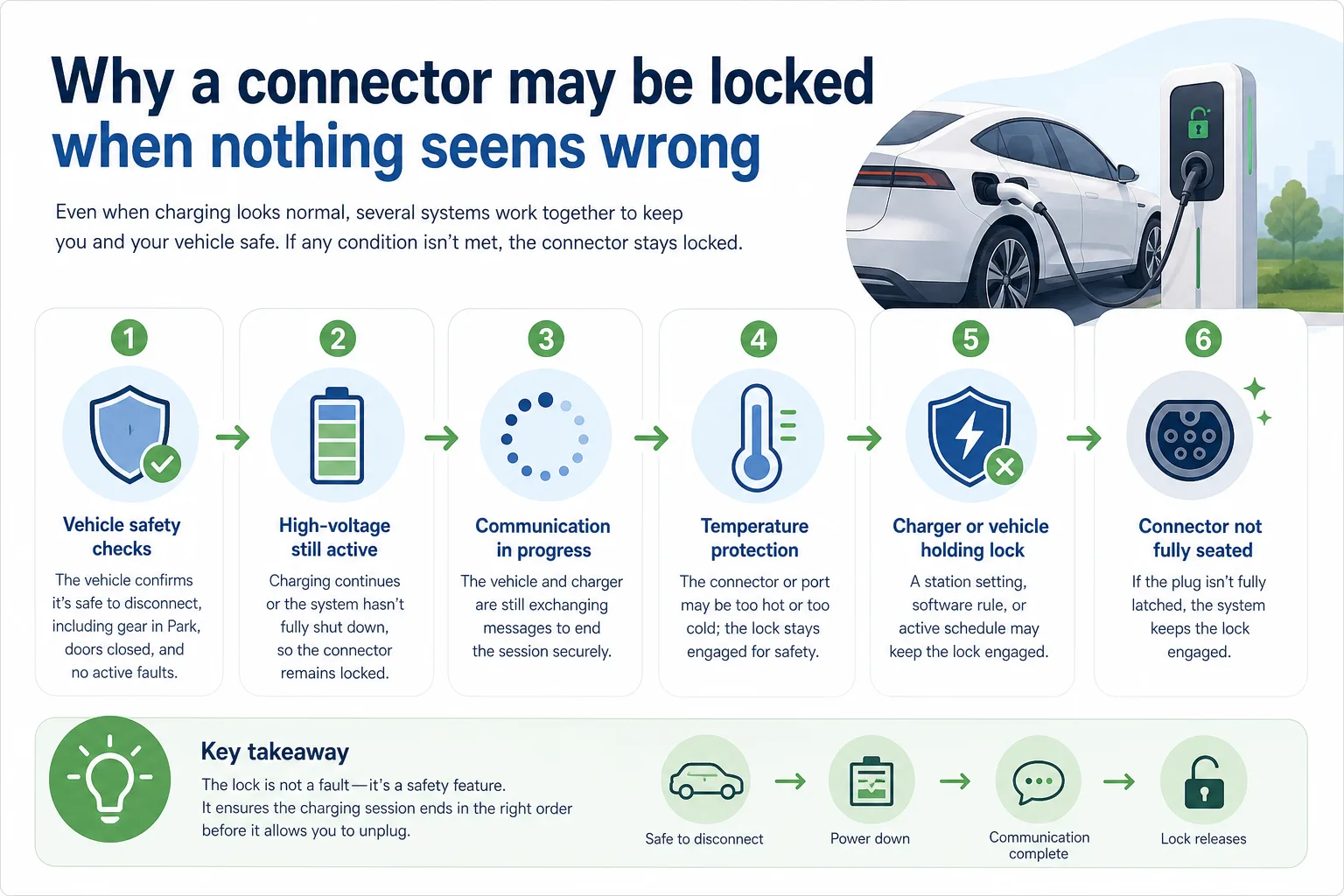
A connector that will not release is not automatically a charging-station fault. The vehicle may be intentionally securing it while charging, while the vehicle is locked, or until it receives a normal release command.
That is why the right answer is specific to the vehicle. One model may release the connector when you unlock the doors; another may require a touchscreen command or app action. Toyota’s bZ4X documentation is one example of a vehicle where the AC connector lock is associated with door locking and unlocking. Review the applicable Toyota guidance here, but do not assume those behaviours apply to another make or model.
Use your vehicle’s own owner’s manual as the decision point. Search its charging or charge-port section for terms such as “remove charge cable,” “connector lock,” “charge port,” “emergency release,” or “manual release.” Make sure the manual matches the vehicle’s model year and market.
If cold weather, debris, or a latch issue is suspected
Cold conditions can add another variable. Tesla identifies a frozen charge-port latch as one possible reason a cable may not release on affected vehicles, and its guidance directs owners to use the vehicle’s defrost functions rather than improvised methods. Tesla’s troubleshooting guidance is model-specific, but the general lesson is useful: follow the manufacturer’s approved cold-weather steps for your own vehicle.
Do not apply improvised heat, chemicals, lubricants, ice-removal tools, or excessive force to the latch area unless your owner’s manual specifically instructs you to do so. What is appropriate for one vehicle may be unsuitable for another.
If you can safely see loose material around the outside of the port or connector, do not push it deeper into the mechanism. If the connector cannot be released through the normal controls, move to support and service escalation instead of attempting a repair at the charger.
Before using a manual or emergency release
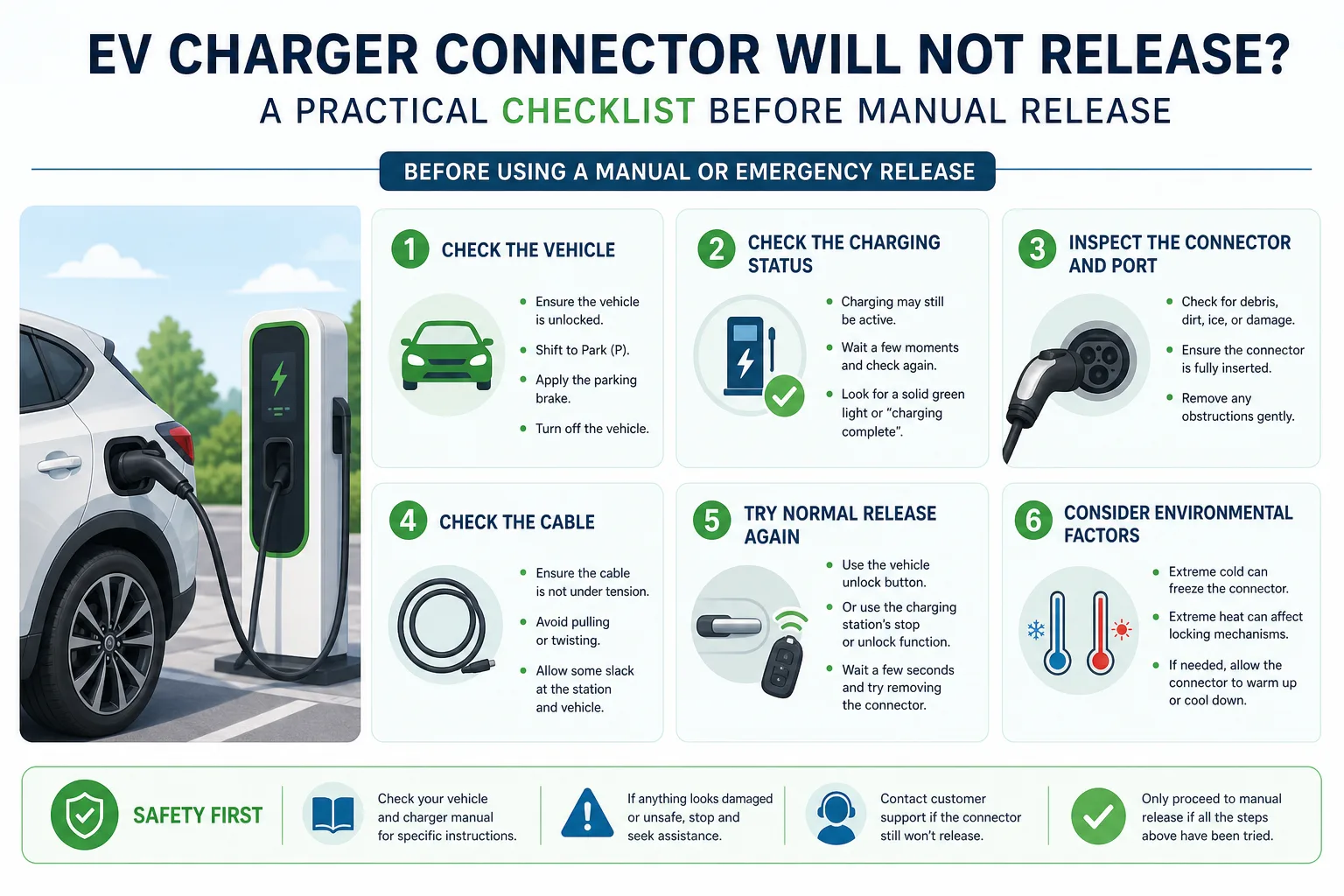
A manual release may exist on some vehicles, but it is not a standard step to try on every EV. It should only be considered after the normal release methods have failed and after you have read the exact instructions and warnings in the owner’s manual for your specific vehicle.
The safety conditions matter. Tesla instructs Model Y owners to ensure the vehicle is not actively charging before using its manual charge-port release. It also warns not to pull the release cable while pulling the connector at the same time, and not to perform the procedure if high-voltage conductors are exposed. Read Tesla’s complete warning language rather than relying on a generic sequence.
Manufacturer documentation also treats this as an exceptional measure. Toyota describes its emergency release wire as a temporary emergency procedure and advises inspection if connector-lock trouble continues. Toyota’s bZ4X manual section is not a guide for other vehicles.
Even documentation intended for emergency responders reflects the need for model-specific caution. Ford’s 2026 Mustang Mach-E emergency-response guide identifies a manual charge-cord lock actuator release and directs responders to attempt to de-power the charging unit before using it. Ford’s emergency-response guide is not a consumer owner’s manual, so drivers should not use it as a substitute for their own vehicle instructions.
In practical terms, only proceed when all of the following are true:
Do not create your own manual-release sequence. In particular, do not pull a release mechanism and the connector simultaneously unless the exact vehicle manual explicitly directs that action.
Who to contact when the connector remains trapped
If the normal sequence does not release the connector, choose the support route that fits the likely issue.
Call the charging-network support number when the station session will not end, the screen or app shows an error, or you believe the station is still controlling the session. The support number is commonly displayed on the charger. Have the station identifier, location, and any error message ready.
Call roadside assistance if you need help at the vehicle, cannot access or interpret the vehicle-specific manual procedure, or cannot safely leave the connector in place.
Contact the vehicle manufacturer or a qualified service provider when the connector lock repeatedly fails, the vehicle will not follow its ordinary release sequence, or an emergency release has been used. Repeated sticking is a reason to have the system assessed rather than relying on a workaround.
These services may help identify the next step, but they cannot guarantee an immediate release or repair. If conditions look unsafe, do not wait beside the equipment or continue manipulating it.
Prevent a repeat problem
A few small preparations can make a stuck connector less disruptive:
A stuck connector is often resolved through the vehicle’s normal unlock and session-end controls. If those steps fail, the safest next move is not more force—it is the exact owner’s manual, then the appropriate charging-network, roadside, or vehicle-service support.
Sources
- U.S. Department of Energy, Alternative Fuels Data Center. Search for Alternative Fueling and Charging Stations
- U.S. Department of Energy, Alternative Fuels Data Center. Electric Vehicle Charging Networks
- EVgo. EVgo Support
- ChargePoint. What are the other ways to reach out to support?
- Electrify America. FAQ
- Ford Motor Company. 2026 Ford Mustang Mach-E Emergency Response Guide
- Tesla. Troubleshooting Alerts
- Tesla. Charging Instructions
- Tesla. Charging
- Toyota. 2024 bZ4X — Locking and unlocking AC charging connector