
EV Charger Cybersecurity Checklist for Site Hosts
Connected EV chargers can give site hosts valuable operating data, payment options, usage monitoring, remote diagnostics, and charger-management tools. But networked charging stations also introduce devices, user accounts, communications links, cloud platforms, and vendor relationships into a site’s technology environment.
That makes EV charger cybersecurity more than an IT issue. For workplaces, hotels, apartment buildings, parking operators, retailers, and other charger hosts, it is also part of equipment procurement, vendor management, driver privacy, physical security, and operational continuity.
The potential effects are practical. The U.S. Department of Energy (DOE) explains that compromised EV supply equipment or associated networks may expose user data, interrupt charging, or affect connected infrastructure. DOE’s overview, Securing EV Charging Infrastructure Part 1: Why Cybersecurity Matters, provides useful background for organizations assessing these risks.
This article is an EV charger cybersecurity and procurement checklist, not a cybersecurity certification or compliance guide. Appropriate safeguards depend on the charger type, site, payment model, network architecture, existing IT environment, applicable regulations, and agreements with installers and charging-network providers. Involve IT, privacy, facilities, legal, and security teams where appropriate.
Why cybersecurity belongs in EV charging planning
A basic non-networked charger may operate largely as electrical equipment. A networked EV charger, however, can communicate with a charging-network provider, cloud systems, site administrators, payment services, and potentially other building or energy-management systems.
The U.S. Department of Energy’s Alternative Fuels Data Center (AFDC) explains that networked charging infrastructure can support:
- RFID, smartphone, or credit-card payments
- Charger usage monitoring
- Utilization analysis
- Customer support
- Remote management
- Transmission of charging and usage information
See the AFDC’s Procurement and Installation for Electric Vehicle Charging Infrastructure guidance for additional planning considerations.
Cybersecurity planning should therefore begin before a purchase order is signed.
Retrofitting security expectations after installation can become difficult if the host:
- does not control the charger-management account;
- cannot access logs or operational data;
- does not know how software and firmware updates are handled;
- cannot remove former administrators;
- depends entirely on a vendor for remote access;
- or does not know who can isolate or disable a potentially compromised charger.
The goal is not to eliminate every possible cybersecurity risk. Instead, the organization should understand the connections being introduced, choose safeguards appropriate to the site, clearly assign responsibilities, and have a practical response plan.
The National Institute of Standards and Technology (NIST) describes four connected domains in its Cybersecurity Framework Profile for Electric Vehicle Extreme Fast Charging Infrastructure:
- Electric vehicles
- Charging equipment
- Cloud or third-party operations
- Utility and building networks
The NIST profile focuses specifically on extreme fast-charging infrastructure and is not intended as a universal compliance checklist for every Level 2 or DC fast-charging installation. However, its four-domain model provides a useful way for any charger host to think beyond the charging pedestal itself.
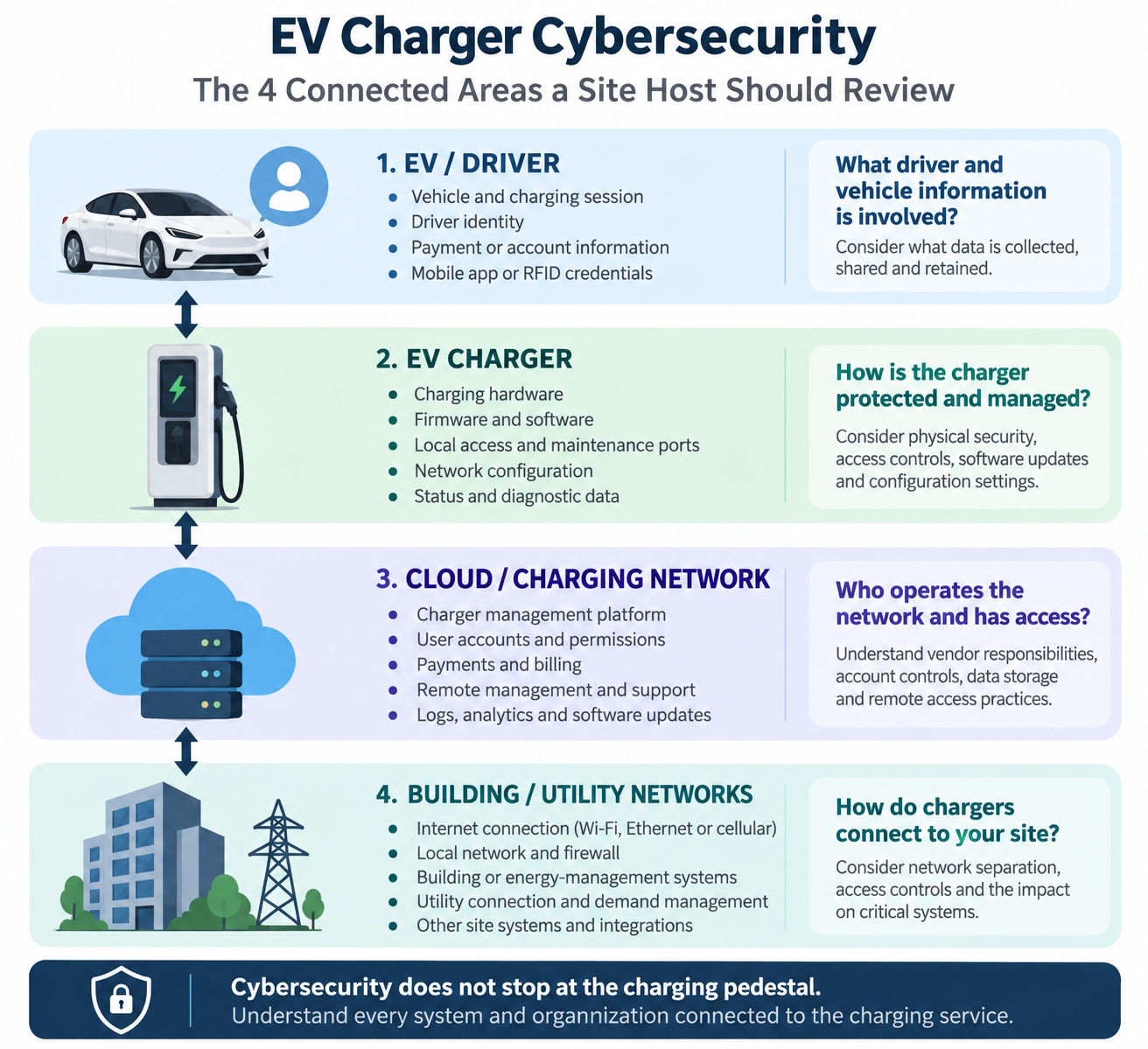
Diagram showing the four connected cybersecurity areas of an EV charging site: vehicle, EV charger, cloud charging network, and building or utility networks.
Map the connected systems and data at the EV charging site
Before comparing EV charging vendors, create a simple one-page map of the charging environment.
It does not need to start as a detailed technical network diagram. The purpose is to understand what is connected, what information moves between systems, and who controls each component.
Include:
- EV chargers and charging ports
- Local network or communications equipment
- Wi-Fi, Ethernet, or cellular connectivity
- Charger-management platforms
- Charging-network provider
- Payment processor, if applicable
- Driver accounts or RFID systems
- Building or energy-management systems
- Utility connections or demand-management services
- Remote maintenance or support systems
- Site administrator accounts
- Data exports, APIs, or integrations with third-party platforms
Then ask:
Which systems must communicate for a driver to charge, receive support, or make a payment?
The answer may be very different depending on the type of EV charging site.
For example:
- An employee-only workplace charger may use access cards but no public payment system.
- A hotel charger may need guest-access controls.
- A multifamily property may connect charging sessions to resident accounts.
- A public commercial charger may depend on payment processing, mobile applications, remote monitoring, and network services.
Also ask:
What is the minimum amount of driver and charging data the site actually needs?
A property owner may need only aggregate utilization and energy information for capacity planning, while a charging-network operator manages individual driver accounts.
Clarifying this distinction early helps organizations make deliberate decisions about data access, retention, reporting, and privacy rather than simply accepting a vendor’s default configuration.
Assign ownership for charger, network, and administrator accounts
One of the easiest cybersecurity gaps to create is assuming that someone else is responsible.
A site host may own the chargers. An electrical contractor may install and configure them. A charging-network company may operate the cloud platform. An IT team may manage the local network. A property manager may administer user accounts.
Those are separate responsibilities.
For every charging deployment, document who is responsible for:
- Charger administrator accounts
- Network credentials
- Creating and removing users
- Password and authentication policies
- Firmware and software updates
- Security notifications
- Payment configuration
- Charger logs
- Data exports
- Remote support
- Communications equipment
- Incident escalation
- Physical access
- Vendor contact management
- Charger shutdown or isolation procedures
Ask whether the charging platform supports different administrator roles and permission levels.
For example, a facilities employee might only need to see whether a charger is online, while a smaller group of authorized administrators can change:
- network configurations;
- payment settings;
- pricing;
- user permissions;
- charger settings;
- or integrations.
Also confirm:
- How does account recovery work?
- Who can reset an administrator account?
- Is multi-factor authentication available?
- Can administrator activity be logged?
- What happens if the primary charger administrator leaves the organization?
Offboarding should be part of the operating procedure.
When an employee, installer, property manager, contractor, or vendor contact no longer requires access, the organization should know who removes that access and when.
Add cybersecurity questions to EV charger procurement
Cybersecurity requirements should be considered alongside charger power, installation cost, networking, warranties, payment capabilities, and support.
Include security questions in requests for proposals, vendor demonstrations, quote reviews, and contract discussions whenever appropriate.
Useful questions include:
- How are charger firmware updates delivered?
- Are updates automatic, scheduled, or manually approved?
- How long will the charger receive security updates?
- How does the vendor notify customers about important vulnerabilities?
- Does the charger support secure remote updates?
- What authentication methods are available for administrator accounts?
- Is multi-factor authentication supported?
- Are different user roles and permissions available?
- Are administrator actions logged?
- What information is collected about drivers and charging sessions?
- Where is that data stored?
- How long is it retained?
- Can the host export its operational data?
- What happens to host and driver data when the contract ends?
- How does remote technical support access chargers?
- Can remote support access be restricted or audited?
- What happens if the charging network is temporarily unavailable?
- Can drivers still charge during a network outage?
- Who is responsible for responding to a charger security incident?
- What cybersecurity documentation can the vendor provide?
Written responses are particularly useful because they can become part of the vendor-comparison process and contract discussions.
Evaluate OCPP and charger interoperability separately from cybersecurity
Interoperability and cybersecurity are related, but they are not the same thing.
The DOE Alternative Fuels Data Center recommends considering hardware using Open Charge Point Protocol (OCPP) version 1.6 or higher when organizations want greater flexibility to change charging-network providers without replacing the charger hardware.
OCPP is an open communication protocol between charging stations and charging-management systems.
The Open Charge Alliance currently maintains OCPP 1.6, OCPP 2.0.1, and OCPP 2.1. OCPP 1.6 remains widely deployed, while newer OCPP versions introduce additional functionality, including expanded device-management and security capabilities.
However, an OCPP label alone does not guarantee:
- cybersecurity;
- network compatibility;
- a simple vendor migration;
- charger uptime;
- access to all operational data;
- freedom from commercial restrictions;
- or complete interoperability between every charger and charging-management platform.
Ask vendors:
- Which OCPP version does this charger support?
- Is the implementation OCPP-certified?
- Which functions are supported?
- Does the proposed network support the same version and features?
- Can the host obtain charger configuration and transaction data?
- What is required to move the chargers to another network?
- Are migration fees or contractual restrictions involved?
- Who owns the charger credentials needed for migration?
Treat interoperability as a procurement and business-continuity question, not simply a protocol checkbox.
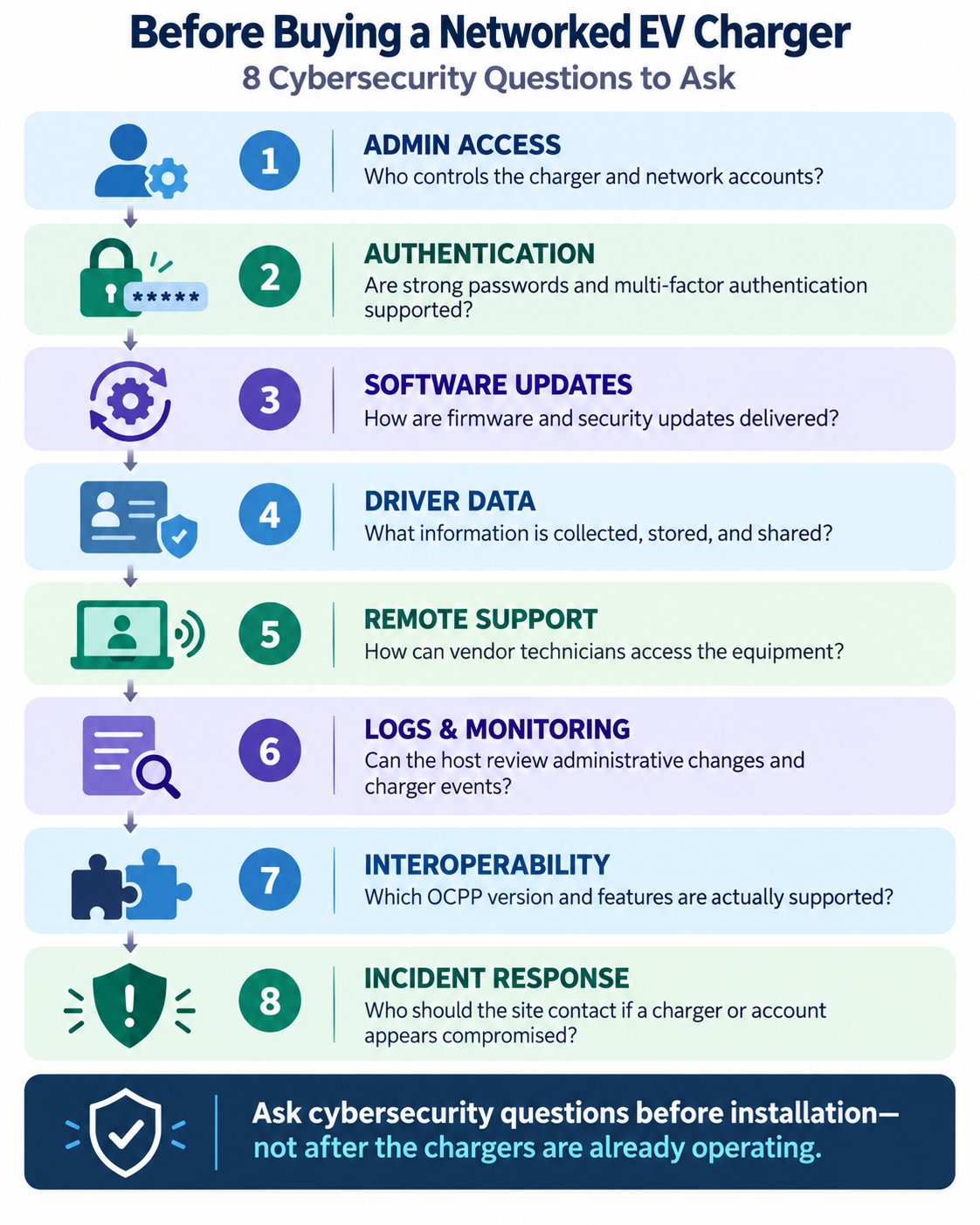
Eight-question EV charger cybersecurity procurement checklist covering administrator access, authentication, updates, driver data, remote support, logs, OCPP interoperability, and incident response.
Review physical access and EV charger communications
EV charging cybersecurity is not limited to cloud dashboards and passwords.
Physical access to charging hardware and communications equipment should also be considered.
Walk the charging site with facilities, IT, and the installer before commissioning and identify:
- charger enclosures;
- maintenance ports;
- communications gateways;
- routers or cellular equipment;
- network cabinets;
- electrical rooms;
- access panels;
- physical keys;
- service credentials;
- and other equipment that could affect charger operation.
Decide who requires routine access and how sensitive equipment will be protected.
At publicly accessible charging sites, ask the charger manufacturer or installer what staff should do if they notice:
- a damaged charger enclosure;
- exposed wiring;
- a broken connector;
- an opened service panel;
- suspicious attachments;
- or evidence of physical tampering.
Staff should not attempt to bypass charger safeguards or repair potentially unsafe equipment unless they are qualified and authorized to do so.
Consider network separation and communications responsibilities
Give the organization’s IT team enough information to evaluate how networked chargers should communicate with other systems.
Depending on the site, IT teams may consider whether EV charging equipment should be separated from business-critical networks or systems.
The appropriate architecture will depend on the organization. The important point is that the network decision should be intentional rather than occurring simply because an installer connected the chargers to the easiest available Wi-Fi network.
Clarify responsibility for:
- Wi-Fi credentials
- Ethernet connections
- Cellular service
- Firewall configuration
- Network monitoring
- Router or gateway replacement
- SIM management
- Communications outages
- IP or VPN configuration, if applicable
Vendor-support access deserves similar attention.
Remote support can be valuable for diagnosing charger faults, but site hosts should understand when, how, and by whom remote access can be used.
Ask whether significant remote configuration changes are recorded and whether the host can review those records.
If a third-party company manages the chargers for the host, make sure the organization can still obtain essential operational information during an outage, vendor dispute, or transition to another provider.
Create a simple EV charger incident-response plan
An EV charging cybersecurity response plan does not need to be a large technical document.
A short operational playbook can help staff respond consistently to situations such as:
- suspicious charger damage;
- unexpected administrator-account changes;
- unusual charger behaviour;
- unauthorized configuration changes;
- lost administrator credentials;
- loss of network connectivity;
- a vendor cybersecurity notification;
- a compromised employee account;
- or unexplained charger outages.
The playbook should answer five practical questions:
- Who should staff contact first?
- Who can disable or isolate a charger if necessary?
- Who contacts the charging-network or hardware provider?
- How will affected drivers be informed?
- What information should be preserved for investigation or support?
Keep vendor contacts, charger identifiers, account information, and escalation paths somewhere that authorized staff can access even if the primary charging-management system is unavailable.
Test the contact list periodically.
An incident-response document that points to a former employee, inactive mailbox, or expired support contract will not be useful during an actual disruption.
For larger charging deployments, a simple tabletop exercise with facilities, IT, operations, security, and management can reveal unclear responsibilities before an incident occurs.
Review EV charger cybersecurity when the site changes
Charging environments evolve.
A property might:
- add additional charging stations;
- replace older chargers;
- change charging-network providers;
- introduce public payments;
- integrate chargers with a building-management system;
- add solar or battery storage;
- change Wi-Fi or cellular providers;
- move from free charging to paid charging;
- switch from guest access to employee or resident access;
- or renovate the parking area.
Any of these changes can alter the systems, organizations, users, or data involved.
Instead of relying only on an annual cybersecurity review, consider reviewing the charging environment whenever:
- new chargers are installed;
- a charger-management provider changes;
- networking equipment changes;
- payment features are introduced;
- administrator responsibilities change;
- an important firmware update is released;
- a vendor reports a security issue;
- the property changes management;
- integrations or APIs are added;
- or charging policies change substantially.
The result does not need to be complicated.
A review may simply identify the need to:
- remove an old administrator account;
- update an emergency contact;
- replace an expired credential;
- obtain documentation from a vendor;
- update a driver notice;
- change network access;
- or revise the incident-response plan.
Small maintenance tasks can significantly improve an organization’s understanding of its connected charging environment over time.
EV charger cybersecurity FAQ
Are networked EV chargers a cybersecurity risk?
Network connectivity introduces additional systems, accounts, data flows, and third-party dependencies that should be considered as part of cybersecurity risk management. This does not mean networked chargers are inherently unsafe. Networked functionality can provide valuable capabilities such as monitoring, payments, diagnostics, remote management, and customer support.
Does OCPP make an EV charger secure?
Not by itself. OCPP provides a standardized way for charging stations and charging-management systems to communicate. The protocol version, implementation, configuration, authentication, network architecture, vendor practices, and software-update process can all affect security.
Who is responsible for EV charger cybersecurity?
Responsibility is often shared among the charger host, hardware manufacturer, charging-network provider, installer, IT team, property manager, payment provider, and other service providers. Hosts should document which organization is responsible for each operational and cybersecurity task instead of assuming one vendor manages everything.
Final EV charger cybersecurity checklist for site hosts
For EV charging site hosts, the most useful cybersecurity question is not whether one standard, charger model, or contract clause can eliminate every risk.
Instead, ask whether the organization can:
- identify the systems connected to its EV chargers;
- understand what data is collected and shared;
- control administrator access;
- explain how charger software is updated;
- understand vendor remote-access procedures;
- evaluate interoperability and OCPP support;
- identify who owns each operational responsibility;
- respond appropriately to suspicious activity or outages;
- and revisit those decisions as the charging site changes.
That provides a practical foundation for managing EV charging station cybersecurity throughout the life of the installation.
Sources
- U.S. Department of Energy — Securing EV Charging Infrastructure Part 1: Why Cybersecurity Matters
- U.S. Department of Energy Alternative Fuels Data Center — Procurement and Installation for Electric Vehicle Charging Infrastructure
- National Institute of Standards and Technology — Cybersecurity Framework Profile for Electric Vehicle Extreme Fast Charging Infrastructure (NIST IR 8473)
- Open Charge Alliance — Open Charge Point Protocol (OCPP)