
Installing EV chargers is not simply a matter of ordering equipment and booking an electrician. For a workplace, multifamily property, hotel, retailer, fleet depot, or public site, the opening date may depend on electrical-service capacity, utility review, design decisions, permits, construction conditions, inspections, and final energization.
The useful planning question is not, “How long does an EV charger installation take?” It is: what must be true before each project stage can move forward, and who controls that decision?
This guide offers a practical preflight process for site hosts. It is educational planning guidance, not electrical, permitting, utility-rate, or legal advice. Confirm site-specific requirements with the serving utility, the authority having jurisdiction, qualified electrical professionals, and your charging provider.
Why equipment delivery does not determine the installation schedule
Charger delivery is only one dependency. The U.S. Department of Energy (DOE) identifies several factors that can affect charging-project energization timelines, including site location, requested capacity, charger type, equipment availability, grid-upgrade needs, distributed-energy resources, local-government processes, and easements.
That means two sites installing similar chargers can have very different schedules. A site with usable electrical capacity, straightforward trenching, complete drawings, and a clear permitting path may move through the process relatively smoothly. Another may need a utility service review, a transformer or other distribution-system work, an easement, redesigned parking layouts, or revisions requested during permit review.
These are not necessarily signs that a project is poorly managed. They are project conditions that should be identified early and communicated plainly.
DOE categorizes activities such as siting, permitting, utility load-service requests or interconnection, and inspections as EV charging soft costs—work beyond buying and installing equipment. Treating those activities as real project work, with owners and decision dates, helps prevent an equipment-delivery date from becoming an unrealistic opening-date commitment.
Separate the project into stages
A host can make the work more manageable by treating installation as a sequence of stages rather than one broad “installation” task.
Some work can overlap. For example, preliminary equipment research may continue while utility questions are being answered. But do not assume every downstream task can begin before an upstream decision is settled. Ordering equipment before the electrical design, service approach, or utility path is sufficiently understood can create avoidable change orders, storage issues, or equipment mismatches.
1. Site screening
Start with the operating case, not the charger model. Define who will use charging, when they will charge, how long vehicles typically stay, whether access is private or public, and whether the site expects future expansion. Also identify candidate parking spaces, distance to electrical equipment, traffic circulation, accessibility considerations, communications needs, lighting, drainage, and any physical barriers to trenching.
For public-facing projects, the Joint Office of Energy and Transportation’s site-selection checklist advises reviewing applicable building, zoning, and parking requirements. Those questions belong in early screening, before the project team presents a firm opening date.
2. Utility review
Utility engagement is a critical early workstream, particularly when the proposed charging load is material relative to the site’s existing service. The DOE Alternative Fuels Data Center recommends engaging the utility during planning and installation to identify installation requirements, costs, potential electrical-service upgrades, and applicable pricing implications.
A public hosting-capacity map may be useful for an initial comparison of candidate areas. However, DOE cautions that these maps provide a general view of where the grid may accommodate new load; they do not answer site-specific interconnection questions. Use them as a screening input, not an approval or a substitute for utility review.
3. Design and permits
The electrical contractor or design team may need to translate the operating plan into load calculations, equipment locations, conduit routes, panel or switchgear changes, civil work, signage, and construction drawings. The authority having jurisdiction may require permits, plan review, inspections, or other documentation. Requirements vary by location and project scope.
At this stage, a host should confirm who is responsible for each submission, who pays application or review charges where applicable, and how requests for clarification will be handled. A permit application is a milestone; it is not the same as permit issuance.
4. Construction
Construction may involve more than mounting chargers. Depending on the site, work can include trenching, saw cutting, conduit, concrete pads, protective equipment, panel work, switchgear changes, communications infrastructure, pavement restoration, striping, and signage.
Construction schedules should account for site access, tenant or customer operations, material lead times, weather exposure, and coordination with other property projects. If utility upgrades are needed, utility-side and customer-side work may need to be sequenced carefully.
5. Inspection, energization, and commissioning
A passed local inspection, if required, may be necessary before the final utility step, but it does not automatically mean chargers are energized or ready to welcome drivers. Energization can depend on the utility’s process and completion of its work. After power is available, commissioning may still involve configuration, connectivity checks, payment or access settings where relevant, and operational testing.
Use distinct milestones for construction complete, inspection complete, utility energization complete, and operationally ready. Combining them into one status can make stakeholders think the site is open before it actually is.
What to prepare before the first utility conversation
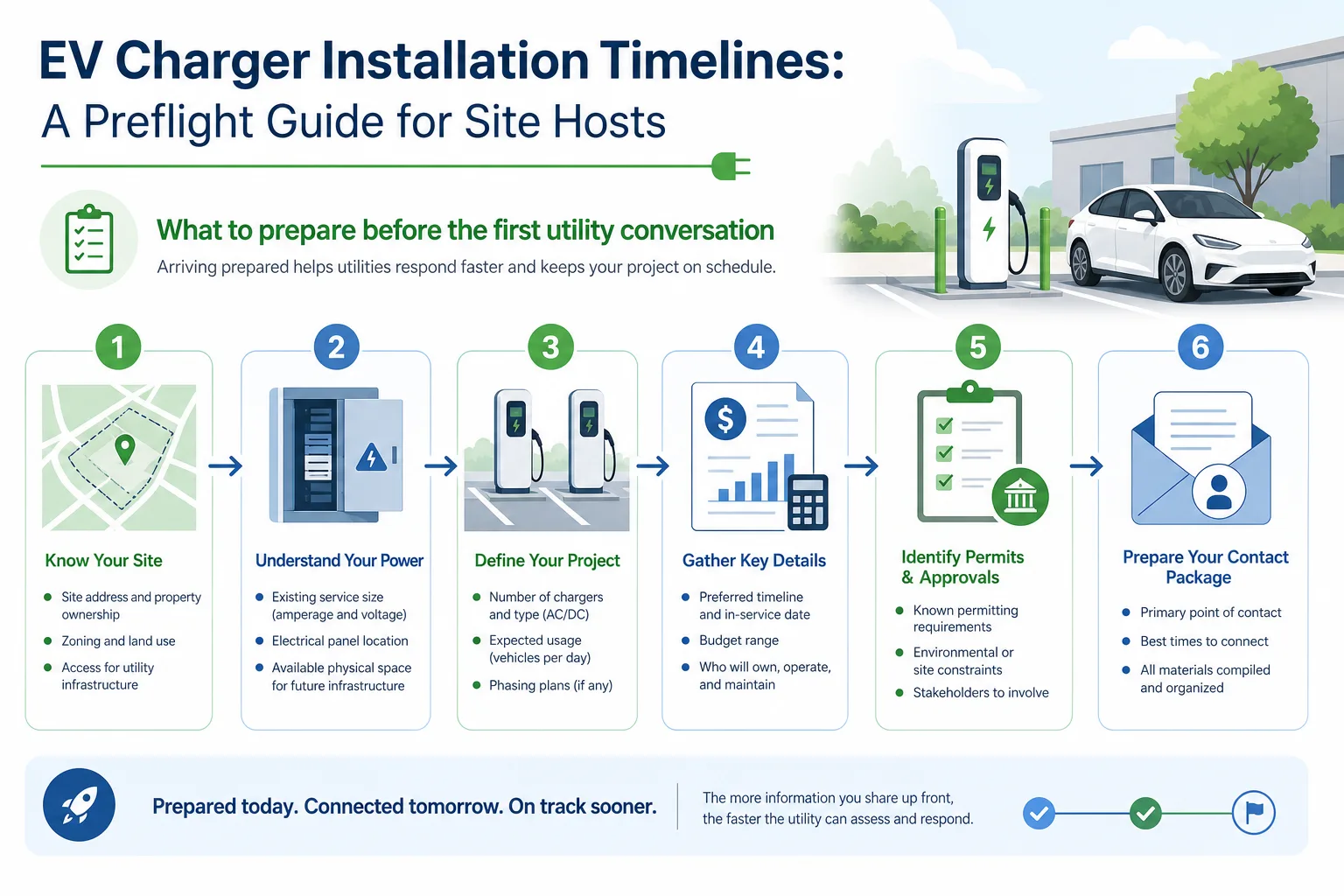
A well-prepared first conversation is more likely to reveal the right next steps. The goal is not to provide a final engineering package; it is to give the utility enough context to identify its process and information needs.
Prepare the following:
Ask the utility what it needs next, rather than assuming a generic checklist applies. The process may differ by utility, service configuration, project size, and local conditions.
Build a milestone schedule, not one promised go-live date
A credible schedule distinguishes between a target and a committed date. Early in planning, use a target operational window with stated assumptions. Move toward a firmer opening date only when key external dependencies have been resolved.
A simple schedule can use decision gates like these:
This framework does not eliminate uncertainty. It makes uncertainty visible while there is still time to adjust scope, budget, phasing, or stakeholder expectations.
For larger portfolios, consider a two-level plan:
Do not use a single equipment ship date as the master schedule. It is a procurement milestone, not proof that service capacity, permits, installation, inspection, and energization will be complete.
Questions to ask each project partner
Clear questions reduce handoffs and expose gaps in responsibility.
Questions for the utility
Questions for the electrical contractor or design professional
Questions for the charging provider
Avoid assuming all charging providers offer the same services or that a provider manages utility, permitting, or construction work. Confirm scope in the contract and project plan.
Questions for the permitting authority
Communicate uncertainty without losing stakeholder confidence
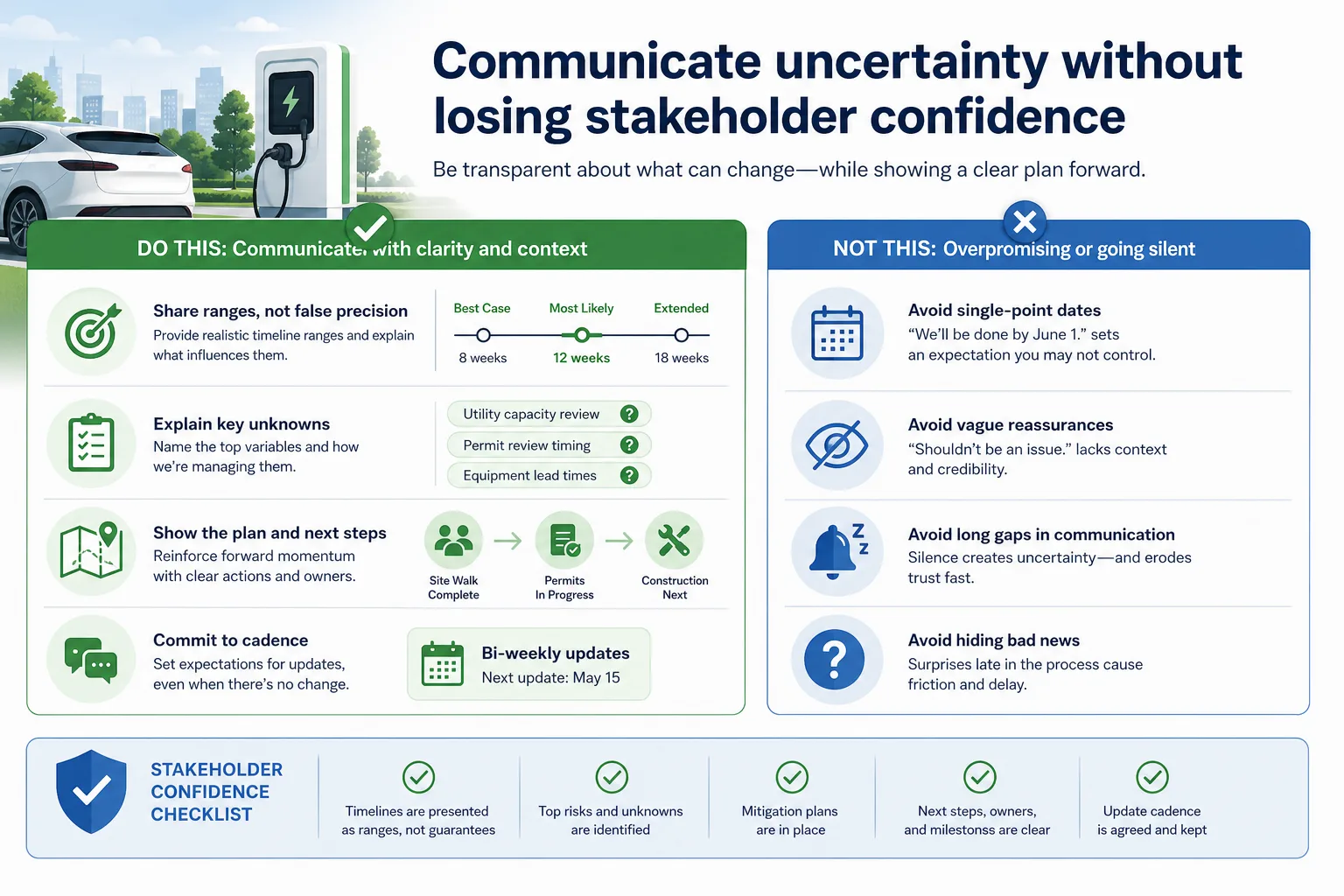
Internal stakeholders, tenants, guests, customers, and fleet users usually need a clear answer about when charging will be available. They also need an honest one.
Use status language tied to completed milestones:
Avoid phrases such as “installation is complete” when only equipment has arrived or been mounted. A more accurate status protects trust and helps operations teams prepare signage, support contacts, parking rules, tenant notices, and customer communications at the right time.
If a date moves, explain the dependency without assigning blame: “The project timeline has been updated while the team completes utility-related requirements.” Share the next decision point, the owner of the next action, and when stakeholders can expect another update.
EV charger installation preflight checklist
Before committing to a public opening date, confirm that the following items have a named owner and current status.
Site and operating plan
Utility and design
Permits and construction
Opening readiness
When the project stalls: use an escalation path
A stalled project often becomes harder to solve when the team only asks, “What is the new completion date?” Instead, identify the blocked milestone and the information needed to clear it.
Use this escalation sequence:
This approach reflects a recurring issue identified in IREC’s review of charger interconnection practices: developers reported that interconnection-process delays, easement difficulties, and slow permitting can lengthen timelines. A documented escalation path will not remove those constraints, but it can keep the host focused on the decision or action most likely to move the project forward.
Plan for readiness, not just installation
A useful EV charger installation timeline is a readiness plan. It makes utility review, permits, construction, inspection, energization, and commissioning visible as separate dependencies. It also gives site hosts a disciplined way to communicate uncertainty without making vague promises.
Before announcing an opening date or treating equipment delivery as the finish line, confirm the next project gate, the responsible party, and the evidence required to pass it. That preflight habit supports better budgeting, clearer internal communication, and a more orderly handoff into day-to-day charging operations.
Sources
- Joint Office of Energy and Transportation. Public EV Charging Station Site Selection Checklist
- U.S. Department of Energy Alternative Fuels Data Center. Procurement and Installation for Electric Vehicle Charging Infrastructure
- Interstate Renewable Energy Council. Paving the Way: Emerging Best Practices for Electric Vehicle Charger Interconnection
- U.S. Department of Energy. Understanding the Soft Costs of EV Charging
- U.S. Department of Energy. U.S. Atlas of Electric Distribution System Hosting Capacity Maps