
EV chargers need an operating plan long after installation is complete. A charger can be energised, connected, and available on day one, yet still create a poor driver experience if no one owns routine care, incoming fault reports, vendor escalation, or communication during an outage.
For workplace, retail, hospitality, multifamily, and other property operators, the aim is not to create a complicated maintenance program. It is to make sure every issue has a clear path from discovery to verified resolution. The right plan will vary with the equipment, service agreement, site conditions, warranty, and local requirements. But the operating framework below can help a host ask the right questions and avoid common gaps.
Why charger operations need an owner after commissioning
Commissioning is a handoff point, not the end of the work. Chargers remain physical assets exposed to daily use, weather, vehicle traffic, cleaning practices, communications dependencies, and occasional component failures. The U.S. Department of Energy’s Alternative Fuels Data Center notes that routine charging-infrastructure maintenance can include securing cables against damage, periodically checking components, keeping equipment clean, and troubleshooting or repairing equipment when needed.
Without a named operational owner, small problems can remain unresolved: a connector may be damaged, a cable may not be returned properly, a payment or network issue may go unreported, or a driver may find an out-of-service charger with no indication of what to do next. The responsible owner does not need to perform every task personally. Their job is to make sure ownership, escalation, records, and decisions are clear.
For a small site, this may be a facilities manager, property manager, or workplace sustainability lead. A larger portfolio may assign responsibility to a facilities operations team with a central vendor-management contact. The important point is that staff, drivers, and vendors know who coordinates the response.
A useful first decision is the ownership model. In a host-owned arrangement, the host may carry associated operating costs, including maintenance and payment-transaction fees. In a third-party-owned arrangement, the provider may install and maintain the infrastructure, according to DOE’s procurement and installation guidance. In either model, the property operator still benefits from knowing who receives reports, who communicates with users, and what happens when service is disrupted.
Define responsibilities before there is a fault
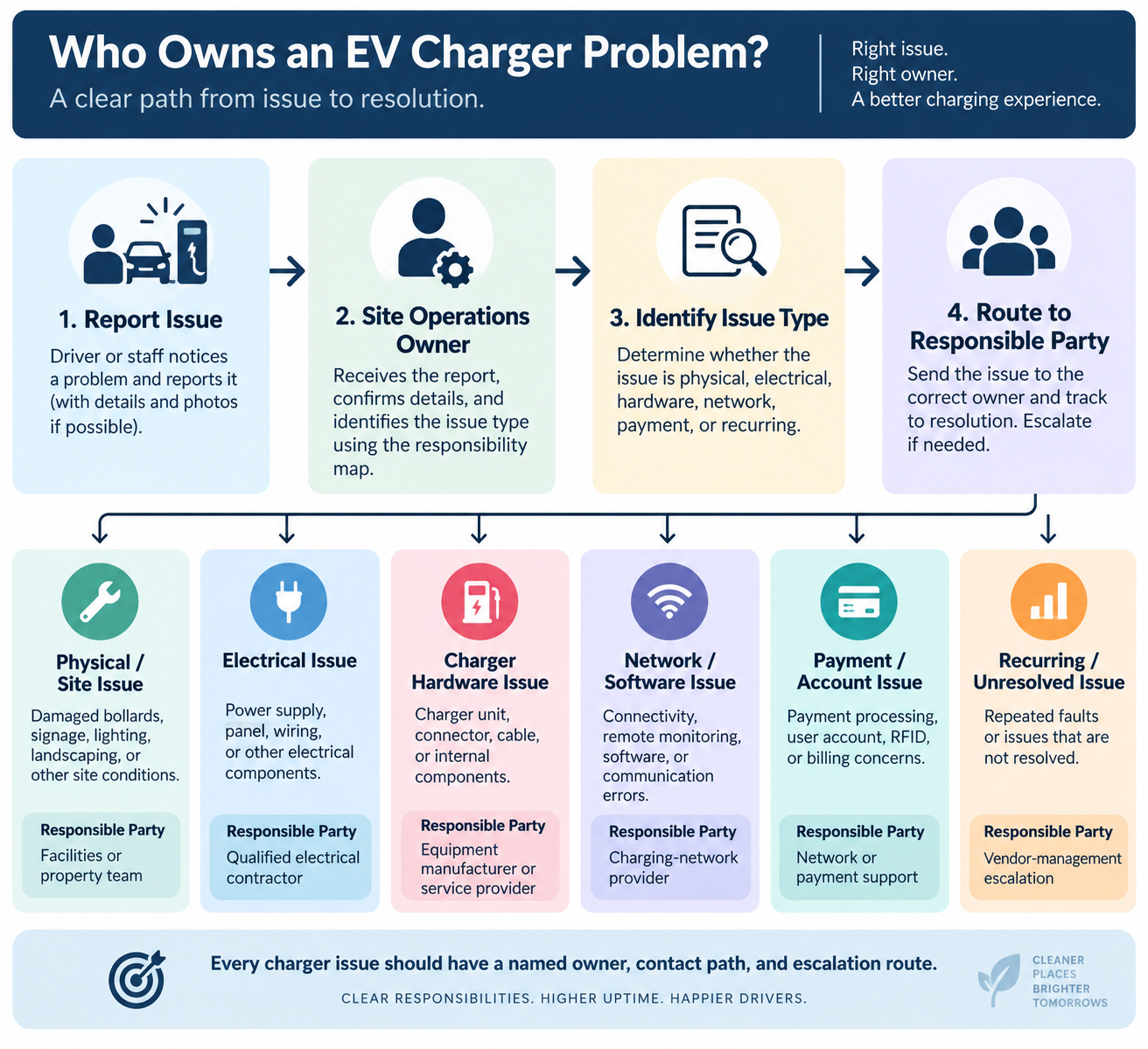
A reliable service response starts with a simple responsibility map. Avoid relying on an assumption that “the installer handles it” or “the network will fix it.” Different parties may own different parts of the charging experience.
Create a one-page contact and responsibility list for each site. At minimum, identify these roles:
The exact division of work depends on the contracts. DOE advises hosts to establish whether the site host, charging network, or installer is responsible for maintenance costs; it also recommends that maintenance contracts address response time, repair time, and an uptime requirement. See its operation and maintenance guidance.
Turn that guidance into practical questions:
Document names, phone numbers, account numbers, equipment serial numbers, warranty information, and escalation contacts in a location that the on-site team can access. Review the list whenever a vendor, contract, or site contact changes.
Build a practical routine for care and issue reporting
Routine attention can catch visible problems before they become a larger service event. The appropriate frequency and task list should follow the manufacturer’s documentation, the service contract, local conditions, and the level of use. A busy outdoor fast-charging location may need a different approach from a lightly used indoor workplace charger.
A host’s routine may include:
Do not ask unqualified site staff to open electrical enclosures, modify wiring, bypass protective equipment, or perform repairs beyond their training and authority. A report with photos and clear observations is often more useful than an attempted fix.
Remote monitoring can be valuable when it is included in a site’s chosen service arrangement, but it should not be treated as a complete substitute for physical observation. The Joint Office of Energy and Transportation notes that charging operations can involve communications-network operation, diagnostics, remote troubleshooting, customer support, spare-parts management, and software-update management. It also highlights that some physical defects, such as damaged connector housings, may require an on-site inspection or a customer report to identify.
Give staff a short reporting template. For example: charger location or number, date and time, visible condition, screen message or indicator, whether a connector or cable appears damaged, whether a vehicle was charging, and photos where safe and appropriate. This helps the support party begin triage with usable information.
Create a fault-response workflow
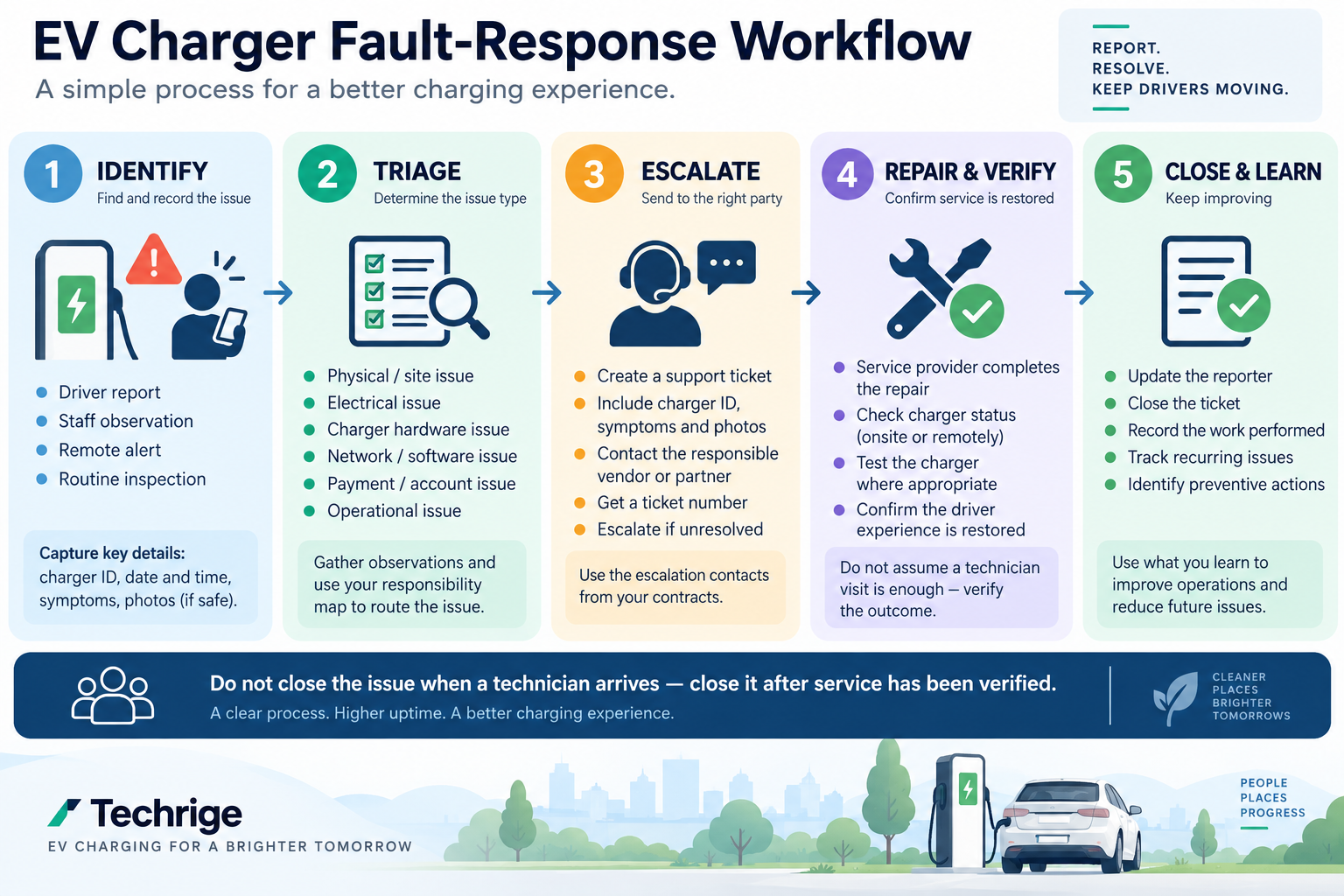
A fault-response workflow should be simple enough to use during a busy day. The objective is to protect the user experience, route the problem to the right party, and retain enough information to learn from the event.
1. Identify and make the status clear
A problem may come from a driver report, staff observation, remote alert, or routine inspection. Record the time, charger identifier, reporter, and symptoms. If the equipment appears unsafe, visibly damaged, or unsuitable for use, follow the manufacturer’s and site’s established process to restrict access and request qualified service. Avoid placing staff or drivers in the position of diagnosing electrical hazards.
Where appropriate, communicate a clear temporary status to users. For a workplace or residential site, that may mean an internal message. For a public-facing site, it may involve the communication channels and service provider specified in the operating arrangement. Keep the message factual: identify the affected charger, state that service is being investigated, and point users to available alternatives if known.
2. Triage the issue
Triage determines whether the issue is likely physical, electrical, network-related, account-related, software-related, or operational. The host does not need to make a technical diagnosis. Instead, gather observations and route the ticket using the responsibility map.
Examples of useful distinctions include:
Set internal escalation categories that make sense for your site, such as “urgent site condition,” “charger unavailable,” “degraded operation,” and “administrative question.” These categories are operating choices, not universal technical classifications.
3. Dispatch or escalate to the responsible party
Submit the ticket with the site address, charger identifier, observations, photos if available, and the impact on users. Ask for a ticket number and the next expected update. If the first contact cannot resolve the issue, use the escalation contact identified in the contract.
For recurring faults, provide prior ticket numbers. That history may help determine whether the issue is isolated, related to an environmental condition, or connected to a component that needs a more durable remedy.
4. Repair, test, and verify
Once service work is complete, verify the outcome using the method appropriate to the arrangement. This could include confirmation from the service provider, a remote status check where available, a qualified on-site inspection, or a documented test process. Do not assume that a technician visit alone means the driver experience has been restored.
Before closing the ticket, confirm the charger’s condition, whether any temporary user notice should be removed, what work was performed, and whether follow-up is required. Record parts replaced, warranty decisions, charges, and recommended preventive actions.
5. Close the loop with the reporter
If a driver, tenant, or staff member reported the issue, a short acknowledgement and resolution update can build confidence in the program. The message does not need technical detail. It should avoid promising availability until the appropriate verification is complete.
Use contracts and warranties to make response expectations usable
Service expectations are most useful when they are written before a fault occurs. DOE specifically points to response time, repair time, and uptime requirements as subjects for maintenance contracts. The right targets are commercial decisions that should reflect the site’s user needs, charger type, available redundancy, service coverage, and vendor capacity—not numbers copied from another site.
When negotiating or reviewing agreements, consider asking for clarity on:
Read warranty exclusions carefully. Physical damage, misuse, environmental exposure, network services, and third-party modifications may be treated differently depending on the manufacturer and agreement. If terms are unclear, ask the vendor to explain the operational process in writing.
For workplace programs, DOE recommends designating a responsible person or group for ongoing operations-and-maintenance issues and related costs so problems can be addressed promptly. Its workplace charging guidance offers a helpful principle that applies broadly: assign accountability, not just a vendor name.
Track a small set of operational measures
Hosts do not need a large dashboard to improve operations. Start with a monthly or quarterly review of a few measures that support decisions. Keep definitions consistent, and note what your data cannot show.
Possible measures include:
These measures are not proof of universal reliability, and they should not be compared casually across different sites or charger types. Their main value is operational: they can reveal a repeated connector issue, a slow approval process, a vendor handoff gap, or a location that needs better protection, signage, or user instructions.
Review notable events with the relevant parties. Ask what happened, what information was missing, what delayed restoration, and what change could reduce recurrence. Record the answer and assign an owner for the follow-up action.
A starter operations checklist for hosts
Use this checklist as a planning baseline, then tailor it to your equipment documentation and service agreements.
A clear maintenance and response plan does not eliminate every outage. It does make problems easier to identify, communicate, route, repair, and learn from. For charger hosts, that practical discipline is the foundation of a more dependable charging experience.
Sources
- U.S. Department of Energy, Alternative Fuels Data Center — Operation and Maintenance for Electric Vehicle Charging Infrastructure
- U.S. Department of Energy, Alternative Fuels Data Center — Procurement and Installation for Electric Vehicle Charging Infrastructure
- Joint Office of Energy and Transportation — Ensuring a Reliable Charging Experience
- U.S. Department of Energy, Alternative Fuels Data Center — Workplace Charging for Electric Vehicles