
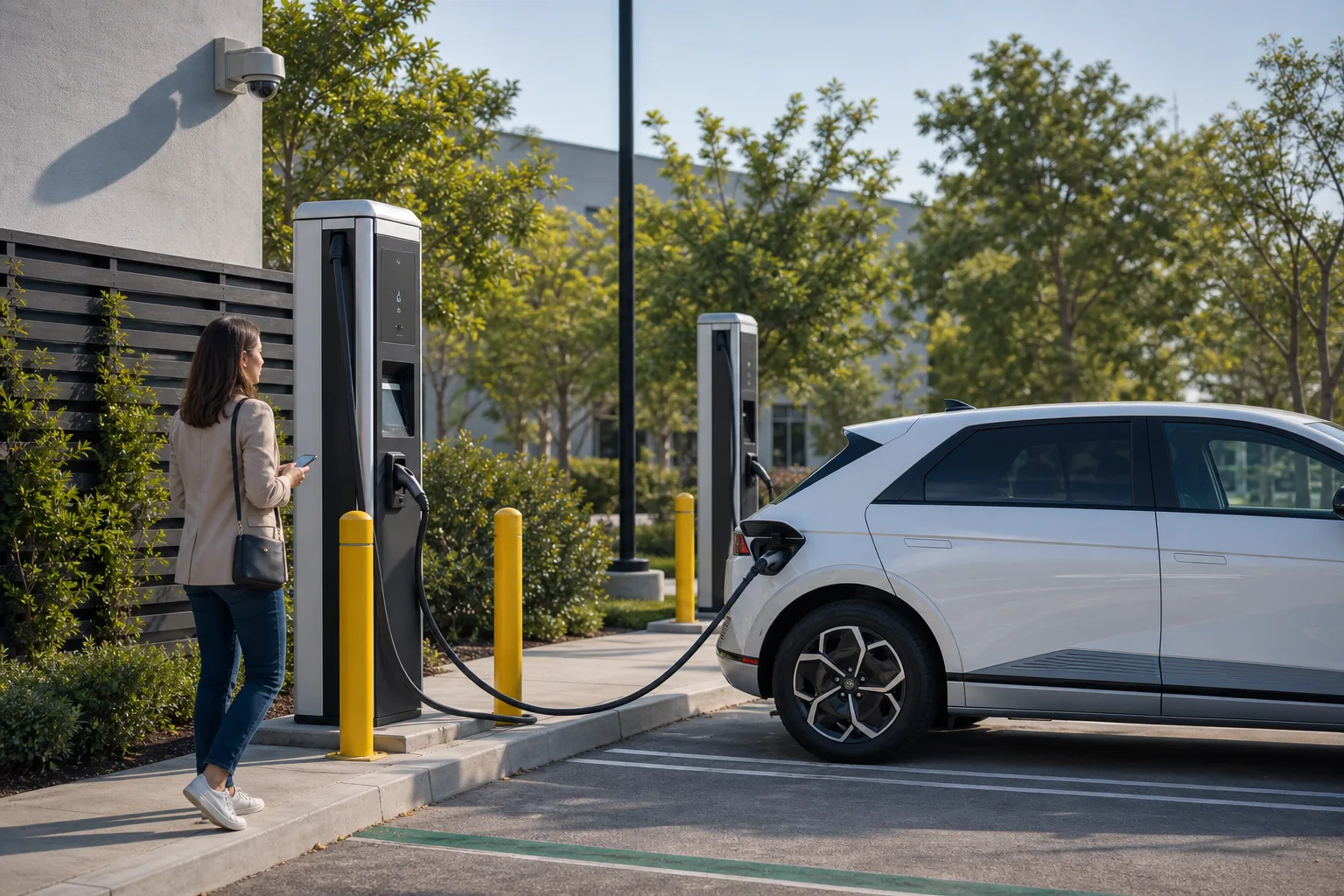
Physical safety and security planning for EV charging is about more than selecting a charger. The physical setting affects whether drivers can find and use equipment comfortably, whether cables and electrical equipment are protected, and how the site team responds when something goes wrong.
This is distinct from cybersecurity, routine maintenance, accessibility design, and wayfinding signage, although those topics can overlap in a real project. The purpose here is to help a charger host review physical risks before installation—or identify practical gaps at an existing location.
No single design feature suits every property. The Joint Office of Energy and Transportation’s physical-site security guidance stresses that the appropriate combination of measures depends on the location and context, and that not every measure is needed at every site. Use the checklist below as a structured discussion with the project team, property manager, installer, equipment provider, insurer, and relevant local authorities.
Why physical site safety and security belong in charger-host planning
Charging equipment is used outdoors or in parking environments where vehicles, pedestrians, weather, property operations, and public access meet. A charger may be technically functional yet poorly placed for safe approach, visible use, or incident response.
Early site planning gives hosts a chance to make decisions that are harder and more expensive to revisit later. Examples include:
These choices are not a promise that theft, vandalism, injury, or downtime will be eliminated. They are ways to identify vulnerabilities and choose proportionate controls for the site’s operating conditions.
Start with a site walk: visibility, lighting, access routes, and surrounding activity
Begin with an in-person review at the times the chargers are likely to be used. A daytime walk can miss conditions that are obvious after dark, during a busy retail period, or when a workplace is closed.
The U.S. Department of Transportation’s EV infrastructure planning checklist identifies lighting, security, visibility, and signage as relevant site-planning factors. It notes that cameras, motion-sensing security lights, and locations visible from heavily trafficked areas may help discourage vandalism. Treat these as options to evaluate—not universal specifications.
Questions for the site walk
Can drivers readily see the charging area? Consider sightlines from entrances, reception areas, storefronts, security desks, roads, and commonly used parking lanes. Avoid creating a charging area that is hidden from normal activity without a reasoned operational plan.
What is lighting like when charging is most likely? Review existing lighting in the stall, around the charger face, along pedestrian paths, and near any supporting electrical equipment. Look for shadows, failed fixtures, glare, or areas where a driver may struggle to read instructions or inspect a cable.
How do people move through the area? Trace the route from the vehicle to the charger and from the parking area to building entrances, sidewalks, elevators, or payment areas. Identify where a cable could cross a walking route, where people may step into vehicle traffic, or where snow, leaves, standing water, or stored materials could affect access.
Who else is normally nearby? A retail location, residential garage, workplace lot, and remote public lot have different activity patterns. Record when the area is occupied, when staff are available, and whether there are periods of low visibility or limited support.
Can emergency and service vehicles reach the equipment? Discuss access and shutoff arrangements with the installer and appropriate local stakeholders. Do not assume a layout that works for drivers also works for site operations or emergency response.
Take photographs, mark concerns on a site plan, and turn observations into assigned actions. This creates a more useful record than a generic statement that the site was “reviewed.”
Protect the equipment: placement, impact protection, cords, and tamper resistance
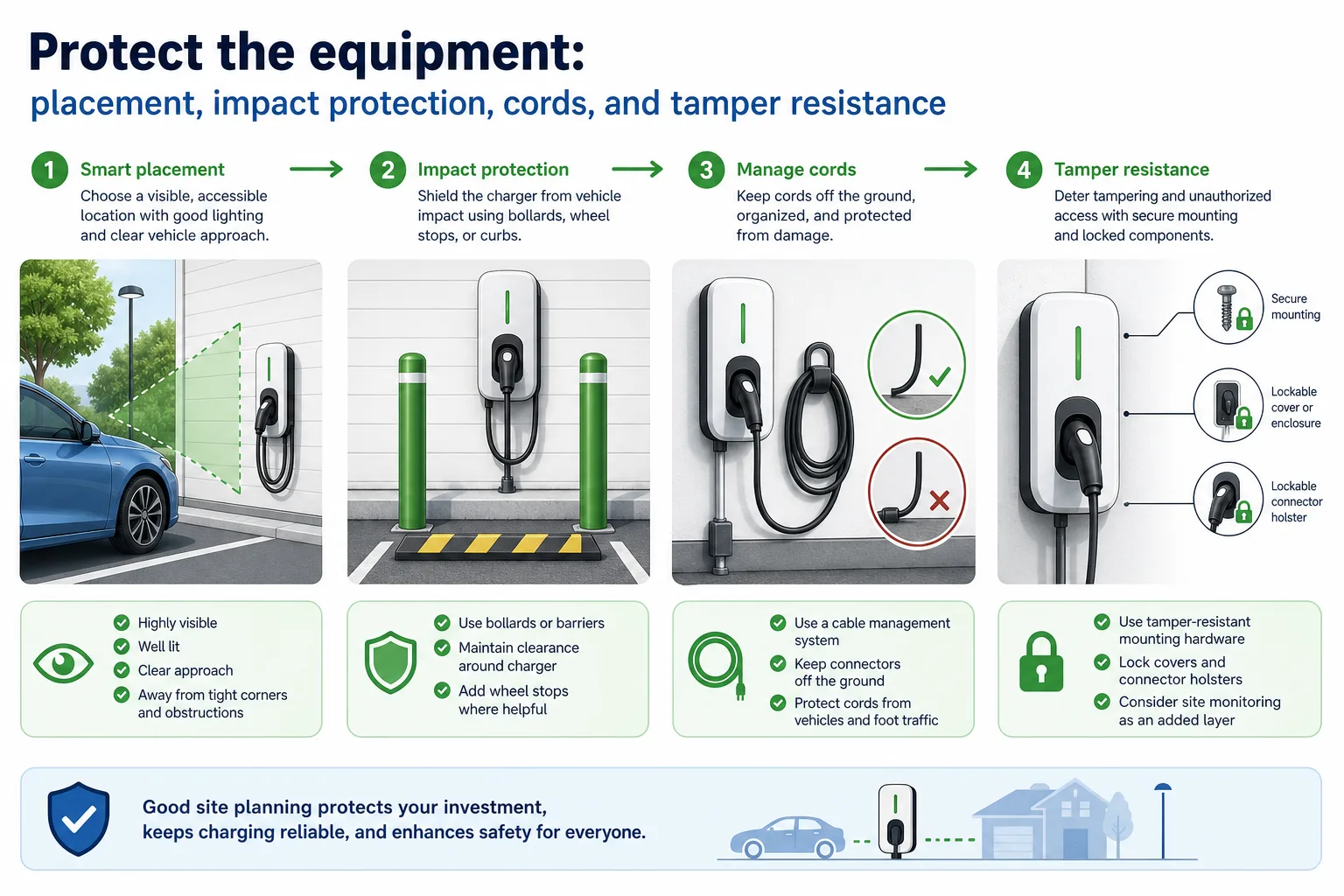
Equipment protection starts with placement. Chargers, pedestals, cabinets, and associated electrical infrastructure can be exposed to turning vehicles, reversing vehicles, delivery activity, carts, weather, and intentional interference.
The Joint Office guidance specifically calls out protection from vehicle impact, cord management to reduce trip hazards, external emergency disconnect considerations, fencing around supporting electrical equipment, and tamper-resistant equipment as possible physical-site measures. The Alternative Fuels Data Center’s procurement and installation guidance likewise includes theft deterrence, lighting, motion detectors, and anti-vandalism hardware among considerations.
A host’s review should separate two questions: what needs protection, and what kind of protection is appropriate for that exact location.
Bollards, wheel stops, fencing, and hardware should be planned as part of the overall layout, not selected in isolation. For example, a physical barrier that protects equipment could also restrict doors, pedestrian movement, snow clearing, or service access if poorly placed.
Plan for people and incidents: emergency communications, staff roles, and escalation contacts
A physical issue becomes harder to manage when nobody knows who owns the next step. Hosts should define a simple incident path before opening the chargers: how a driver reports a concern, who receives it, who assesses the area, and when the charger should be taken out of service pending review.
The Joint Office guidance includes emergency calling options and staff training among the measures hosts may consider. For workplace charging, the Alternative Fuels Data Center recommends assigning responsibility for ongoing operations and maintenance and identifying who will enforce charging policies. It also notes that workplace hosts may need to consider vandalism and theft outside regular business hours.
A proportionate operating plan may include:
For a site with public access, consider whether users can reasonably find help outside business hours. The right approach depends on the property, staffing model, and local emergency arrangements. Discuss emergency communication and electrical safety procedures with qualified professionals rather than relying on a generic template.
Address theft and vandalism through layered deterrence rather than a single product choice
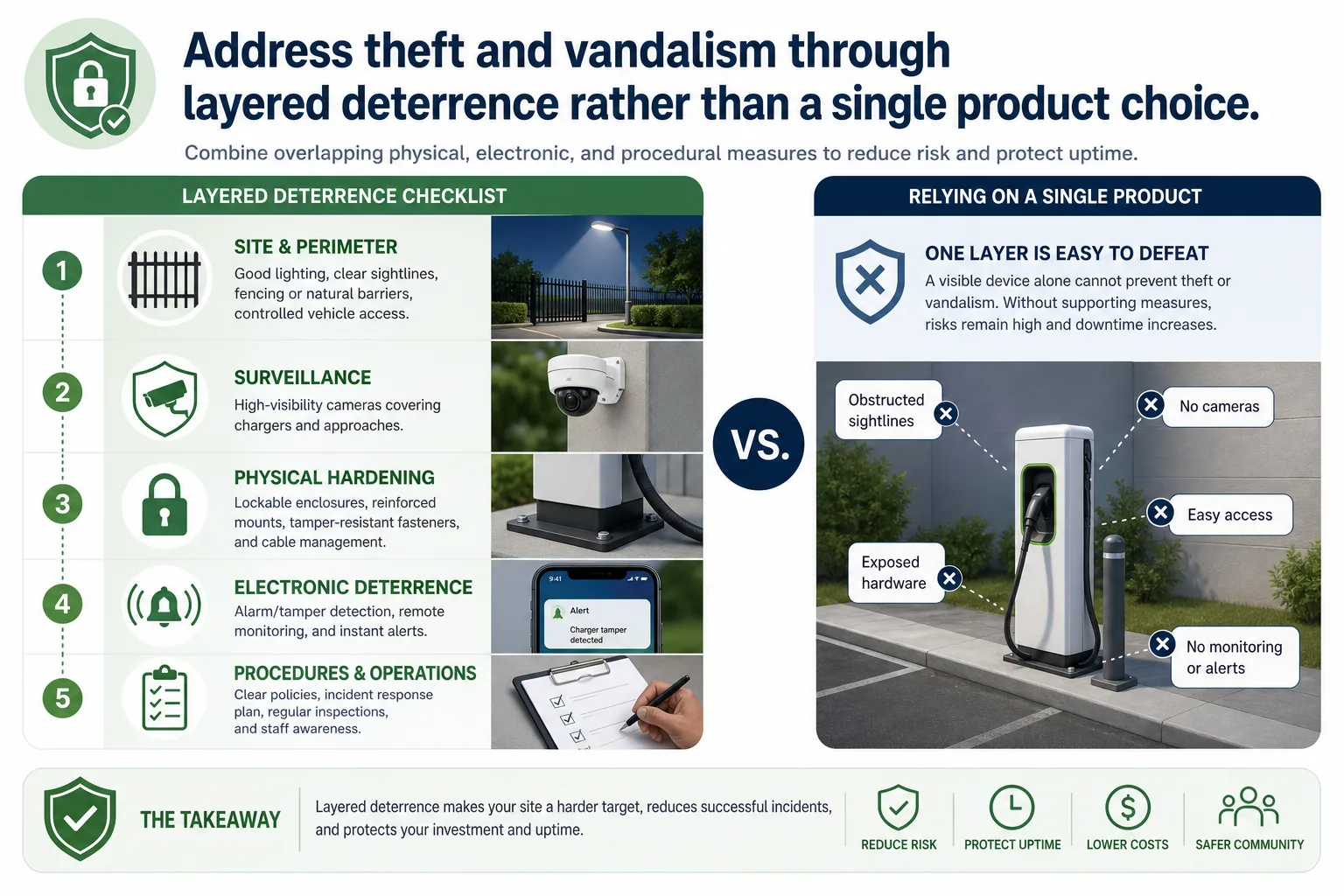
There is no one device that makes a charging site secure. A more useful approach is layered deterrence: make the area observable, make equipment harder to interfere with, clarify who responds, and maintain the site so damage is detected quickly.
A layered review can combine:
The Joint Office guidance includes landscaping visibility and surveillance among considerations. If a host is considering cameras, lighting controls, or access controls, the project team should also review property rules, privacy expectations, contracts, maintenance responsibilities, and any site-specific requirements. These systems need a practical owner; an unmonitored camera or unrepaired light may offer less value than expected.
Put responsibilities into procurement, service, insurance, and maintenance reviews
Physical safety and security should appear in project documents, not only in a pre-installation conversation. Asking suppliers and service partners precise questions can reveal gaps before equipment arrives.
During procurement, ask which physical risks the equipment design addresses, what parts are most exposed to damage, what replacement process applies to cables or connectors, and what site-preparation assumptions the supplier is making. Ask the installer to identify layout constraints, service clearances, protection needs, and items that require coordination with other trades.
During service planning, assign responsibility for routine visual checks, lighting repairs, landscape upkeep, snow or debris removal where relevant, damage documentation, and escalation. Establishing these owners is particularly important where a property owner, parking operator, facilities contractor, employer, and charger provider all have roles.
Insurance and contract reviews are also sensible planning steps. A host can ask its broker, insurer, property manager, and counsel which physical-loss, liability, surveillance, and incident-reporting provisions merit review for the specific property. Requirements and coverage depend on the jurisdiction and the parties’ agreements.
A practical site-security review checklist for charger hosts
Use this checklist during design, before opening, and periodically after operations begin.
Site setting and visibility
Pedestrian and vehicle interaction
Equipment and physical deterrence
Incidents and operations
A site plan does not need to be complicated to be effective. The important outcome is clear: the host understands the location’s main physical risks, has selected reasonable measures for that setting, and has assigned someone to keep those measures working.
Sources
- U.S. Department of Energy Alternative Fuels Data Center / Joint Office of Energy and Transportation. Physical Safety and Security at Electric Vehicle Charging Sites
- U.S. Department of Energy Alternative Fuels Data Center. Workplace Charging for Electric Vehicles
- U.S. Department of Energy Alternative Fuels Data Center. Procurement and Installation for Electric Vehicle Charging Infrastructure
- U.S. Department of Transportation. EV Infrastructure Project Planning Checklist