
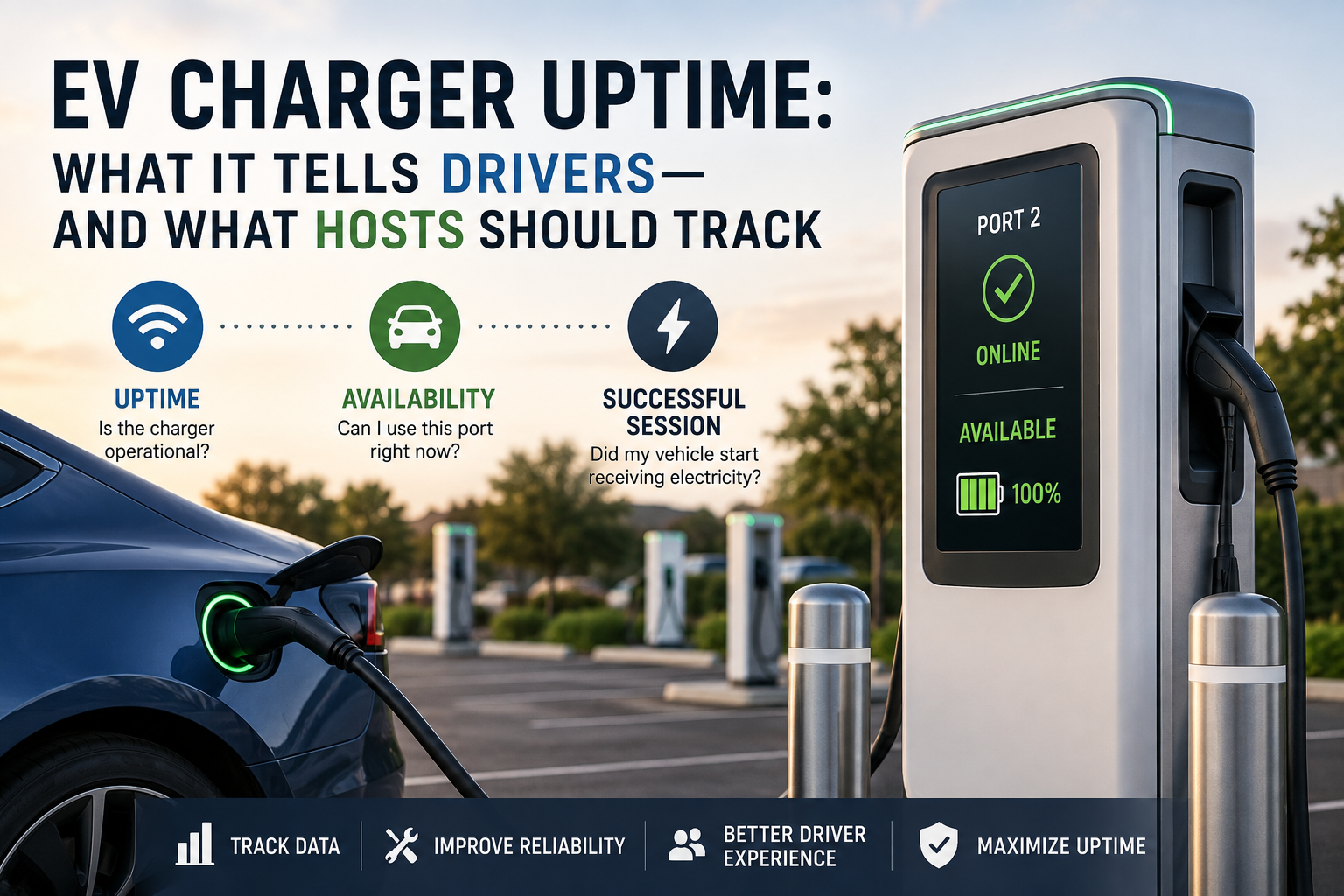
EV charger uptime is one of the most useful measures of EV charging station reliability, but it does not tell the whole story.
A charger may appear online in an app yet be occupied, inaccessible, unable to start a charging session, or affected by a problem that only becomes clear after a vehicle connects.
For EV drivers, charger uptime and live availability are useful planning signals—not guarantees that charging will work when they arrive.
For charger hosts and operators, uptime is an important performance metric, but it should be reviewed alongside failed charging sessions, outages, repair times, utilization and driver feedback.
This guide explains what EV charger uptime means, how it differs from charger availability and a successful charging session, and what both drivers and charger hosts can do with that information.
What Does EV Charger Uptime Mean?
EV charger uptime generally describes the percentage of time a charging port is considered operational according to a defined measurement standard.
The exact definition matters because different programs, contracts, charging networks and jurisdictions may calculate uptime differently.
For example, California's EV Charger Performance Standards and Uptime Reporting Regulations define uptime for applicable DC fast chargers around whether the charger hardware and software are online, the port is available for use or being used, and the charger can successfully dispense electricity.
Importantly, California calculates uptime by charging port, rather than treating an entire multi-port charging location as one unit.
That distinction matters because one charger at a site may work perfectly while another repeatedly fails.
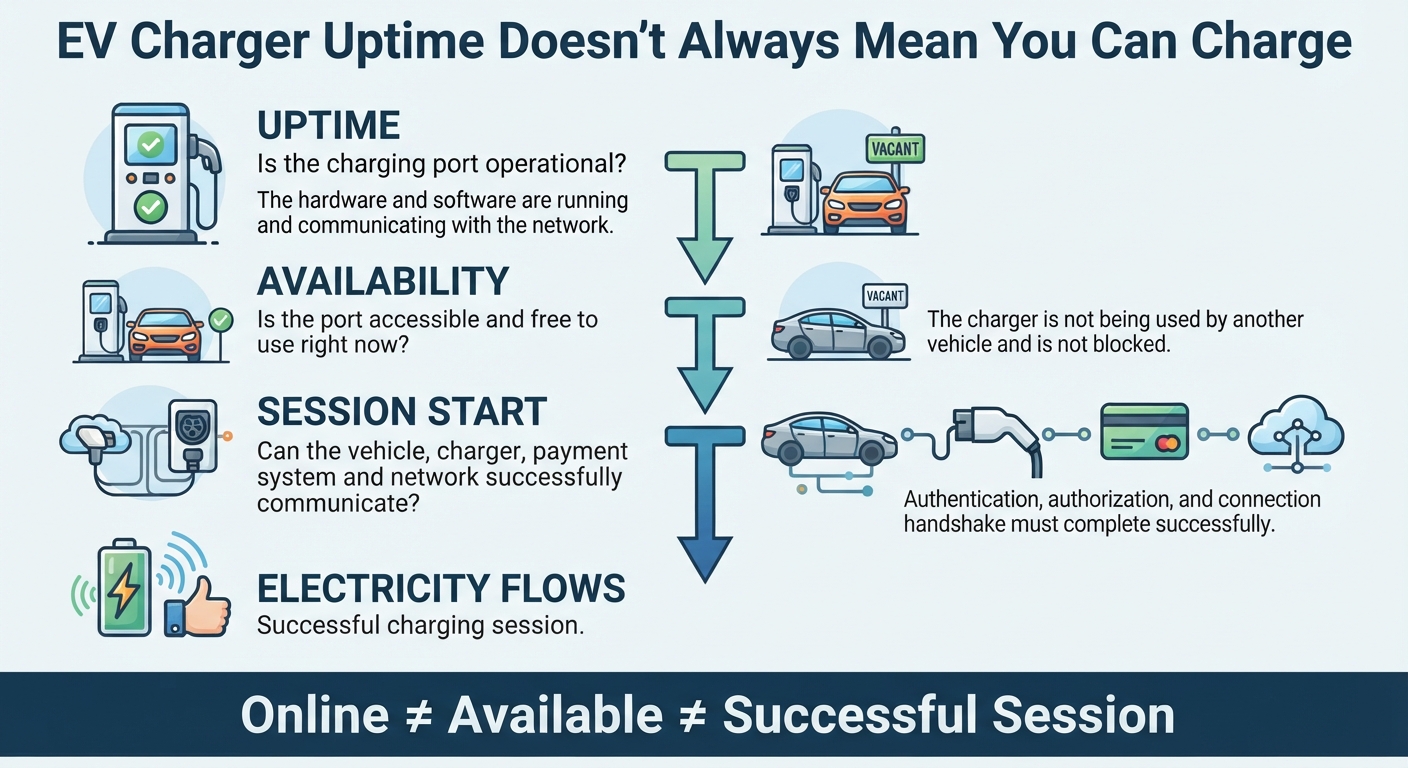
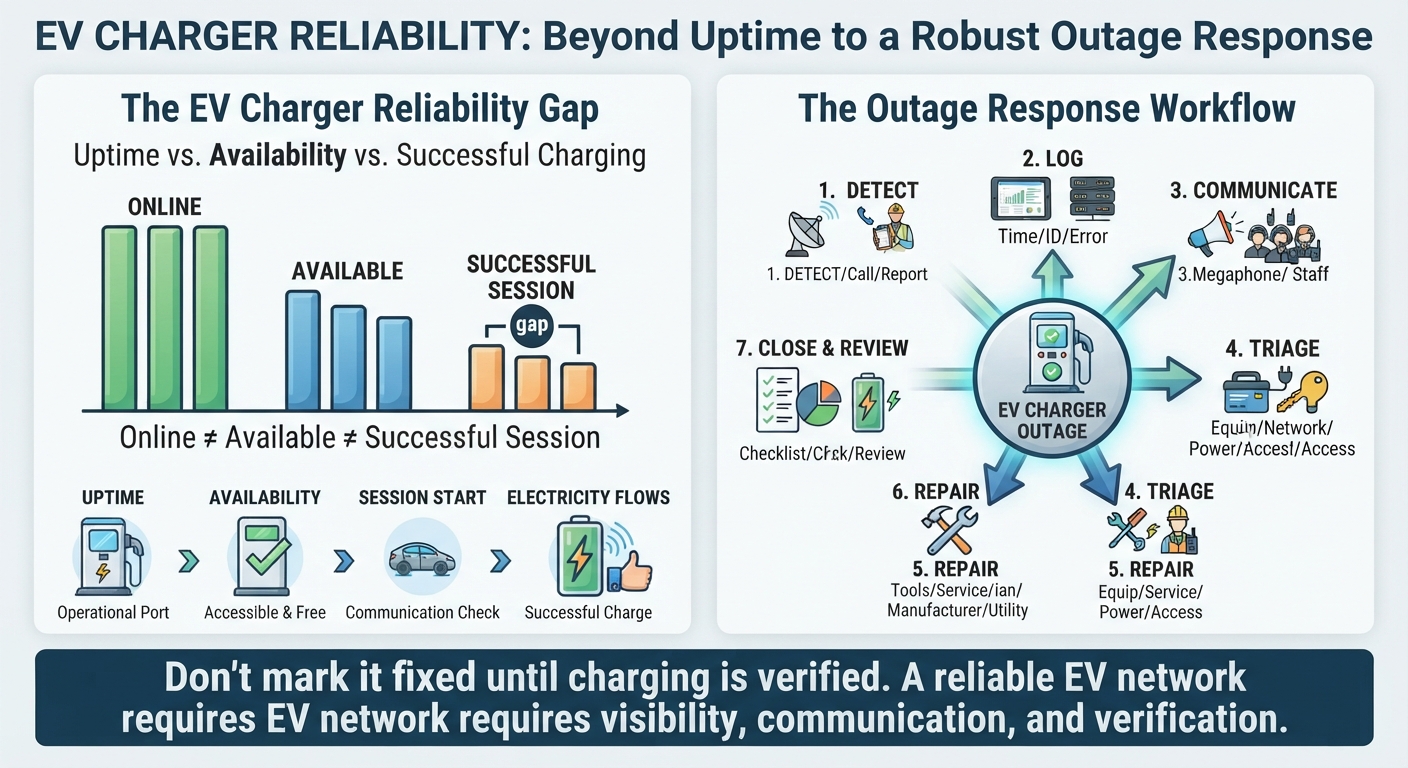
EV Charger Uptime vs Availability vs a Successful Charging Session
These terms are related, but they answer different questions.
Uptime: Is the charging port operational?
Uptime measures whether a charger is functioning according to the definition being used.
It is generally a historical performance measure calculated over a period of time.
Availability: Can a driver use the charger right now?
Availability is more immediate.
A functioning charger may still be unavailable because:
- another vehicle is charging;
- the port is reserved;
- parking access is restricted;
- the property is closed;
- the charging space is blocked; or
- the charger has temporarily been placed out of service.
Conversely, an app may show a charger as available even though a driver later encounters a problem starting a session.
Successful charging session: Did charging actually begin?
This is the result that matters most to a driver.
A successful session means the vehicle and charging equipment complete the steps necessary to begin delivering electricity.
Session initiation can depend on several systems working together, including:
- charger hardware;
- charging software;
- connector condition;
- vehicle compatibility;
- payment authorization;
- account authentication;
- charging-network communication;
- vehicle-to-charger communication; and
- site connectivity.
The distinction is important. The National Laboratory of the Rockies' ChargeX Consortium research describes a "seamless retry" approach designed to automatically restart certain failed DC fast-charging session attempts that might otherwise require the driver to unplug and reconnect the vehicle.
A simple way to think about the three measures is:
UPTIME
→ Is the port operational?
AVAILABILITY
→ Can I use this port now?
SUCCESSFUL SESSION
→ Did my vehicle actually start receiving electricity?
A high EV charger uptime percentage is valuable, but it should never be interpreted as a promise that every driver arrival or charging attempt will succeed.
How EV Drivers Should Use Charger Uptime and Live Status
EV drivers can use charger status information to reduce uncertainty, especially during road trips or when travelling through areas with limited charging options.
The key is to treat the information as one part of the charging plan rather than absolute confirmation that a charger will work.
1. Treat Live Charger Status as One Planning Input
Whenever possible, check the charging network's current information before travelling to a location.
Look for:
- total number of charging ports;
- number currently available;
- ports marked in use;
- ports marked out of service;
- connector type;
- charging power; and
- reported station issues.
Not every public charging listing receives information at the same frequency.
The U.S. Department of Energy's Alternative Fuels Data Center explains that its charging-station information may be received through daily API imports for some networks, periodic CSV uploads for others, or manual verification for non-networked charging stations.
This means the freshness of charging-station information can vary.
Live status is valuable, but it should not be treated as a guarantee that a charger will still be available—or successfully start charging—when you arrive.
2. Confirm Site Access Before Depending on a Charger
A charger can be fully operational while remaining practically unusable to a particular driver.
Before making a charging location an essential part of your route, check:
- opening and closing hours;
- parking restrictions;
- whether charging is public or restricted;
- whether a reservation is required;
- gates or garage-access requirements;
- parking fees;
- maximum parking duration;
- whether charging spaces may be occupied by other vehicles; and
- any site-specific access instructions.
These conditions are separate from charger uptime.
A technically functioning charger does not help if you cannot reach or legally use the charging space.
3. Confirm Connector and Session Requirements
Before arriving, verify that the charging port provides a connector your vehicle can use.
Also check the charging network's activation and payment requirements.
Depending on the charger, starting a session might require:
- a network app;
- an account;
- an RFID card;
- a credit or debit card;
- contactless payment;
- vehicle-based authentication; or
- another network-specific activation method.
If you are using an unfamiliar charging network, setting up the necessary account or payment method beforehand can reduce avoidable delays.
4. Keep a Backup EV Charger Within Range
When charging is essential to completing your trip, identify at least one practical alternative before you leave.
Your backup charger does not have to be identical.
It might offer:
- fewer charging ports;
- slower charging;
- different pricing;
- fewer amenities; or
- a short detour from your preferred route.
The important thing is that it remains a realistic option within your vehicle's available range.
Keeping some additional battery margin can also give you more flexibility if the first charging location is busy, inaccessible or unable to start your session.
5. Report Charger Problems Clearly
Driver reports can help charging operators identify problems that automated monitoring does not immediately reveal.
If a charging attempt fails, record useful details such as:
- charging port or station number;
- approximate time;
- error message displayed;
- whether payment was accepted;
- whether charging started and then stopped;
- visible connector or cable damage; and
- any site-access problem.
Report the problem through the charging network's official support channel when one is available.
Specific information can help an operator distinguish a one-time charging-session problem from a recurring equipment fault.
What EV Charger Hosts Should Track
For EV charger hosts, the objective should not simply be achieving an attractive uptime percentage.
The goal is to understand whether drivers can reliably access the charger, initiate a session and receive electricity.
The Alternative Fuels Data Center's guidance on EV charging operation and maintenance identifies uptime and utilization data as important parts of charging-station management.
It also recommends establishing responsibility for maintenance costs and defining response times, repair expectations and uptime requirements in maintenance agreements.
Track EV Charger Reliability by Port
Hosts with multiple chargers should avoid relying exclusively on a site-wide reliability number.
Consider a location with four charging ports where three operate reliably but one repeatedly fails.
A site-level average may look acceptable while drivers assigned to the problematic port continue having a poor experience.
Maintain a record for each charging port that includes:
- port identifier;
- operational status;
- outage start time;
- outage end time;
- total downtime;
- failed session-start reports;
- interrupted charging sessions;
- error or fault codes;
- incident cause;
- repair performed;
- technician or provider involved;
- repair completion time; and
- post-repair verification result.
An internal uptime calculation can generally be expressed as:
Available operating time ÷ total operating time × 100
However, the harder—and more important—part is establishing a consistent definition of available operating time, including how exclusions and exceptional events are treated.
If a charger is subject to a funding agreement, service contract or regulatory uptime requirement, hosts should use the applicable definition rather than assuming a general uptime formula applies.
Do Not Treat 97% Uptime as a Universal Requirement
A 97% uptime target is often discussed in EV charging, but it should not be presented as a universal rule.
California provides one current example.
Its requirements apply to certain publicly or ratepayer-funded DC fast chargers installed on or after January 1, 2024 and include specific exclusions and reporting rules.
Different jurisdictions, incentive programs, charging-network contracts and service-level agreements may use different requirements.
Hosts should therefore confirm the rules that apply to their particular property, funding source, equipment and operating model.
Track Why EV Chargers Go Offline
Knowing that a charging port was unavailable is only the beginning.
Tracking why an outage occurred makes reliability data much more useful.
A practical outage classification might include:
Equipment
- charger hardware fault;
- damaged component;
- connector failure;
- cable damage; or
- display or reader failure.
Network or Software
- charger lost network connectivity;
- backend unavailable;
- software error;
- configuration issue; or
- failed firmware update.
Payment or Authentication
- payment terminal unavailable;
- account authentication failure;
- RFID issue; or
- payment authorization problem.
Electrical Supply
- utility outage;
- breaker or electrical-system problem;
- upstream equipment fault; or
- site power interruption.
Site or Access
- blocked charging space;
- locked gate;
- parking restriction;
- snow, ice or other site condition; or
- construction or planned closure.
Session or Compatibility
- communication failure between vehicle and charger;
- connector compatibility issue;
- session-start failure; or
- repeated charging interruption.
Record both the cause and duration of each problem.
A recurring five-minute charging-session failure may cause more driver frustration than a single longer outage that is clearly identified and communicated.
Cause tracking also helps determine whether the next action belongs to the host, charging-network operator, equipment manufacturer, electrician, utility or property manager.
Define Charger Maintenance Responsibilities Before an Outage
EV charger downtime becomes much harder to manage when no one knows who owns the next step.
Before problems occur, hosts should clearly determine:
- who monitors charger status;
- who receives automated fault notifications;
- who receives driver reports;
- who performs initial troubleshooting;
- who can remotely restart or reset equipment;
- who contacts the charger manufacturer;
- who dispatches a technician;
- who authorizes repair expenses;
- who updates driver-facing status information; and
- who verifies that the charger works after repair.
Service and maintenance arrangements should also establish practical expectations for:
- problem acknowledgement time;
- remote diagnosis time;
- technician dispatch;
- repair targets;
- after-hours support;
- escalation procedures;
- replacement-part availability;
- status communication; and
- final verification.
These expectations should reflect the charger's use case.
A workplace charger used during business hours may require a different support model from a public DC fast charger expected to serve drivers around the clock.
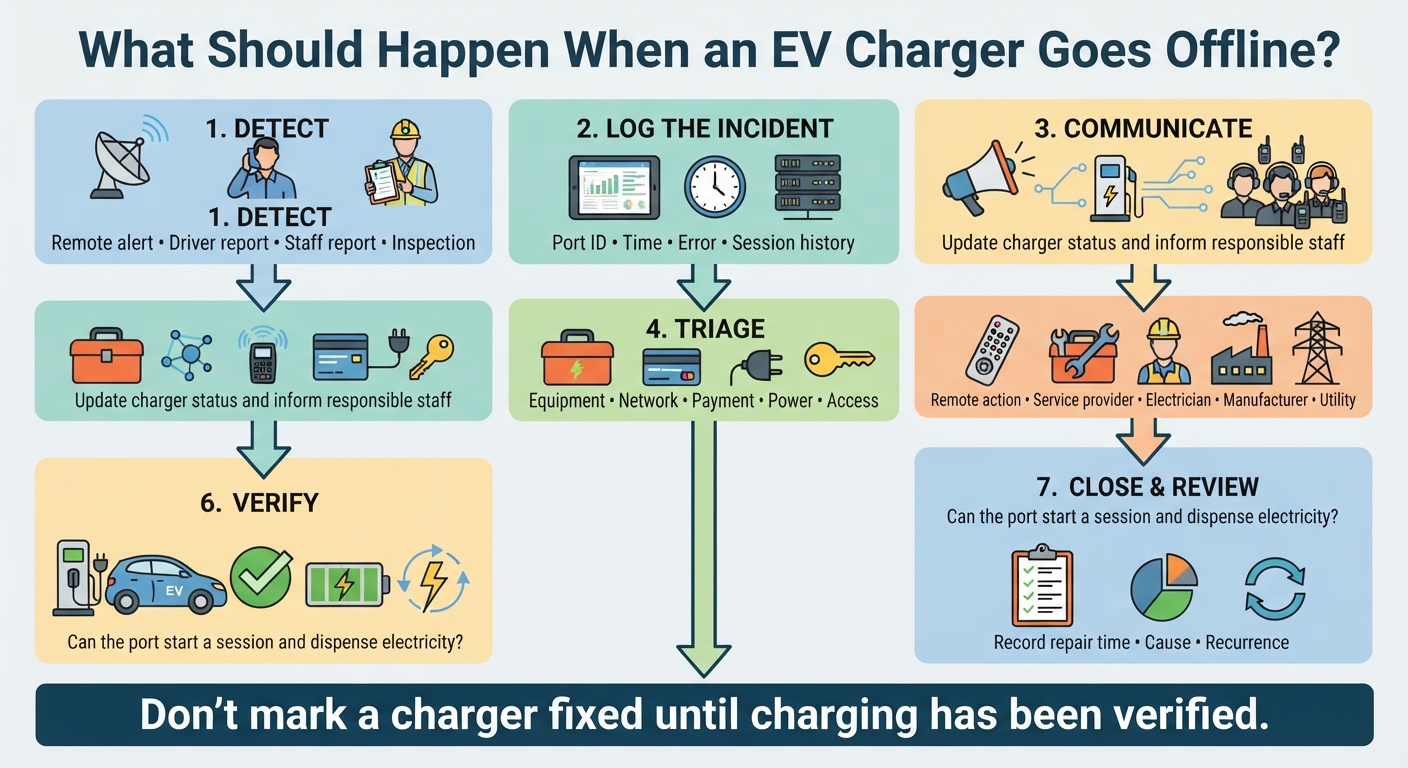
A Simple EV Charger Outage Workflow for Hosts
A consistent outage process turns individual charger problems into useful operational information.
1. Detect the Problem
Identify the issue through:
- automated charger alerts;
- charging-network monitoring;
- failed transaction records;
- driver reports;
- property staff; or
- routine inspections.
Record the affected port and the time the problem was first detected.
2. Communicate the Charger Status
If the host or charging operator controls driver-facing status information, update it when appropriate.
Property staff should also know whether the charger can currently be recommended to drivers.
Avoid marking a charger as operational until the problem has actually been verified.
3. Triage the Fault
Determine whether the issue appears to involve:
- site access;
- network connectivity;
- payment;
- charger equipment;
- electrical supply;
- connector condition; or
- vehicle-to-charger communication.
Capture relevant error messages, recent session information and photos when appropriate.
Escalate the issue according to the site's maintenance agreement.
4. Repair the Charger
Corrective work might involve:
- a remote system restart;
- software intervention;
- network troubleshooting;
- replacing a damaged component;
- repairing electrical infrastructure;
- addressing a parking or access problem; or
- arranging specialist service.
Record what was done and who performed the work.
5. Verify That Charging Actually Works
Do not rely exclusively on a green or "online" indicator.
Where safe and practical, verify that:
- the charging port is physically accessible;
- the charger is online;
- a charging session can begin; and
- the charger successfully dispenses electricity.
Record the verification time and result.
6. Document and Review the Incident
Close the incident only after verification is documented.
Over time, review failures by:
- charging port;
- charger model;
- outage category;
- repair type;
- time of day;
- session-start failures;
- repair duration; and
- recurrence.
Repeated incidents may reveal a broader equipment, connectivity, maintenance, parking-management or driver-instruction problem.
Why EV Charger Uptime Percentage Is Not Enough
Uptime remains a valuable headline metric.
It can help hosts measure charging-station reliability over time and determine whether maintenance performance is improving.
But a single percentage cannot fully describe the driver experience.
A charger uptime figure can hide:
- one unreliable port at an otherwise reliable multi-port site;
- repeated short outages;
- unsuccessful charging-session attempts;
- sessions that begin and then stop;
- payment failures;
- stale availability information;
- blocked charging spaces;
- access restrictions;
- connector problems; and
- slow repair or support processes.
For that reason, charger hosts should review uptime alongside:
- failed session-start rate;
- charging-session interruption rate;
- mean time to repair;
- outage duration;
- repeat incidents;
- utilization;
- support requests; and
- driver feedback.
A simple monthly reliability review can answer questions such as:
Which ports generate the most failed charging attempts?
Which outage causes occur repeatedly?
How long does an average problem remain unresolved?
Are drivers reporting problems that monitoring systems do not detect?
Are the same components repeatedly being repaired?
Can site signage, parking management or driver instructions reduce avoidable failures?
Those questions make uptime data operationally useful.
Frequently Asked Questions About EV Charger Uptime
Does 97% uptime mean an EV charger will work 97% of the time for every driver?
Not necessarily.
The result depends on the definition used to calculate uptime. A charger can also technically meet an uptime requirement while individual drivers still encounter occupancy, access, payment, compatibility or session-initiation problems.
Does "available" in an EV charging app mean the charger will work?
No status indicator can guarantee a successful charging session.
"Available" normally means the charging network currently considers the port available for use. Conditions can change, data can be delayed and some problems only become apparent after a vehicle connects.
What should EV charger hosts track besides uptime?
Hosts should consider tracking failed session starts, interrupted sessions, outage causes, outage duration, repair time, repeat faults, utilization and driver reports in addition to basic uptime.
Should EV charger reliability be measured by station or by port?
Tracking individual charging ports usually provides more actionable information.
Station-level averages can hide a repeatedly failing port at a multi-port location.
The Bottom Line
EV charger uptime is an important reliability metric, but it is only one part of the charging experience.
For drivers, the practical lesson is:
Check live status → confirm access → verify compatibility → keep a backup option.
For charger hosts:
Track each port → record failures → diagnose causes → repair → verify → review recurring issues.
Ultimately, EV charging reliability is experienced at the charging port and during the charging session.
The most useful question is not simply:
"Was the charger online?"
It is:
"Could the driver access the charger, start a session and receive the electricity they needed?"
Sources
- California Energy Commission — EV Charger Performance Standards and Uptime Reporting Regulations
- U.S. Department of Energy Alternative Fuels Data Center — Electric Vehicle Charging Networks
- U.S. Department of Energy Alternative Fuels Data Center — Operation and Maintenance for Electric Vehicle Charging Infrastructure
- National Laboratory of the Rockies / ChargeX Consortium — Automated Solution for Failed EV Charging Session Initiation