Can You Use an EV Charging Adapter? A Compatibility Checklist Before You Plug In
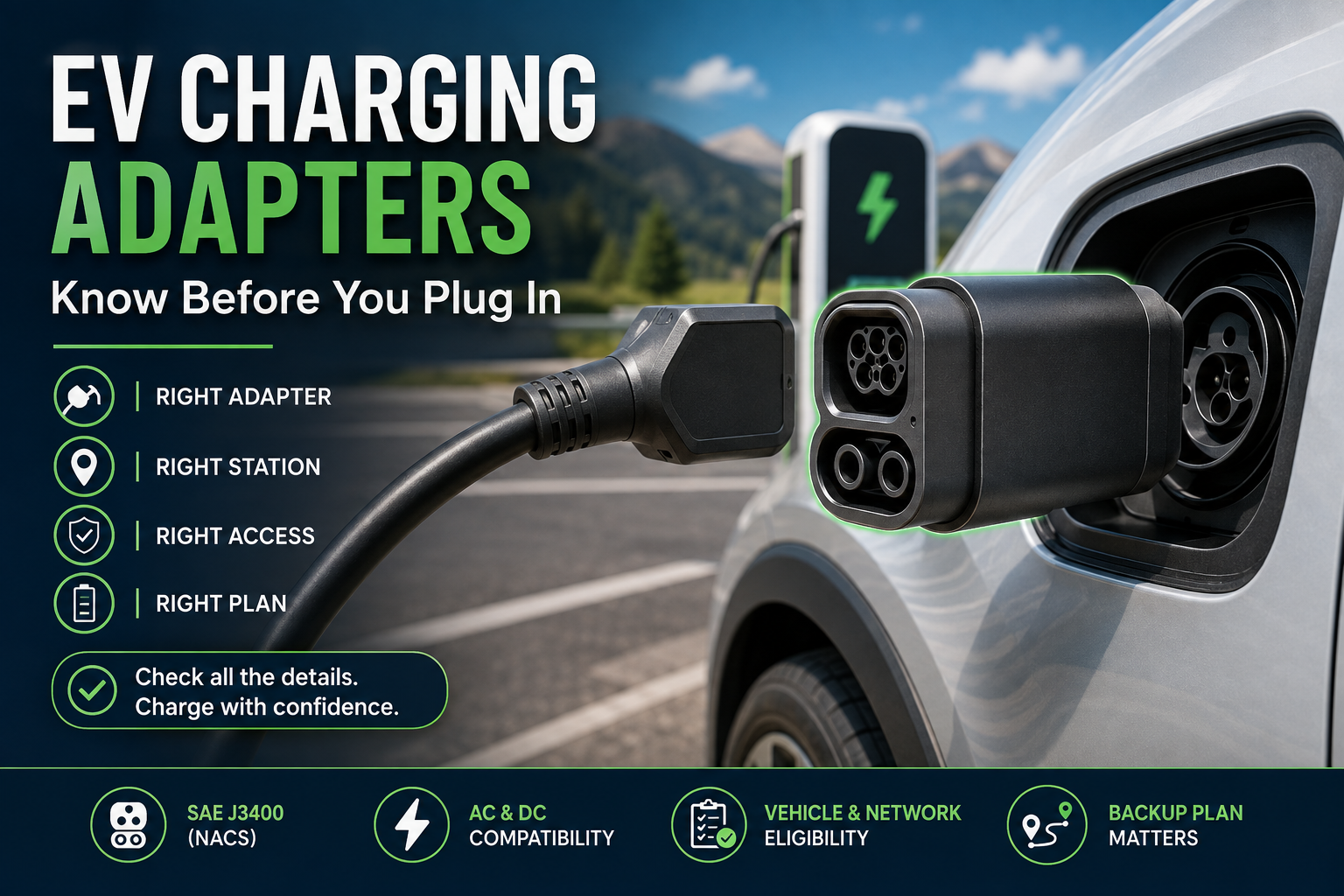
An EV charging adapter can expand the number of chargers available to your vehicle. It is not, however, a universal key to every charging station or charging network.
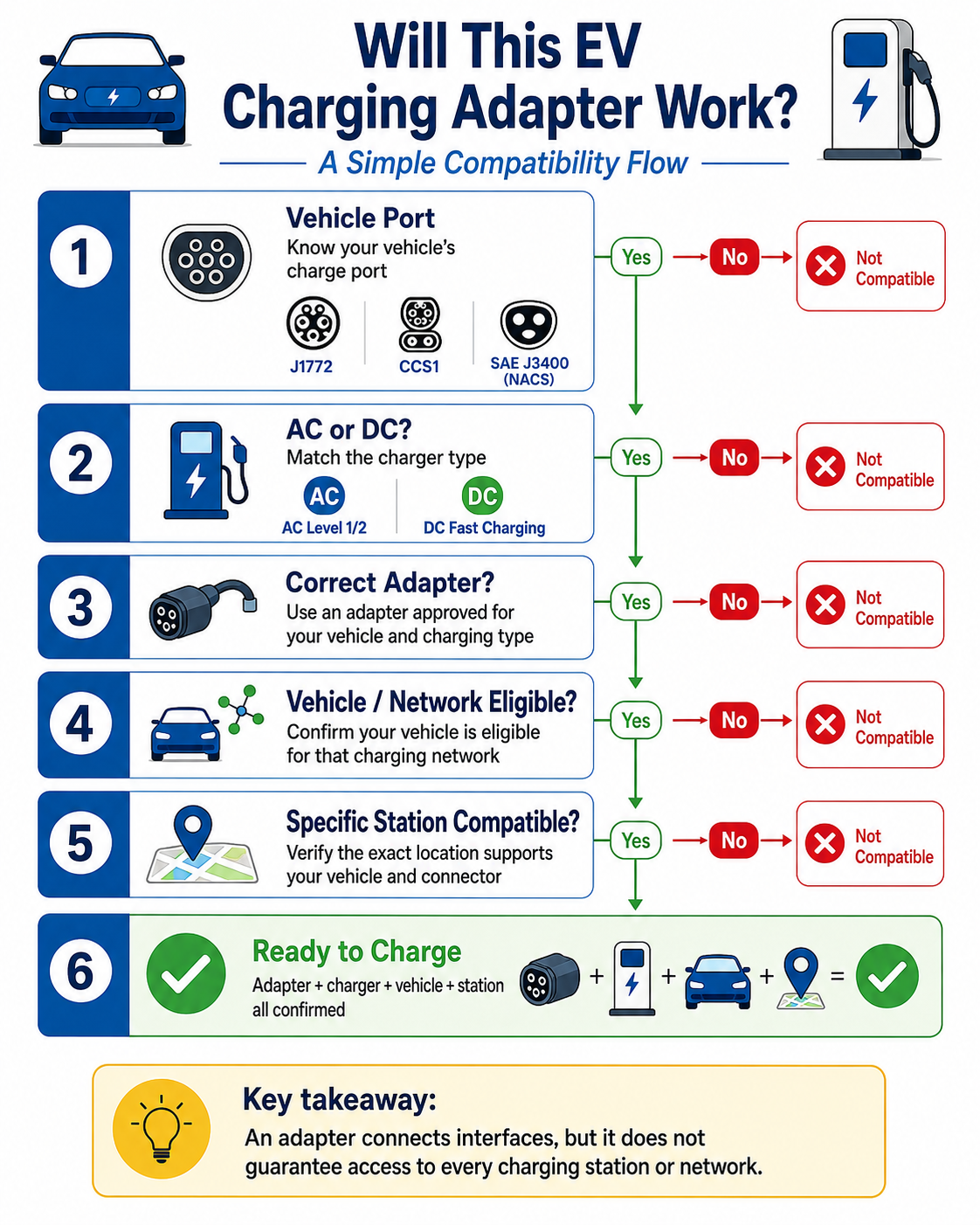
Whether an adapter will work depends on several connected factors: your vehicle's charge port, whether the charger supplies AC or DC power, the exact adapter supported for your vehicle, and whether that particular charging location is available to your vehicle.
Network access can also depend on the automaker, vehicle model, software and charging provider. As charging standards and network partnerships continue to evolve, information that was correct when you bought an adapter may not always remain sufficient for planning a future trip.
Use this checklist before making an adapter-dependent charging stop, especially when the station is an important part of a road trip.
Why an EV charging adapter is not a universal access pass
Public EV charging does not use a single connector and charging method.
For DC fast charging in the United States, the U.S. Department of Energy's Alternative Fuels Data Center identifies three connector systems: Combined Charging System (CCS), CHAdeMO and SAE J3400, the standardized version of the connector commonly known as the North American Charging System or NACS.
An adapter solves only one part of the compatibility question.
A connector may physically fit through an adapter, but that does not by itself confirm that:
- the adapter is approved or supported for your exact vehicle;
- the adapter is intended for AC or DC charging at that station;
- your vehicle is eligible to use that charging network;
- the particular charging location supports your vehicle;
- the vehicle has any required software or account setup; or
- the charging session can be activated through the required app, vehicle interface or network.
This distinction is especially important when discussing SAE J3400/NACS and Tesla Superchargers.
Tesla says its North American Supercharger network has been opening to additional automakers and identifies a growing list of supported vehicle manufacturers. Tesla also notes that EV drivers may obtain access using adapters provided by their automakers as manufacturers transition their vehicles to NACS/J3400.
That still does not mean every Supercharger is available to every non-Tesla EV.
Treat an adapter as one component of a charging plan, not as proof that a destination will work.
1. Identify your vehicle's charge port and the charger type
Start with your vehicle, not the charging-network logo.
Check your owner's manual, vehicle charging screen or current manufacturer documentation to identify:
- the charging port installed on your vehicle;
- the connector types the vehicle supports;
- whether an adapter is required;
- which adapters your manufacturer supports; and
- whether there are different requirements for AC and DC charging.
Then determine whether the station you intend to use is an AC charger or a DC fast charger.
This distinction matters because an adapter intended for DC fast charging is not necessarily suitable for Level 1 or Level 2 AC charging.
Ford provides a useful real-world example. Its Fast Charging Adapter allows compatible Ford EVs with a CCS1 inlet to connect to compatible NACS DC fast chargers. Ford specifically states that this adapter is not compatible with Level 1 or Level 2 AC chargers, including Tesla Destination Chargers and NACS home chargers.
That is guidance for Ford's adapter, not a universal rule covering every EV or adapter. The broader lesson is what matters: do not assume that an adapter works with every charger simply because the connector appears compatible.
Before leaving, save four pieces of information:
- your vehicle's charge-port type;
- whether you need AC or DC charging;
- the exact adapter you intend to use; and
- the connector and charging type available at the destination.
2. Check adapter guidance for your exact vehicle
Once you know which connector you need, check your vehicle manufacturer's current adapter documentation.
Do not assume that guidance for one vehicle, model year or brand automatically applies to another.
Look specifically for:
- compatible models and model years;
- approved or recommended adapter types;
- AC versus DC compatibility;
- required vehicle software updates;
- charging-network eligibility;
- instructions for connecting and disconnecting the adapter; and
- any manufacturer warnings or restrictions.
Manufacturer guidance is particularly important when comparing an original-equipment adapter with a third-party alternative.
For example, Ford tells its customers to use its NACS DC adapters as instructed and has separately warned against relying on unsupported aftermarket adapters for its vehicles.
That does not establish a universal rule for every automaker. Instead, check what your vehicle manufacturer says before buying or using an adapter.
Product listings, forums, videos and reports from other EV drivers can help identify questions worth investigating, but they should not replace current vehicle-specific guidance.
3. Confirm that the specific charging station supports your vehicle
Having the right adapter does not automatically give your vehicle access to every charger using that connector.
This is one of the most important checks when planning an adapter-dependent stop.
Before leaving, use the charging tools recommended by your vehicle manufacturer and, where appropriate, the charging-network operator to confirm the exact location.
Check:
- whether the station appears in your vehicle manufacturer's supported charging map;
- whether your vehicle is eligible to use that location;
- whether the correct connector is listed;
- whether the station is currently reported as operational;
- whether charging requires an app, account or other activation method;
- whether there are parking, operating-hour or access restrictions; and
- whether another compatible charger is available nearby.
Ford again provides a useful example. Its instructions tell drivers using the Ford Fast Charging Adapter to use the Ford app to confirm that the Tesla Supercharger they intend to use is compatible with their vehicle because not every Tesla Supercharger is available.
Tesla likewise describes Supercharger access as expanding across supported automakers rather than presenting every Supercharger as universally accessible to every EV.
The practical rule is simple:
Confirm the adapter and confirm the station. One does not replace the other.
Check again reasonably close to departure if the charging stop is important to your trip. Charging-network availability, station status and vehicle access can change after a route was originally planned.
4. Build a backup into an adapter-dependent road trip
A reliable charging plan should not depend entirely on one unfamiliar station when an adapter is required.
Whenever practical, identify another charger that your vehicle can reach if the primary station cannot be used.
Your backup might be:
- another compatible fast charger on the same route;
- a station on another charging network;
- a slower but confirmed compatible charger;
- an earlier charging stop that gives you more battery margin; or
- another confirmed location within comfortable driving range.
The amount of battery margin you need depends on your vehicle, route, weather, traffic and driving conditions. The important principle is to avoid reaching a critical state of charge while depending on a charger you have never confirmed or used before.
Before a long leg of your trip, ask:
Do I have enough range to reach another confirmed charger if this stop fails?
If the answer is no, consider charging earlier or selecting a route with more redundancy.
5. Do not force or improvise an adapter connection
If the connector does not fit as expected, stop and check the equipment.
Do not force an adapter or connector into place.
Look for:
- visible damage;
- dirt or debris;
- an incorrect connector;
- an adapter intended for a different charging type;
- an incomplete connection; or
- a connection sequence that differs from your manufacturer's instructions.
Avoid combining multiple adapters unless your vehicle manufacturer explicitly documents and supports that exact configuration.
Adapters involve high-power charging equipment, so compatibility should come from documented vehicle and equipment guidance rather than trial and error.
When general charging advice conflicts with the instructions supplied for your vehicle, adapter or charging equipment, follow the applicable manufacturer instructions.
6. What to do if the charging session does not start
A failed charging session does not necessarily mean the adapter is defective.
The problem could involve the charging station, network access, account setup, activation process, vehicle eligibility or the specific location.
If charging does not begin, work through a simple sequence:
- Stop the attempt and read any message displayed by the vehicle, charger or app.
- Confirm that the charger is one your vehicle is eligible to use.
- Check that the adapter is the correct type and properly connected according to its instructions.
- Confirm that any required app, account or payment method is ready.
- Follow the troubleshooting instructions provided by your vehicle manufacturer or charging network.
- Move to your backup charging location if the issue cannot be resolved safely.
Avoid repeatedly forcing or reconnecting equipment without understanding the error.
If you need support, record the station location, charger or stall number, approximate time, error message and adapter used. Those details can help the vehicle manufacturer or charging-network support team identify what happened.
A single failed charging session also does not necessarily mean that every charger on that network is incompatible with your vehicle.
7. What to do if the connector or adapter will not release
Do not pull forcefully on a cable or adapter that appears locked to the vehicle.
EV charging systems can lock the connector during charging or until the correct release procedure has been completed.
Follow the disconnect procedure documented for your vehicle and adapter.
Ford, for example, warns users of its Fast Charging Adapter not to attempt to remove the cable or adapter before the vehicle has been unlocked because doing so can damage the vehicle, charging cable or adapter. Ford's disconnect instructions call for stopping the charge, unlocking the connector and then using the appropriate release control.
Your vehicle may use a different procedure, so consult its current instructions rather than assuming the Ford sequence applies universally.
If the connector remains locked after you have followed the documented procedure, avoid excessive force. Check the vehicle and charging-network troubleshooting instructions or contact the appropriate support provider.
Quick EV charging adapter checklist
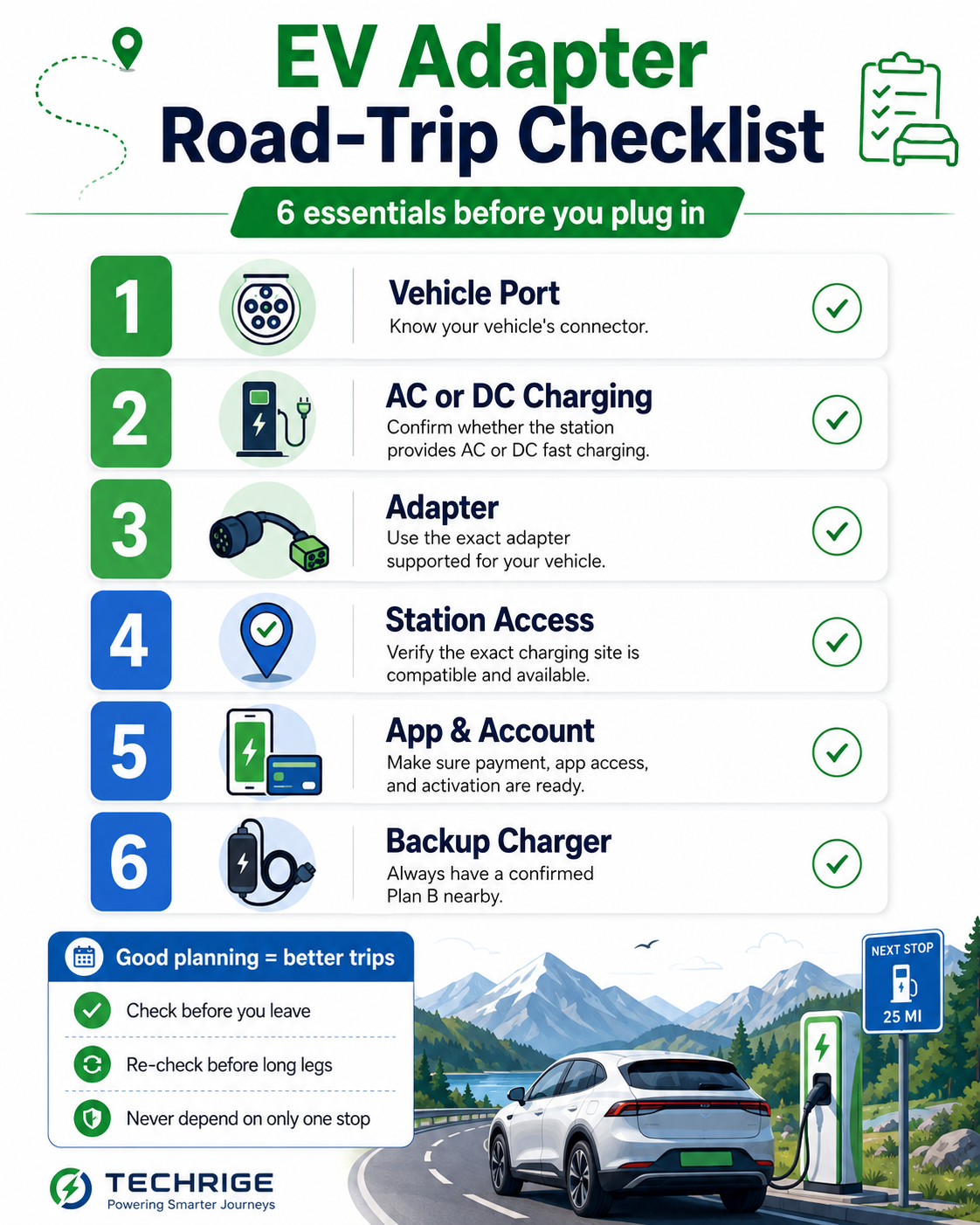
Before depending on an adapter at a public charger, confirm:
- Vehicle: I know the charging port installed on my exact vehicle.
- Charging type: I know whether the destination is AC or DC fast charging.
- Adapter: My manufacturer supports or recommends this adapter for this use.
- Compatibility: The adapter supports the required charger type.
- Vehicle eligibility: My vehicle is eligible to use the charging network.
- Station eligibility: I have confirmed the exact charging location, not just the network.
- Software: Any required vehicle software or app setup is complete.
- Account: I know how the charging session will be activated and paid for.
- Equipment: The adapter and connector show no obvious damage.
- Instructions: I know the correct connection and disconnection sequence.
- Backup: I have another workable charging option if the station is unavailable.
An EV charging adapter can make many more charging options available, but the adapter itself is only one part of compatibility.
The safest way to plan an adapter-dependent charging stop is to check the vehicle, charging type, adapter and specific station together. Confirm access before you leave, follow your vehicle manufacturer's instructions and keep another charging option within reach.
Sources
- U.S. Department of Energy — Alternative Fuels Data Center: Electric Vehicle Charging Stations. Technical guidance covering J1772, CCS, CHAdeMO and SAE J3400/NACS charging equipment and connector terminology.
- SAE International — SAE J3400: North American Charging System (NACS) for Electric Vehicles. Defines physical, electrical, functional, safety and performance requirements for the J3400 charging system.
- Tesla — NACS / Charging for All. Current information about automaker participation and expansion of Supercharger access through NACS/J3400 and automaker-provided adapters.
- Ford — Fast Charging Adapter (NACS). Ford's specifications and compatibility information, including the distinction between NACS DC fast charging and Level 1/Level 2 AC charging.
- Ford — Using a Fast Charging Adapter at an Upgraded Tesla Supercharger. Instructions for identifying compatible Superchargers and connecting and disconnecting Ford's adapter.