
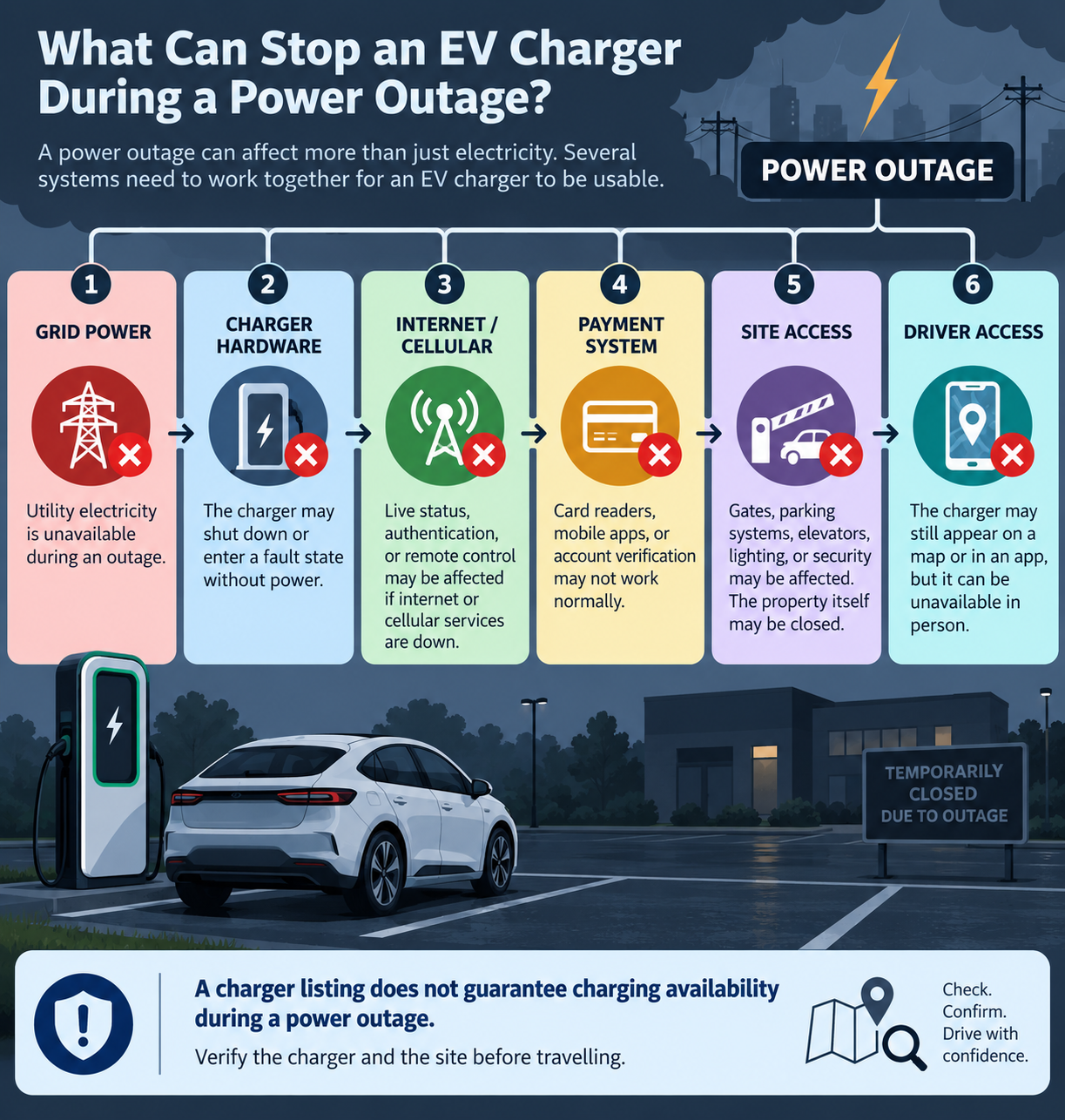
A power outage changes more than whether electricity reaches an EV charger. It can also disrupt site access, lighting, cellular or internet connections, payment systems, staff availability, and nearby services.
For EV drivers and charger hosts, the practical goal is not to assume charging will continue. It is to have a workable plan for when it does not.
This guide is preparedness education, not emergency-management, electrical, or utility-operating advice. During an active outage, follow directions from local emergency authorities, your utility, and the relevant vehicle and charging-equipment documentation.
Start with a realistic expectation: a listed charger may not be usable
An EV charger shown on a map or in an app is not necessarily operating during a power outage.
Many charging sites depend on several systems working together:
- Utility electricity
- Charging hardware
- Network connectivity
- Payment or authentication systems
- Property access
- Lighting and security
- Site staff or remote support
Network services can support functions such as charger-status information, session initiation, payments, access control, and operator management. The U.S. Department of Energy’s Alternative Fuels Data Center explains EV charging-network services, including station status, access, fees, and payments.
It is useful to separate three related ideas:
- Charger reliability: whether the charging equipment itself works as expected.
- Grid resilience: whether electricity remains available or can be restored after a disruption.
- Site resilience: whether the complete location remains accessible and capable of serving drivers.
These factors are related but distinct, as discussed in the National Renewable Energy Laboratory’s research on EV charging-station reliability, resilience, and location.
A normally dependable charger may still be inaccessible or unavailable during a local emergency.
For drivers, this means treating public charging as an option to verify, not a guaranteed resource. For hosts, it means communicating the actual status of the site rather than leaving visitors to infer it.
Driver pre-outage checklist
Preparedness works best before severe weather, wildfire risk, flooding, or another local disruption becomes urgent.
Your appropriate charging buffer depends on your vehicle, normal trips, weather, evacuation needs, local charging density, and household circumstances. There is no single state-of-charge percentage that fits every EV driver.
1. Set a personal charging buffer
Choose a charge level that leaves room for ordinary travel plus a reasonable margin for changed plans.
Consider increasing that buffer when:
- Severe weather is forecast
- A utility warns of possible outages
- Nearby charging options are limited
- You may need to travel unexpectedly
- Cold or hot weather could affect energy consumption
A personal buffer is a planning choice, not a promise that you will be able to charge later.
If authorities issue evacuation or travel guidance, follow that guidance rather than delaying travel to reach a preferred battery percentage.
2. Identify more than one charging option
Map out alternatives before they become urgent.
Consider identifying:
- Your normal charging location
- A second charging site nearby
- Another charging option along your likely travel route
- Charging locations outside the immediate outage area
- A destination where you could safely wait if charging is unavailable
Keep in mind that an alternative station may face the same outage, access restrictions, queues, or communications problems.
The goal is to have choices—not to assume that any individual charger will be operating.
3. Keep navigation, payment, and communication access ready
Have a way to access essential charging information if connectivity becomes limited.
That may include:
- Keeping your phone charged
- Carrying a power bank for personal devices
- Saving important charging-station addresses
- Keeping more than one payment method available
- Saving charging-network support numbers
- Taking screenshots of important route information before travelling
FEMA’s Ready.gov power-outage guidance recommends preparing ahead, keeping mobile devices charged, and planning alternative ways to power electronic devices during an outage.
Where possible, save important information instead of relying solely on live data.
An app may display outdated information, and a station that appears online may still be unavailable because of conditions at the property.
4. Know the limits of your vehicle and equipment
Do not assume that an EV can automatically power your home, building, or another device.
Bidirectional technologies such as:
- Vehicle-to-load (V2L)
- Vehicle-to-home (V2H)
- Vehicle-to-building (V2B)
- Vehicle-to-grid (V2G)
depend on the specific vehicle, compatible charging equipment, electrical installation, transfer equipment, software, and sometimes utility requirements.
The U.S. Department of Energy’s guidance on bidirectional charging and EVs as mobile storage explains that compatible bidirectional vehicles and charging equipment are required.
Read your vehicle documentation before an emergency—not during one—and consult qualified professionals about any plans to use an EV for building backup power.
Never improvise a connection between an EV, charging equipment, generator, and building wiring.
What to do during a power outage
When the power is out, prioritize safety and verified information over the fastest-looking charging option.
Verify the charger before travelling
Before driving to a public charger, try to confirm that the location is available through:
- The charging-network app or website
- The charger operator
- The property or charger host
- A reliable local contact
Also check whether the property itself is open and safely accessible.
Consider conditions such as:
- Road closures
- Flooding
- Wildfire restrictions
- Severe weather
- Curfews
- Evacuation orders
- Emergency instructions
If you cannot confirm availability, make the trip only if it remains a sensible option within your available range and current local conditions.
Do not treat a charger pin on a map as confirmation that you will be able to charge.
Use your available energy thoughtfully
Conserve energy where practical without compromising safety or emergency guidance.
Examples may include:
- Combining essential trips
- Avoiding unnecessary detours
- Reducing optional driving
- Choosing routes with multiple backup options
- Leaving a larger battery margin than usual
Weather, traffic, road conditions, HVAC use, vehicle speed, and elevation can affect energy consumption.
Allow extra margin rather than planning around an exact range estimate.
If your available range becomes a concern, seek help through appropriate local channels while you still have reasonable flexibility.
Expect changing conditions and charging queues
Even a site with backup capability may have:
- Reduced charging power
- Limited operating hours
- Growing queues
- Restricted access
- Limited stored energy
- Communications problems
Be prepared to leave if a charging location is unsafe, inaccessible, or unable to serve additional vehicles.
Courtesy also matters during disruptions. Follow posted rules, avoid blocking access routes, and move your vehicle after charging when requested.
A charger-host continuity plan
Workplaces, multifamily properties, destination sites, and public charging hosts can reduce confusion by having a simple written outage procedure.
The procedure should be practical enough for property staff, facilities teams, and contractors to follow under pressure.
Assign responsibility before an outage
Identify who is responsible for:
- Checking charger status
- Checking property access
- Communicating with the charging-network provider
- Updating drivers or tenants
- Closing charging spaces when necessary
- Reporting equipment problems
- Confirming service after power restoration
Name a primary contact and a backup.
Also establish who has authority to close chargers or restrict access if conditions become unsafe.
Define what “status verified” means
Avoid vague updates such as:
Chargers may be available.
Instead, use simple operational categories such as:
- Available — verified
- Unavailable — power outage
- Charger powered, site access restricted
- Status unknown — do not rely on charger
- Service restored — verification in progress
- Available again — operation verified
This is an operational communication framework, not a claim that every charging property can provide real-time status.
Hosts should use communication channels they can realistically maintain, such as:
- Property notices
- Website updates
- Tenant messages
- Email or SMS alerts
- Charging-network updates where supported
Plan for the complete driver experience
A charger may be electrically functional while the location remains unsuitable for public use.
Consider whether an outage affects:
- Parking gates
- Lighting
- Elevators
- Security systems
- Parking-control equipment
- Washroom access
- Building access
- Staff availability
- Emergency communications
Also decide in advance how the property will handle vehicles already parked in charging spaces if charging stops.
After utility service is restored, inspect the site and follow the equipment provider’s procedures before announcing that charging has returned.
Restoration of utility electricity alone does not prove that every charger, network service, payment function, or site-access system is operating normally.
Backup power: distinguish options from guarantees
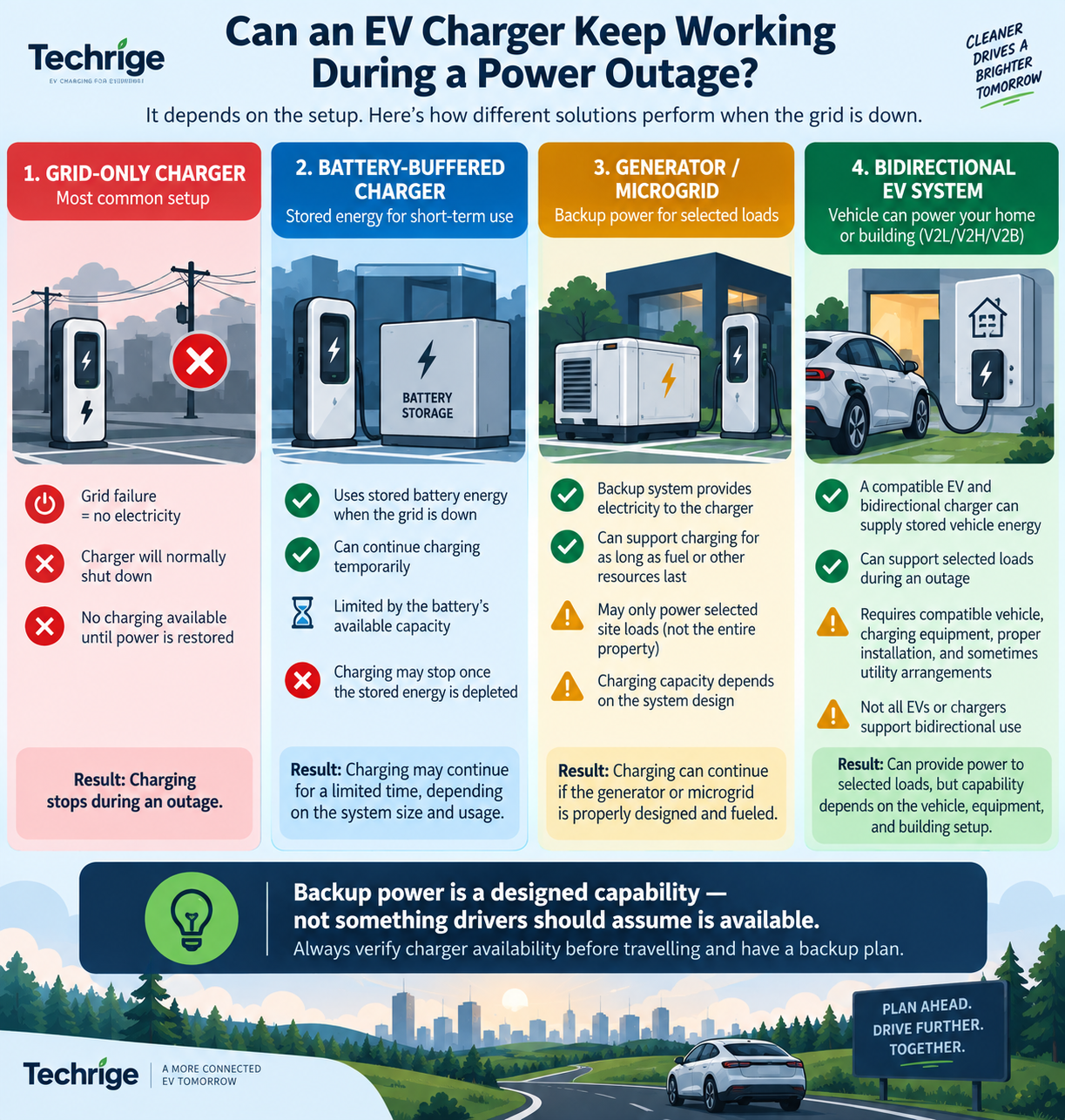
Ordinary grid-connected EV charging will generally stop when the supporting utility service is interrupted.
Continued charging requires a site-specific resilience design. It should not be assumed simply because a property has EV chargers, solar panels, batteries, or a generator.
Potential resilience approaches can include:
- Stationary battery energy storage
- Backup generators
- Solar plus battery storage
- Microgrids
- Bidirectional EV charging
- Combinations of these technologies
DOE’s bidirectional charging and mobile-storage guidance explains that site resilience can involve microgrids or backup generation and that vehicle-to-building systems can complement existing backup-power solutions.
For a charger host considering resilience, important questions include:
- Which charging loads must remain powered?
- For how long should charging continue?
- How many vehicles should the system support?
- At what charging power?
- What other building loads have priority?
- What happens when stored energy becomes low?
- Can the system safely isolate from the grid when required?
- Who verifies the system after an outage?
- How will drivers know that backup charging is actually available?
These are questions for property stakeholders, equipment manufacturers, utilities where relevant, and qualified electrical professionals.
A resilience strategy needs to account for the whole site—not simply the charging connector.
Battery-buffered DC fast charging: useful, but limited
Battery-buffered DC fast charging combines EV charging equipment with battery energy storage.
In some configurations, stored energy may allow a charging station to continue operating temporarily when utility electricity is interrupted.
The Joint Office of Energy and Transportation’s Battery Energy Storage for Electric Vehicle Charging Stations guide identifies resilience during grid disruptions as one potential application of battery-buffered DC fast charging.
However, battery storage alone does not guarantee that charging will continue during an outage.
The hardware and software need to be specifically configured for outage operation.
Available charging will also depend on factors such as:
- Usable battery capacity
- Battery state of charge
- Number of vehicles charging
- Charging power requested
- Other loads supported by the battery
- System configuration
- Operational controls
Once the stored energy is depleted, charging may stop or become significantly limited until grid power is restored or another energy source becomes available.
For hosts, the practical lesson is to define the intended outage service clearly.
A system intended to provide limited, short-duration emergency charging is very different from a system designed to support many vehicles through an extended outage.
Drivers should therefore treat battery-buffered charging as a capability to confirm, not something to assume.
Driver-host communication checklist
Clear communication can prevent unnecessary trips and reduce frustration during an outage.
A charger host’s status update should ideally answer:
- Is the charger operating?
- Is the property accessible?
- Is charging power limited?
- Are all charging ports available?
- Are payment and authentication systems working?
- Are operating hours different?
- Is there a queue or access restriction?
- When was the status last verified?
- Where can drivers find the next update?
Drivers can also help by checking for current information before travelling and reporting observed problems through the appropriate channel.
When sharing charging information with other drivers, distinguish between:
- What you directly observed
- What the charger app reports
- What the operator or property has confirmed
The bottom line
An EV can still be useful during a power outage, but charging infrastructure should not be treated as guaranteed.
For drivers, the strongest approach is simple:
- Maintain a sensible charging buffer
- Identify alternative chargers
- Keep your phone and payment options ready
- Verify a charging site before travelling
- Leave extra range for changing conditions
For charger hosts:
- Establish an outage procedure
- Assign responsibility
- Communicate charger status clearly
- Consider the entire property’s accessibility
- Test any backup-power strategy before relying on it
Backup power, battery-buffered charging, microgrids, and bidirectional charging can improve resilience, but only when they are deliberately designed and configured for that purpose.
During an active emergency, follow instructions from local authorities, your utility, vehicle manufacturer, charging-equipment provider, and qualified electrical professionals.
Sources
- U.S. Department of Energy — Alternative Fuels Data Center: EV Charging Networks
- National Renewable Energy Laboratory — Impact of Electric Vehicle Charging Station Reliability, Resilience, and Location on EV Adoption
- FEMA Ready.gov — Power Outages
- U.S. Department of Energy — Bidirectional Charging and Electric Vehicles for Mobile Storage
- Joint Office of Energy and Transportation — Battery Energy Storage for Electric Vehicle Charging Stations