
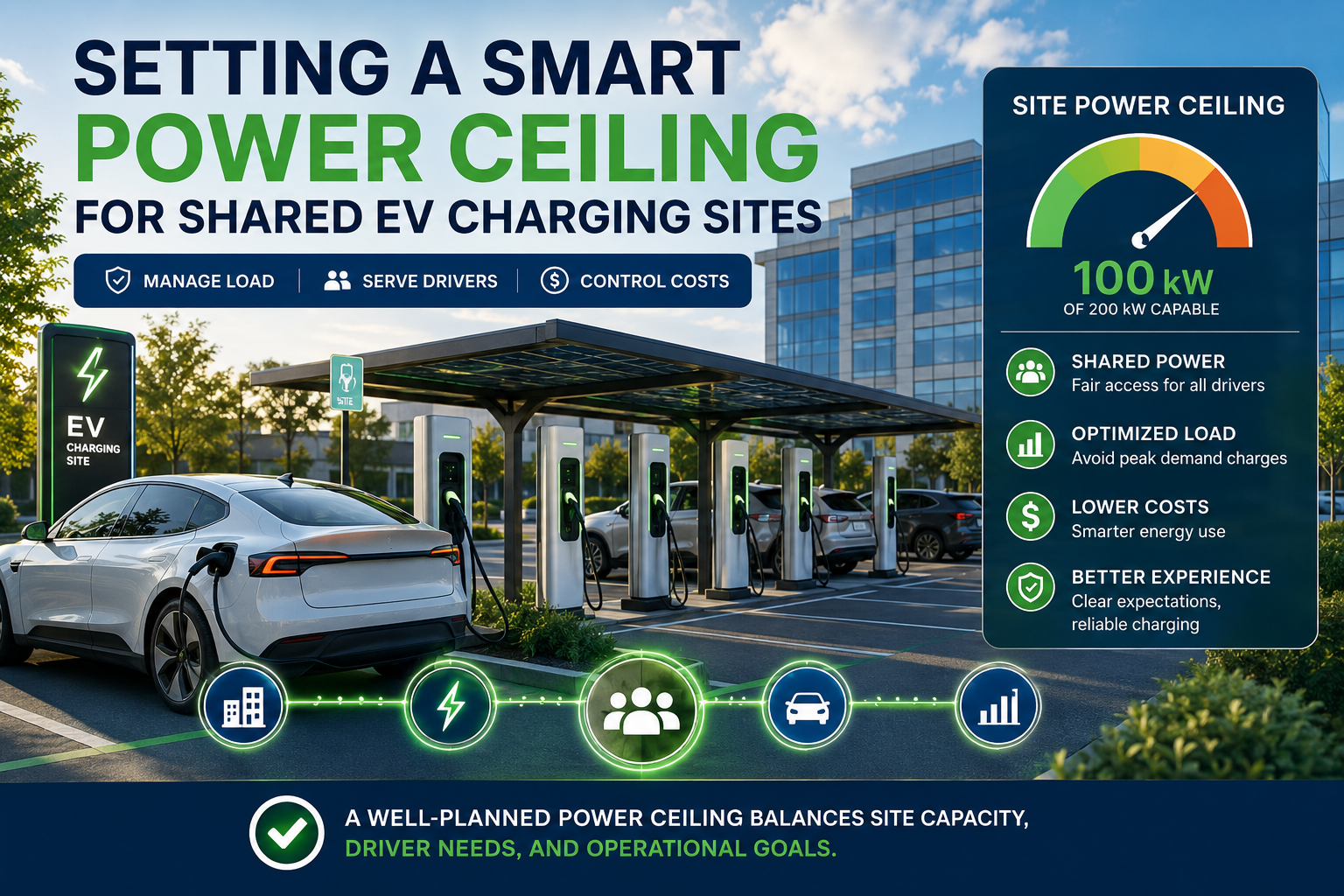
Shared EV charging sites often face a practical constraint: the chargers may be capable of drawing more power in total than the site wants—or is prepared—to provide at one time. That does not automatically mean drivers need to lose access.
A site-wide EV charging power ceiling is an operating limit on the combined charging load. It can be used as part of a broader plan to work within available site capacity, understand exposure to utility demand charges, or evaluate whether an electrical upgrade should be considered later.
The key is to treat the ceiling as a driver-service policy as well as a power-management setting.
For workplace, retail, hospitality, multifamily, and fleet-adjacent hosts, the goal is not simply to make the lowest possible power limit work. It is to allocate the available charging capacity in a way that fits typical dwell times, gives drivers clear expectations, and has a sensible response when conditions change.
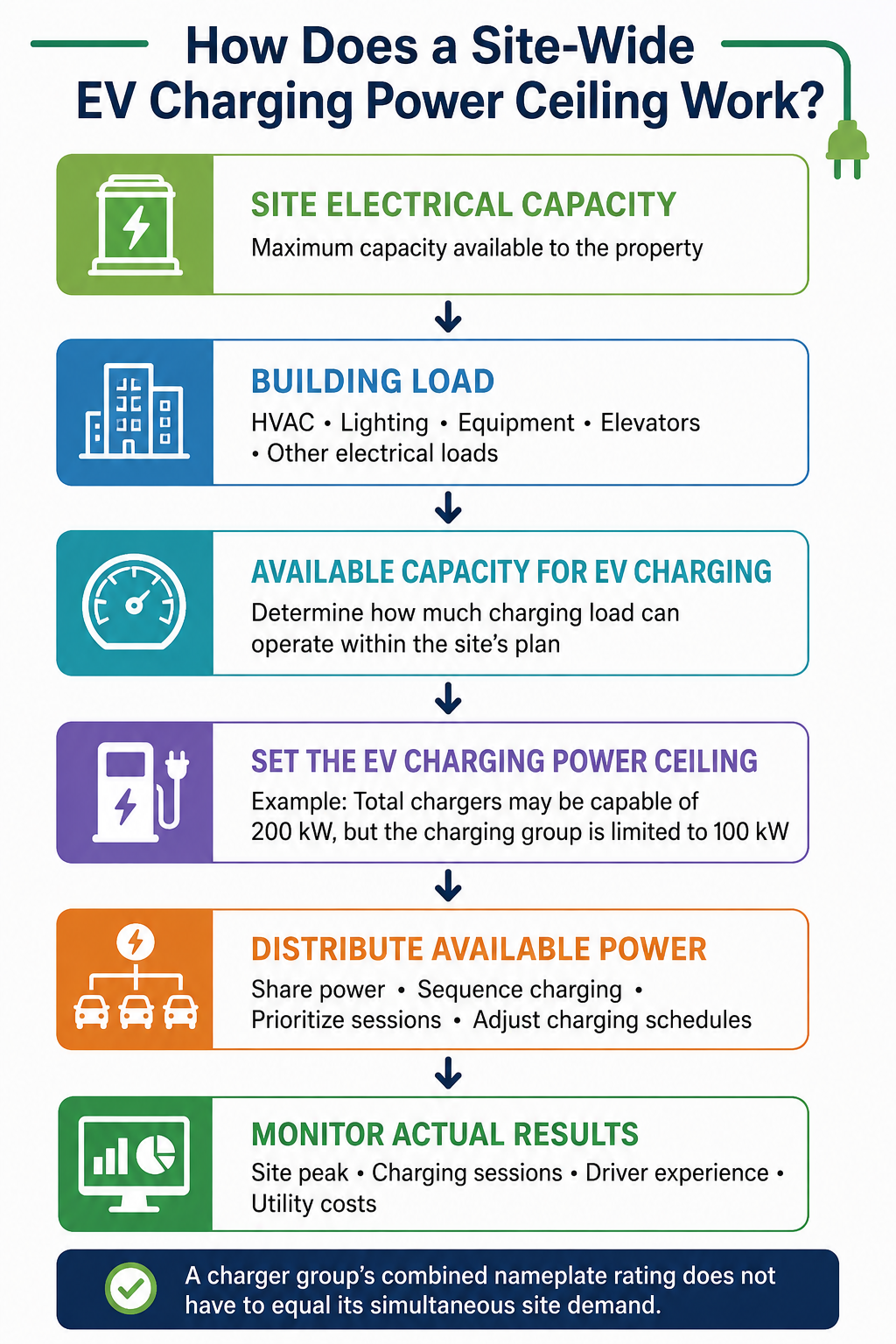
Why the chargers' nameplate ratings are not the same as a site power plan
A charger's nameplate rating describes its potential electrical rating under relevant conditions. It does not, by itself, determine how much power the entire charging area should draw at once.
A site plan has to consider the charging equipment alongside:
- Building operations and existing electrical loads
- Electrical service and distribution capacity
- The number and type of EV chargers
- Expected charging demand
- Typical vehicle dwell times
- Utility rate structures
- Potential demand charges
- Future expansion plans
The U.S. Department of Energy (DOE) describes smart charge management as coordinated EV charging control that can respond to charging demand, building load, electricity rates, and operational needs. It can also coordinate charging loads under a site-wide limit. DOE's Smart Charge Management Applications and Benefits for Federal Fleets provides a useful conceptual model, even though each shared charging site needs its own technical and operational review.
This distinction becomes especially important when several vehicles plug in during the same period.
A host may decide that not every connector needs to receive its maximum possible output simultaneously. Instead, the site can establish a combined ceiling and use an available control approach to distribute power, sequence sessions, prioritize certain charging needs, or apply operating rules.
Whether a particular charger, network, vehicle, or energy-management system supports these approaches is a product- and configuration-specific question that should be verified with the relevant vendor.
A power ceiling is therefore not a substitute for electrical design, utility review, installation approvals, or local electrical requirements. It is an operating parameter that should be selected within the limits confirmed for the site.
Start with the utility bill, interval data, and the site's existing peak load
Before selecting a power ceiling, understand what the site is actually trying to manage.
Start with recent utility bills and identify the applicable rate schedule. Utility bills commonly include energy charges based on kilowatt-hours, while some rate structures also include demand charges based on the site's maximum kilowatt demand during a specified billing period.
Time-of-use periods and demand-charge structures vary by rate schedule, so hosts should confirm the details with their utility documentation or account representative. DOE's guidance on evaluating utility rate options is a useful starting point for understanding these distinctions.
Then gather interval data where it is available. Hourly, 15-minute, or other interval consumption data can help reveal when existing building demand is highest and whether likely EV charging periods overlap with those peaks.
It will not predict every future charging session, but it provides a much more grounded basis for questions such as:
- When does the building typically reach its highest electrical demand?
- Does EV charging demand tend to overlap with those periods?
- How much does the site's load vary between normal and peak periods?
- Are there predictable periods when additional charging capacity may be available?
- Do weekends, evenings, or overnight periods look significantly different?
- Could EV charging create a new site peak?
- Are there seasonal changes in building demand that need to be considered?
DOE's implementation guidance identifies utility rate information, building electrical-load data, charger and vehicle inventory, expected dwell periods, and available transformer or service capacity as relevant inputs to a charge-management process. Review DOE's Smart Charge Management Implementation guidance as a planning checklist rather than a prescriptive design for every property.
Keep the data collection practical. A host does not need to solve every possible future operating scenario before starting.
But a ceiling chosen without reviewing utility bills, peak patterns, charging demand, and site-capacity information will be harder to explain—and harder to improve later.
Choose a clear power-ceiling objective
A charging power ceiling should have a specific job.
Avoid choosing a number solely because it sounds conservative or because it represents an arbitrary percentage of the chargers' combined maximum rating.
Common objectives may include:
- Keeping EV charging within an identified site capacity limit
- Reducing the likelihood that EV charging creates or contributes to a new peak
- Managing exposure to utility demand charges
- Delaying or potentially reducing the scope of certain electrical upgrades
- Allowing more charging connectors to operate within limited available capacity
- Shifting more charging into lower-load or lower-cost periods
- Prioritizing operationally important vehicles
- Maintaining a predictable charging experience during normal demand
- Testing actual charging demand before committing to larger infrastructure investments
These objectives can overlap, but they can also conflict.
A retail property may prioritize a straightforward experience for short-stay drivers. A workplace may have more flexibility to distribute power over an eight-hour parking period. A multifamily property may need a policy that functions throughout the night while accounting for resident expectations. A fleet-adjacent facility may have departure schedules or vehicle priorities that need to be incorporated.
Write down:
- The primary objective of the ceiling
- When the ceiling applies
- Whether it changes by time of day
- Who has authority to modify it
- Whether certain vehicles or chargers receive priority
- What evidence would trigger a policy review
That turns an otherwise hidden technical setting into a documented operating policy.
Match charging rules to dwell time and driver needs
A ceiling is less likely to disrupt access when it reflects how people actually use the site.
Begin with a simple segmentation of expected charging sessions:
- Short visits
- Medium-duration stays
- Long-duration stays
- Overnight parking
- Operationally critical vehicles
Ask what drivers realistically need from the charger during their likely parking window, not simply what the charger could theoretically deliver under ideal conditions.
For example, a host could explore different policies for different circumstances:
- Allocate more available power to drivers with short expected dwell times
- Use lower sustained charging power for vehicles parked for many hours
- Prioritize vehicles that have operational departure requirements
- Allow charging to increase when building demand falls
- Reduce charging temporarily during known building peaks
- Spread charging sessions throughout the available parking window
- Set different operating rules for daytime and overnight charging
These are policy examples, not universal technical prescriptions.
The appropriate approach depends on utilization, parking rules, charging-equipment behaviour, tariff structure, available electrical capacity, and the host's service objectives.
The transferable lesson from a DOE workplace case study is that managed charging can coordinate a defined combined charging-load limit with individual session needs such as requested energy and parking duration. DOE's National Laboratory of the Rockies parking-garage managed charging case study demonstrates one approach, but it should not be interpreted as evidence that every shared or public-facing charging site will achieve the same results.
Before implementing a rule, test it against ordinary driver scenarios.
Ask:
- What happens when every connector is occupied?
- What happens when only one vehicle is charging?
- What happens when a driver arrives late in the day?
- What happens when several vehicles arrive simultaneously?
- What happens if a vehicle stays much longer than expected?
- What happens if a vehicle leaves much earlier than expected?
- What happens if communication with the charging-management system is lost?
- What happens if actual building load suddenly increases?
A policy with understandable answers to these questions is much easier for staff to operate and drivers to accept.
Questions to ask vendors about group power management, monitoring, controls, and fallback behaviour
Do not assume a charging system can enforce the desired ceiling simply because a sales description uses terms such as smart charging, dynamic load management, power sharing, or load balancing.
Ask the charger manufacturer, installer, network provider, energy-management provider, or electrical professional specific questions and document the answers.
Useful questions include:
- Can the system enforce a combined power limit across multiple chargers?
- Is the limit applied to individual chargers, groups of chargers, or the entire charging site?
- Can the available limit change dynamically based on building load?
- Can charging power be adjusted by time of day?
- Can certain chargers or vehicles receive priority?
- How is available power divided when several vehicles are connected?
- Can the system use departure time, requested energy, or other session information?
- What is the minimum charging output the system may assign to an active session?
- What happens when another vehicle plugs in?
- What happens when a vehicle finishes charging?
- How quickly does the system redistribute available capacity?
- What monitoring information is available to the site operator?
- Can the operator see historical power, energy, occupancy, and session information?
- Are alerts available when a charger stops communicating?
- What happens if internet connectivity is interrupted?
- What happens if the network platform becomes unavailable?
- What happens if the local controller fails?
- Does charging continue under a defined fallback limit?
- Can the site operator manually override the ceiling?
- Which controls require remote vendor support?
- Are configuration changes recorded in an audit log?
- Are software, networking, licensing, or subscription fees required for these capabilities?
- What functionality remains available if the network subscription ends?
DOE's smart charge management implementation guidance also discusses communication between charging stations, management systems, building loads, vehicles, and utilities, reinforcing why these capabilities should be verified rather than assumed. See DOE's Smart Charge Management Implementation for Federal Fleets.
Also clarify ownership and responsibility.
Someone should be accountable for:
- Reviewing charging-system alerts
- Monitoring recurring capacity constraints
- Communicating service changes
- Approving temporary exceptions
- Escalating technical problems
- Reviewing charging and building-load data
- Deciding when the operating policy should be reassessed
A charging ceiling without a named operator can quickly become an unexplained driver problem.
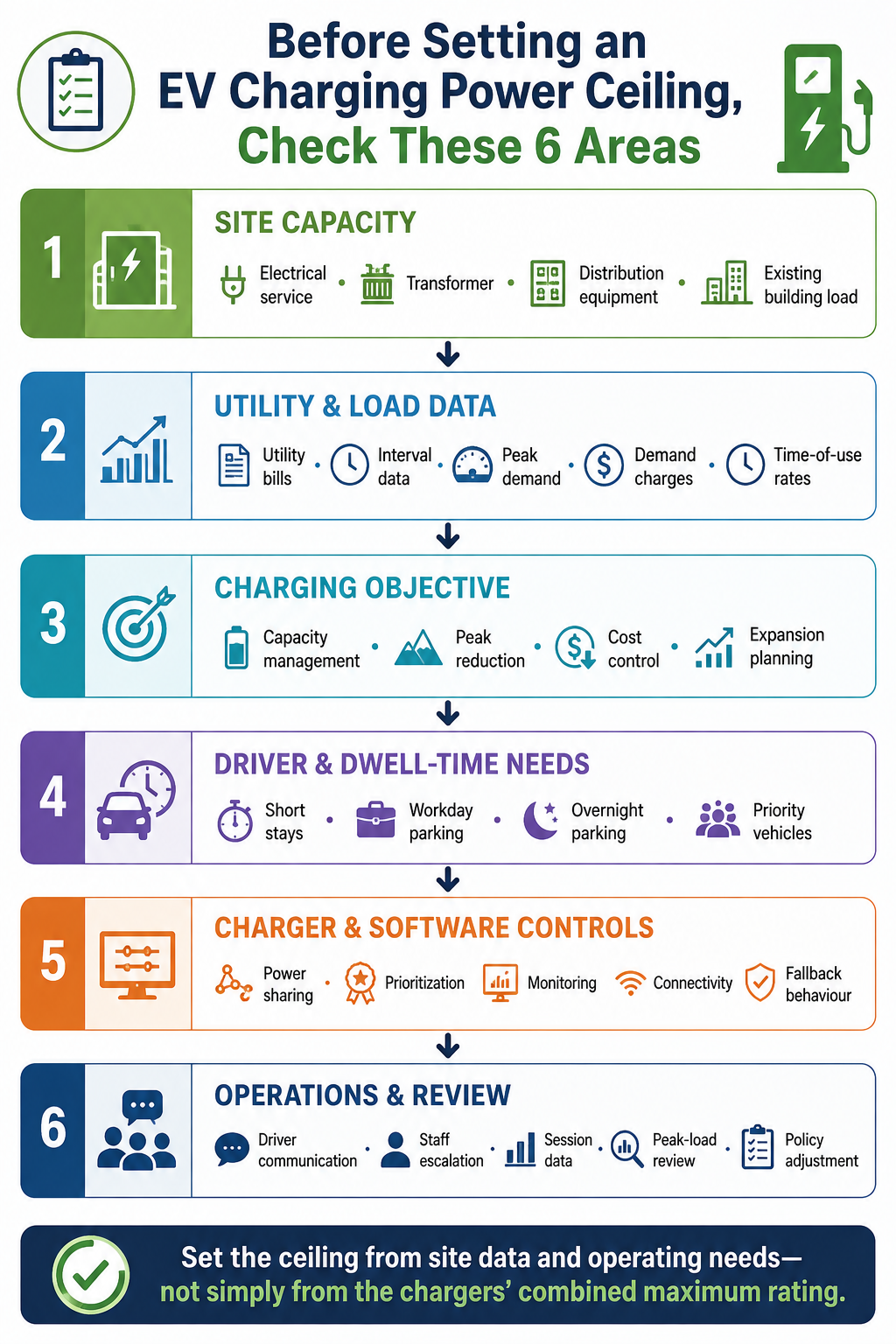
Set a driver communication and escalation plan before reducing charging power
Drivers can usually adapt to shared or reduced charging power more easily when the site explains the arrangement clearly.
Avoid implying a guaranteed charging speed or completion time. Actual charging performance can depend on:
- The vehicle
- Battery state of charge
- Battery temperature
- Vehicle charging limits
- Charging equipment
- Other active sessions
- Site electrical conditions
- Power-management rules
A clear driver communication plan can explain:
- That charging power may be shared between connected vehicles
- That charging speed can change during a session
- Whether certain periods tend to have more available power
- Whether there are charging or parking time limits
- Whether drivers need to enter a departure time or energy requirement
- Whether notifications are available
- How drivers can report a suspected charger problem
- Who to contact if charging does not behave as expected
This information could appear in the charging app, on site signage, in employee or resident onboarding information, or within the property's charging policy.
Internally, create an escalation path.
Front-line staff should understand the difference between a normal power-sharing outcome and a suspected equipment failure.
They should also know when a concern should be directed to the:
- Charging network provider
- Site operator
- Charger manufacturer
- Installer
- Utility
- Qualified electrical professional
Good communication does not increase available electrical capacity, but it can prevent normal managed-charging behaviour from being interpreted as a broken charger.
Review actual session, peak-load, and driver-feedback data before expanding
Treat the initial charging ceiling as a planning assumption that should be reviewed against real operating evidence.
At regular intervals, review whatever information is available, including:
- Charging-session frequency
- Connector occupancy
- Energy delivered per session
- Charging duration
- Periods when the ceiling is reached
- Building peak-load information
- Demand-related billing outcomes
- Charger faults and downtime
- Support tickets
- Driver complaints and feedback
Look for recurring patterns.
For example:
- Are drivers routinely leaving before receiving the energy they expected?
- Are particular hours consistently constrained?
- Is the charging ceiling reached every day or only occasionally?
- Does EV charging regularly coincide with the building's existing peak?
- Are some chargers consistently more heavily used than others?
- Are long-dwell vehicles consuming capacity that could be shifted to another period?
- Is the original ceiling rarely reached, suggesting more capacity might be available within the approved operating plan?
Use this evidence to decide whether the next step is to:
- Keep the current policy
- Adjust the charging ceiling
- Change allocation or priority rules
- Improve driver communication
- Add monitoring or automation
- Expand the number of connectors
- Investigate an electrical upgrade
- Begin a more detailed utility or engineering review
Do not infer site-specific capacity or upgrade requirements from a general map.
DOE notes that utility hosting-capacity maps can provide a general indication of where new electrical loads may potentially be accommodated, but they do not replace site-specific utility discussions or interconnection review. See DOE's U.S. Atlas of Electric Distribution System Hosting Capacity Maps.
A well-run EV charging power ceiling is not just a technical constraint.
It is a documented operating choice: informed by the site's electrical load and utility-rate context, matched to driver dwell time, supported by verified equipment behaviour, clearly communicated to users, and adjusted when real-world evidence calls for it.
Sources
- U.S. Department of Energy — Smart Charge Management Applications and Benefits for Federal Fleets
- U.S. Department of Energy — Evaluating Your Utility Rate Options
- U.S. Department of Energy — Smart Charge Management Implementation for Federal Fleets
- U.S. Department of Energy — Managed Charging Minimizes Costs in National Laboratory of the Rockies' Parking Garage
- U.S. Department of Energy — U.S. Atlas of Electric Distribution System Hosting Capacity Maps