
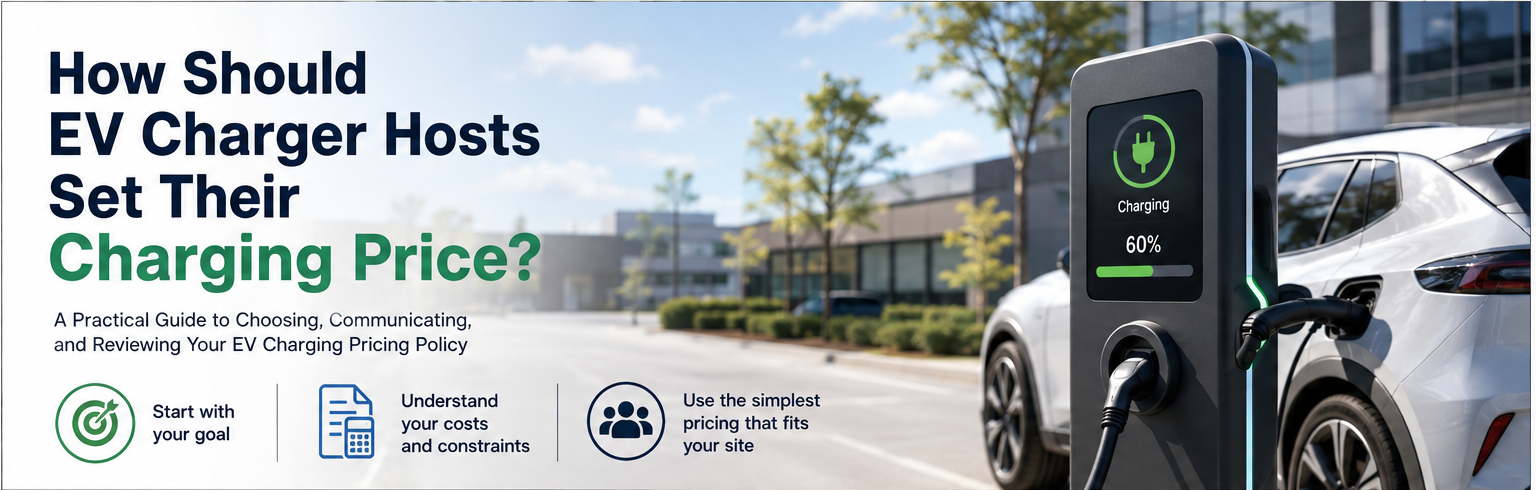
Choosing an EV charging price is not simply a question of what drivers are willing to pay.
For a charger host, the better question is: what behaviour and operating outcome should the pricing policy support?
A workplace may want to provide a useful employee benefit while making a limited number of chargers available to more people. A multifamily property may need to share charging spaces fairly among residents. A shared-parking site may be more focused on recovering part of its electricity, maintenance, or network costs.
Those goals can lead to very different pricing policies.
The U.S. Department of Energy's Alternative Fuels Data Center (AFDC) identifies several common EV charging pricing structures, including charging by kilowatt-hour (kWh), by session, by length of time, or through a subscription. AFDC also notes that charging stations may be offered free of charge.
The right structure depends on the site's objectives, equipment, parking environment, charging demand, operating costs, network capabilities, and applicable local requirements.
This guide provides a practical framework for choosing, communicating, testing, and reviewing an EV charging pricing policy. It is general educational guidance rather than legal, tax, employment, utility-rate, or accounting advice.
Start with the operating goal
Before deciding what to charge, define what the site is trying to accomplish.
Trying to make one fee solve every operational problem can result in a policy that is difficult for drivers to understand and difficult for the host to manage.
A site's primary objectives might include:
- Recovering some or all charging operating costs
- Providing an employee, resident, customer, or visitor benefit
- Encouraging drivers to move their vehicles when charging is complete
- Giving more users an opportunity to access limited chargers
- Keeping pricing and administration simple
- Generating revenue from charging
- Encouraging EV adoption
- Managing demand for a limited number of charging spaces
Put those goals in order.
For example, a residential property with two shared chargers and many EV-driving residents may rank fair access and turnover above precise cost recovery.
A workplace with plenty of available charging capacity may instead prioritize a simple employee benefit.
This ranking becomes useful later when comparing pricing models.
It is also important to separate charging pricing from parking management.
A per-kWh fee can determine what a driver pays for energy received, while a time limit or post-charge rule can address how long the charging space remains occupied. These are different tools, and a site may use both.
DOE workplace guidance similarly treats pricing, station sharing, administration, and enforcement as related but separate parts of operating a workplace charging program.
List your costs and site constraints before setting a price
A pricing policy should be based on the site's actual operating environment rather than a number copied from another charging location.
According to AFDC, operating costs for charging infrastructure can include electricity, maintenance, and applicable charging-network fees. Electricity costs may also vary depending on the site's utility rate structure and when charging occurs.
Start with a simple internal review that considers:
- Electricity costs
- Utility rate structure
- Charging-network or software fees
- Maintenance and repair costs
- Payment-processing or transaction costs, where applicable
- Number of chargers and connectors
- Expected number of users
- Typical parking duration
- Whether charging spaces are scarce
- Whether users can charge elsewhere
- Administrative effort required to manage the program
- Whether the site wants full, partial, or no cost recovery
The objective does not have to be a perfect financial model.
The exercise is primarily meant to show the host what the pricing policy needs to accomplish and where additional information may be required from the charging-network provider, utility, accountant, property manager, or other relevant professional.
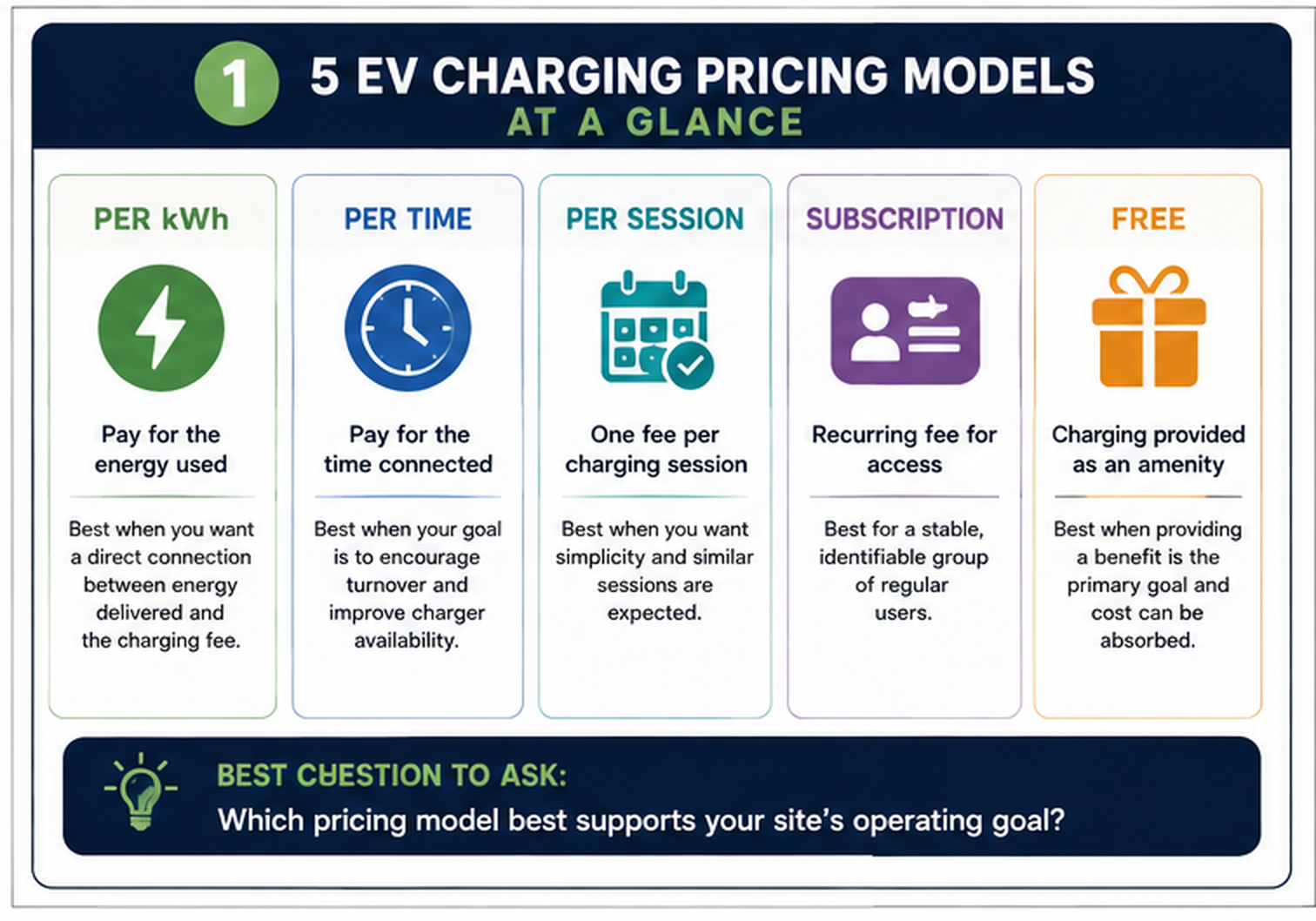
Which model best supports the site's operating goal?
Compare the main EV charging pricing models
There is no single pricing model that works best for every charger host.
Each option should be assessed against the site's objectives, costs, parking constraints, expected utilization, and administrative requirements.
1. Price by kWh
With per-kWh pricing, the driver pays according to the amount of electrical energy delivered during the charging session.
AFDC identifies per-kWh charging as one of the common EV charging pricing structures.
It may be worth considering when:
The host wants the charging fee to have a direct relationship with the amount of energy delivered and the site's equipment, network, metering, and applicable requirements support this pricing method.
Potential advantages:
- Creates a direct connection between energy delivered and the charging fee
- Makes different-length charging sessions easier to compare
- Can support energy-cost recovery
- Does not require a driver to pay more simply because a vehicle remains connected longer while charging slowly
Limitations to consider:
- A per-kWh fee alone does not necessarily encourage a driver to move after charging is complete
- Network, payment, metering, and regulatory requirements may differ depending on the location
- Electricity cost may not represent the host's entire operating cost
- A host still needs separate policies if charging-space availability is limited
For parking-constrained locations, per-kWh pricing can therefore be paired with a time limit or a separate post-charge parking policy.
2. Price by time
Time-based pricing charges the driver according to the duration of the charging session, such as by minute or hour.
Time-based pricing is another structure identified by AFDC.
It may be worth considering when:
The host is particularly concerned about charger or parking-space availability and wants the policy to encourage turnover.
Potential advantages:
- Creates an incentive to pay attention to how long a charging space is occupied
- Can help discourage unnecessarily long sessions
- Can be relatively straightforward to communicate
- May work well where parking duration is already part of site management
Limitations to consider:
- Time connected does not always correspond directly to energy received
- Vehicles and charging sessions can have different charging characteristics
- Drivers may perceive time-based pricing differently when charging performance varies
- The host still needs a clear rule defining when the charge begins and ends
Charging rate can depend on the vehicle and battery conditions, including factors monitored during charging such as battery temperature and state of charge.
For that reason, time-based pricing should be explained clearly rather than presented as equivalent to paying directly for energy.
3. Charge a flat fee per session
With a session-based model, the driver pays a set fee each time a charging session begins.
AFDC also lists per-session charging among common pricing structures.
It may be worth considering when:
The host values simplicity, charging sessions are reasonably predictable, or the fee is intended to provide a modest contribution toward operating costs rather than exact cost recovery.
Potential advantages:
- Easy for drivers to understand
- Easy for the host to explain
- Can simplify a pilot program
- Reduces the need to explain detailed rate calculations
Limitations to consider:
- Short and long sessions may cost the same
- Energy use can vary significantly between sessions
- Frequent short sessions may produce different results from fewer long sessions
- It may not encourage drivers to leave promptly unless combined with another rule
A flat session fee can be particularly useful during an early pilot when the host is still learning how drivers use the site.
4. Subscription or membership access
A subscription model charges an eligible user a recurring amount for charging access.
The subscription may provide charging access by itself or operate alongside another fee structure. AFDC includes subscriptions among the common pricing approaches used for EV charging.
It may be worth considering when:
The charging population is relatively stable and identifiable, such as employees, tenants, condominium residents, or members of a defined user group.
Potential advantages:
- Predictable recurring payments
- Can simplify access management for regular users
- May fit naturally into existing resident, employee, parking, or membership programs
- Can reduce the need for a separate transaction during every charging session
Limitations to consider:
- Users may consume very different amounts of charging
- Heavy and light users may perceive the value differently
- The host must decide who qualifies
- Subscription access does not by itself solve charger congestion
- Additional rules may still be required for sharing limited stations
For workplaces in particular, DOE recommends establishing clear policies covering administration, sharing, access, and pricing.
5. Offer free charging
Free charging can be a deliberate pricing strategy rather than the absence of a policy.
DOE notes that many workplace charging programs have offered free charging, while also explaining that charging fees may help offset capital and operating costs and may influence charger congestion.
It may be worth considering when:
The site's main objective is to provide an employee, resident, customer, or visitor benefit and the host is prepared to support the associated operating cost.
Potential advantages:
- Very simple for drivers
- Removes a payment step from the charging experience
- Can function as an employee, resident, or customer amenity
- Can support an organization's EV adoption goals
Limitations to consider:
- The host absorbs the charging cost
- Demand may increase as EV adoption grows
- Drivers have little financial incentive to minimize unnecessary use
- Limited charging spaces may become difficult to share
- A policy that works when only a few people drive EVs may become less practical as utilization increases
Free charging therefore does not have to mean unlimited charging.
A free program can still establish eligibility rules, charging time limits, reservation procedures, or active-charging requirements.
Pair the price with clear access and parking rules
Pricing is only one part of the charging experience.
A short, visible policy should tell drivers:
- Who may use the chargers
- During what hours charging is available
- What the charging price is
- How the fee is calculated
- How payment works
- Whether charging spaces are reserved for actively charging vehicles
- Whether there is a time limit
- What drivers should do when charging is complete
- Whether reservations or queues are used
- Who to contact if the charger or payment system does not work
- Whether any post-charge, idle, parking, or other applicable fees exist
Make the language operational.
“Please be courteous to other drivers” can be a useful reminder, but it is not a complete charger-sharing rule.
A statement such as “Charging spaces are for actively charging vehicles only” communicates a much more specific expectation.
DOE's signage guidance notes that charging-station signage can help hosts communicate policies such as active-charging restrictions and time limits. It also explains that signs installed in public rights-of-way can be subject to local ordinances and traffic-control requirements.
Requirements for private properties may differ, so hosts should review the rules applicable to their location before relying on signs, penalties, towing, or other enforcement measures.
Avoid announcing an idle fee, penalty, or enforcement process that the site is not actually prepared or authorized to administer.
If an overstay or idle charge is being considered, determine in advance:
- What behaviour the fee is intended to change
- When it begins
- How much it costs
- How drivers will be notified
- Whether exceptions exist
- How disputes will be handled
- Whether the charging network can technically administer it
- Whether the arrangement is compatible with applicable site rules and requirements
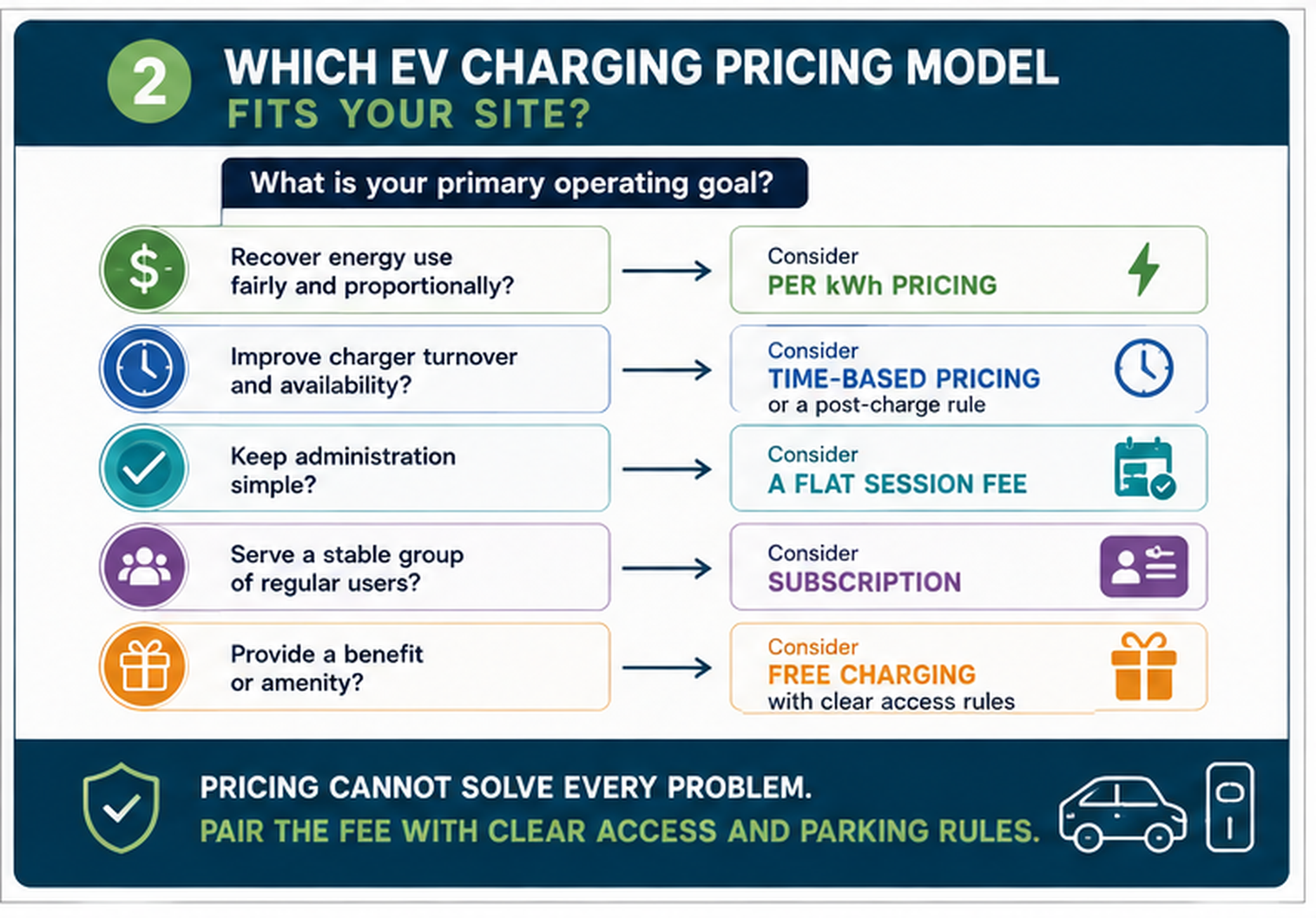
Pricing cannot solve every problem. Pair the fee with clear access and parking rules.
Use a pilot, then review what happened
The first pricing policy does not have to become the permanent pricing policy.
A pilot gives the host an opportunity to see how drivers actually use the chargers before making long-term assumptions.
AFDC recommends collecting and analyzing utilization information as part of charging-station management and notes that utilization data can help determine whether a pricing structure is working and whether additional infrastructure may be needed.
A simple pilot process can be:
- Define the site's primary operating goal.
- Choose the simplest pricing structure that appears to support that goal.
- Establish clear access and parking rules.
- Communicate the policy before launch.
- Run the policy for a defined review period.
- Measure charger utilization, session patterns, complaints, availability, costs, and other useful site data.
- Collect feedback from drivers and site administrators.
- Compare the results with the original goal.
- Adjust the pricing or operating rules where necessary.
- Document the reason for significant changes.
The objective is not to discover a theoretically perfect price.
It is to maintain a charging policy that drivers can understand, administrators can operate, and the site can adjust as charging demand changes.
Questions that require local review
Some decisions cannot be resolved with a general EV charging pricing framework.
Before implementing or substantially changing a policy, determine whether the site needs additional guidance regarding:
- Utility tariffs and electricity billing
- Metering requirements
- Charging-network capabilities and contracts
- Payment processing
- Taxes or accounting treatment
- Employee-benefit or workplace considerations
- Tenant, condominium, or property rules
- Accessibility
- Parking enforcement
- Consumer pricing and disclosure requirements
- Signage
- Local permits or regulations
These issues can differ considerably by jurisdiction and property type.
Multifamily charging is a good example: AFDC identifies parking, electrical access, billing, and legal concerns among the considerations property owners may encounter when deploying EV charging.
The host should therefore verify the requirements that apply to the specific property rather than assuming a pricing policy used somewhere else can be copied unchanged.
A practical decision rule for charger hosts
A useful rule is:
Choose the simplest charging price that supports your primary operating goal, then use access and parking rules to address the problems that pricing alone cannot solve.
If energy-based cost recovery is the priority, per-kWh pricing may deserve consideration.
If charger turnover is the problem, time limits or post-charge rules may matter more.
If simplicity is the goal, a session fee may be easier to operate.
If the same group uses the chargers regularly, a subscription may be appropriate.
If charging is primarily an amenity, free charging may remain completely reasonable—but it should still have a policy.
Document the reason for the decision. Measure what happens. Listen to users. Review utilization and costs. Then adjust the policy as the site evolves.
That approach is more useful than assuming a single EV charging price will work for every workplace, multifamily property, or shared-parking site.
Sources
U.S. Department of Energy — Alternative Fuels Data Center: Operation and Maintenance for Electric Vehicle Charging Infrastructure
Covers charging infrastructure operating costs, network fees, fee collection, pricing structures, access, and utilization data.
U.S. Department of Energy — Alternative Fuels Data Center: Workplace Charging for Electric Vehicles
Covers workplace charging administration, station sharing, access policies, pricing, congestion, and employee charging management.
U.S. Department of Energy — Alternative Fuels Data Center: Signage for Electric Vehicle Charging Stations
Covers station signage, active-charging restrictions, time limits, and public-right-of-way considerations.
U.S. Department of Energy — Alternative Fuels Data Center: Electric Vehicle Charging for Multifamily Housing
Covers considerations for multifamily charging, including parking, electrical access, billing, and legal issues.