
EV charging signage does more than point to a parking space. It sets driver expectations, helps staff handle disputes consistently, and connects a charging installation to the way people actually move through a property.
For a workplace, multifamily building, retail site, or public-facing car park, unclear signs can create avoidable friction: drivers may not find the chargers, non-EVs may occupy stalls, EVs may remain after charging, or staff may be left to interpret rules that were never clearly communicated. A useful sign plan treats these as operating decisions, not simply graphics to order after installation.
This article offers a planning framework for U.S. charger hosts. It is not a substitute for reviewing local rules, property agreements, accessibility obligations, or funding conditions that apply to a specific site.
Why charger signage is an operations issue, not an afterthought
A charger host needs to answer two different questions:
The U.S. Department of Energy’s Alternative Fuels Data Center distinguishes wayfinding signage from station signage. Wayfinding helps drivers navigate to charging; station and stall signs identify equipment and communicate access or parking policies.
That distinction is practical. A large property may need decision-point signs at an entrance, garage ramp, or parking aisle. But a driver who reaches the charger also needs concise rules at the stall. Combining every instruction into one crowded sign usually makes both jobs harder.
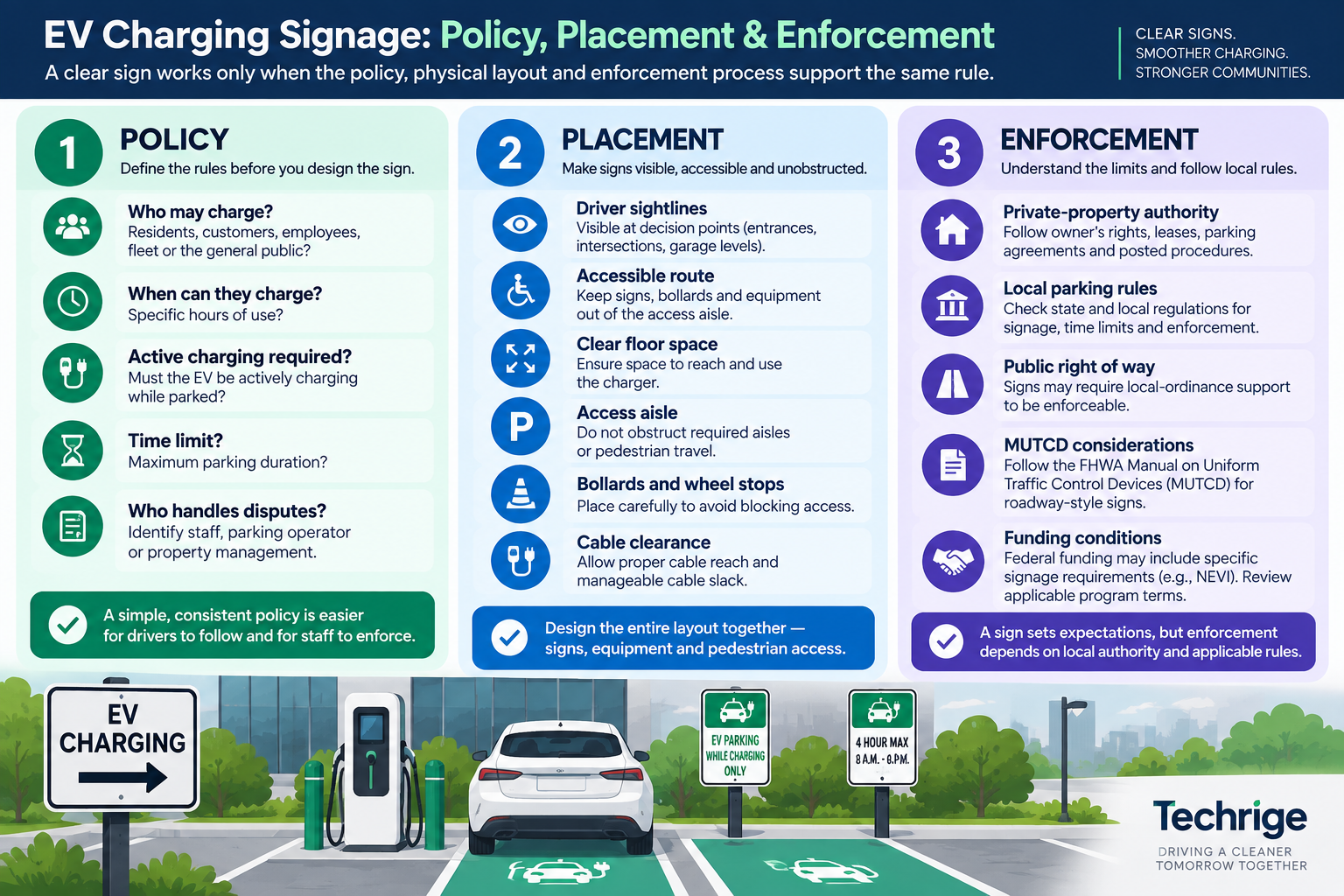
Before choosing sign wording, establish the operating policy behind it. Decide who may charge, when, whether staff or visitors have different access, how long a vehicle may remain, and who handles questions. Then make the sign system reflect that policy consistently across signs, driver communications, parking agreements, and staff procedures.
Separate the sign system into four jobs
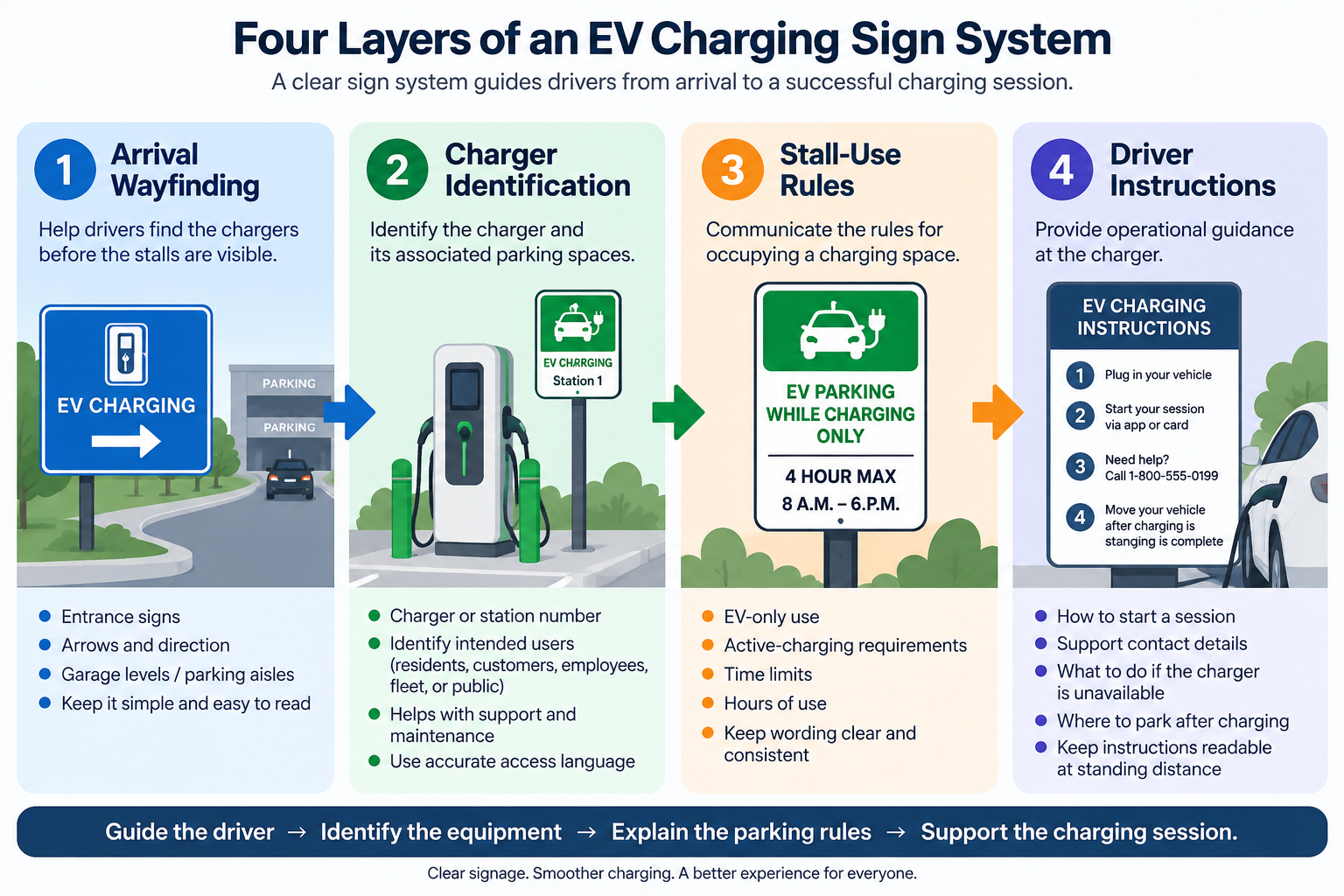
A clear EV charging sign plan commonly has four layers. Not every site needs every layer, but treating them separately makes gaps easier to spot.
1. Arrival wayfinding
Wayfinding signs help a driver make turns before the charging stalls are visible. Consider the site entrance, key intersections, garage levels, elevator lobbies, and long parking aisles. The goal is not to decorate the route; it is to give a driver the next useful direction at the point where a choice is required.
Keep these signs simple: an EV charging symbol where appropriate, an arrow, and a location or level identifier can be easier to read than a full policy statement. If a roadway-style sign will be placed on a public street, public highway, bikeway, or a private road open to public travel, confirm applicable state and local implementation requirements. The Federal Highway Administration’s Manual on Uniform Traffic Control Devices (MUTCD) has a defined scope for traffic-control devices in those settings, as noted by the Alternative Fuels Data Center’s signage guidance.
2. Charger identification
At the charging area, identify the charger and its associated parking spaces. At multi-unit sites, a simple charger or station identifier can help drivers report a problem and help staff direct maintenance teams to the correct equipment.
A charger identification sign can also clarify whether the equipment serves a specific audience, such as residents, customers, employees, fleet vehicles, or the general public. Avoid language that implies public access if access is restricted by the site’s actual operating policy.
3. Stall-use rules
Stall signs communicate the rules for occupying a charging space. The Alternative Fuels Data Center identifies examples including EV-only use, active-charging requirements, time limits, and hours of use. Choose only the rules the site intends and is able to administer.
A stall sign should answer the driver’s immediate questions:
For example, a site may decide on a policy such as “EV parking while charging only, 8 a.m.–6 p.m., 4-hour maximum.” That is an example of operational wording, not a universal legal formula. Whether it is enforceable, and what additional wording or notices may be needed, depends on the property and jurisdiction.
4. Driver instructions
Some instructions belong at the charger rather than on a parking sign: how to begin a session, where to find support contact details, what to do if the charger is unavailable, or where to park after charging. Keep operational instructions readable at standing distance and avoid duplicating lengthy instructions across multiple signs.
Where a host uses digital driver communications, those may reinforce the site policy. They should not be treated as a replacement for signage where a physical notice is needed for wayfinding or site operations.
Choose a plain-language parking policy
A parking rule is easier to follow when it can be stated in one short sentence and explained consistently by staff. Start by selecting the underlying policy, then test its wording with the people who will encounter it.
Common policy elements include:
There are trade-offs. An active-charging rule may discourage long stays after a session ends, but it also raises practical questions: how will a driver know charging has stopped, how are equipment faults handled, and how will staff respond to an honest misunderstanding? A strict time limit can improve turnover, while a residential property may instead prioritize predictable overnight access.
Build an escalation path before announcing the rule. A private site might begin with a courteous reminder, document repeat concerns, and use only procedures authorized for that property. The appropriate approach will differ between a retail car park, a condominium, and an employee lot.
Do not copy penalty amounts, towing language, or sign text from another city or operator. State and local parking, zoning, and building rules can address charging-space signage, time limits, accessibility, and enforcement. Confirm the requirements and available enforcement mechanisms for the specific location.
Design for visibility without obstructing access
A sign that is easy to see but poorly placed can introduce a different problem. Consider sign posts, bollards, wheel stops, charger pedestals, cable reach, vehicle doors, and pedestrian travel as one layout rather than separate installation items.
The U.S. Access Board’s EV charging technical assistance recommends considering accessible routes, unobstructed access aisles, charger clear floor space, operable parts, and cable management together. It specifically cautions that signs, bollards, wheel stops, and cable slack should not obstruct an access aisle or required clear floor space.
That guidance is useful in early design and in a post-installation review. However, hosts should not assume that following a general recommendation alone establishes compliance. The Access Board material discusses both applicable accessibility requirements in certain contexts and nonbinding design recommendations. A qualified accessibility professional can help assess the particular facility, layout, and governing requirements.
During planning, examine the route a person takes from parking to the charger and from the charger to nearby site amenities. Check sightlines from a moving vehicle, but also look at the sign from a pedestrian’s position. Make sure site elements do not make charger controls, payment or support information, or cable handling unnecessarily difficult to reach.
Understand the enforcement boundary
A sign is a communication tool; it does not independently create every enforcement power a host may want. The most important dividing line is often whether the space is on private property or in a public right of way.
For private property, begin with the owner’s rights, leases, parking operator agreement, posted-parking procedures, and local rules. Establish who can issue reminders, authorize towing where lawful, respond to disputes, and change the wording when the policy changes. Train front-line staff not to make promises that the written policy or local rules do not support.
For a public right of way, the enforcement authority and required sign treatment may rest with a municipality or other public agency. The Alternative Fuels Data Center notes that signs in a public right of way need local-ordinance support to be enforceable. Consult the responsible local authority before treating an EV parking rule as enforceable or installing traffic-control-style signs.
Funding can be another boundary. Federal minimum standards for certain federally funded, publicly accessible EV charging projects address subjects that include traffic-control devices and on-premises signage. As explained in the U.S. Department of Transportation’s National Electric Vehicle Infrastructure Standards and Requirements, those standards do not automatically set the rules for every privately funded charging site. Review applicable funding terms with the project team rather than assuming they apply—or do not apply.
Run a pre-opening walk-through and review the system
A pre-opening walk-through is an inexpensive way to identify confusion before drivers arrive. Include the property manager, installer or electrical contractor as appropriate, parking operator, site staff, and an accessibility professional when the project warrants it.
Walk the route as a first-time driver would. Start at each entrance, use the garage or car park at different approach angles, and try to find the chargers without prior knowledge. Then inspect the charging spaces on foot. Ask whether the signs are legible, whether the policy is understandable, and whether posts or other objects affect pedestrian access.
After opening, review the plan at regular intervals and after material changes, such as a parking layout revision, new chargers, repeated disputes, policy changes, or construction. Keep a simple record of issues: blocked stalls, driver questions, mistaken turns, damaged signs, and staff interventions. Patterns can reveal whether the problem is policy, placement, wording, or a missing direction sign.
Practical host checklist
Before ordering or installing signs, confirm the following:
Useful questions for the project team include:
For the property manager: Who is entitled to park and charge here, and who has authority to address violations?
For the installer: Will the planned posts, bollards, wheel stops, and charger equipment work together with the final striping and pedestrian routes?
For the local authority or parking agency: Which local rules govern signs, time limits, public-right-of-way use, and enforcement at this location?
For an accessibility professional: Does the complete site layout support accessible use, including the route, space, charger controls, and cable management?
A well-run EV charging area is easier to find, easier to understand, and easier for staff to manage. The strongest sign plan is not necessarily the one with the most signs. It is the one that gives drivers clear information, supports the property’s actual policy, and is checked against the rules and physical conditions that apply at the site.
Sources
- U.S. Department of Energy Alternative Fuels Data Center — Signage for Electric Vehicle Charging Stations
- Federal Highway Administration — Manual on Uniform Traffic Control Devices (MUTCD)
- U.S. Access Board — Design Recommendations for Accessible Electric Vehicle Charging Stations
- Alternative Fuels Data Center — Building Codes, Parking Ordinances, and Zoning Ordinances for EV Charging Infrastructure
- U.S. Department of Transportation — National Electric Vehicle Infrastructure Standards and Requirements