
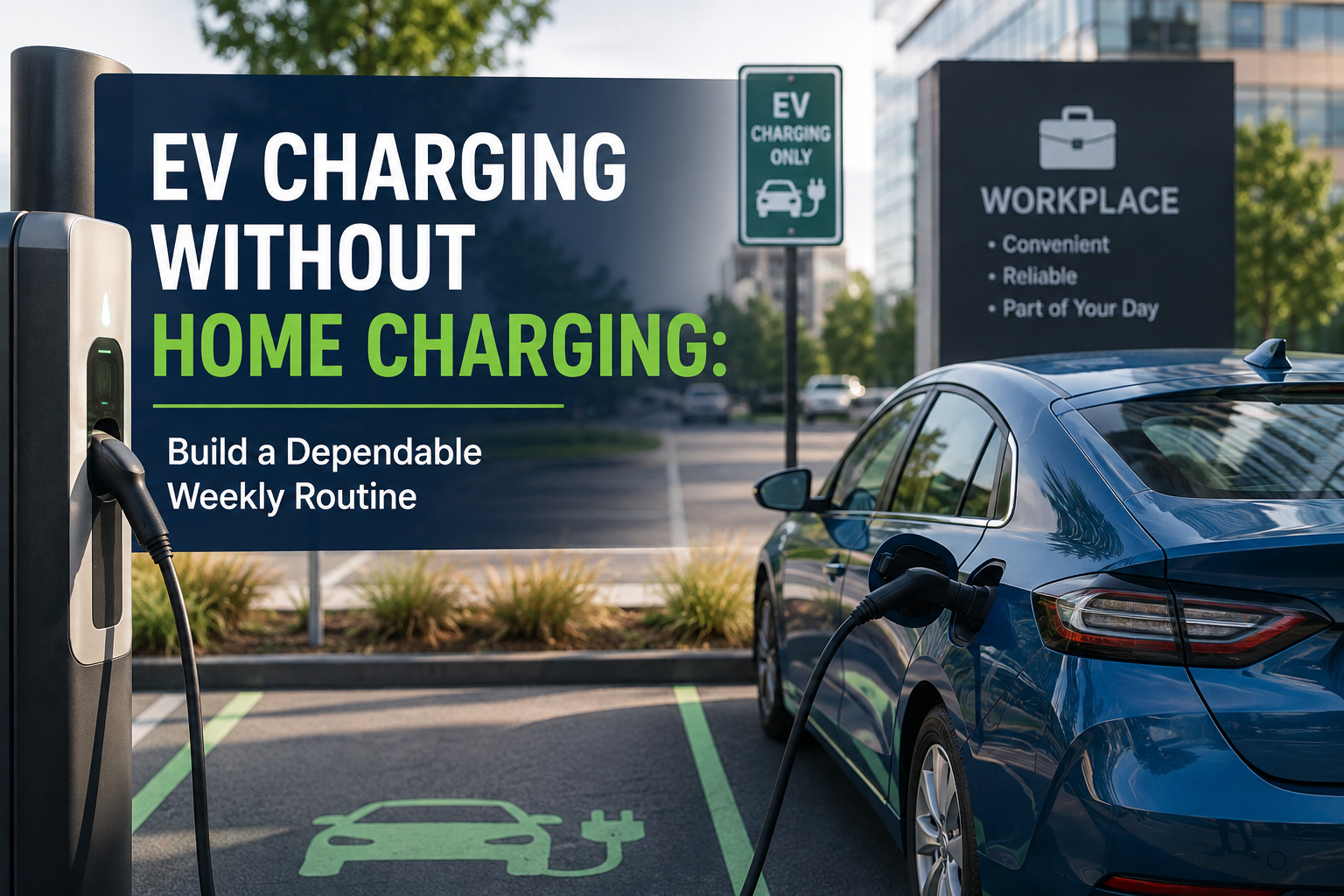
Living without dependable EV charging at home does not automatically rule out electric vehicle ownership. However, it changes the charging routine from simply plugging in overnight to planning charging around the places where you already spend time.
A practical routine usually depends on three things: predictable parking periods, realistic weekly energy needs, and backup charging options in the areas you regularly visit.
Public and workplace charging can extend the useful daily range of all-electric vehicles and reduce gasoline use for plug-in hybrid electric vehicles (PHEVs). According to the U.S. Department of Energy Alternative Fuels Data Center, general public EV charging commonly includes Level 2 and DC fast charging.
The important question is not simply whether chargers appear on a map. It is whether the available chargers fit your vehicle, schedule, budget, parking habits, and tolerance for occasional disruption.
This guide provides a practical weekly planning framework for EV drivers who rely primarily on workplace, public, or destination charging. Charging availability cannot be guaranteed. Prices, access rules, connector availability, operating hours, and station status may change, so always verify current information before relying on a location.
Start with your real weekly charging requirement
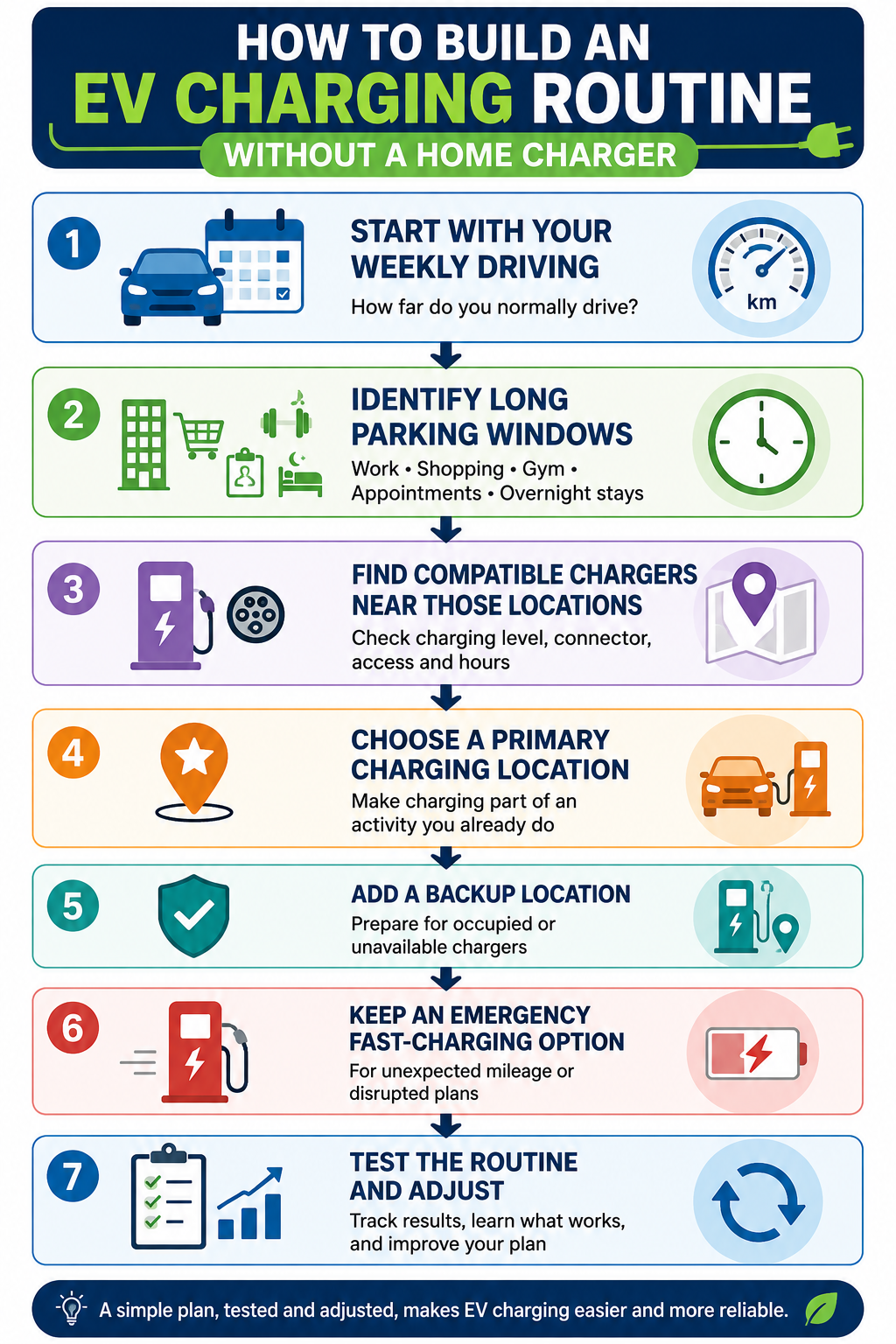
Before choosing favorite charging locations, understand what your normal driving actually requires from the vehicle.
Start with an ordinary week rather than an unusually busy road-trip week.
Write down:
- Your typical daily driving distance
- Your approximate weekly driving distance
- Your longest regular driving day
- Where the vehicle normally sits parked for one hour or more
- How often you make longer or unexpected trips
- Your vehicle's usable driving range under normal conditions
- How much battery buffer you prefer to keep
- Which days of the week have the most flexible charging opportunities
This creates a more useful picture than relying only on the vehicle's advertised range.
The DOE recommends considering typical daily driving, charging opportunities near work, and compatible public charging for longer trips when evaluating how an EV fits your needs. See the Electric Vehicles for Consumers guide.
It also helps to separate routine energy needs from occasional travel needs.
A driver covering a modest and consistent distance during the week may be able to rely on one or two planned charging sessions. Another driver may need shorter, more frequent sessions because of higher mileage, shorter parking periods, or fewer convenient chargers.
Neither approach is automatically better. The goal is to find a routine you can repeat without constantly rearranging your day around charging.
Do not assume that a charger's advertised maximum power automatically translates into a specific number of miles or kilometers added during every session. Actual charging time and power can depend on factors such as the vehicle's charging capability, battery state of charge, charger output, and equipment involved. The DOE provides additional information in its overview of electric vehicle charging stations.
Map charging around time you already spend parked
For drivers without home charging, one of the most useful strategies is to treat charging as something that happens while the vehicle is already parked, rather than as a separate errand.
Look first for places where your vehicle regularly sits for a useful amount of time.
Potential charging windows include:
- During the workday
- While grocery shopping
- During gym or fitness sessions
- At shopping centers
- During appointments
- At restaurants or entertainment venues
- In public parking garages
- During recurring classes or activities
- While visiting family or friends
- During hotel or other overnight stays
Use a charging map or station-locator tool to identify possible locations, but verify each station before making it part of your weekly routine.
For drivers in the United States and Canada, the DOE's Alternative Fueling Station Locator allows searches by location or route and provides filters for different station criteria.
Create a simple list of the areas you visit most often:
- Home neighborhood
- Workplace
- Regular shopping areas
- Recreation or fitness locations
- Family destinations
- Common travel corridors
For each area, identify more than one plausible charging station.
Record useful information such as:
- Charging location
- Charging level
- Connector type
- Number of charging ports
- Access restrictions
- Operating hours
- Parking restrictions
- Pricing
- Typical parking duration
- Charging network or payment method
A charger close to home can be valuable, but it is not automatically the best primary charging option.
For example, a Level 2 charger that fits naturally into a recurring three-hour activity may be more practical than a charger five minutes from home that requires a dedicated trip and waiting nearby.
On the other hand, a conveniently located DC fast charger may be valuable as a backup when your normal charging routine is disrupted.
Match charging speed to your parking time
Choose the charging type based on how long the vehicle will be parked and how quickly you need additional energy.
The goal is not necessarily to find the fastest charger every time. It is to make charging fit naturally into your schedule.
Use Level 2 charging when the vehicle will be parked longer
Level 2 charging can make sense during a workday, long errand, appointment, or overnight stay when the vehicle will remain parked for an extended period.
Instead of waiting beside the vehicle, charging happens while you are already doing something else.
Before relying on workplace or destination charging, check:
- Who is allowed to use the charger
- Whether it is restricted to employees, customers, residents, or hotel guests
- Whether reservations are required
- Whether there is a charging time limit
- Whether parking fees apply
- Whether you must move the vehicle when charging finishes
- Whether the charger is available outside normal business hours
The DOE's workplace charging guidance discusses strategies such as charging assignments, reservation systems, time limits, and employee-managed charging when multiple drivers share workplace infrastructure.
Do not assume that a charger located at a business or property is automatically available to everyone.
Use DC fast charging for shorter time windows
DC fast charging may be more appropriate when you need energy quickly, have a heavier-than-normal driving day, or are traveling between your usual areas.
It can also serve as a valuable contingency when your normal Level 2 charging plan falls through.
However, building an entire weekly routine around a single fast-charging station introduces additional risk. The station could be busy, temporarily unavailable, inaccessible, or simply inconvenient when your schedule changes.
The right combination of Level 2 and DC fast charging depends on your vehicle, driving habits, available infrastructure, and schedule.
Treat fast charging as one tool within the plan rather than assuming every session will deliver the maximum advertised charging speed.
Verify the details before depending on a station
A charger appearing in an app or station directory is a useful starting point, but it does not guarantee that the charging stop will work for you.
Before designating a location as your primary or backup charging station, verify the details most likely to cause a failed charging attempt.
Use this pre-charging checklist:
- Is the connector compatible with your vehicle?
- Does your vehicle require an approved adapter?
- Is the charging level appropriate for the time you will be parked?
- Is the station currently accessible?
- Are there restrictions for employees, customers, residents, or hotel guests?
- What are the station's operating hours?
- Are there parking fees in addition to charging fees?
- Is a network account or mobile app required?
- Can you pay without an account?
- Are there idle or overstay fees?
- Is there a parking or charging time limit?
- Does the network currently show the charger as available?
- Are there additional compatible chargers nearby?
For networked charging stations, software may support functions such as station discovery, status information, session activation, payment, and station monitoring. Capabilities vary by network and station, so check current network information before traveling.
The DOE provides an overview of how these systems work in its guide to electric vehicle charging networks.
Even with advance planning, allow for uncertainty.
TheJoint Office of Energy and Transportation's EV Charging User Experience and Reliability guidance identifies issues such as waiting, difficulty starting sessions, payment failures, and slower-than-expected charging as examples of problems drivers may encounter.
That is why a dependable weekly EV charging routine needs alternatives rather than relying on one preferred pin on a map.
Build a primary, secondary, and emergency charging plan
For each area you regularly visit, consider creating three levels of charging options.
This does not guarantee that every driver can comfortably operate an EV without home charging. Instead, it gives you a practical framework for deciding whether the charging infrastructure around your normal routine is sufficient.
Primary charging plan
Your primary charging location should fit naturally into something you already do every week.
It might be:
- A workplace charger
- A Level 2 charger near a recurring long errand
- A charger at a shopping center
- A charger near a gym or activity
- A destination charger used during regular overnight stays
Choose the location because it aligns with your normal parking time and route, not simply because it appears close on a map.
Know approximately:
- Which day or days you normally use it
- How long you expect to remain parked
- How much energy you typically need
- What battery level you want before your next major driving period
Secondary charging plan
Your secondary option is where you go if the primary charger is occupied, unavailable, inaccessible, or no longer fits your schedule.
Ideally, the backup should be in the same general area or along a route you already drive.
Test the secondary location before you urgently need it.
Confirm:
- How to enter the property
- Where the chargers are located
- Connector compatibility
- How payment works
- Whether an account or app is required
- Access hours
- Parking restrictions
A charging station that works well during weekday afternoons, for example, may not necessarily offer the same access late at night or during weekends.
Emergency charging plan
The emergency option is designed for a disrupted week.
You might need it after:
- Unexpected additional driving
- Missing your regular workplace charging session
- Finding your primary station unavailable
- A sudden schedule change
- Returning from a longer trip with less battery than expected
Your emergency option may be a DC fast charger or another public location capable of providing a useful amount of energy without requiring a long parking period.
The point is not to use the emergency option every week.
The goal is to know where it is, how to access it, and how it fits into your route before the battery level becomes uncomfortable.
If there is no realistic backup or emergency charging option near the places you regularly drive, that is useful information when deciding whether relying on public charging is practical for you.
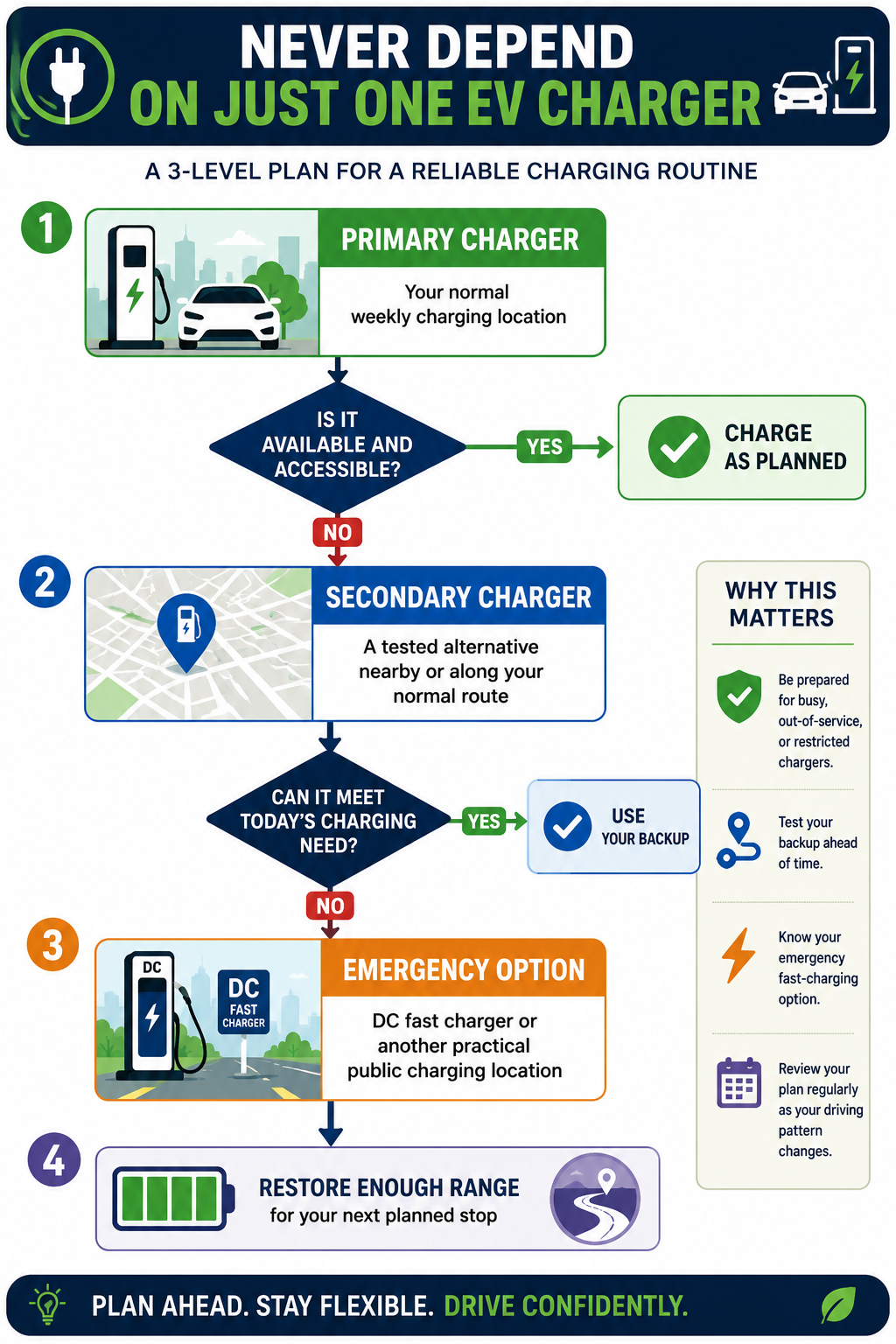
Primary → Backup → Emergency = A More Resilient Charging Routine
Test your charging routine using real-world results
A charging plan becomes much more useful after you test it against your actual driving.
For a few weeks, keep a basic record of:
- Distance driven
- Battery level before charging
- Battery level after charging
- Charging location
- Charging type
- Time spent charging
- Time spent waiting
- Cost of the session
- Parking cost, if applicable
- Whether the charger worked on the first attempt
- Whether you had to use a backup location
- Any unnecessary detour time
You do not need a complicated spreadsheet.
A simple note on your phone can reveal patterns quickly.
You might discover that workplace charging is extremely convenient but only reliable on certain days. A public charger that appeared ideal on a map might require too much extra driving. Or perhaps one planned DC fast-charging session per week makes the rest of your Level 2 charging routine comfortable.
Use the results to improve the plan rather than forcing your original strategy to work.
If your primary charger repeatedly fails the practical test, consider downgrading it to a backup and testing another location.
You should also revisit the plan when your driving pattern changes because of a new job, seasonal travel, school schedules, household responsibilities, or other regular commitments.
A dependable EV charging routine is designed for ordinary disruption
EV ownership without dependable home charging can be practical for some drivers, but the routine needs to be based on your real driving patterns and realistic access to charging.
Start with how much you actually drive and identify when the vehicle already spends time parked.
Use Level 2 charging during longer parking periods when it fits your schedule. Keep DC fast charging available for shorter stops, heavier driving days, travel, or unexpected situations.
Before depending on any charging location, confirm:
- Vehicle compatibility
- Connector availability
- Access restrictions
- Operating hours
- Payment requirements
- Parking rules
- Current station information
Most importantly, avoid building your entire charging routine around one station.
A simple structure can make the plan much more resilient:
Primary charging location → tested backup → emergency charging option
If those three options fit naturally into the places you already drive and spend time, you have a much stronger basis for deciding whether EV charging without a home charger can support your weekly routine.
Sources
- U.S. Department of Energy — Charging Electric Vehicles in Public
- U.S. Department of Energy — Electric Vehicles for Consumers
- U.S. Department of Energy — Electric Vehicle Charging Stations
- U.S. Department of Energy — Alternative Fueling Station Locator
- U.S. Department of Energy — Workplace Charging for Electric Vehicles
- U.S. Department of Energy — Electric Vehicle Charging Networks
- Joint Office of Energy and Transportation — EV Charging User Experience and Reliability