

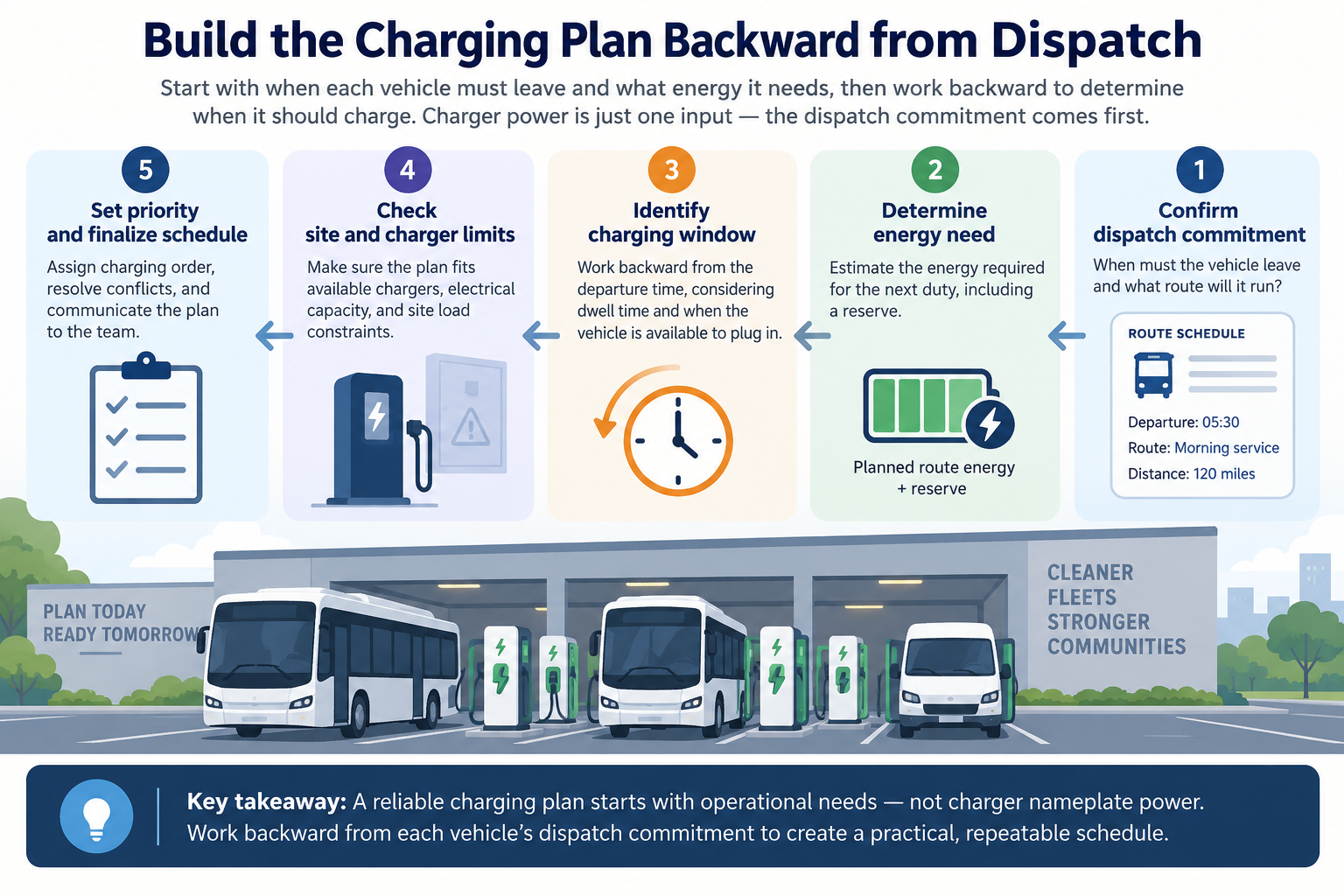
Fleet-depot charging is an operations problem before it is a charger-power problem. A depot may have chargers capable of delivering substantial energy, but that does not by itself show whether every vehicle will be ready for its assigned departure. The useful starting point is the dispatch commitment: which vehicle must leave, when it must leave, and what energy it needs to complete its next duty.
This approach helps depot hosts make deliberate trade-offs. Vehicles with long, predictable overnight dwell may have broad charging windows. Vehicles returning late, leaving early, or covering variable routes may need earlier charging access, a priority rule, or an operational fallback. The plan must also fit the electrical limits and load pattern of the site.
The objective is not to create a schedule that promises readiness under every circumstance. It is to build a repeatable process that gives operations staff a clear view of priorities, highlights conflicts early, and provides a practical response when the plan changes.
Start with dispatch commitments, not charger nameplate power
Unmanaged charging generally means vehicles begin charging as soon as they are plugged in, without accounting for electricity cost, grid capacity, or overall demand. The U.S. Department of Energy (DOE) identifies higher peak-period energy costs, possible demand charges, and pressure for infrastructure upgrades as potential challenges of that approach. DOE’s managed EV charging guidance describes managed charging as controlling when and how vehicles charge while preserving fleet operational needs.
For a depot host, that distinction leads to a simple question: what must be true at the next dispatch deadline? For each vehicle, define the required departure time and the planned energy target before deciding when it should charge.
A vehicle parked for 10 hours is not automatically flexible. It may arrive with a low battery, share chargers with other vehicles, require cleaning or maintenance before being plugged in, or be assigned an early route. Conversely, a vehicle with a shorter dwell may need only a modest energy top-up. Dwell time matters most when considered alongside energy need and the next departure.
Treat charger power as one input to this operational picture. It affects how much energy can be delivered during a window, but it does not settle the priority order, the number of vehicles charging at once, or the site’s ability to support simultaneous charging.
Define the operating inputs for each vehicle group
Avoid building a depot schedule around an “average vehicle.” Group vehicles by similar work patterns, then collect actual or planned operating data for each group. The U.S. Department of Transportation’s Charging Ahead: How Government Agencies Can Support the Electrification of Private Vehicle Fleets toolkit identifies useful route and operating-profile inputs: daily distance, stops, speed, climate conditions, route characteristics, hours of operation, and non-operating time available for charging. These inputs can help a fleet estimate performance and plan depot charging.
For each vehicle or vehicle group, record the following:
Keep the distinction between arrival and plug-in time. A vehicle might reach the depot at 18:00 but not become available for charging until it has completed inspections, unloading, cleaning, or maintenance. Planning with the earlier time can overstate the usable charging window.
It is also useful to identify variability. Ask which routes regularly overrun, which vehicles make unplanned trips, and which drivers may return to a different parking position. A schedule should be designed around normal operations, but it must acknowledge the patterns most likely to disrupt them.
Build a charging-window table
A charging-window table turns dispatch information into a working daily plan. It can begin as a spreadsheet, a dispatch-board view, or another format the depot team can reliably maintain. The key is that it is visible to the people who park, plug in, dispatch, and supervise vehicles.
A basic table could include these fields:
| Vehicle or group | Return / plug-in available | Next departure | Expected energy need | Dwell window | Priority | Planned charging window | Exception owner |
|---|---|---|---|---|---|---|---|
| Early-route group | 17:30 | 05:30 | Planned route energy plus reserve | Overnight | High | First available window | Night supervisor |
| Standard daytime group | 18:30 | 08:00 | Planned route energy plus reserve | Overnight | Medium | Staggered overnight window | Charging coordinator |
| Late-return group | 22:30 | 06:00 | Route-specific estimate | Short | High | Priority on arrival | Dispatch lead |
| Pool vehicles | Variable | Variable | Confirmed by next assignment | Variable | Flexible | Fill unused capacity | Fleet coordinator |
The values in this example are illustrative, not a readiness calculation. Each depot should set its own energy targets and escalation points based on its vehicles, routes, equipment, and operations.
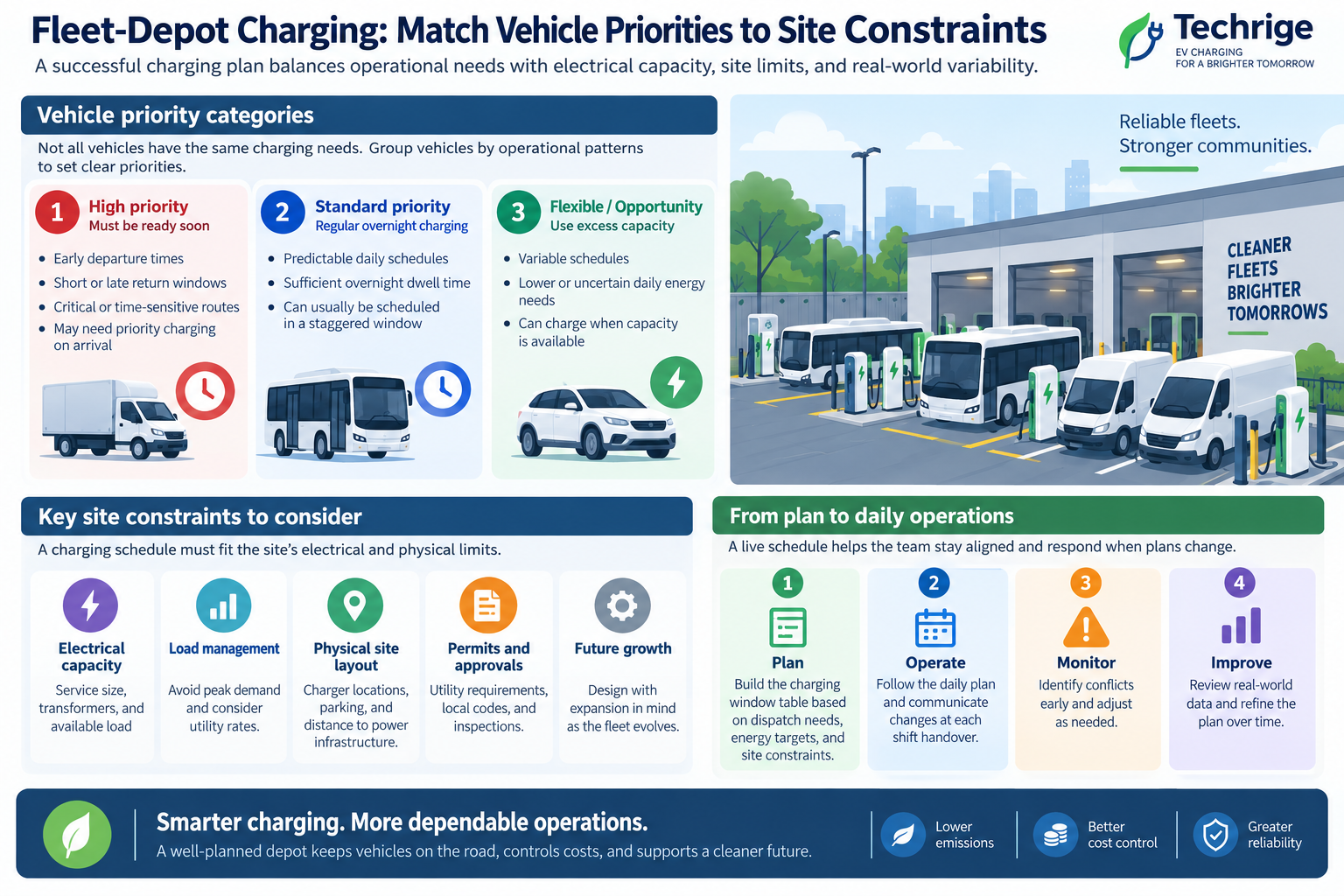
Use the table to sort vehicles into three practical categories:
The table should not be a one-time planning document. Review it at each shift handover or at another interval that matches fleet operations. The next day’s route assignments, unexpected mileage, and vehicle status can all change the order of need.
Match the schedule to site constraints
A schedule that works on paper can still create a site-load conflict. Site assessment should therefore be part of charging planning, not a separate exercise completed only at installation.
DOE’s EVI-LOCATE guidance identifies charger quantity and power level, nearby transformers and service panels, existing peak load, and available panel capacity as relevant charging-site assessment inputs. It also says metered data is the preferred input for identifying existing peak load, and that a 12-month metered peak-load record is ideal when assessing service-panel capacity.
Translate those inputs into a schedule review:
The correct answers are site-specific. Review actual interval or metered data with appropriate electrical and utility stakeholders rather than relying on assumptions about facility peaks. Rate design and demand billing also vary by account and location, so confirm the applicable tariff before treating a time period as lower-cost or higher-cost.
A practical sequencing rule is: reserve enough charging opportunity to meet high-priority departures first, then allocate remaining capacity to flexible vehicles. This makes the operating objective visible. It also reduces the chance that a low-priority vehicle consumes a shared resource while a critical early departure waits.
Choose a control approach after setting the objective
Write down the operating objective before selecting a scheduling method. Possible objectives include meeting early dispatch deadlines, limiting simultaneous charging, avoiding overlap with known facility peaks, or reducing manual work. A depot may have more than one objective, but it should decide which one takes precedence when they conflict.
Manual or static schedules
A manual or static schedule can be appropriate for a small, stable operation with predictable routes and staff who can consistently follow plug-in and reassignment procedures. Examples include a posted charging rotation, charger assignments by parking bay, or a shift checklist that identifies priority vehicles.
This method is transparent, but it has limits. DOE notes that static, manually programmed schedules may require staff updates as vehicle operations or peak and off-peak pricing schedules change. The process should therefore identify who updates the schedule, how changes are communicated, and what happens when an assigned vehicle is not present.
Managed charging
DOE describes managed charging as an approach that can control charging timing and power while maintaining operational needs. Its examples include avoiding higher-priced periods, reducing coincidence with facility peaks, and enforcing a shared charging-power ceiling. DOE also notes that networked managed-charging systems can adjust charging power or shift sessions in response to changing schedules, rates, equipment capacity, and building loads.
That does not mean every managed system will deliver those outcomes at every depot. Capability depends on the selected equipment, configuration, data inputs, vehicles, and site conditions. Before choosing an approach, ask providers and internal stakeholders to demonstrate how the proposed setup handles priority departures, shared power limits, changed route assignments, and loss of communications. Treat any integration with fleet, dispatch, or facility systems as a requirement to verify, not an assumption.
Create exception rules before the first difficult night
A normal schedule is only useful if staff know what to do when it breaks. Define a small set of exception rules, assign an owner, and make the escalation path available at the depot.
Consider rules for these situations:
Keep the language operational. For example: “If a priority vehicle has not been connected by the specified check time, the night supervisor contacts dispatch.” This is more actionable than a general instruction to “monitor charging.”
A charging plan is not a substitute for site-specific electrical design, commissioning, utility coordination, or professional advice. It is the operational layer that helps staff use the available charging setup consistently.
Run a phased pilot before expanding
A phased pilot lets the depot test the plan against real dispatch behaviour without assuming that forecasts are perfect. Start with a representative vehicle group, defined operating period, and a limited set of success measures.
Review the pilot with facilities, fleet operations, dispatch, drivers or attendants, and relevant charging or electrical providers. DOE’s fleet toolkit recommends early stakeholder coordination and planning for flexibility, noting that future electrical-service or nearby-grid upgrades may be needed as charging installations grow.
Useful review questions include:
Do not judge the pilot only by whether vehicles charged. A plan that depends on frequent staff intervention may be fragile even if it works during a short test. Update the table, priority rules, training, and site assumptions before adding more vehicles or chargers.
Pre-launch checklist for depot hosts
Before putting a recurring charging plan into service, confirm that the depot has:
Involve the utility when service capacity, rate treatment, or project coordination needs site-specific clarification. Involve licensed electrical professionals for electrical design, installation, evaluation, and changes to site infrastructure. Bring operations staff into the process early because they understand the real causes of late returns, route changes, parking conflicts, and missed connections. Consult fleet software and charging providers about the specific functions, data requirements, and operating limits of any proposed solution.
The durable principle is straightforward: plan charging backward from the next dispatch deadline, then fit that plan within real vehicle dwell windows and site constraints. That gives fleet-depot hosts a practical basis for prioritizing charging without treating a schedule as a guarantee.
Sources
- U.S. Department of Energy, Federal Energy Management Program — Managed EV Charging for Federal Fleets
- U.S. Department of Transportation — Charging Ahead: How Government Agencies Can Support the Electrification of Private Vehicle Fleets
- U.S. Department of Energy, Federal Energy Management Program — EVI-LOCATE Step by Step