
Higher gasoline prices can make drivers pay closer attention to the cost of every trip. For EV drivers and home charger owners, however, rising gas prices raise two related—but importantly different—financial questions:
- How does driving an EV compare with buying gasoline?
- Could making an existing home charger available to other drivers generate worthwhile additional income?
These questions should be evaluated separately.
Higher gasoline prices do not directly reduce electricity rates, and owning a charger does not automatically make hosting profitable. The better approach is to compare the costs and practical considerations that actually apply to your vehicle, charging habits and property.
This guide offers a practical framework for EV drivers and prospective home charger hosts in the United States.
Higher gasoline prices and EV charging are different cost questions
When gasoline prices increase, the fuel cost of operating a gasoline-powered vehicle can rise immediately.
The U.S. Energy Information Administration publishes national and regional gasoline-price data in dollars per gallon, providing a useful reference for drivers who want to follow changes in fuel prices.
View U.S. gasoline price data from the EIA
For an EV owner, though, a higher gasoline price does not directly reduce the cost of charging.
EV charging expenses continue to depend primarily on factors such as:
- your electricity rate;
- how much energy your vehicle consumes;
- where you charge;
- when you charge;
- and whether you use home or paid charging.
The U.S. Department of Energy's Alternative Fuels Data Center explains that home charging is commonly used by EV owners and can provide a convenient and cost-effective charging option. Public charging remains important when drivers need additional range or do not have convenient access to home charging.
Learn about charging an EV at home
Learn about public EV charging
The important distinction is therefore:
Gasoline vehicle operating cost = gasoline consumption × gasoline price
while:
EV charging cost = electricity consumption × applicable electricity price
If gasoline prices rise while a driver's electricity costs remain relatively stable, the operating-cost difference between the two vehicles may become larger.
But there is no universal savings percentage.
The result depends on the specific vehicles, their efficiency, gasoline prices, electricity rates and where charging occurs.
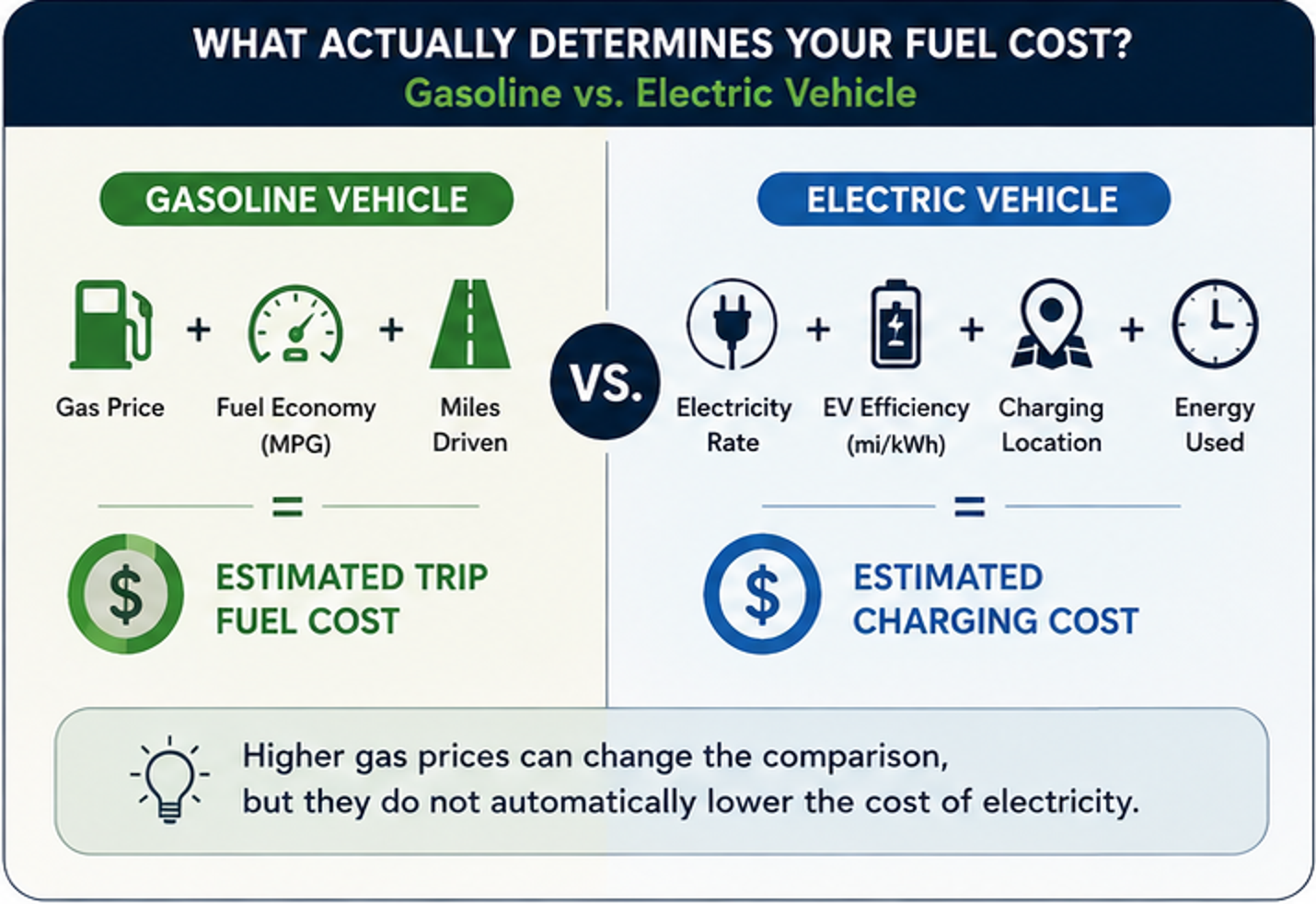
Higher gas prices can change the comparison, but they do not automatically lower the cost of electricity.
For EV drivers: compare a charging booking with the alternative that actually matters
For many EV owners, home charging is the natural reference point.
DOE notes that the majority of EV owners charge at home, while public charging can increase usable driving range and make EV travel more convenient.
That does not mean home charging is always the best option for every trip.
A paid charging session can still make sense when it:
- reduces range uncertainty;
- fits naturally into a destination stop;
- provides charging when home charging is unavailable;
- prevents an inconvenient detour;
- or helps you begin the next part of a trip with more range.
TECHRIGE allows drivers to search for available charging stations, select a time, reserve a charging slot, make a payment and visit the host location at the booked time.
See how TECHRIGE works for EV drivers
Before reserving a charger, compare the booking against your realistic alternatives rather than looking at the listed charging price alone.
What is the expected total cost?
Review the pricing shown in the listing and estimate what the session is likely to cost based on the pricing structure and charging time or energy you expect to need.
If an important detail is unclear, verify it before depending on the session.
What would charging at home cost?
Use your own electricity rate as the baseline.
If your electricity plan changes by time of day, compare the booking against the rate you would realistically pay when you normally charge—not simply the cheapest rate appearing anywhere on the utility plan.
Do you actually need the additional charge?
A nearby charging session may be valuable before a longer journey, when arriving with additional battery capacity would make the trip more comfortable, or when home charging cannot provide enough range before departure.
On the other hand, paying for another charging session may not be necessary when charging at home already covers the planned trip comfortably.
How much additional travel or waiting is involved?
Charging cost is only part of the decision.
Consider:
- distance to the charger;
- the booked charging window;
- time spent traveling there;
- whether the charging stop fits another activity;
- and whether another charging option is more convenient.
A lower listed charging price may not necessarily produce the lowest overall trip cost if reaching the charger requires a significant detour.
Does the charger fit your vehicle and charging plan?
Review the charger information provided in the listing before booking.
Confirm the details relevant to your vehicle and understand the property's access arrangements rather than assuming that every charger will work for every charging situation.
Think of paid charging as a trip-planning decision
Instead of asking:
"Is this charger cheaper than gasoline?"
a more useful question for an EV owner is:
"Is this charging option better than the alternatives available for this particular trip?"
Home charging may provide the cost baseline.
A booked charger may provide something different: location, timing, availability or convenience.
Those benefits can sometimes be more important than finding the lowest possible electricity price.
For home charger owners: EV savings and hosting income are separate
Owning an EV may reduce how frequently a household needs to purchase gasoline.
Hosting is a different financial decision.
A charger owner may choose to make unused charging availability accessible to other EV drivers during specific periods.
TECHRIGE's current host workflow allows prospective hosts to apply, list charging-station information including location, available times and pricing, control their availability and manage bookings. The platform states that hosts receive payment after a completed booking and that TECHRIGE charges a service fee for each booking.
See how TECHRIGE works for hosts
That creates an opportunity to make otherwise-unused charger availability accessible to other drivers.
It does not, however, guarantee:
- bookings;
- consistent local demand;
- a particular utilization level;
- or a specific amount of income.
Your results can depend on factors such as:
- local EV-driver demand;
- charger location;
- available hours;
- electricity costs;
- your listed price;
- platform fees;
- ease of property access;
- and the amount of effort you are willing to devote to hosting.
Start with a limited, manageable schedule
A new host does not necessarily need to make a charger available every day.
A more practical way to test hosting may be to begin with periods that are easy for your household to support.
For example:
- weekday daytime hours;
- selected evenings;
- weekends;
- or periods when your own EV normally does not need the charger.
Make the listing as clear as possible about:
- available hours;
- parking arrangements;
- charger information;
- access instructions;
- and any relevant property considerations.
Clear availability is particularly important at a residential property because the same driveway, parking space or charger may also be needed by the host.
Starting small gives you a chance to observe actual demand before increasing your availability.
A simple host break-even framework
There is no universal price that makes sense for every home charger.
Instead, evaluate the economics of each completed booking.
A useful planning formula is:
Estimated net per booking = booking revenue − electricity cost − platform fee − maintenance allowance − other host-specific costs
This is an educational planning framework, not a TECHRIGE earnings calculator or a prediction of income.
1. Booking revenue
Start with the amount generated by the completed booking before subtracting your costs.
Use the actual pricing structure associated with your listing and booking.
2. Electricity cost
Estimate the amount of electricity delivered during the session and multiply it by the electricity cost applicable to you.
A simple version is:
Estimated electricity cost = energy delivered in kWh × applicable cost per kWh
Your actual household electricity expenses may be more complicated than a single rate, especially where rates change by time or the bill contains multiple components.
The objective is not to create a perfect utility accounting model. It is to avoid treating the electricity supplied to a guest as free.
3. Platform fee
TECHRIGE currently states that it charges a service fee for each booking.
Include the applicable platform fee when determining whether the amount remaining from a booking is worthwhile.
Because platform policies and pricing can change, hosts should check the current information provided during the listing and booking process.
4. Maintenance allowance
Hosts may also choose to reserve a small amount from each booking for future maintenance or routine wear.
That could include things such as charger-related upkeep or maintaining the surrounding charging area.
This amount is a personal planning assumption rather than a prediction that a particular repair will occur.
5. Other host-specific costs and effort
Electricity is not necessarily the only cost of hosting.
Consider whether hosting requires you to:
- communicate with a driver;
- keep a parking area accessible;
- change your own charging schedule;
- manage access;
- provide instructions;
- or deal with missed or delayed arrivals.
The value of that effort will vary significantly between hosts.
Some may consider it minor.
Others may decide that making their charger available is only worthwhile above a certain expected return.
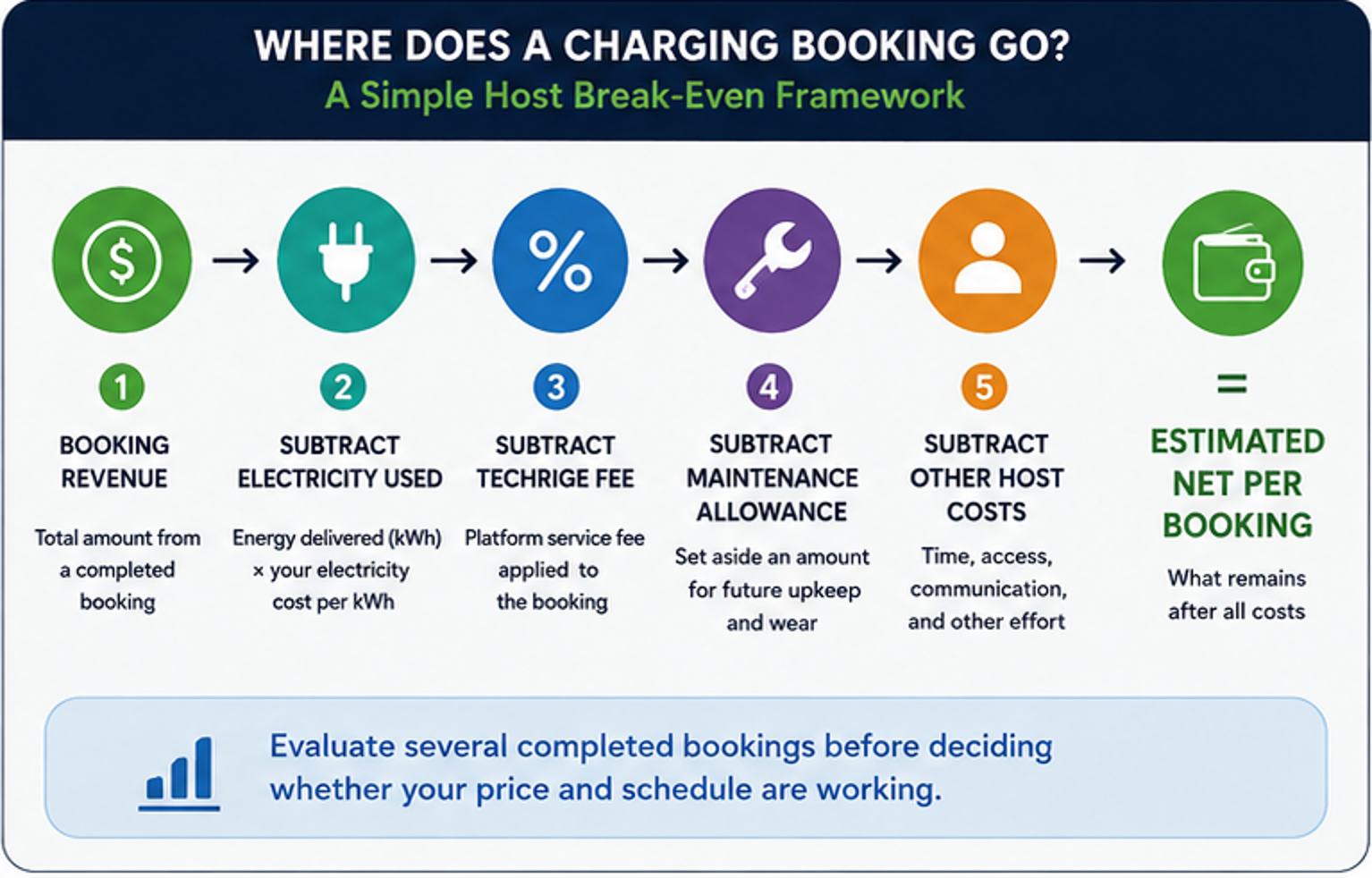
Evaluate several completed bookings before deciding whether your price and schedule are working.
Example: calculate the result without assuming a price
Instead of relying on a generic example using electricity prices that may not match your location, create your own booking record.
ItemAmountBooking revenueActual completed-booking amountElectricity costApplicable electricity cost × estimated energy deliveredTECHRIGE service feeFee associated with the bookingMaintenance allowanceYour chosen amountOther host-specific costsYour estimateEstimated netRevenue minus estimated costs
Repeat the calculation across several completed bookings.
One session may not tell you very much.
After multiple bookings, you may begin to see whether:
- the listed price makes sense;
- bookings happen frequently enough;
- your available times match driver demand;
- guests can access the charger easily;
- and the remaining amount justifies the effort involved.
Treat records and potential tax obligations as part of hosting
Receiving money for allowing others to use property or equipment can create tax considerations.
IRS Topic No. 414 states that money or the fair market value of property or services received for the use of real estate or personal property is generally taxable as rental income. The specific reporting treatment and deductible expenses can depend on the nature and circumstances of the activity.
Read IRS Topic No. 414: Rental Income and Expenses
For a charger host, maintaining organized records can therefore be useful regardless of how small the activity initially appears.
Consider recording:
- completed booking payments;
- platform fees;
- estimated electricity used for bookings;
- related expenses;
- and booking dates.
A simple spreadsheet or dedicated folder can make the activity easier to review later.
Tax treatment depends on individual circumstances and how the activity is structured, so a qualified tax professional can provide guidance for a specific situation.
This article provides general educational information and is not tax advice.
A practical pre-listing checklist for home charger owners
Before making a residential charger available to visitors, review the practical conditions around the property.
Charger
- Is the charger operating normally?
- Is the charger information in the listing accurate?
- Can you explain clearly where the driver should park and connect?
Availability
- Which hours can you reliably offer?
- Does your own vehicle need the charger during those periods?
- Can you keep the parking space available for a confirmed booking?
Access
- Can a visiting driver identify the correct parking area?
- Are instructions needed to enter the property?
- Can the driver reasonably access and leave the space during the booking period?
Pricing
- What is your approximate electricity cost?
- What platform fee applies?
- What amount would make hosting worthwhile for you?
- Have you included other costs or effort you consider important?
Household and property considerations
Think about whether allowing visiting drivers onto the property fits your parking arrangements and household routines.
Where applicable, owners should also review any property, insurance, lease, condominium, homeowners-association or local requirements that may apply to their particular situation rather than assuming that residential charger sharing is treated identically everywhere.
Review the results instead of assuming hosting works
If you decide to list your charger, treat the first few bookings as useful operating information.
Track questions such as:
Are people actually booking?
High theoretical demand for EV charging does not necessarily mean drivers will need your particular charger.
Which availability periods are requested?
Demand may occur during different hours than you originally expected.
Is the price working?
A price can appear reasonable on paper while producing different results once electricity costs, fees and actual demand are considered.
Is hosting convenient for you?
The financial calculation matters, but so does the experience of having another driver use your charging space.
Would you change the schedule?
Your first availability settings do not have to become permanent.
A limited trial gives you the opportunity to adjust them based on actual experience.
The practical takeaway
Higher gasoline prices can make the financial difference between gasoline driving and EV driving more noticeable.
They do not, however, directly make electricity cheaper.
For an EV driver, the better decision is to compare:
home charging + available booked charging + trip convenience
rather than assuming that any paid charging option is automatically inexpensive simply because gasoline prices are high.
For a home charger owner, the decision is different.
TECHRIGE provides a way for hosts to list charging-station information, set availability and pricing, manage bookings and receive payment after completed sessions, with a service fee applied to bookings under the platform's current description.
Whether that produces worthwhile additional income depends on the charger, location, electricity cost, pricing, demand, availability and effort involved.
A sensible approach is therefore:
Start small → track completed bookings → calculate your approximate net → review the experience → adjust your availability and pricing.
That provides a much better basis for deciding whether home charger sharing works for you than relying on gasoline prices or theoretical income alone.
Sources
- U.S. Energy Information Administration — Gasoline and Diesel Fuel Update
- U.S. Department of Energy Alternative Fuels Data Center — Charging Electric Vehicles at Home
- U.S. Department of Energy Alternative Fuels Data Center — Charging Electric Vehicles in Public
- IRS — Topic No. 414, Rental Income and Expenses
- TECHRIGE — How It Works
This article is intended for general educational purposes and does not constitute financial, tax, legal, electrical, insurance or property-management advice.