
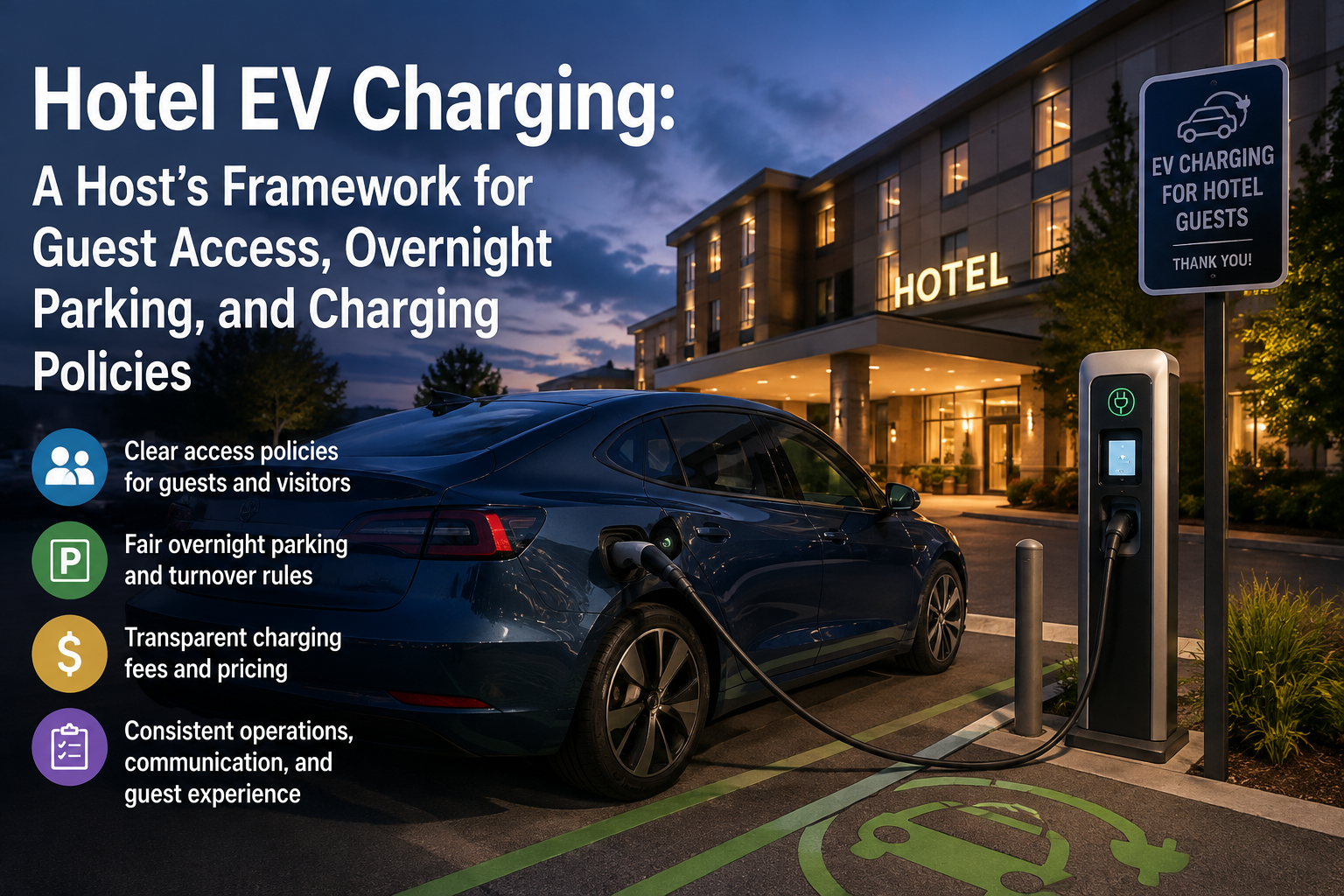
Electric vehicle charging at a hotel is more than an equipment decision. It is an operating decision that affects parking availability, front-desk conversations, guest expectations, pricing, and staff responsibilities.
Hotels have a distinctive parking pattern. Many vehicles remain parked for several hours or overnight, while other visitors may stay only for a meal, meeting, event, or short appointment.
The U.S. Department of Energy’s Alternative Fuels Data Center notes that Level 1 and Level 2 charging can be appropriate where vehicles are concentrated and parked for long periods, including hotels. (Charging Electric Vehicles in Public)
That makes destination charging worth evaluating for many lodging properties. But installing chargers does not answer the operational questions that guests and staff will eventually face:
- Who is allowed to use the chargers?
- Are charging spaces reserved for hotel guests?
- Can a vehicle remain plugged in overnight?
- What happens when every charging space is occupied?
- Is charging included with a stay or billed separately?
- Who handles a charger problem at 11 p.m.?
A clear hotel EV charging policy turns those questions into repeatable decisions. The framework below can help hotels, motels, inns, resorts, and other lodging operators create charging rules that fit their parking capacity and guest-service objectives.
Start with the parking pattern, not the charger
Before deciding how hotel EV charging will work, identify the people who use the parking area and how long they typically remain on the property.
Common groups may include:
- Registered overnight guests
- Restaurant, spa, or event visitors
- Conference and meeting attendees
- Hotel employees
- Fleet, valet, or service vehicles
- Members of the public who are not hotel guests
These groups do not necessarily need equal access.
A roadside hotel, for example, may treat EV charging primarily as an overnight amenity for registered guests. A hotel near a commercial district might give guests priority while permitting non-guests to charge during selected daytime hours. A smaller inn with limited parking may decide that charging should remain guest-only.
The goal is to define what the charging spaces are supposed to accomplish.
Write the objective in one sentence, such as:
“EV charging spaces are primarily available to registered overnight guests.”
Or:
“Hotel guests receive priority access, with public charging permitted during designated hours when capacity is available.”
That statement can then guide pricing, signs, website information, front-desk procedures, and charger settings.
Match the charging approach to parking duration and site objectives
Not every hotel needs the same type of charging equipment.
For properties centered on overnight stays, Level 2 destination charging can align naturally with vehicles that remain parked for several hours. Faster charging may make sense in other situations, but DC fast charging should not automatically be treated as a better version of Level 2.
The Alternative Fuels Data Center recommends considering expected charging needs, infrastructure, equipment, parking, site conditions, ownership arrangements, costs, maintenance, and other operational factors when planning charging infrastructure. (Procurement and Installation for Electric Vehicle Charging Infrastructure)
Useful planning questions include:
- How long do vehicles typically remain parked?
- How many EV-driving guests might need charging at the same time?
- How many parking spaces can reasonably be dedicated to charging?
- Is the objective overnight charging, faster turnover, or both?
- What electrical capacity is available at the property?
- How far are the proposed spaces from the electrical service?
- Will the chargers need network connectivity?
- Does the property want payment, access control, monitoring, or usage reporting?
- Who will own, operate, and maintain the equipment?
- How will accessible parking and charging requirements be addressed?
- Could future expansion be planned during the initial electrical work?
These questions are part of operational planning, not a substitute for site-specific electrical, accessibility, legal, permitting, fire-code, utility, or building-code requirements.
Qualified local professionals and the relevant authorities should be involved where those requirements apply.
Choose and document a hotel EV charging access policy
The access policy should answer one basic question:
Who may charge, and when?
The strongest policies are easy for guests to understand and specific enough for hotel employees to apply consistently.
Guest-only charging
Charging is limited to registered hotel guests.
This approach can fit properties that treat EV charging as a lodging amenity or have relatively few charging spaces.
The hotel should still define:
- How guest eligibility is confirmed
- Whether charging is available before check-in
- Whether access continues after checkout
- Whether employees or restaurant visitors have separate access
- Whether a guest may use the charger for multiple nights
Guest-priority charging
Registered guests receive priority, while other drivers may use chargers when capacity is available.
This policy requires a clear definition of priority.
For example, the property might:
- Allow public charging only during designated daytime hours
- Release unused spaces when no guest charging requests are pending
- Restrict selected chargers to overnight guests while keeping others more broadly available
Avoid relying on staff to invent the rule during a busy evening.
Public charging during defined hours
Some hotels may choose to permit non-guests to charge during certain periods.
If public access is allowed, communicate:
- Permitted charging hours
- Parking restrictions
- Charging and parking fees
- Whether overnight parking is prohibited
- What happens if guest demand increases
- Whether drivers must leave the property while charging
Parking access and charger access should be treated as related but separate questions.
Reservation or request-based charging
A smaller property may choose to manage chargers through the front desk or another request process.
Be careful with the word reservation.
Allowing a guest to request a charger is not necessarily the same as guaranteeing that a charging space will be available at a specific time. Only advertise charger reservations if the hotel has a system capable of reliably honoring them.
Likewise, avoid publishing only:
“EV charging available.”
That phrase can create more certainty than the property intends.
Actual availability may depend on:
- Charger condition
- Space occupancy
- Guest eligibility
- Vehicle compatibility
- Access hours
- Current hotel policy
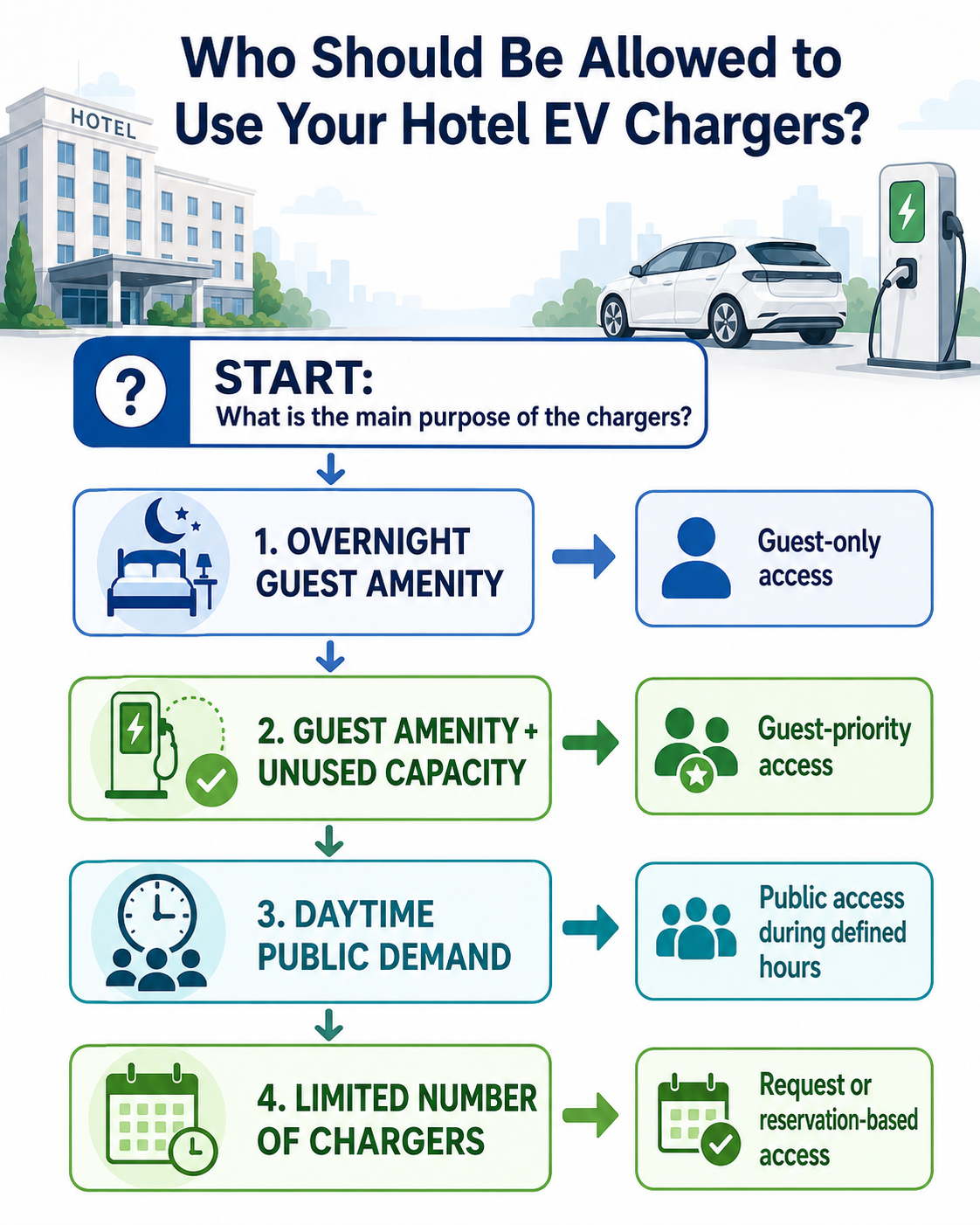
Define the rule before demand exceeds capacity.
Create an overnight charging and parking policy
Overnight parking creates one of the most important policy questions for hotel EV charging.
A vehicle can finish charging long before the guest is ready to leave.
That is not necessarily a problem. Destination charging is designed around longer parking periods. But once demand begins to exceed the number of available chargers, hotels need a predictable way to manage those spaces.
A workable policy should address:
- Whether overnight parking while connected is allowed
- Whether vehicles should be moved after charging finishes
- Whether move requests apply only when another guest is waiting
- How a guest will know that charging has finished
- How the hotel contacts the vehicle owner
- Whether late-night vehicle moves are expected
- Whether exceptions apply during low-demand periods
- Whether non-charging EVs may remain in charging spaces
- What happens after checkout
For a property with ample charger capacity, allowing a guest to remain connected overnight may provide the best experience.
At a hotel where chargers are frequently full, the property might instead ask guests to move their vehicle after charging when practical and when another driver needs access.
The policy should match the actual parking environment rather than automatically imposing aggressive turnover rules.
Front-desk escalation should also be proportionate. Staff might begin with a courteous reminder, explain that another guest is waiting, and provide a practical next step.
Management should decide in advance when staff may contact a vehicle owner and how recurring parking conflicts should be documented.
Separate the charging-space policy from the parking policy
A guest may be authorized to use an EV charger while still being subject to the hotel’s normal parking rules.
For example, separate rules may apply to:
- Overnight parking
- Valet parking
- Paid parking
- Event parking
- Hotel checkout
- Accessible parking
- Loading areas
- Employee parking
Publishing these rules together in straightforward language can reduce misunderstandings.
A statement might say:
“EV charging is available to registered guests subject to availability. Hotel parking rules continue to apply, and guests may be asked to move a fully charged vehicle when charging demand is high.”
The exact wording should reflect the property's actual policy.
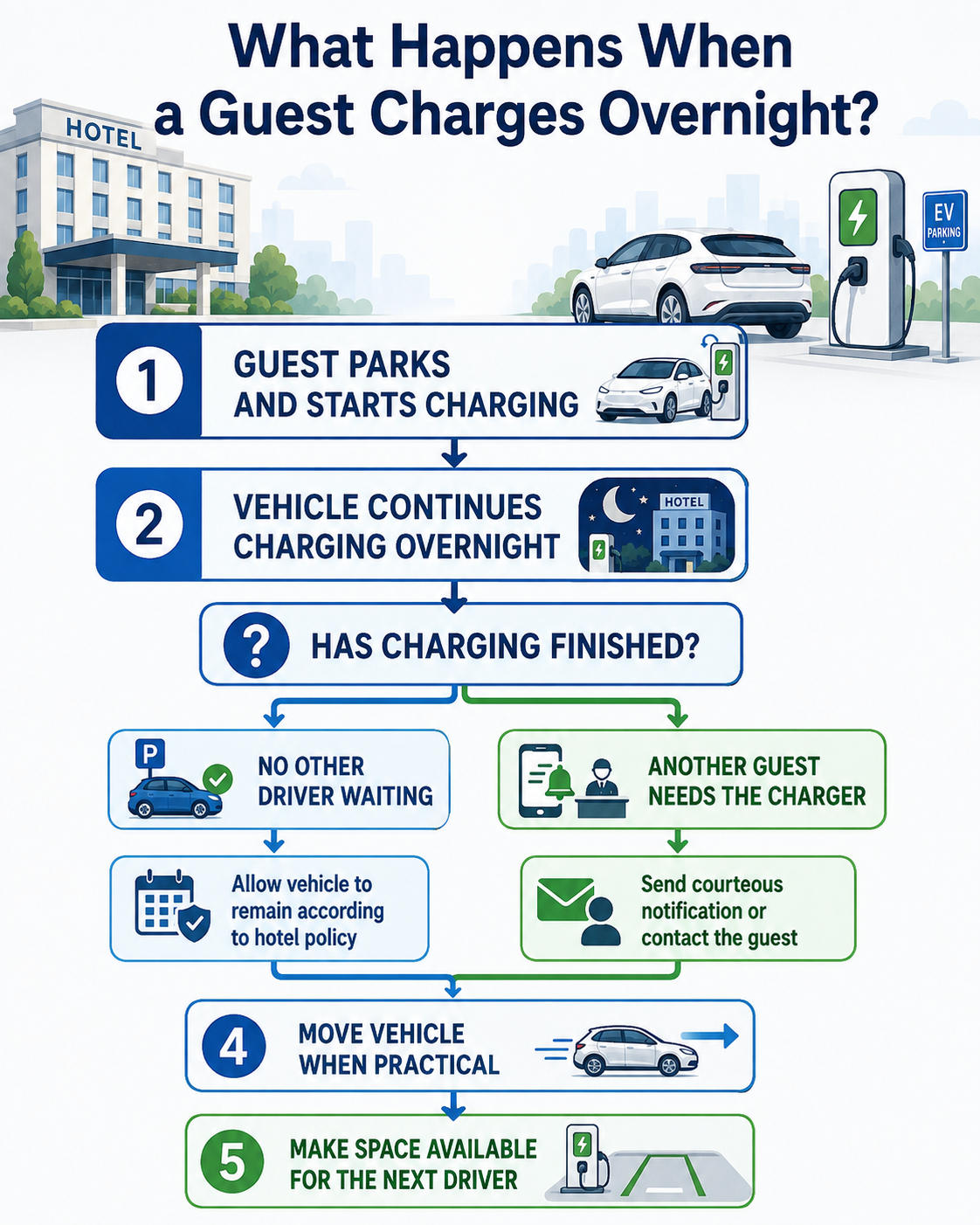
Clear expectations before check-in prevent late-night parking conflicts.
Decide how EV charging fees and hotel parking fees work together
Pricing should support the access policy rather than contradict it.
A hotel might choose to:
- Include charging with the room
- Charge separately for electricity
- Charge based on charging time
- Apply a session fee
- Combine EV charging with paid parking
- Offer different terms to guests and non-guests
- Use another pricing structure supported by its equipment and local rules
The correct approach will depend on the property's costs, guest expectations, parking model, equipment capabilities, applicable regulations, and business objectives.
Before enabling payments or publishing rates, define:
- Who pays for charging
- Whether hotel guests receive a different rate
- Whether regular parking fees also apply
- When charging fees begin and end
- Whether any post-charging or occupancy fee exists
- Who handles billing questions
- Who may issue refunds or adjustments
- How price changes are communicated
Ownership arrangements also matter.
The Alternative Fuels Data Center explains that charging projects can involve different ownership, network, maintenance, data, transaction, and payment structures. (Procurement and Installation for Electric Vehicle Charging Infrastructure)
Confirm who controls pricing and billing before front-desk staff make commitments to guests.
Build EV charging information into the guest journey
A good hotel EV charging experience begins before the guest reaches the parking lot.
Charging information should appear at the points where guests make decisions.
Hotel website and booking information
Publish only information that the property has verified.
Useful details can include:
- Number of charging ports
- Charging level or equipment type
- Who may use the chargers
- Access hours
- Whether charging is complimentary or paid
- Parking fees
- How charging is started
- Whether access is first-come, request-based, or reservable
- Any important overnight-parking rule
Avoid implying that charging is guaranteed unless the property actually guarantees a space.
Likewise, avoid claiming universal vehicle compatibility unless it has been confirmed.
Pre-arrival communication
If EV charging is an important amenity, consider including basic instructions in pre-arrival communications.
For example:
- Where the chargers are located
- Whether the guest should contact the front desk
- Whether access credentials are required
- Whether charger availability is guaranteed
- What overnight parking rule applies
This can prevent the guest from reaching the parking area with different expectations.
Front-desk scripts
Hotel employees do not need to become EV technicians.
They do need a reliable source of information.
A short staff script can explain:
- Charger location
- Eligibility
- Current availability
- How a session is started
- Applicable fees
- Overnight parking expectations
- What to do when the station does not work
- Who handles technical support
If a charger is temporarily unavailable, employees should have a simple way to know about it so they do not continue directing guests toward equipment that is out of service.
On-site signs
Signs should reinforce the charging policy.
Depending on the property, useful information may include:
- EV charging directions
- Authorized users
- Access hours
- Active-charging expectations
- Parking restrictions
- Applicable fees
- A support or front-desk contact
Signage should also be reviewed against applicable local parking and accessibility requirements.
Public charger listings
If the hotel publishes its charging stations in network apps, station directories, or other driver-facing tools, those listings should match the real property rules.
The Alternative Fuels Data Center explains that network service providers may enable operators to manage access, set fees, monitor station health, and review utilization data while allowing drivers to find stations, view status, start sessions, and make payments. (Electric Vehicle Charging Networks)
Those capabilities depend on the network, charger, contract, and configuration. They should be confirmed rather than assumed.
A hotel listing should be updated if:
- Access hours change
- Charging becomes guest-only
- A charger is removed
- Equipment is temporarily unavailable for an extended period
- Fees change
- The parking arrangement changes
Assign responsibility before something goes wrong
Hotel EV charging can become difficult to operate when every task has an unclear owner.
Assign responsibility for routine charging operations before the first problem occurs.
A practical responsibility list might include:
- Checking charging spaces for obvious damage or blockage
- Confirming whether stations appear operational
- Reviewing network alerts, where available
- Helping guests understand the access procedure
- Handling basic charging and parking questions
- Escalating technical problems
- Contacting the equipment or network provider
- Managing billing or refund questions
- Updating website and booking information
- Updating public charger listings
- Reviewing parking conflicts
- Coordinating preventive maintenance
At a small property, one employee may handle several of these responsibilities. The important point is that ownership is defined.
Include charger inspection and maintenance in hotel operations
Charging equipment should not be treated as a set-it-and-forget-it amenity.
ENERGY STAR's Energy and Water Efficiency Checklist for Hotels, Motels, and Inns recommends considering separate metering of charger electricity use and notes that EV chargers may require periodic inspection, testing, and preventive maintenance typically performed by a qualified electrical contractor. (ENERGY STAR Hotel Efficiency Checklist)
Routine hotel checks can include obvious issues such as:
- Damaged connectors
- Damaged cables
- Broken signs
- Blocked charging spaces
- Visible equipment damage
- Repeated fault messages
- Incorrect guest-facing information
Employees should not attempt electrical repairs unless they are appropriately qualified and authorized.
The Alternative Fuels Data Center also provides guidance specifically covering charging infrastructure operation and maintenance. (Operation and Maintenance for Electric Vehicle Charging Infrastructure)
Understand what networked or smart chargers can—and cannot—do
Networked charging equipment can make hotel operations easier, but capabilities vary.
ENERGY STAR notes that some connected EV charger models support features such as remote power monitoring and control of charging state. (Electric Vehicle Chargers)
Depending on the equipment and network, a hotel may have access to functions such as:
- Charger-status monitoring
- Access control
- Pricing configuration
- Charging-session information
- Usage reporting
- Remote administrative tools
Do not assume every charger supports these functions.
Confirm the capabilities of the property's actual equipment and give employees access only to the tools they are authorized and trained to use.
Review the hotel EV charging policy using real operating experience
An EV charging policy should evolve as the hotel learns how guests actually use the equipment.
Review the policy after an initial operating period and periodically afterward.
Useful questions include:
- Are all charging spaces routinely occupied overnight?
- Are guests waiting for chargers?
- Are chargers sitting unused for long periods?
- Are non-guests using capacity intended for hotel guests?
- Are vehicles remaining in spaces long after charging ends?
- Are staff receiving the same questions repeatedly?
- Are guests confused about fees?
- Does the website describe charging accurately?
- Are charger listings still correct?
- Are equipment faults being resolved quickly enough?
- Would different access hours improve utilization?
- Does the hotel need additional charging capacity?
- Are current rules creating unnecessary work for staff?
Usage data can help where it is available, but staff observations and guest feedback are also valuable.
Build the policy around the guest experience
A successful hotel EV charging program is not defined only by the number or power of its chargers.
It is defined by whether guests understand how to use them and whether employees can manage the spaces consistently.
For hotel hosts, the strongest foundation is usually a combination of:
- A clear charging purpose
- Defined guest-access rules
- Realistic overnight parking expectations
- Transparent pricing
- Accurate booking and pre-arrival information
- Visible on-site instructions
- Assigned staff responsibilities
- Reliable maintenance and support
- Periodic review based on actual demand
The objective is not to create a rule for every possible charging situation. It is to create a hotel EV charging policy that is understandable, manageable, and aligned with the property's parking capacity and guest-service goals.
Clear policies can prevent many of the conflicts that equipment alone cannot solve.
Sources
- U.S. Department of Energy Alternative Fuels Data Center — Charging Electric Vehicles in Public
- U.S. Department of Energy Alternative Fuels Data Center — Procurement and Installation for Electric Vehicle Charging Infrastructure
- U.S. Department of Energy Alternative Fuels Data Center — Operation and Maintenance for Electric Vehicle Charging Infrastructure
- U.S. Department of Energy Alternative Fuels Data Center — Electric Vehicle Charging Networks
- ENERGY STAR — Energy and Water Efficiency Checklist for Hotels, Motels, and Inns
- ENERGY STAR — Electric Vehicle Chargers