
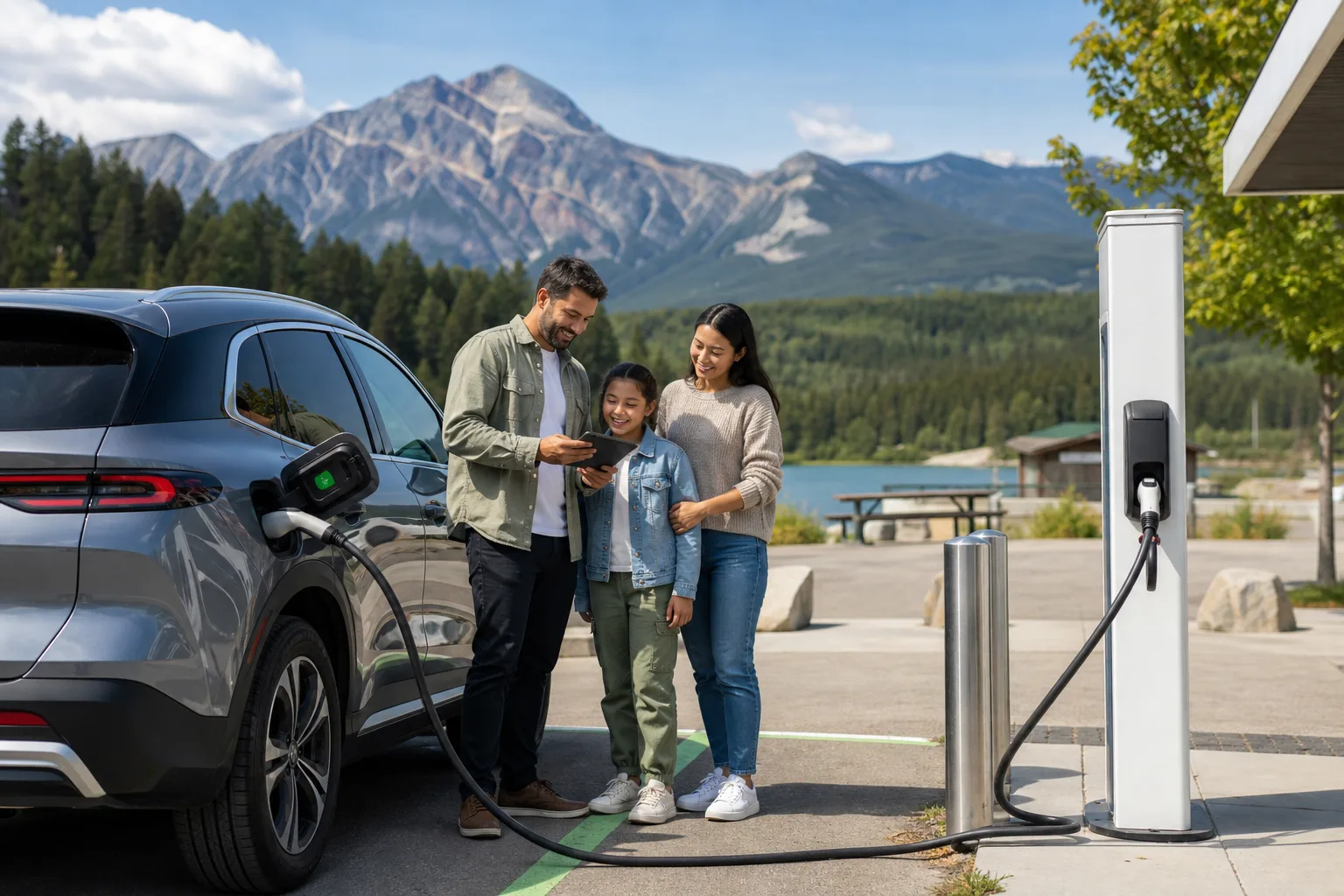
An EV road trip is easiest when you plan it as a series of charging decisions rather than a single range estimate. Your route may work well on paper, but a useful plan also accounts for connector access, charging speed, station access rules, payment preparation, and a realistic alternative if a stop does not suit your needs.
The U.S. Department of Energy recommends planning ahead for longer electric trips, confirming that stations on the route are compatible with your vehicle, and planning charging stops as needed. Read its EV consumer guidance.
1. Start with your vehicle
Before choosing a route, check the details that define which public chargers you can use:
Use the range shown by your vehicle as a planning input, not a promise. Speed, weather, elevation, passenger and cargo load, and driving conditions can all affect how far one charge will take you.
Your vehicle's built-in navigation may be helpful, but its features vary. For example, Tesla's Model 3 documentation describes a Trip Planner that can add Supercharger stops and show estimated arrival battery level and charging time. That is an example of a vehicle-specific tool, not a capability to assume across all EVs, model years, or charging networks.
2. Build a primary route around compatible charging
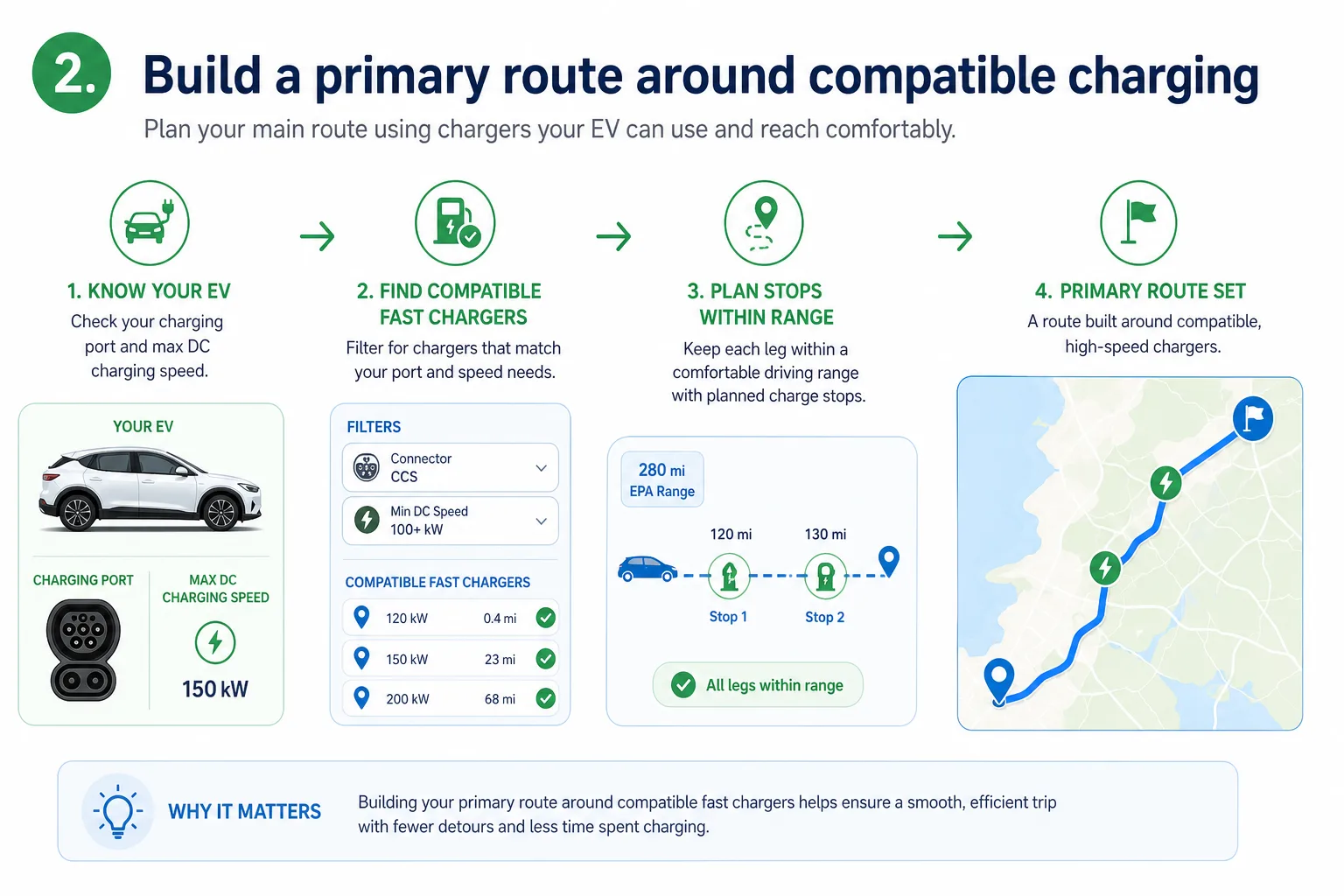
For an intercity trip, identify compatible public charging stations along the route before you leave. The Alternative Fueling Station Locator covers charging stations in the United States and Canada and defaults to publicly accessible, available stations. It can be a practical starting point for mapping the corridor you intend to travel.
Think about stops by their role:
Avoid selecting a stop solely because it appears closest on a map. A slightly earlier or later station may give you a better margin for the next leg, more nearby services, or a stronger fallback option.
3. Check every planned charging stop
Review each key stop individually, especially those needed to complete a long stretch. The Joint Office notes that station-search tools can be filtered by charging level, access type, station status, charging network, and connector type. Use those filters to narrow the results to chargers that fit your vehicle and plan.
For each primary stop, check:
Real-time information can help drivers assess expected charger availability, but it should not be treated as a guarantee. The Joint Office highlights the value of current charger information for trip-planning tools, including information that helps drivers find chargers and assess expected availability. Learn more about that context.
4. Make backup stops part of the route
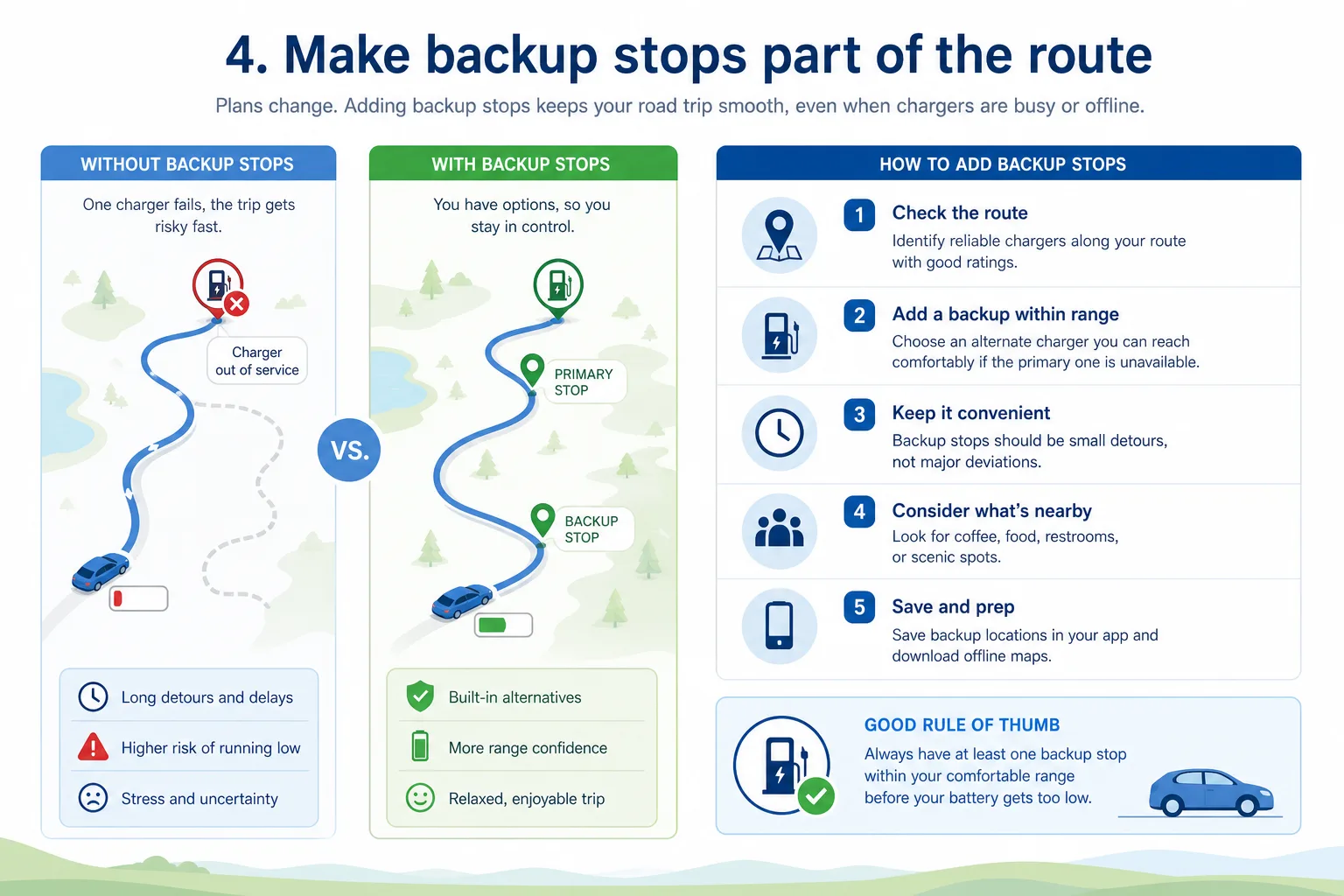
A backup plan is not a sign that the primary plan is poor. It is a practical response to changing conditions, such as an occupied charger, a station outage, an access issue, or a slower-than-expected drive.
For every major charging leg, identify one compatible fallback station. Record its location, connector type, and the point at which you would choose it instead of continuing. If possible, choose backups that are far enough apart that they do not create the same single point of failure.
A simple decision rule can help: if your expected arrival charge drops below the margin you planned, or the next station's status creates doubt, stop earlier at a compatible option rather than relying on a narrow arrival estimate.
5. Recheck the plan on departure day
Begin with the charge level your plan assumes. Then review live station information, route conditions, and any changes to your schedule. Use in-vehicle navigation where it suits your vehicle, while keeping your primary and backup stops available in another accessible format.
During the drive, reassess at each charging stop. Your next decision should reflect your actual battery level, the next station's current information, and your available fallback—not only the original itinerary.
A note for charger hosts
Travelling drivers make route decisions using the information they can find. Clear access instructions, accurate site details, and current operating-status information can make a station easier to include in a practical trip plan. If you host charging, consider reviewing what a first-time visitor needs to know: where to enter, when charging is accessible, how parking works, and whom to contact if there is a site issue.
A reliable road-trip plan is not about predicting every outcome. It is about arriving with compatible options, enough decision time, and a backup before you need one.
Sources
- U.S. Department of Energy, Alternative Fuels Data Center. Search for Alternative Fueling and Charging Stations
- U.S. Department of Energy, Alternative Fuels Data Center. Electric Vehicles for Consumers
- Joint Office of Energy and Transportation. New Resource Provides API Implementation Tips to Improve the Public Charging Experience
- Joint Office of Energy and Transportation. Electric Vehicle Charging Stations
- Tesla. Maps and Navigation