
A Level 2 EV charger can be a practical way to add range while you shop, work, dine, attend an appointment, or spend time at another destination. But Level 2 charging is usually designed around longer parking stays, not the rapid top-ups associated with DC fast charging.
So the most useful question is not simply:
“Is there an EV charger there?”
It is:
“Will the energy I can add during the time I am parked cover what I need for my next drive?”
Answering that question requires only a few inputs. With a conservative estimate, you can decide whether plugging into a Level 2 charger is worthwhile, whether you should extend your stop, or whether you need a faster or more reliable charging option.
Start With Your Parking Time and Actual Charging Need
Before estimating anything, identify two numbers:
- How long do you realistically expect to be parked?
- How much additional energy or driving range do you need afterward?
This avoids a common EV charging mistake: assuming that every Level 2 charger will significantly change your battery level.
A 30-minute grocery stop may add useful range, but it probably will not replace the energy consumed during a long highway drive. An eight-hour workplace stay can be much more valuable because even a moderate charging rate has hours to accumulate energy.
The U.S. Department of Energy's Alternative Fuels Data Center says that Level 2 charging typically adds about 10 to 30 miles of range per hour.
U.S. Department of Energy — Electric Vehicles for Consumers
That range is useful for planning, but it is not a guarantee for every vehicle, charger, or charging session.
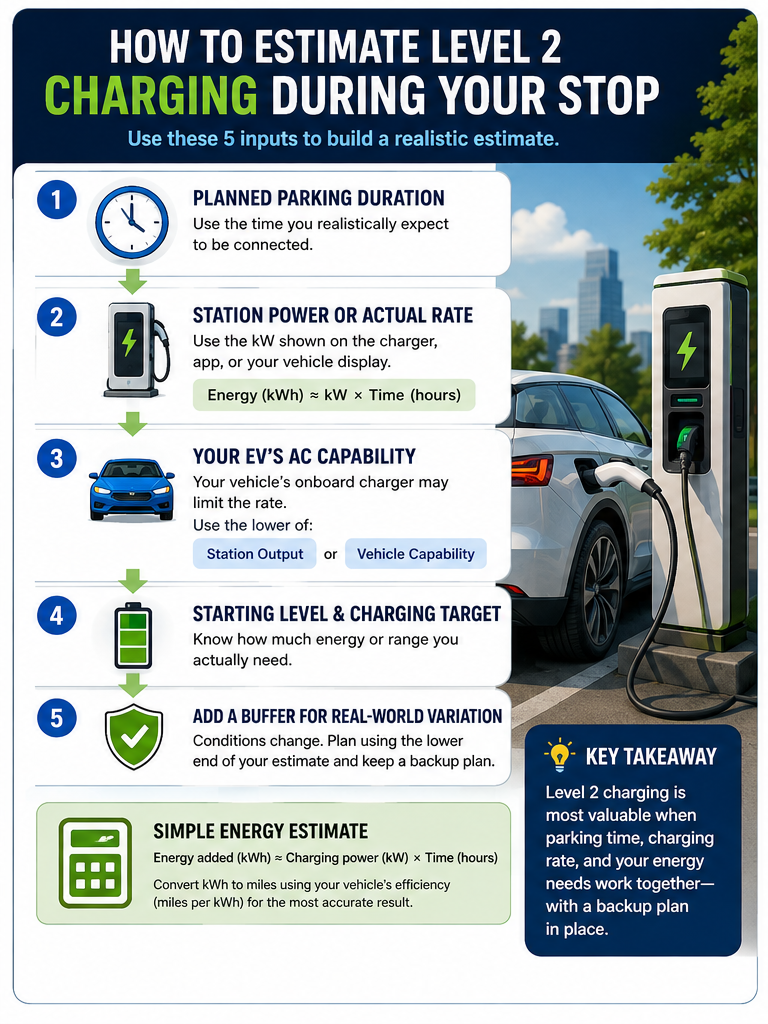
Gather Five Inputs Before You Decide
Use these five factors to build a realistic Level 2 charging estimate.
1. Planned Parking Duration
Estimate how long your EV will actually be connected to the charger.
Do not simply use the venue's opening hours.
For example, a two-hour appointment may provide less than two full hours of charging if:
- the charging spaces are occupied when you arrive;
- parking or charger access takes extra time;
- you spend time starting the charging session;
- you arrive later than expected; or
- you need to leave early.
If your schedule is uncertain, use the shorter realistic parking time for your estimate.
2. Charger Power or Actual Charging Speed
If the charging station listing, charger screen, or vehicle display provides the charging rate in kilowatts (kW), use that number whenever possible.
A simple estimate is:
Energy added (kWh) ≈ Charging power (kW) × Charging time (hours)
For example:
6 kW × 2 hours = approximately 12 kWh
That does not necessarily mean exactly 12 kWh will reach the battery. Real-world charging conditions and other losses can affect the final result.
But it provides a much better planning estimate than simply seeing the words Level 2 and assuming a specific charging speed.
If you do not know the charger's kW output, you can use a range-per-hour estimate.
The Department of Energy lists Level 2 charging at approximately 10 to 30 miles of range per hour.
ChargePoint provides a somewhat broader estimate, stating that Level 2 charging may add approximately 25 to 50 miles of range per hour, depending on station amperage and vehicle capability.
ChargePoint — Charging Types and Speeds
The difference between these estimates reinforces an important point:
There is no single universal Level 2 charging speed.
3. Your EV's AC Charging Capability
The charging station may be capable of providing more AC power than your EV can accept.
With Level 2 charging, the station supplies AC electricity to the vehicle. The vehicle's onboard charger then converts that electricity into DC power for the battery.
The U.S. Department of Energy explains that the vehicle's onboard charger can therefore limit the charging rate.
U.S. Department of Energy — Electric Vehicle Supply Equipment Infrastructure
For practical planning, your actual charging power will generally be limited by whichever is lower:
Charging station output
or
Vehicle AC charging capability
For example, if a station can provide 11 kW but your EV's onboard charger accepts only 7.2 kW, you should not plan around receiving 11 kW.
Once charging begins, your vehicle display can be especially useful because many EVs show the actual charging power being received.
Your vehicle owner's manual or manufacturer documentation can also tell you its maximum AC charging capability.
4. Starting Battery Level and Charging Target
Next, consider how much energy you actually need.
Ask yourself whether the purpose of the stop is to:
- add a small safety buffer;
- replace the energy used during today's drive;
- gain enough range to reach home;
- prepare for another trip later that day; or
- charge close to your normal daily target.
You may not need the maximum amount of energy the charger could theoretically provide.
For example, if you arrive at 65% and normally stop charging at 80%, a long parking stay does not necessarily mean your EV will continue accepting energy for the entire time.
Avoid building a plan around reaching an exact battery percentage at an exact minute.
Give yourself some margin.
5. Add a Buffer for Real-World Variation
Charging estimates should always include some flexibility.
The actual range you gain can vary because of:
- vehicle efficiency;
- outside temperature;
- battery temperature;
- route and elevation;
- highway versus city driving;
- HVAC use;
- charging conditions;
- vehicle charging limits;
- station power;
- shared charging infrastructure; and
- how long the vehicle actually remains connected.
For an important trip, make your decision using the lower end of your reasonable estimate.
If the conservative result covers your next drive plus a comfortable reserve, the charging stop is more likely to work for your needs.
If your plan only works when everything performs at the optimistic end of the estimate, you should identify a backup charging option.
Two Simple Ways to Estimate Level 2 Charging
You can estimate the value of a charging stop using either energy or expected range.
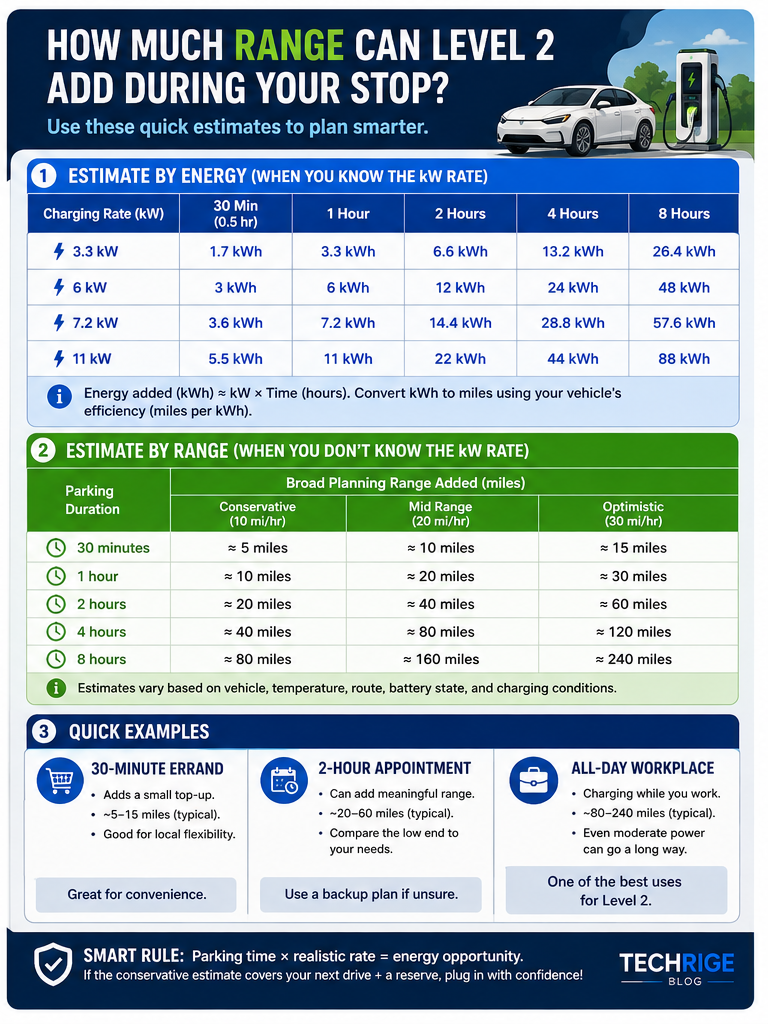
Method 1: Estimate Energy Added From kW
If you know the approximate charging power:
Energy added (kWh) ≈ Charging power (kW) × Time connected (hours)
Examples:
| Charging rate | Parking time | Approximate energy |
|---|---|---|
| 6 kW | 30 minutes | 3 kWh |
| 6 kW | 1 hour | 6 kWh |
| 6 kW | 2 hours | 12 kWh |
| 7.2 kW | 4 hours | 28.8 kWh |
| 7.2 kW | 8 hours | 57.6 kWh |
These are simple planning calculations rather than promises of exactly how much energy will reach the battery.
To convert energy into approximate driving range, use your EV's recent efficiency.
For example, if your vehicle normally achieves approximately 3.5 miles per kWh:
12 kWh × 3.5 miles/kWh ≈ 42 miles
Using your own vehicle's efficiency is usually more useful than relying on another EV owner's experience.
Method 2: Estimate Using Range Added Per Hour
If you do not know the charger's actual kW rate, use a cautious range-per-hour estimate.
Using the Department of Energy's broad estimate of 10 to 30 miles per hour:
| Parking time | Broad planning estimate |
|---|---|
| 30 minutes | About 5–15 miles |
| 1 hour | About 10–30 miles |
| 2 hours | About 20–60 miles |
| 4 hours | About 40–120 miles |
| 8 hours | About 80–240 miles |
The longer-duration numbers should not be interpreted as guaranteed range.
Your EV may:
- reach its charging target before the parking period ends;
- accept less power than the charger can provide;
- reduce or stop charging;
- experience different conditions than assumed; or
- simply require less energy than the theoretical maximum.
The table mainly demonstrates why Level 2 charging becomes increasingly useful when the vehicle will already be parked for several hours.
For additional context, the Department of Energy provides an example of a typical EV sedan gaining about 25 miles of range per hour from a 6.7 kW Level 2 charger.
That is an illustration—not a universal charging rate.
Example 1: A 30-Minute Errand
Imagine you are stopping for groceries for approximately 30 minutes.
You only need a little additional range for local driving afterward.
Using the Department of Energy's broad Level 2 range, a half-hour charging session might add approximately:
5 to 15 miles of range
depending on the charger, vehicle, and conditions.
Is it worth plugging in?
Probably yes if:
- the charger is conveniently located;
- you only need a small top-up;
- starting the session is easy; and
- you are already parking there.
Probably not as your only plan if:
- you need significant range;
- you have a long highway drive afterward; or
- your remaining battery level is already low.
For a short stop, convenience matters almost as much as charging speed.
Example 2: A Two-Hour Appointment
Suppose you will be parked for approximately two hours.
At a theoretical 6 kW charging rate:
6 kW × 2 hours ≈ 12 kWh
If your vehicle averages around 3.5 miles per kWh, that could represent roughly:
42 miles of additional driving range
under similar driving conditions.
Alternatively, using the Department of Energy's broad range-per-hour estimate gives a planning range of approximately:
20 to 60 miles
Is it worth plugging in?
Two hours can make Level 2 charging quite useful.
Compare the conservative estimate with the distance you need to drive after the appointment.
If even the low-end result leaves enough range for your next trip plus a reserve, the stop is a good candidate.
If your plan only works at the highest estimated charging rate, identify a backup charger.
Example 3: An All-Day Workplace Stay
Level 2 charging is especially well suited to vehicles that remain parked for several hours.
Imagine arriving at work in the morning and remaining there for most of the day.
Even a relatively moderate charging rate can add significant energy over that amount of time.
The important question is usually no longer:
“How fast is this charger?”
Instead, it becomes:
“Can it add the energy I need before I leave?”
A lower-powered Level 2 charger may still work extremely well when the vehicle is parked for six, seven, or eight hours.
Is it worth plugging in?
For workplace parking, Level 2 charging can be highly practical because charging happens while the vehicle would already be sitting unused.
Set an appropriate charging target and follow the property's rules about moving your vehicle after charging finishes.
Why the “Level 2” Label Is Not Enough
Level 2 is a charging category—not one fixed charging speed.
Two stations labeled Level 2 can deliver very different amounts of power.
Actual charging performance depends on several factors:
Station capability → Vehicle capability → Actual session rate → Time connected → Energy added
For example, the charging station's advertised output might be 11 kW while your EV accepts only 7.2 kW through AC charging.
In that situation, the higher station rating does not mean your vehicle will charge at 11 kW.
Likewise, a lower-powered charger can still be extremely useful if the vehicle remains parked for several hours.
This is why parking duration and actual energy needs are often more important than the Level 2 label itself.
Check the Charging Location Before You Leave
A perfect charging calculation does not help if the station cannot be used when you arrive.
Before depending on a Level 2 charging stop, check the relevant charging-network app or site listing.
Confirm:
- charger status;
- number of ports;
- real-time availability when provided;
- charging speed;
- connector type;
- compatibility with your EV;
- price;
- parking fees;
- property opening hours;
- site access restrictions;
- charging time limits;
- parking time limits; and
- whether the station appears to be operational.
ChargePoint's current Driver App documentation says its station pages can provide information including charger speed, connector type, real-time availability, pricing, hours, parking information, accessibility, and nearby amenities.
ChargePoint — How to Find a Charging Station
The Department of Energy's Alternative Fuels Data Center also provides a public station locator covering EV charging locations in the United States and Canada.
Alternative Fuels Data Center — Station Locator
Check the listing shortly before departure because charger availability and site conditions can change.
Remember That Available Does Not Mean Reserved
Seeing a charger marked available does not necessarily mean it will still be free when you arrive.
Another EV could begin charging before you get there.
The station could also:
- go offline;
- be blocked by another vehicle;
- become inaccessible;
- have a connector problem; or
- fail to start your charging session.
For a casual top-up, that uncertainty may not matter much.
For a critical charging stop, it does.
Make a Backup Plan Before Your Battery Gets Low
If your conservative Level 2 estimate does not provide enough energy, decide what you will do before your battery level becomes restrictive.
Possible alternatives include:
- staying at the Level 2 charger longer;
- choosing a different Level 2 station with a longer parking opportunity;
- using another charger along your route;
- visiting a DC fast charger if your EV supports it;
- charging earlier in the trip; or
- reducing the amount of driving required before your next planned charge.
A useful backup charger should be:
Compatible + Accessible + Reachable with your remaining battery
Do not choose an alternative that you could only reach if your first charging plan works.
If a charging stop is essential to completing the next part of your journey, keep enough reserve to reach another practical option.
A Simple Rule for Deciding Whether a Level 2 Stop Is Worth It
A Level 2 charging stop is most useful when three conditions are true:
1. You will already be parked long enough
The charger can work while you are doing something else rather than creating a separate charging stop.
2. A conservative estimate provides enough energy
Use the actual kW rate when available and make the decision using realistic rather than best-case assumptions.
3. You still have another option if the charger does not work
The more important the charging stop is to your journey, the more important the backup becomes.
Put simply:
Parking time × realistic charging rate = estimated energy opportunity
Then ask:
Is that enough for my next drive plus a comfortable reserve?
If yes, the Level 2 charging stop is probably worthwhile.
If the answer only becomes yes under the most optimistic assumptions, choose a more reliable charging plan.
Final Takeaway
Level 2 charging works best when you match the charging opportunity to the amount of time your EV will already be parked.
Do not judge a charging stop only by the presence of a charger or by the words Level 2.
Instead:
- Estimate your realistic parking time.
- Check the charger's expected or actual kW rate.
- Know your vehicle's AC charging limit.
- Determine how much energy you actually need.
- Use a conservative estimate.
- Verify the charger and site before leaving.
- Keep a reachable backup option when the stop is important.
For a 30-minute errand, Level 2 charging may provide only a modest top-up.
For a two-hour appointment, it can add meaningful useful range.
For an all-day workplace stay, even a moderate Level 2 charger may provide most or all of the energy you need.
The goal is not to predict your battery percentage perfectly.
It is to answer a much more useful question:
Will this charging opportunity give me enough energy for what I need to do next?
Sources
- U.S. Department of Energy, Alternative Fuels Data Center — Electric Vehicles for Consumers
- U.S. Department of Energy — Electric Vehicle Supply Equipment Infrastructure: Federal Fleet Training
- Alternative Fuels Data Center — Alternative Fueling Station Locator
- ChargePoint — What Are the Different Charging Types and Speeds Available?
- ChargePoint — How Do I Find Charging Stations With the ChargePoint App?