
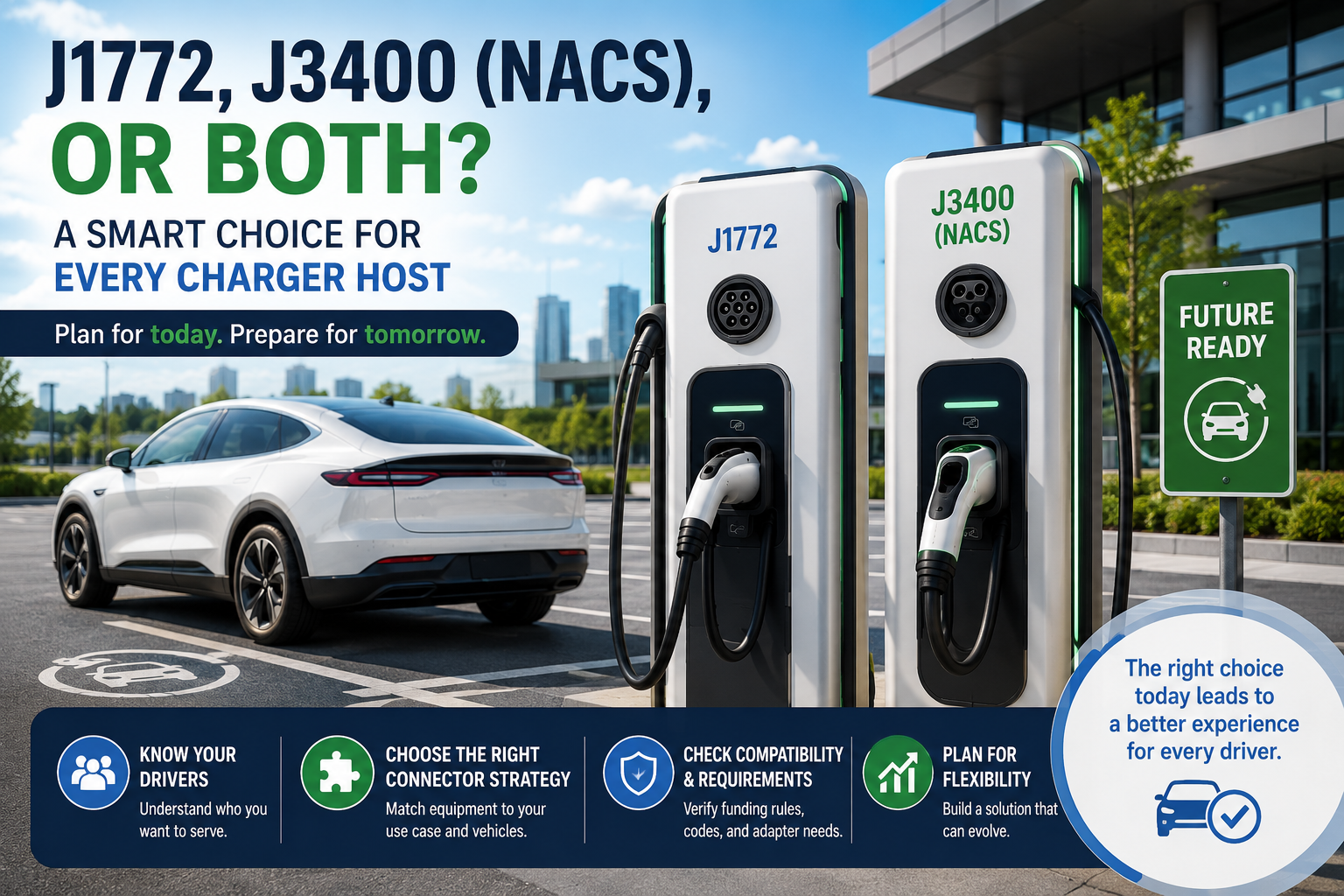
Choosing J1772, SAE J3400 (often called NACS), or both is not simply a question of picking the connector that seems most popular. For a charger host, it is a service-design and procurement decision: which drivers should the site serve, what kind of charging do they need, and what equipment configuration can the host support over its operating life?
A sound decision starts by separating several terms that are often grouped together: the vehicle inlet, the connector attached to the charging station, a charging port, and an adapter. It then considers the site’s charging use case, equipment details, legacy access expectations, and any funding conditions.
There is no universal best connector configuration. The practical aim is to select equipment that serves the vehicles the site intends to accommodate, while making limitations clear to drivers and leaving room for periodic review.
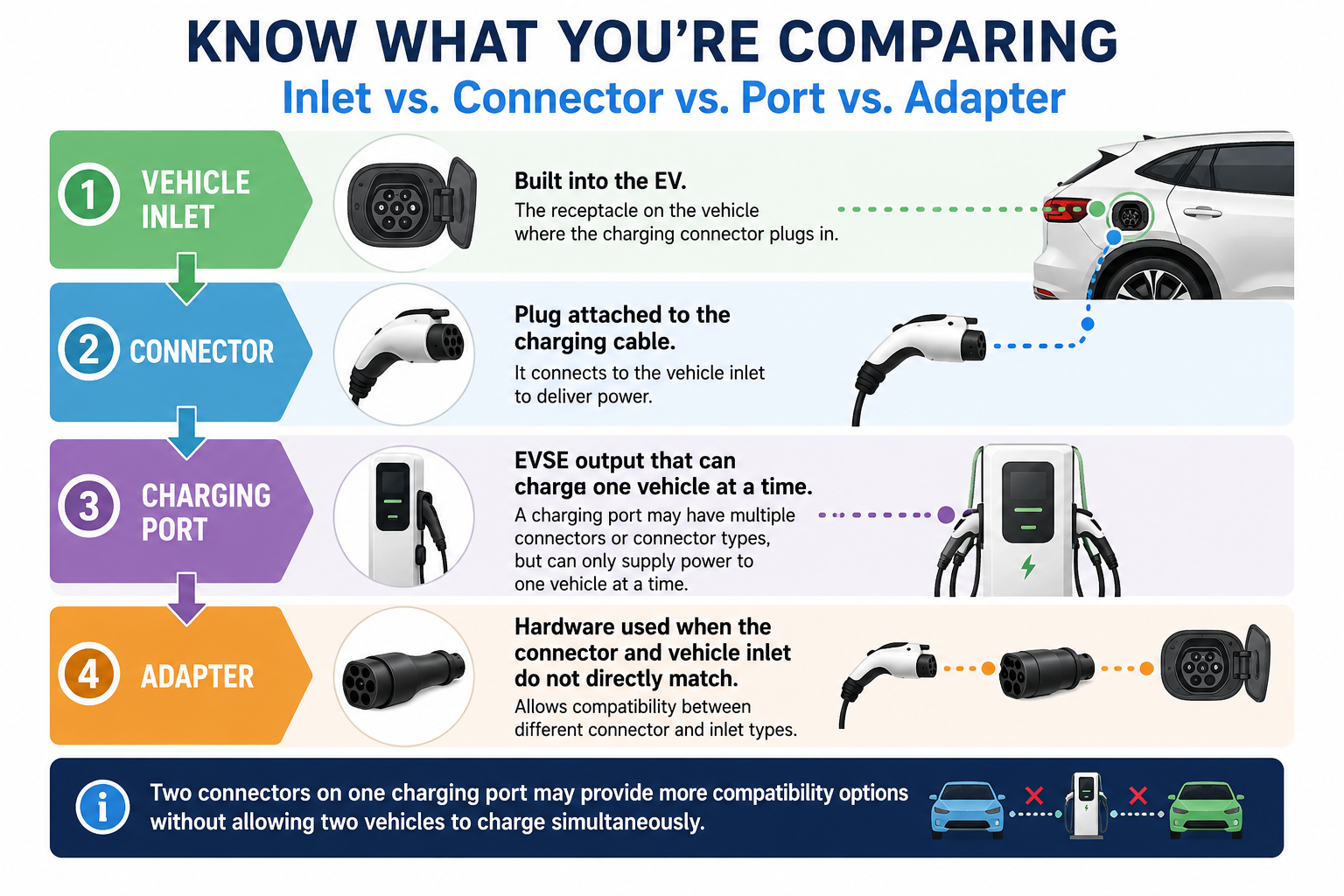
Start by defining what is being compared
Connector discussions can become confusing because the same word may describe different parts of the charging experience.
- Vehicle inlet: The physical receptacle built into the EV.
- Connector: The plug on the charging cable that connects to the vehicle.
- Charging port: The EVSE output capable of charging one vehicle at a time.
- Adapter: Hardware used between a charging connector and a vehicle inlet when a direct connection is not available.
This distinction matters when comparing quotes. The U.S. Department of Energy’s Alternative Fuels Data Center explains that multiple connectors and connector types can be available on one EV charging port, while only one vehicle can charge from that port at a time.
A proposal advertising two attached connectors may therefore provide connector choice rather than capacity for two simultaneous sessions.
Ask each supplier to state, in writing:
- How many charging ports are included?
- How many vehicles can charge simultaneously?
- Which connector type is attached to each port?
- Is power shared between ports?
- Can both attached connectors be used at the same time?
- What maximum power is available per active vehicle?
Those answers are more useful than a simple connector count.
Match connector strategy to the site’s use case
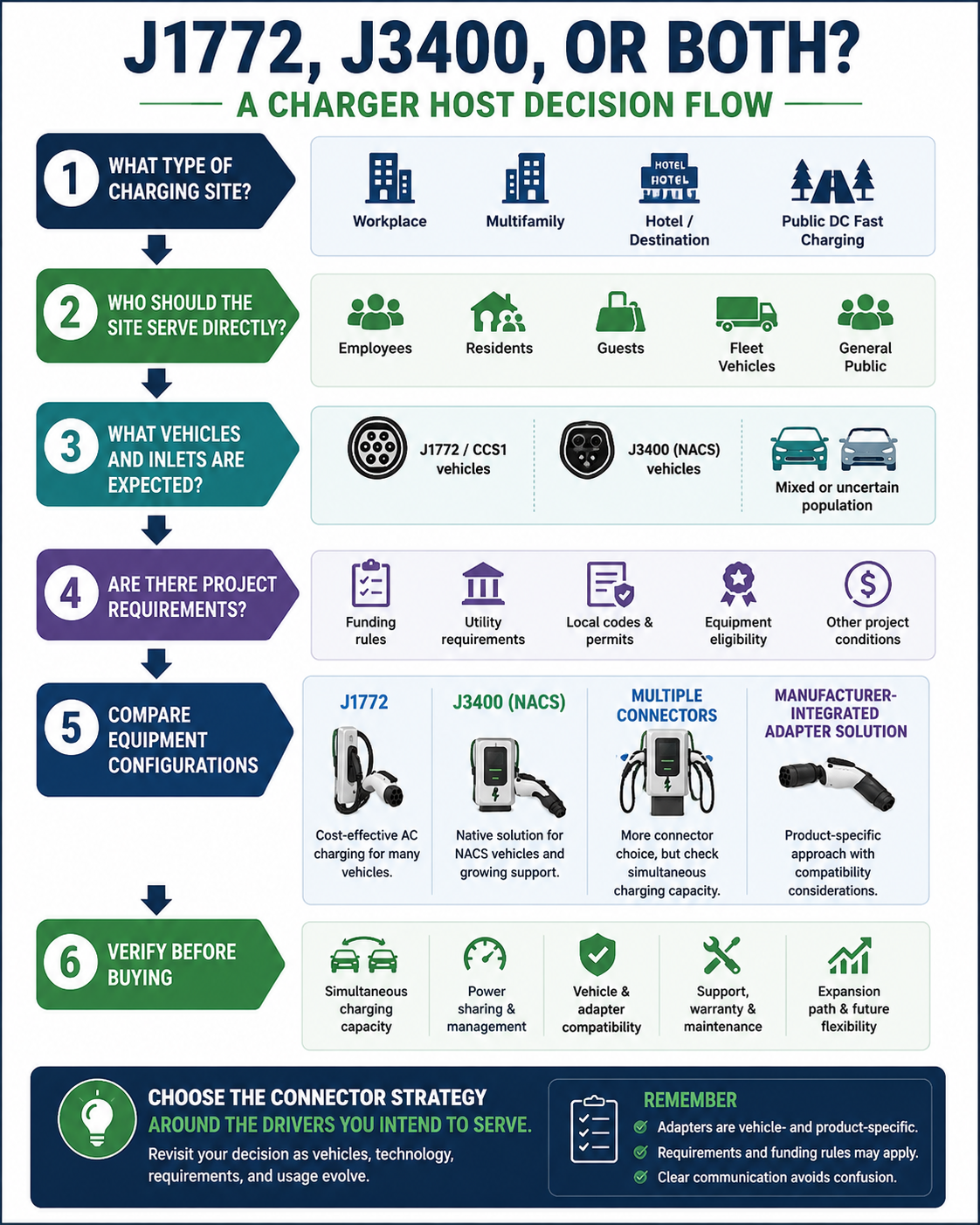
The first major branching point is whether the project is primarily AC Level 2 destination charging or DC fast charging. The connector choices, driver expectations, and adapter considerations differ between those use cases.
For U.S. equipment, the Alternative Fuels Data Center identifies J1772 and J3400/NACS for AC Level 2 charging, while DC fast charging can use CCS, CHAdeMO, or J3400 connectors. Review the current DOE connector overview before finalizing equipment specifications, because available products and the vehicle market can change.
AC Level 2: workplace, multifamily, and destination sites
AC Level 2 charging is commonly considered where vehicles will be parked for a meaningful part of the day or overnight. For these sites, the decision should begin with expected dwell time and the driver population, not a general assumption about connector direction.
A workplace host might examine employee vehicle information through an optional survey. A multifamily host might consider resident demand, visitor access, parking allocation, and how often residents change vehicles. A destination site may focus on the types of guests it expects and typical visit length.
Useful questions include:
- Which vehicles currently use the property?
- Which vehicles should be able to plug in directly?
- How long do vehicles normally remain parked?
- Are the chargers intended for residents, employees, guests, or the general public?
- Would drivers reasonably be expected to carry a vehicle-approved adapter?
- How often should the site's connector strategy be reviewed?
For a site with a mixed or uncertain vehicle population, offering a configuration that addresses more than one connector pathway may be worth evaluating.
That is a service choice, not a guarantee that every vehicle can charge. The final result still depends on the specific vehicle, station, charging mode, software settings, and manufacturer-approved connection method.
DC fast charging: public and corridor-oriented sites
DC fast charging decisions warrant a more detailed review. Drivers expect a fast-charging site to communicate its available connectors accurately before they arrive, and connector or adapter limitations can affect whether a visit is successful.
That standardization context does not make every J3400-equipped station, vehicle, or adapter interchangeable. Hosts should evaluate the precise equipment model, supported charging modes, vehicle compatibility information, and manufacturer documentation.
At a DC site, assess:
- Expected charging traffic
- Required charging power
- Uptime and repair procedures
- Cable reach
- Parking geometry
- Vehicle orientation
- Demand management
- Power sharing
- Connector redundancy
- The operational impact of a failed cable, connector, or adapter component
These considerations can be as important as the connector list itself.
Evaluate the equipment configurations available
Hosts will encounter several broad equipment approaches. The right option depends on the site’s intended users and what the selected equipment manufacturer offers and supports.
1. Native J1772 equipment
For AC Level 2, a permanently attached J1772 connector may be a practical choice where the vehicles to be served support it directly or where the host’s funding conditions require it.
It can also be part of a broader connector plan rather than the entire strategy.
Before choosing this route, document which drivers the site expects to serve directly and which drivers may need a vehicle-approved solution outside the host’s control.
2. Native SAE J3400 equipment
A native J3400 connector may align with the needs of a site whose expected visitors can use it directly. It may be worth considering for a known user population, but it should not be treated as a blanket substitute for evaluating other vehicles the site wishes to accommodate.
The Joint Office also provides guidance on connector and adapter compatibility, including the importance of using adapters appropriate for the specific vehicle and charging equipment.
A host should therefore avoid basing its entire access strategy on an unverified adapter assumption.
3. Multiple attached connectors
Some equipment may offer multiple connector types on a port or across a station. This can broaden the set of drivers a site is designed to serve, but it does not necessarily increase the number of simultaneous charging sessions.
Compare the actual operating model:
- Are drivers choosing between connectors attached to one charging port?
- Are there independent charging ports?
- Can multiple vehicles charge simultaneously?
- Is station output shared?
- What happens to available power when several vehicles are connected?
- How are damaged cables identified and repaired?
Clear answers help avoid buying apparent connector abundance without enough usable charging capacity.
4. Manufacturer-integrated adapter approaches
Some charging equipment may offer a manufacturer-designed approach involving adapters or connector conversion.
Treat these options as product-specific.
Confirm:
- Equipment manufacturer instructions
- Vehicle compatibility
- Safety certifications
- Warranty conditions
- Maximum supported power
- Maintenance responsibilities
- Cable-management requirements
- Applicable vehicle-manufacturer guidance
Do not assume a host-supplied, retained, modified, or broadly marketed adapter is appropriate for every vehicle.
The National Renewable Energy Laboratory report Recommended Actions to Improve Adapter Safety examines adapter safety during the CCS-to-J3400 transition and identifies considerations for both AC and high-power DC charging applications.
Make legacy access an explicit service decision
“Legacy” should not mean “irrelevant.”
A host should identify the J1772 and CCS vehicles it intends to support during the connector transition and decide what level of access is appropriate for the site.
For example, a workplace may decide that maintaining access for existing employees is central to its charging programme.
A destination property may decide that serving a broad cross-section of visitors is part of its guest experience.
Another site with a defined vehicle fleet may make a narrower choice.
Each approach can be reasonable when it is deliberate and clearly communicated.
Create a short access policy for the project:
- Which vehicle connector types should receive direct access?
- Which vehicles may require an approved adapter?
- Who is responsible for providing that adapter?
- Will adapters be supplied by the site or remain the driver's responsibility?
- What compatibility limitations must be disclosed?
- When will the connector strategy be reviewed again?
This approach avoids framing one connector as permanently future-proof. Instead, it ties the purchase to a documented service objective that can be reviewed as the vehicle population changes.
Put connector details into the procurement checklist
Connector selection should appear in a broader specification and contracting process.
A quote comparison should not stop at price, rated power, and connector names.
The Department of Energy's EV charging infrastructure procurement and installation guidance recommends evaluating factors including equipment type, number of connectors, the number of vehicles that can charge simultaneously, networking, maintenance, electrical requirements, future expansion, and applicable codes or programme requirements.
Ask prospective suppliers to document:
- Charging level
- Rated output per port
- Maximum simultaneous output
- Number of independently usable charging ports
- Connector type on each port
- Power-sharing behaviour
- Cable length and reach
- Supported communication standards
- Vehicle compatibility documentation
- Adapter requirements
- Equipment certifications
- Networking requirements
- Payment capabilities, if applicable
- Warranty terms
- Replacement cable and connector availability
- Repair response expectations
- Software-support period
- Upgrade options
- Expansion capability
- Required electrical service
- Applicable funding-program eligibility
A practical evaluation table can help.
List each equipment option in rows and score only the factors that matter to the site: direct access for intended vehicles, simultaneous capacity, parking fit, support responsibilities, expansion path, and project constraints.
Keep adapter assumptions in a separate column so they do not quietly become a substitute for confirmed compatibility.
Run a separate funding and requirements review
Federally funded projects may have connector conditions that do not apply to an entirely privately funded installation.
This should be reviewed separately from the market and user-experience decision.
For installations covered by the relevant federal rule, 23 CFR 680.106 states that each DC fast-charging port must be capable of charging CCS-compliant vehicles and have at least one permanently attached CCS Type 1 connector, while each AC Level 2 charging port must have a permanently attached J1772 connector.
These requirements apply to projects subject to that federal rule. They should not be treated as a universal instruction for every privately funded U.S. charging installation.
Before procurement, confirm the current:
- Federal rule text
- Funding agreement
- Programme guidance
- State requirements
- Utility conditions
- Local permitting requirements
- Equipment eligibility criteria
- Buy America or domestic-content requirements, when applicable
Requirements and programme interpretations can change, and project-specific terms may matter.
A host may benefit from having its funder, equipment provider, installer, utility, and appropriate legal or technical advisers review the final configuration before an equipment order is placed.
Publish clear driver information and review the choice
A connector strategy works only if drivers can understand what the station offers.
Publish the station’s:
- Connector types
- Charging level
- Available power
- Access rules
- Hours
- Pricing, where applicable
- Parking restrictions
- Important compatibility information
- Site instructions
Use the channels the host controls and ensure information provided to charging networks or station directories accurately reflects the installed hardware.
Do not describe broad vehicle compatibility unless it has been confirmed for the specific equipment and charging context.
At the site, use durable, plain-language signage that matches the installed equipment.
If the station has multiple connectors that cannot be used at the same time, make that limitation understandable. If cable routing or parking orientation affects access, communicate it before the driver begins a session whenever possible.
Finally, set a review date.
Revisit the decision when:
- The site has meaningful utilization data
- The vehicle mix changes
- Drivers repeatedly report compatibility problems
- The equipment manufacturer introduces a supported upgrade
- Expansion is planned
- Funding or regulatory requirements change
A practical decision rule
Choose the connector configuration that best supports the vehicles your site intends to serve directly, fits the site’s charging use case, and meets confirmed project requirements.
Consider multiple connector paths when broad access is an important service goal and the specific equipment design supports it.
Treat adapters as a product- and vehicle-specific compatibility issue, not as a universal bridge.
Confirm how many vehicles each station can actually charge at the same time, understand how power is shared, and keep the connector strategy reviewable as the North American EV market continues to change.
Sources
- U.S. Department of Energy Alternative Fuels Data Center — Electric Vehicle Charging Stations
- U.S. Department of Energy Alternative Fuels Data Center — Procurement and Installation for EV Charging Infrastructure
- SAE International — J3400 North American Charging System for Electric Vehicles
- Joint Office of Energy and Transportation — SAE J3400 Charging Connector
- Joint Office of Energy and Transportation — EV Charging Connector and Adapter Compatibility
- National Renewable Energy Laboratory / Joint Office — Recommended Actions to Improve Adapter Safety
- 23 CFR § 680.106 — Federal EV Charging Infrastructure Requirements