
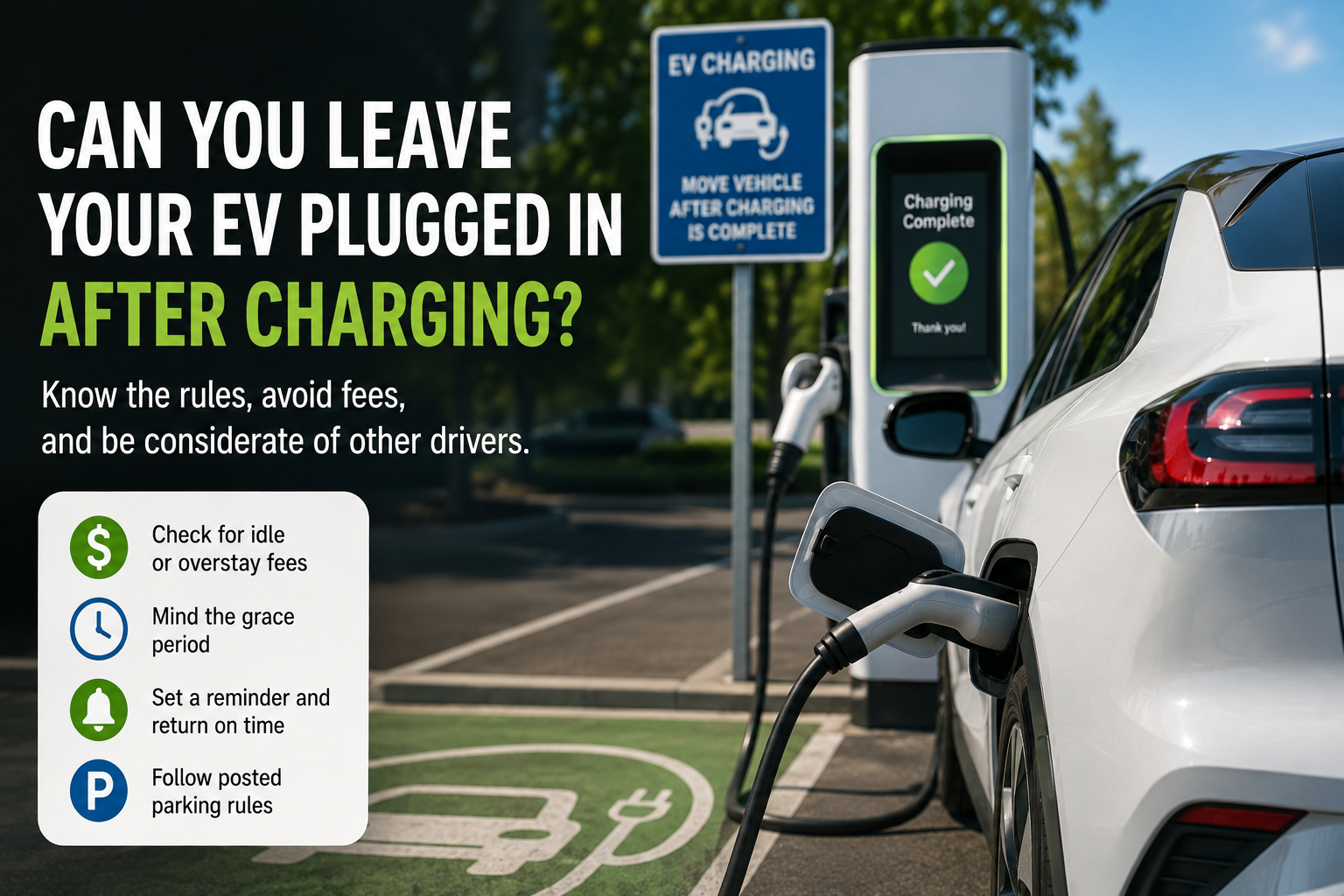
If you are using a public charger, the practical default is simple: move your EV once charging is complete, unless the charger screen, network app, posted signs, or site rules clearly say that continued parking is allowed.
Leaving a vehicle connected is not automatically forbidden everywhere. Some locations are designed for longer parking stays, and each operator can set its own rules. But a completed vehicle can still occupy both the parking bay and the connector another driver may need. At some locations, it can also trigger a time-based fee.
This guide explains how to decide when to return to your EV, what idle or overstay fees to check before you plug in, and what to do if you need to keep your car parked after charging is finished.
Why move your EV after charging finishes?
A public charging space has two purposes: parking and access to electricity. Once your vehicle has stopped drawing energy, leaving it connected can prevent another driver from starting a session—even though no charging is taking place.
That matters most at busy locations, where another driver may be relying on that connector to continue a trip or reach their next destination. The issue is not just courtesy. The cost of keeping a vehicle connected can also change after charging is complete.
Public charging is used in different settings. The U.S. Department of Energy's Alternative Fuels Data Center explains that Level 2 charging is commonly installed where vehicles are parked for longer periods, while public charging is also located along highway corridors and at urban charging hubs.
The setting helps inform expectations, but it does not replace the rules at the specific station.
For example, a workplace, hotel, shopping area, or public car park may be intended for a longer visit. A DC fast-charging stop on a travel route may require a much quicker return.
In either case, the posted parking limit, the network's pricing information, and the site's operating rules are what count.
Are idle fees and overstay fees the same thing?
Not always. Charging networks and site hosts use different names and pricing structures, so read the terms shown for the station you are about to use.
Its current terminology includes:
- Station Time Rate while Connected: A time-based rate that can apply while your vehicle remains connected, whether or not energy is being delivered.
- Overstay Rate: A time-based rate that can apply after charging is complete following a grace period, or after a maximum connection time has been reached.
Other charging networks may use terms such as idle fee, overstay fee, or congestion fee.
The label matters less than the trigger. Find out whether the additional charge starts:
- When charging stops
- After a stated grace period
- After a maximum connection time
- At a particular time of day
- When the charging location becomes busy
These policies are not universal. A fee at one location does not mean that another charger on the same network—or a charger operated by another company—will use the same rules.
Prices, grace periods, parking restrictions, and enforcement can vary and may change. Check the live information on the charger screen or in the relevant network app before starting your session.
What to check before you start charging
A short check before plugging in can help you avoid surprises later.
Look for these details on the charger, in the network app, or on nearby signage:
- Charging price: Is the session billed by energy, time, session, or another method?
- Idle or overstay fee: Does the price change after charging stops?
- Grace period: How much time do you have to disconnect and move?
- Maximum connection time: Is there a limit on how long the vehicle can remain plugged in?
- Parking limit: Does the parking space itself have a separate time restriction?
- Charging-only requirement: Must the vehicle be actively charging to remain in the space?
- Separate parking fees: Do you need to pay for parking in addition to charging?
- Operating hours: Are different rules in effect overnight or outside business hours?
Do not rely on a fee or rule you saw at a previous charger. Treat each new location as its own decision.
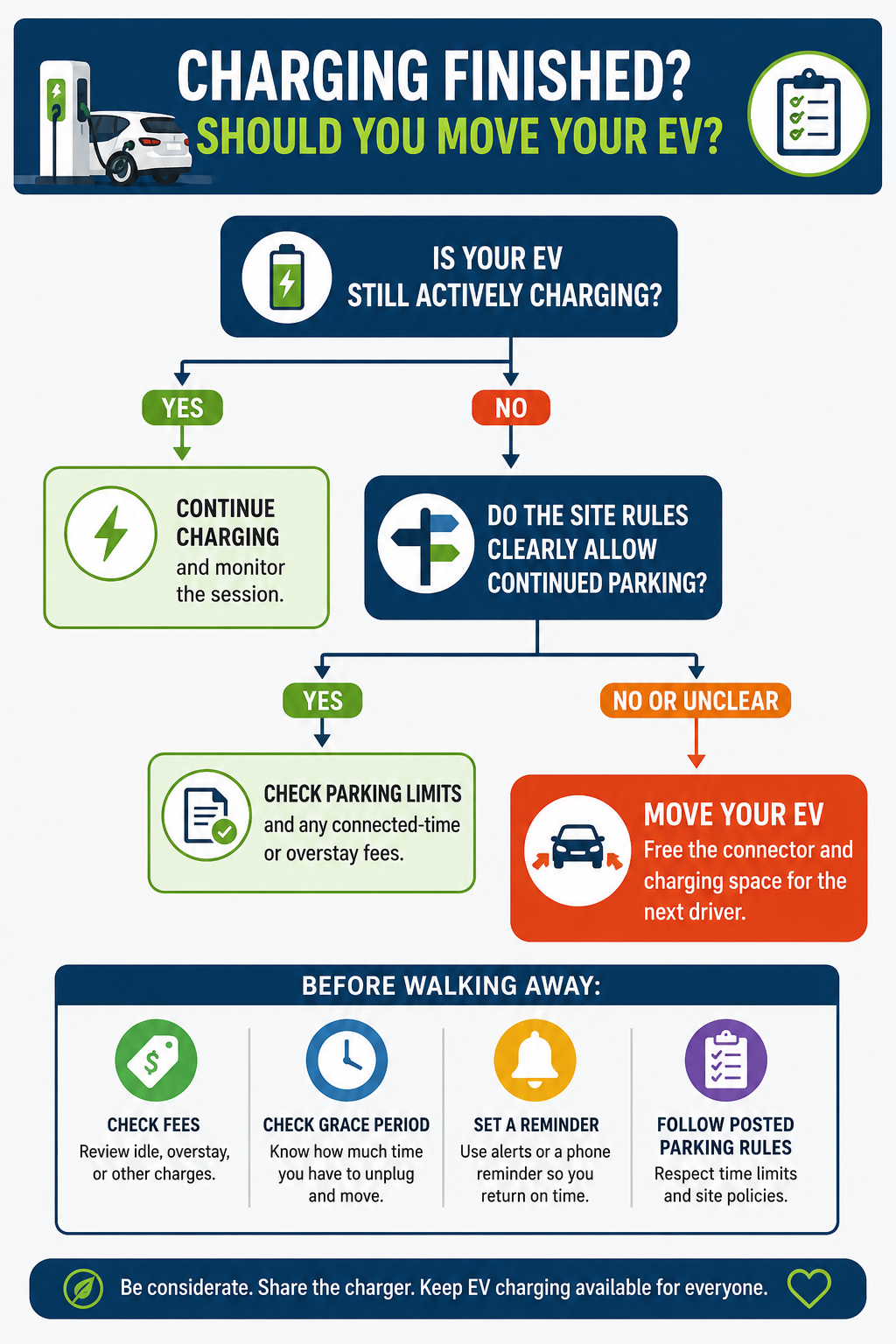
Set a reminder before you walk away
The easiest way to avoid overstaying is to plan for the end of the session before leaving the vehicle.
Estimate when your EV is likely to reach the charge level you need, then set a phone reminder for slightly earlier than that time.
If the charging network offers completion alerts, enable them for the session. A reminder is especially useful if you are going into a shop, restaurant, meeting, hotel, or other place where it is easy to lose track of time.
Network features vary.
That is an Electrify America-specific policy, not a rule for every public charger.
If your station provides a grace period, plan to return before it ends rather than treating the final minute as your target.
Then confirm that the session has actually ended using the charger screen or, where available, the network app. Your vehicle may have reached its target charge level before the charging network records the session as complete, and the display may show important final pricing information.
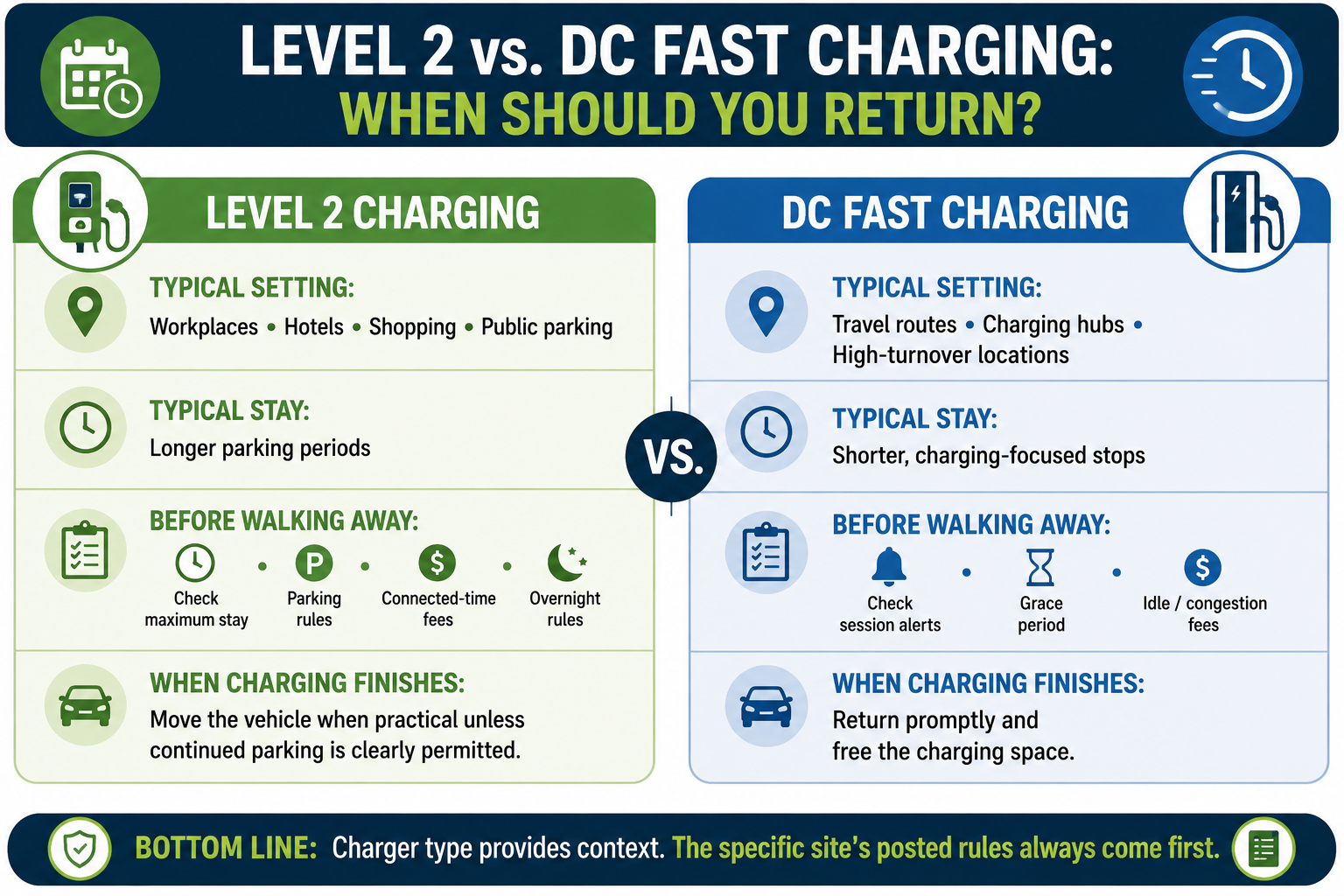
Level 2 versus DC fast charging: does the expectation change?
The right answer depends on the site rather than on charger type alone. Still, the parking context can help you make a reasonable plan.
Level 2 charging
Level 2 stations are often located where drivers park for a longer activity.
A longer stay may be normal at a:
- Workplace
- Hotel
- Shopping centre
- Recreation facility
- Restaurant
- Public parking garage
- Shared residential property
That does not mean it is acceptable to leave an EV connected indefinitely after charging finishes.
Read the local rules. A Level 2 site may have a maximum stay, a time-based rate, an overnight policy, or no stated idle charge at all.
If your vehicle has finished charging and you no longer need the connector, moving it is the considerate default—particularly when other charging spaces are occupied or demand appears high.
DC fast charging
DC fast chargers are frequently used for shorter charging stops and longer-distance travel.
At these locations, prompt turnover is particularly important because other drivers may be waiting for enough energy to continue their journeys.
Tesla provides one example of a network-specific approach. Tesla states that Supercharger locations can apply idle or congestion-related fees, with the applicable rate structure shown on the vehicle touchscreen or in the Tesla app.
Tesla also explains that congestion fees can apply at busy locations after the vehicle reaches the site's congestion threshold or after the charging session ends.
Check the current information displayed for the specific site rather than assuming the same fee or policy applies everywhere.
Whether you are using Level 2 or DC fast charging, do not use charger type as a substitute for checking the actual rules. Check the site, plan your return, and move your EV when the session is complete unless continued parking is clearly permitted.
What if you need to keep your car parked?
Sometimes charging ends before your errand, appointment, workday, meal, or overnight stay does.
If that happens, consider these options:
- Move to a regular parking space once charging is complete.
- Choose a charger that better matches your expected parking time when planning the trip.
- Lower your charging target if appropriate so the session ends closer to when you expect to leave—but only when this fits your vehicle and travel needs.
- Return to the vehicle when charging ends, disconnect, and move it before returning to your activity.
- Check whether the property explicitly permits longer parking after charging has finished.
- Ask the property or charging-network support team if the rules are unclear.
If you know in advance that you will be parked for several hours, a destination-oriented Level 2 charger may fit the trip better than a high-turnover DC fast charger.
Avoid unplugging another vehicle or moving someone else's charging cable. If a charger is blocked, damaged, unavailable, or unclear, use the network's support channel rather than trying to resolve an equipment issue yourself.
Before you leave the charging site
Take a moment to close out the session properly:
- Confirm that charging has stopped.
- Disconnect the cable according to the charger and vehicle instructions.
- Return the connector to its holder if required.
- Check the charger screen or app for the final session status.
- Review the final charging cost.
- Make sure no idle, overstay, or parking fee is continuing.
- Move your vehicle out of the charging space when required.
- Leave the charging cable and surrounding area safely positioned for the next driver.
If the cost seems unexpected, record the charger location, charger or station number, approximate session time, and what the charger or app displayed.
Those details can make a support request easier to investigate.
A practical public-charging rule
You can sometimes leave an EV plugged in after it has finished charging, but you should not assume that you can.
The best public-charging habit is to treat the connector as shared access:
Check the station's current terms → check for idle or overstay fees → set a return reminder → confirm charging has finished → move your vehicle unless the local rules clearly allow it to remain.
That approach respects other drivers, reduces the chance of unexpected time-based charges, and works across the varied settings where public Level 2 and DC fast charging are available.
Sources
- U.S. Department of Energy — Alternative Fuels Data Center: Charging Electric Vehicles in Public
- ChargePoint — What are the pricing policies and fees I should be aware of?
- Electrify America — Frequently Asked Questions
- Tesla Owner's Manual — Charging Instructions and Supercharger Fees