

Managed EV charging is not simply the decision to install more ports. It is an operating approach that coordinates when and how much power EV chargers deliver in response to the needs of vehicles, the site, and the local electricity supply.
For a workplace, multifamily property, destination site, or fleet-adjacent location, that coordination can be worth evaluating when several vehicles may charge at once, available electrical capacity is constrained, or drivers have different departure needs. It is not a guaranteed substitute for electrical upgrades, a guarantee of driver readiness, or a utility approval pathway. It is a planning tool that should be tested against the realities of a specific site.
The U.S. Department of Energy (DOE) describes smart charge management as coordinated EV-charging control that can respond to charging demand, building loads, electricity rates, and operating needs. Its overview of smart charge management provides a useful starting point for hosts: begin with the operating problem, then select controls and technology that fit it.
What managed EV charging means in practice
At its simplest, unmanaged charging allows each connected vehicle to draw power according to the charger and vehicle's normal behaviour. Managed charging adds rules that may adjust charging timing or available power across one or more chargers.
Those rules could be designed to:
The important distinction is between ports and control. Adding ports increases the number of vehicles that can connect. It does not, by itself, decide how limited electrical capacity is shared when many vehicles plug in. Conversely, control rules do not create electrical capacity. They help the host make deliberate choices about how available capacity is used.
The equipment and service model matter. The DOE Alternative Fuels Data Center explains that networked charging systems can provide utilization data and enable scheduled or staggered charging, while non-networked equipment provides basic charging without advanced utilization monitoring or payment capabilities. A host should therefore verify the functions of the specific charger, network service, and site configuration under consideration.
Start with one clear operating objective
Trying to optimize every outcome at once often leads to policies that are difficult to explain and difficult to operate. A better first step is to identify the primary objective, then list secondary objectives and constraints.
A workplace may prioritize predictable end-of-day departures. A multifamily site may place more emphasis on overnight access and transparent sharing. A destination site may need simple rules for shorter stays. A fleet-adjacent site may have a mix of staff, visitor, and operational vehicles. The right answer depends on the site's users, operating hours, and electrical context.
Write the objective in one sentence before speaking with providers: “Our first priority is to support vehicles departing by 8 a.m. while keeping aggregate EV charging within a site-defined limit.” That statement creates a practical basis for reviewing data, control options, and trade-offs.
Build a minimum input list before selecting rules
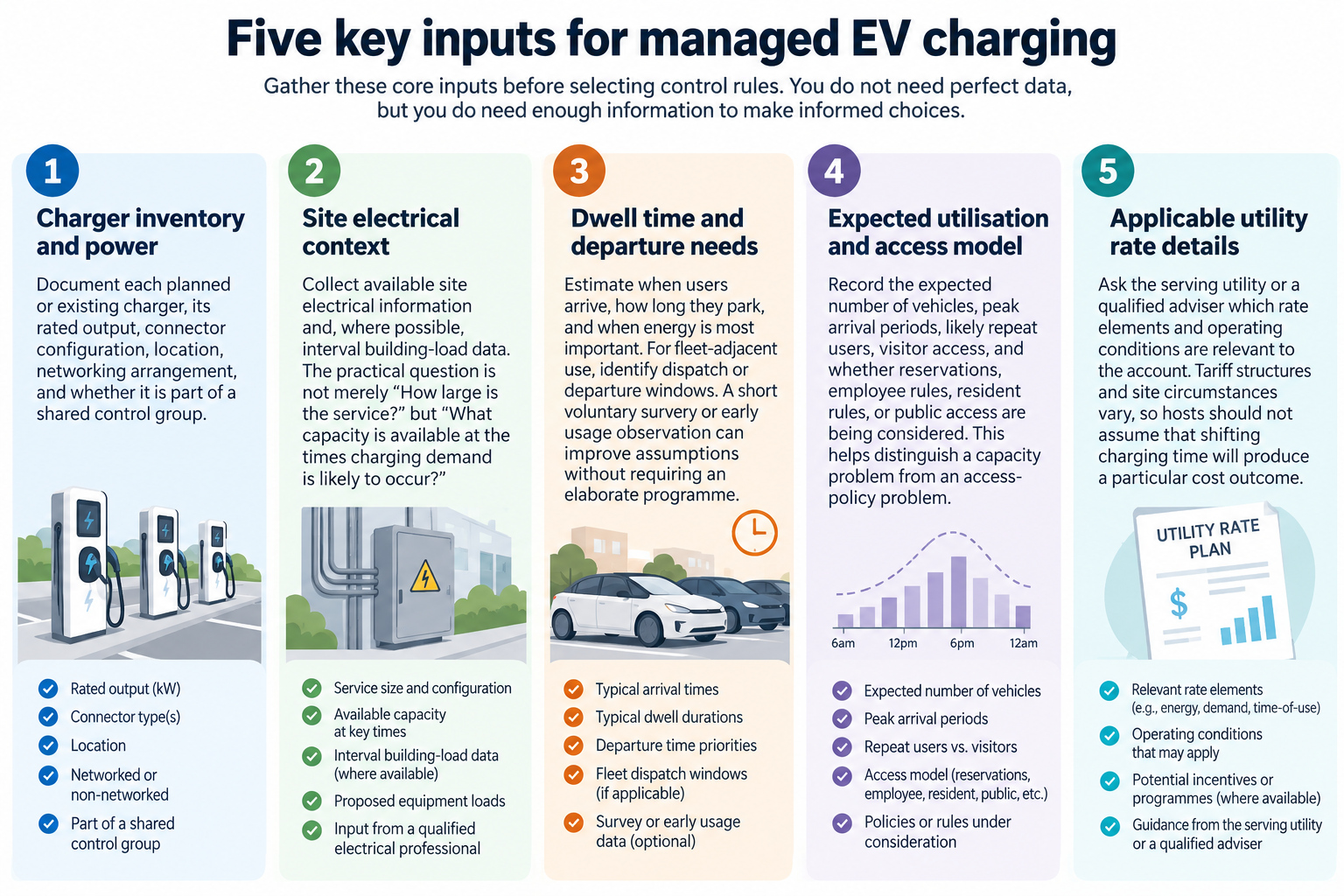
Managed charging is only as useful as the assumptions behind it. Hosts do not need perfect data to begin evaluating options, but they do need enough information to avoid designing controls around guesses.
DOE identifies charger and vehicle inventory, operating schedules or dwell periods, utility-rate information, building-load data, and available electrical capacity as relevant implementation inputs in its smart charge management guidance. For a host, a concise baseline dataset can include the following.
1. Charger inventory and power
Document each planned or existing charger, its rated output, connector configuration, location, networking arrangement, and whether it is part of a shared control group. Note that rated charger power is not the same as the power every connected vehicle will necessarily draw; vehicle capability and charging conditions can affect actual delivery.
2. Site electrical context
Collect available site electrical information and, where possible, interval building-load data. The practical question is not merely “How large is the service?” It is “What capacity is available at the times charging demand is likely to occur?” A qualified electrical professional can help interpret site conditions and proposed equipment loads.
3. Dwell time and departure needs
Estimate when users arrive, how long they park, and when energy is most important. For fleet-adjacent use, identify dispatch or departure windows. For workplaces and multifamily properties, a short voluntary survey or early usage observation can improve assumptions without requiring an elaborate programme.
4. Expected utilisation and access model
Record the expected number of vehicles, peak arrival periods, likely repeat users, visitor access, and whether reservations, employee rules, resident rules, or public access are being considered. This context helps distinguish a capacity problem from an access-policy problem.
5. Applicable utility rate details
Ask the serving utility or a qualified adviser which rate elements and operating conditions are relevant to the account. Tariff structures and site circumstances vary, so hosts should not assume that shifting charging time will produce a particular cost outcome.
Early utility engagement is sensible. The Alternative Fuels Data Center recommends working with the local utility early to confirm short- and long-term charging requirements, understand demand and pricing implications, and identify whether upgrades may be needed. This is a planning conversation, not a substitute for site-specific utility confirmation.
Turn objectives into simple, explainable control rules
Drivers and site staff should be able to understand the policy without reading a technical manual. Start with a small number of rules, test them, and add complexity only when it solves a demonstrated problem.
Common rule categories include:
A useful policy format is: rule, reason, driver impact, exception path.
For example: “The site applies a shared charging limit during weekday business hours to keep EV charging within the operating plan. Vehicles may charge at a reduced rate when demand is high. Drivers with a documented early departure need can contact the site representative before the relevant period.” This does not promise a particular result, but it tells drivers what to expect.
Some charging systems may support capacity allocation, charging schedules, and time or power limits through Open Charge Point Protocol (OCPP) or related implementations. DOE notes these potential functions, while also emphasizing the need to confirm the exact capabilities of the proposed charger and network service. OCPP support alone should not be treated as proof that a particular feature, integration, or control behaviour is available at a given site.
Explain the driver experience before launch
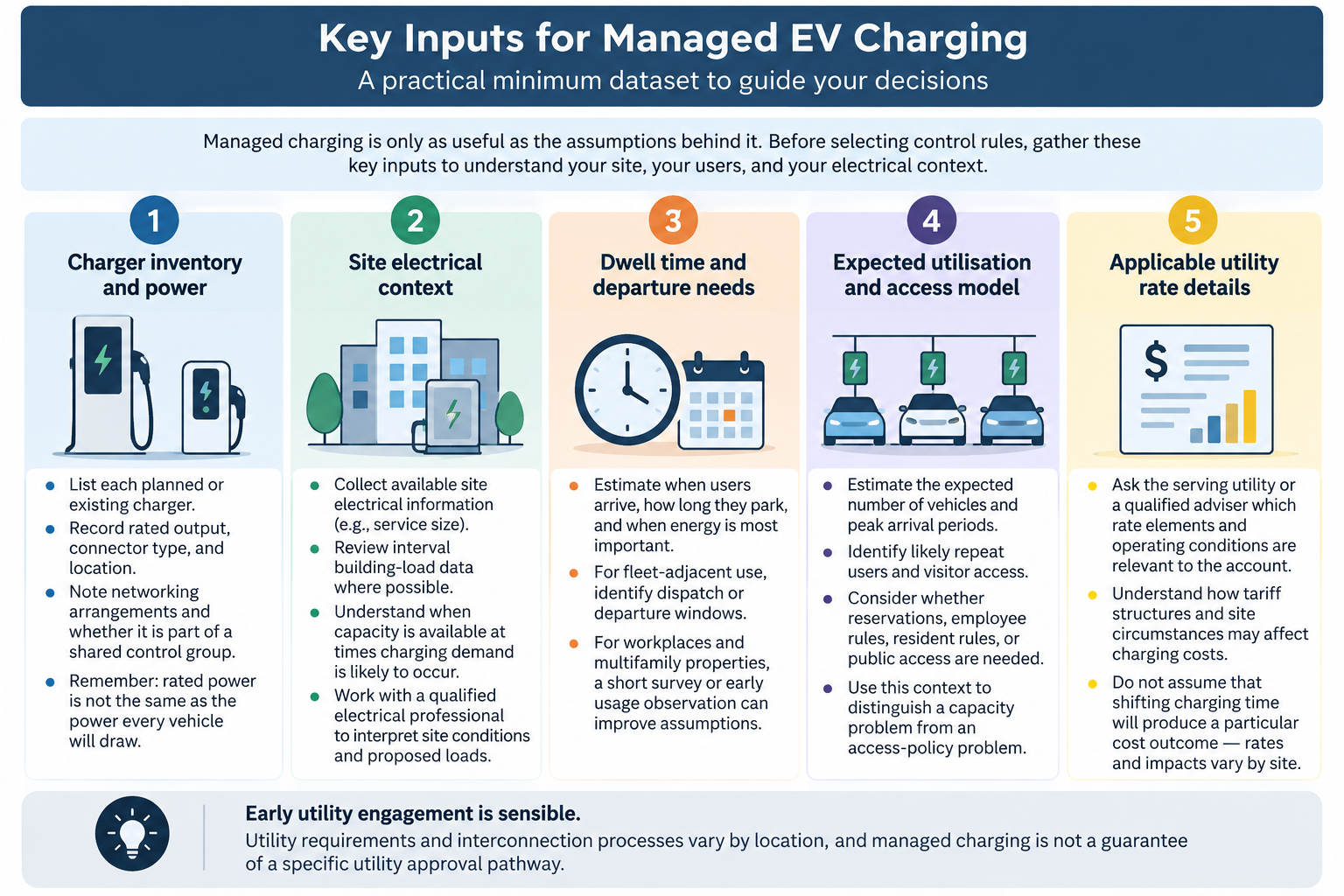
A technically sound policy can still fail operationally if users discover it only after plugging in. Communication should answer the questions drivers are most likely to have:
Use plain signs at the charging area, concise onboarding messages, and a contact path appropriate to the site. For a workplace or residential property, communicate policy changes before they take effect where practical. If a rule is intended to improve fair access, say so plainly and describe the behaviour expected from users, such as moving a vehicle after charging is complete where site policy permits.
Communication should also avoid overpromising. A host can explain the intended policy and available support process without telling drivers that every vehicle will receive a particular amount of energy by a particular time.
Questions to ask providers, utilities, and advisers
Procurement discussions are more productive when questions are tied to the host's operating objective. The following checklist can help compare proposals without assuming that all networked equipment behaves alike.
Questions for charging-service providers
Questions for the utility and electrical professionals
Public hosting-capacity maps can be a useful early planning input, but not a final answer. DOE explains that these maps offer general information about a grid location's ability to accommodate additional load and do not resolve site-specific interconnection questions. Confirm site-specific conditions with the serving utility rather than treating a map as an engineering assessment or approval.
Commission, monitor, and review
Treat launch as the start of an operating cycle, not the end of a procurement project. Before broad rollout, test ordinary and difficult scenarios with the intended users and responsible staff.
A practical commissioning checklist includes:
After launch, review utilisation, user feedback, session timing, and operational issues on a regular schedule. A quarterly review may be a reasonable starting point for many sites, while a new or rapidly growing programme may need closer attention. The host can then decide whether settings remain appropriate as adoption, parking patterns, building operations, or the number of chargers changes.
Managed EV charging is most useful when it is treated as an operating policy supported by technology, not as a set-and-forget feature. Define the objective, use site-specific inputs, select understandable rules, verify supplier claims, and communicate clearly with drivers. For electrical design, permits, utility requirements, accessibility, rates, and local operating obligations, validate the relevant details with the serving utility, qualified electrical professionals, and local authorities.
Sources
- U.S. Department of Energy Alternative Fuels Data Center. Electric Vehicles for Fleets
- U.S. Department of Energy. Smart Charge Management Applications and Benefits for Federal Fleets
- U.S. Department of Energy. Smart Charge Management Implementation for Federal Fleets
- U.S. Department of Energy. U.S. Atlas of Electric Distribution System Hosting Capacity Maps