
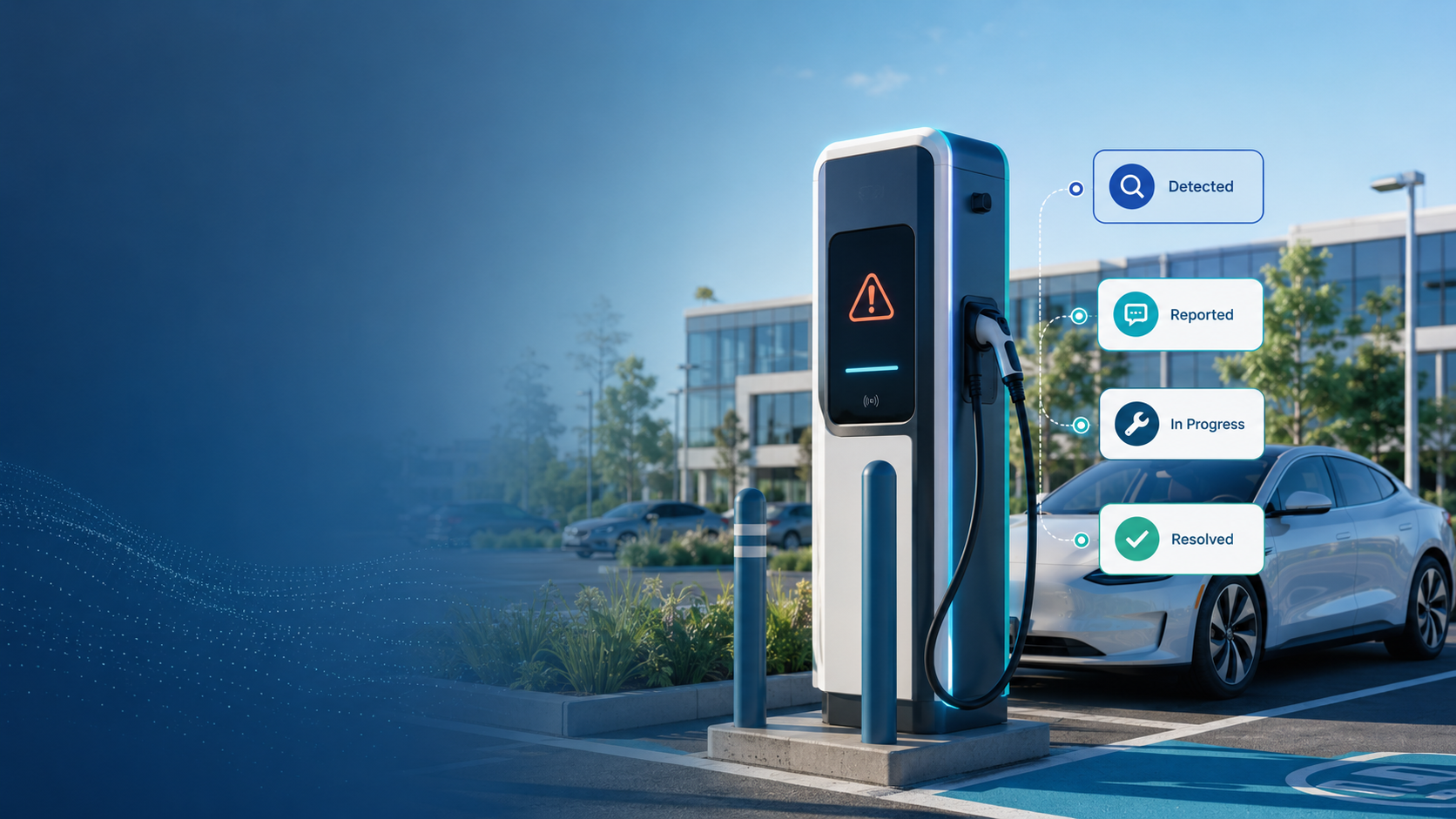
Shared EV charging works best when a charger problem has a clear path from detection to resolution.
At workplaces, multifamily properties, fleets, visitor parking areas and other shared locations, a station that is physically present but unavailable can disrupt a driver’s plans and create additional work for the people managing the site.
Downtime is not always caused by one obvious fault. A driver may be unable to start a charging session, payment or authorization may fail, charging may be slower than expected, or a cable and connector may have visible damage.
The Joint Office of Energy and Transportation identifies problems such as failed session starts, payment difficulties and unexpected charging performance as issues that can negatively affect the charging experience.
A practical operating plan helps a shared charging site respond consistently, even when the cause involves an equipment provider, network operator, property manager, electrician, installer or utility.
This article provides a planning framework rather than a universal maintenance or service standard. The appropriate inspection schedule, escalation process, support coverage and driver-notification procedure will depend on the location, equipment, contracts, operating hours and local requirements.
Why charger downtime needs an operating plan
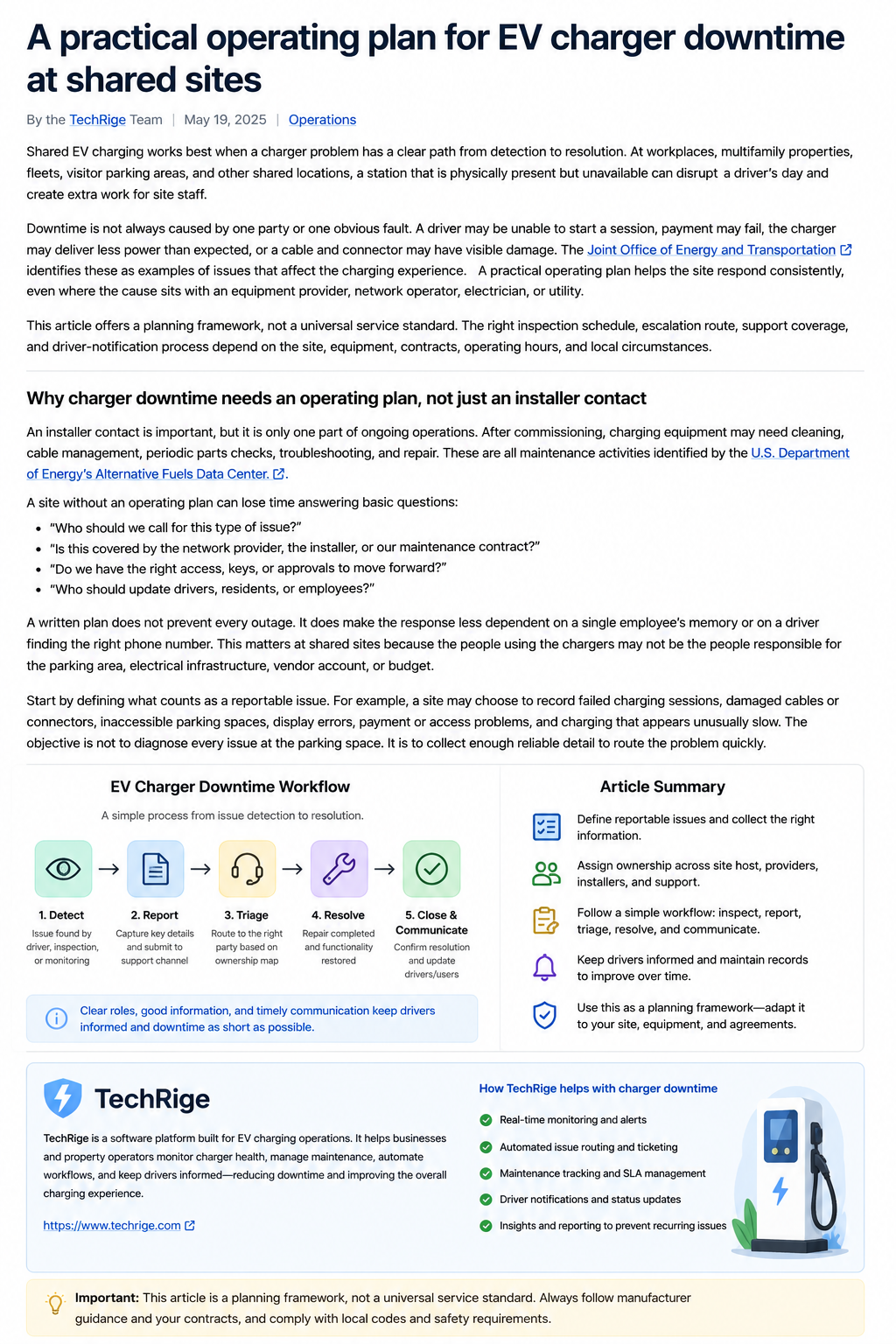
A clear operating workflow helps shared charging sites move from issue detection to resolution.
Having an installer’s telephone number is important, but it is not a complete operating plan.
After installation, charging equipment may require cleaning, cable management, periodic inspections, troubleshooting, replacement parts and repair. The U.S. Department of Energy’s Alternative Fuels Data Center identifies these as common operation and maintenance considerations for EV charging infrastructure.
Without a written process, a site can lose valuable time answering basic questions:
- Who should receive the initial driver report?
- Is the problem related to access, payment, connectivity, equipment or electrical service?
- Is the site operator, network provider, installer or maintenance contractor responsible?
- Who is authorized to request a technician or approve a repair?
- How should drivers be informed that the charger is unavailable?
- Who will confirm that the charger is working before the issue is closed?
A written plan does not prevent every charger failure. It makes the response less dependent on a single employee’s knowledge or on a driver finding the correct support contact.
This is particularly important at shared locations because the people using the chargers may not be responsible for the parking area, electrical infrastructure, provider account, vendor relationship or maintenance budget.
Start by deciding what the site considers a reportable problem. Examples may include:
- A failed charging session
- A payment or authorization problem
- A damaged cable or connector
- A blocked or inaccessible charging space
- A display or error message
- A charger that repeatedly disconnects
- Charging that appears unusually slow
- Missing or unreadable instructions
- A station that appears unavailable
The objective is not to ask drivers or general site staff to diagnose the charger. It is to collect enough reliable information to route the issue to the right party.
Assign clear responsibility
The first operational decision is determining who owns each part of the response.
The Department of Energy’s workplace charging guidance recommends designating a responsible individual or group for ongoing charging operations, maintenance issues and related costs.
Although that guidance is intended for workplaces, the principle is useful for apartment buildings, condominium properties, fleets, commercial locations and other shared charging sites.
Site host or property operator
The site host normally manages the driver experience at the location.
Its responsibilities may include:
- Inspecting the charging area
- Keeping signs and instructions current
- Receiving local problem reports
- Recording incidents
- Coordinating access for technicians
- Communicating with drivers, residents, employees or tenants
- Approving work within its authority
- Following up with service providers
Charging network or equipment support provider
Where the station is connected to a charging network, the support provider may be able to review:
- Charger connectivity
- Session records
- Error messages
- Account settings
- Payment or authorization information
- Reported station status
The site should confirm the provider’s actual responsibilities in its agreement. Network connectivity does not mean that every physical or electrical problem can be diagnosed or repaired remotely.
Installer, electrician or maintenance contractor
This party may be responsible for:
- Electrical troubleshooting
- Physical equipment repair
- Replacement parts
- Warranty work
- Corrective maintenance
- On-site testing
The site should clarify who can authorize a visit and who will provide access to parking areas, electrical rooms, panels and other restricted locations.
Electrical work and repairs should be performed by appropriately qualified professionals. The Alternative Fuels Data Center’s charging infrastructure development guidance recommends involving charging providers, utilities and certified or licensed electrical contractors during infrastructure planning and installation.
Driver-facing support contact
Drivers need one clear way to report a problem.
This may be:
- A charging provider’s support number
- A QR code or online form
- A property-management contact
- A workplace coordinator
- A reception or service desk
- A designated email address
The person or team receiving the report should also know where to send it next.
Internal decision-maker
Someone should be authorized to approve actions such as:
- Requesting a technician
- Accepting a repair quotation
- Ordering replacement parts
- Adding temporary signage
- Closing a charger or connector
- Escalating an unresolved problem
When this responsibility is unclear, a relatively minor problem may remain open while each party assumes that someone else is handling it.
Record these assignments in a short contact document. Include primary and backup contacts, support hours, relevant station identifiers and the preferred method for urgent escalation.
Update the document whenever equipment, providers, contracts or responsible employees change.
Create a simple inspection and reporting process
A useful workflow should be simple enough for drivers and site staff to follow consistently.
It should work whether the problem is discovered through a driver report, visual inspection, provider ticket or available station-status information.
1. Inspect the charging area
Choose an inspection schedule that reflects:
- Charger usage
- Weather exposure
- Staffing
- Equipment history
- Whether the location is public or private
- Previous incident frequency
A heavily used public-facing location may need more frequent checks than a lightly used employee parking lot.
During a visual inspection, site staff can look for:
- A damaged cable
- A loose or damaged connector holder
- A blocked charging space
- Unreadable instructions
- A screen error
- Visible enclosure damage
- Debris or an obstruction
- A charger that appears unavailable
General site staff should not open charging equipment, handle exposed electrical components or attempt electrical repairs.
Their role is to observe, document, restrict access where appropriate and contact the responsible service party.
2. Capture a useful issue report
A report should be short enough for a driver to submit but detailed enough to support initial review.
Consider collecting:
- The station or connector identifier
- The charger’s exact location
- The date and approximate time
- A brief description of the problem
- An error message or code, when available
- A photograph of the screen or visible damage
- Whether the driver tried another connector or charger
- Whether the session started and then stopped
- Whether payment or authorization was involved
- Optional contact information for follow-up
- Any action already taken by site staff
Avoid collecting more personal information than is reasonably needed to investigate the problem.
Where the charging service has its own support process, drivers can be directed to that channel while the site maintains a local record of recurring incidents.
3. Triage the problem
The first reviewer does not need to provide a technical diagnosis.
The purpose of triage is to place the problem into a practical category and route it to the appropriate party.
Categories may include:
- Visible damage or a potential safety concern
- Parking or physical-access problem
- Payment or authorization problem
- Session-start failure
- Network or communication issue
- Apparent charger fault
- Reduced charging performance
- Unknown cause requiring provider review
For visible damage or another potential safety concern, the site’s procedure may include taking the affected connector or charger out of use, placing temporary signage and contacting qualified support.
The response should follow the equipment documentation, site policies, contractual agreements and applicable requirements.
4. Escalate with complete information
When sending the issue to a provider or contractor, include:
- The station or connector identifier
- The symptoms reported
- The date and time first reported
- Relevant photographs
- Displayed error information
- Actions already taken
- The current driver-facing status
- Site-access instructions
- The appropriate site contact
The site should also track:
- The support-ticket number
- The person or company responsible
- The date of the last update
- The expected next action
- Required approvals
- Parts or technician availability
- The current incident status
A single site-side record becomes valuable when multiple companies or systems are involved.
The Joint Office explains that charging issues may take longer to diagnose and repair because multiple vendors and systems can be involved, each with different error-reporting and troubleshooting methods.
5. Close the loop
Before marking an incident as resolved, document what changed.
For example:
- A damaged part was replaced
- A configuration issue was corrected
- Network connectivity was restored
- Payment access was corrected
- A blocked space was cleared
- A technician completed a repair
- The charger remains unavailable while waiting for a part
- The problem could not be reproduced and remains under observation
Where the site has an established verification process, record whether the charger was checked after the work was completed.
Do not assume that a station is available simply because a provider closed the support ticket.
Track charger performance and recurring issues
Maintenance records become more useful when they answer operational questions rather than merely accumulating tickets.
A shared charging site may use:
- A spreadsheet
- A maintenance platform
- A property-management system
- A vendor portal
- A work-order system
- A support-ticketing platform
Consider tracking four related measures.
Uptime
The percentage of a defined reporting period during which a charger or connector is considered available.
The method used to determine availability should be documented.
Outage duration
The length of time the charger remains unavailable.
The site should consistently define when an outage begins. It may begin when the fault occurs, when a provider detects it or when the first report is received.
Repair or resolution time
The time between assigning the incident to the responsible party and restoring service.
This may be separated into:
- Time to acknowledge
- Time to diagnose
- Time to approve work
- Time waiting for a technician
- Time waiting for replacement parts
- Time to restore service
Utilization
A consistently defined measure of charger use, such as:
- Number of charging sessions
- Energy delivered
- Charging time
- Occupied time
- Number of users
Definitions matter.
The site should decide whether planned maintenance, a blocked parking space, a communications outage or one failed connector on a multi-connector station counts as downtime.
The Department of Energy’s August 2025 Federal Workplace Charging Program Guide recommends monitoring networked charging stations, tracking uptime and reviewing monthly utilization reports.
This is useful operational guidance rather than a universal requirement for every private workplace or multifamily property.
A monthly review can help answer practical questions:
- Which chargers receive the most reports?
- Are incidents concentrated at certain times?
- Are the same components failing repeatedly?
- Is the largest delay caused by vendor response, site access, internal approval or parts?
- Are drivers reporting session-start problems even when the equipment appears available?
- Are some chargers heavily used while others receive little use?
- Do the site’s driver instructions need improvement?
- Should the maintenance agreement be reconsidered?
These answers can inform preventive maintenance, vendor discussions, site policies and future charging-infrastructure decisions.
Keep drivers informed
Drivers generally do not need a detailed technical incident report.
They need accurate information that helps them decide what to do next.
When a charger is unavailable, an update may include:
- The affected charger or connector
- Its current status
- Whether support has been contacted
- Whether the charger should be avoided
- The next expected update, when known
- Confirmed alternatives, where available
Avoid promising a restoration time until it has been confirmed by the responsible service party.
Where practical, use more than one communication channel:
- Temporary on-site signage
- Building or workplace messages
- A resident or tenant portal
- A property-management application
- A charging-provider support channel
- Internal workplace communication
Whether a location can show live availability or send automated notifications depends on its selected equipment, network and service agreement. These capabilities should be evaluated during planning rather than assumed.
Offer alternatives carefully.
Do not state that another charger is open, compatible or appropriate unless that information has been confirmed.
Post simple reporting instructions near the station. Ask drivers to identify the charger, describe the issue and use the designated contact method.
Where possible, acknowledge the report so the driver knows that the problem is being tracked.
Define maintenance expectations before an outage
The best time to clarify support responsibilities is before equipment fails.
The Alternative Fuels Data Center recommends establishing who is responsible for maintenance costs. It also notes that maintenance contracts should address response time, repair time and overall uptime expectations.
The actual targets are site-specific commercial decisions rather than universal standards.
During procurement, renewal or a vendor review, discuss:
- Standard and emergency support hours
- Initial response-time expectations
- Target repair or restoration times
- Remote diagnostic capabilities
- Conditions requiring an on-site technician
- Escalation procedures
- Warranty coverage and exclusions
- Responsibility for labour and travel
- Responsibility for replacement parts
- Responsibility for electrical work
- Site-access requirements
- Availability of spare parts
- Uptime definitions and reporting
- Planned-maintenance notifications
- Access to fault and utilization information
- Driver-communication responsibilities
- Verification procedures after repair
Ask each provider to explain which issues it can investigate, which require a technician and which may involve another party.
This becomes especially important when charging hardware, network services, payment systems, electrical infrastructure and property operations are managed by separate organizations.
How this relates to Techrige
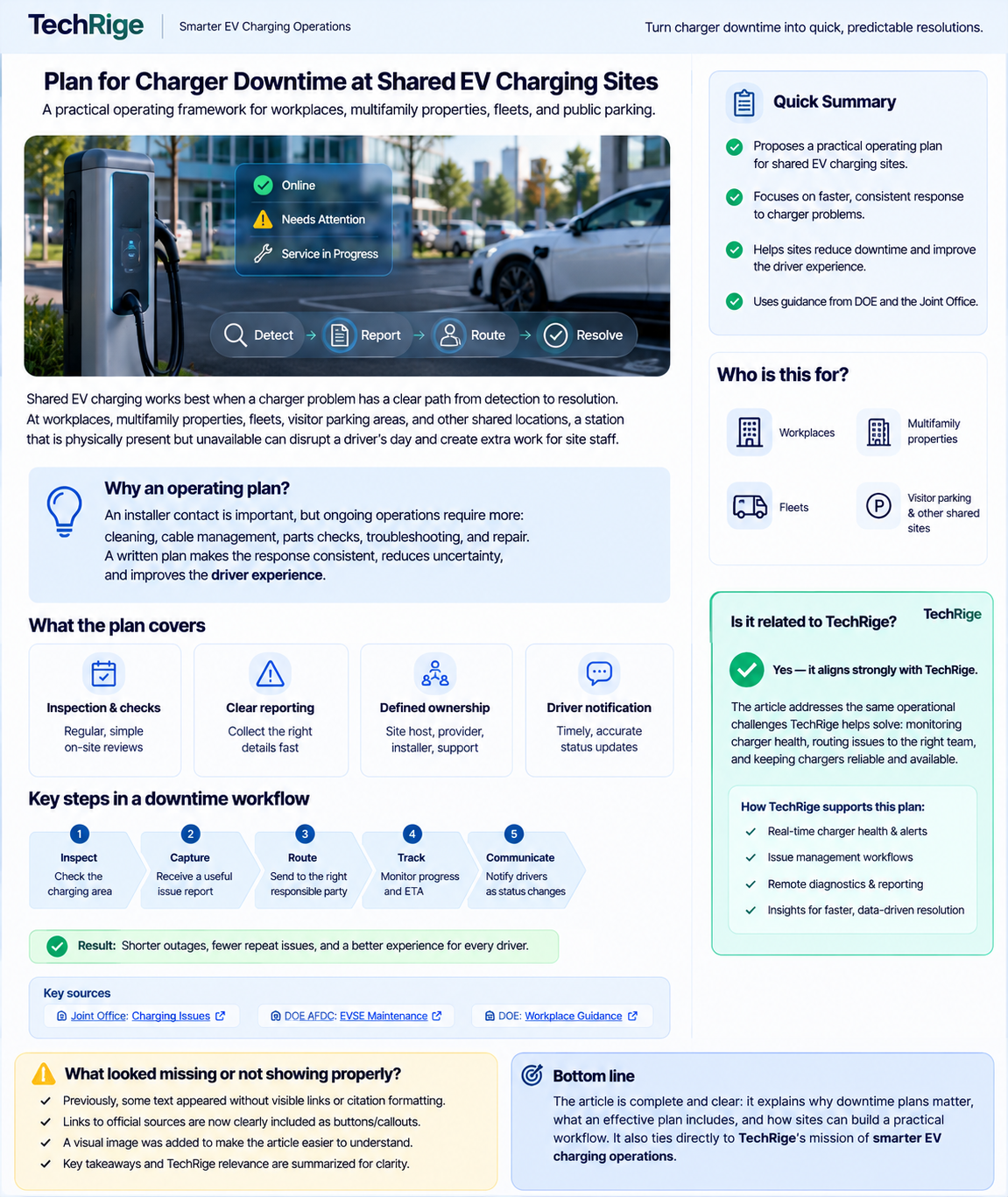
Downtime planning can improve charger reliability, operational coordination and the driver experience.
Techrige connects EV charger hosts with drivers looking for convenient charging opportunities.
Reliable availability information is an important part of that relationship.
When a listed shared charger becomes unavailable, delayed or inaccurate information can result in:
- An unsuccessful reservation
- A driver arriving at an unusable charger
- Additional support requests
- Lower trust in the charging location
- A poorer experience for both the host and driver
Charger hosts can reduce these problems by:
- Inspecting their chargers regularly
- Reporting and tracking equipment problems
- Updating charger availability when it changes
- Communicating disruptions clearly
- Keeping contact information current
- Recording recurring issues
- Coordinating promptly with providers and contractors
Techrige should not be presented as the company repairing or electrically maintaining the equipment unless those services are formally offered.
Instead, Techrige’s connection to this article is the shared-charging experience: helping hosts present dependable charging opportunities and helping drivers make informed decisions.
A practical starting point
A shared charging site does not need a complex operations centre to respond more effectively to downtime.
Start with four basic elements:
- A named person responsible for charger operations
- A clear reporting method for drivers
- A simple incident and action log
- An agreed escalation contact for every provider or contractor
Review the records regularly and improve the plan around the problems drivers actually experience.
The goal is not to guarantee that charging equipment will never fail.
The goal is to create a repeatable response that protects the driver experience, gives service providers useful information and makes recurring problems visible.
For charger hosts, a defined process creates clearer accountability and better operational awareness.
For drivers, an obvious reporting route and honest status updates make an unavoidable charger outage easier to manage.
Share your charger with the Techrige community
Own or manage an EV charger that could be made available to other drivers?
Techrige helps connect charger hosts with EV drivers looking for convenient shared-charging opportunities.
Keep your charger information, availability and host details current so drivers can make better charging decisions.
Sources
- Joint Office of Energy and Transportation — Electric Vehicle Charging User Experience and Reliability
- Alternative Fuels Data Center — Operation and Maintenance for EV Charging Infrastructure
- Alternative Fuels Data Center — Workplace Charging for Electric Vehicles
- U.S. Department of Energy — Federal Workplace Charging Program Guide, August 2025
- Alternative Fuels Data Center — EV Charging Infrastructure Development