

A networked EV charger is more than a piece of electrical equipment. It is part of an operating arrangement that may involve software, connectivity, payment processing, driver support, maintenance coordination, station monitoring, and reporting.
That arrangement can shape the experience of property staff and drivers long after installation.
Before purchasing equipment, charger hosts should decide what the site needs to accomplish. They should then ask prospective equipment vendors and network service providers to explain—in writing—how the proposed service agreement supports that operating model.
This is especially important for shared EV charging at workplaces, multifamily properties, retail locations, hotels, fleet depots, and public-facing sites.
The U.S. Department of Energy’s Alternative Fuels Data Center definition of a network service provider includes software that allows operators to manage access, set fees, monitor station health, and review utilization data. It can also allow drivers to locate chargers, check their status, start sessions, and pay when required.
The precise features, responsibilities, and limitations vary by provider and contract.
This article is an educational procurement checklist, not legal, privacy, electrical, cybersecurity, accounting, or tax advice. For a substantial contract or complex installation, consult the appropriate professional advisers.
1. Start with the EV charging operating model
The first question should not be, “Which charger should we buy?”
A better question is, “How will this charging program operate?”
Start by identifying who will use the chargers:
- Employees
- Residents
- Tenants
- Visitors
- Customers
- Fleet vehicles
- Members of the public
- A combination of user groups
Next, determine who will be responsible for each operational task:
- Owning or leasing the charging equipment
- Managing the network account
- Creating administrator and staff accounts
- Setting driver eligibility and access rules
- Establishing charging and parking prices
- Processing payments, refunds, and chargebacks
- Monitoring station health and connectivity
- Responding to driver questions
- Performing routine physical inspections
- Diagnosing faults remotely
- Dispatching repair technicians
- Paying for labor and replacement parts
- Installing firmware and security updates
- Reviewing utilization and uptime reports
- Managing station listings and driver information
- Coordinating with the utility or electrical contractor
- Exporting data when the agreement ends
A simple responsibility matrix can make these decisions easier to compare.
| Operational task | Primary owner | Backup contact | Included in fee? | Response target |
|---|---|---|---|---|
| Driver support | Provider or host | Named contact | Yes/No | Defined hours |
| Station monitoring | Provider or host | Named contact | Yes/No | Defined interval |
| Repair dispatch | Provider, vendor, or host | Named contact | Yes/No | Defined time |
| Pricing changes | Host or provider | Administrator | Yes/No | Defined process |
| Data export | Provider or host | Administrator | Yes/No | Defined format |
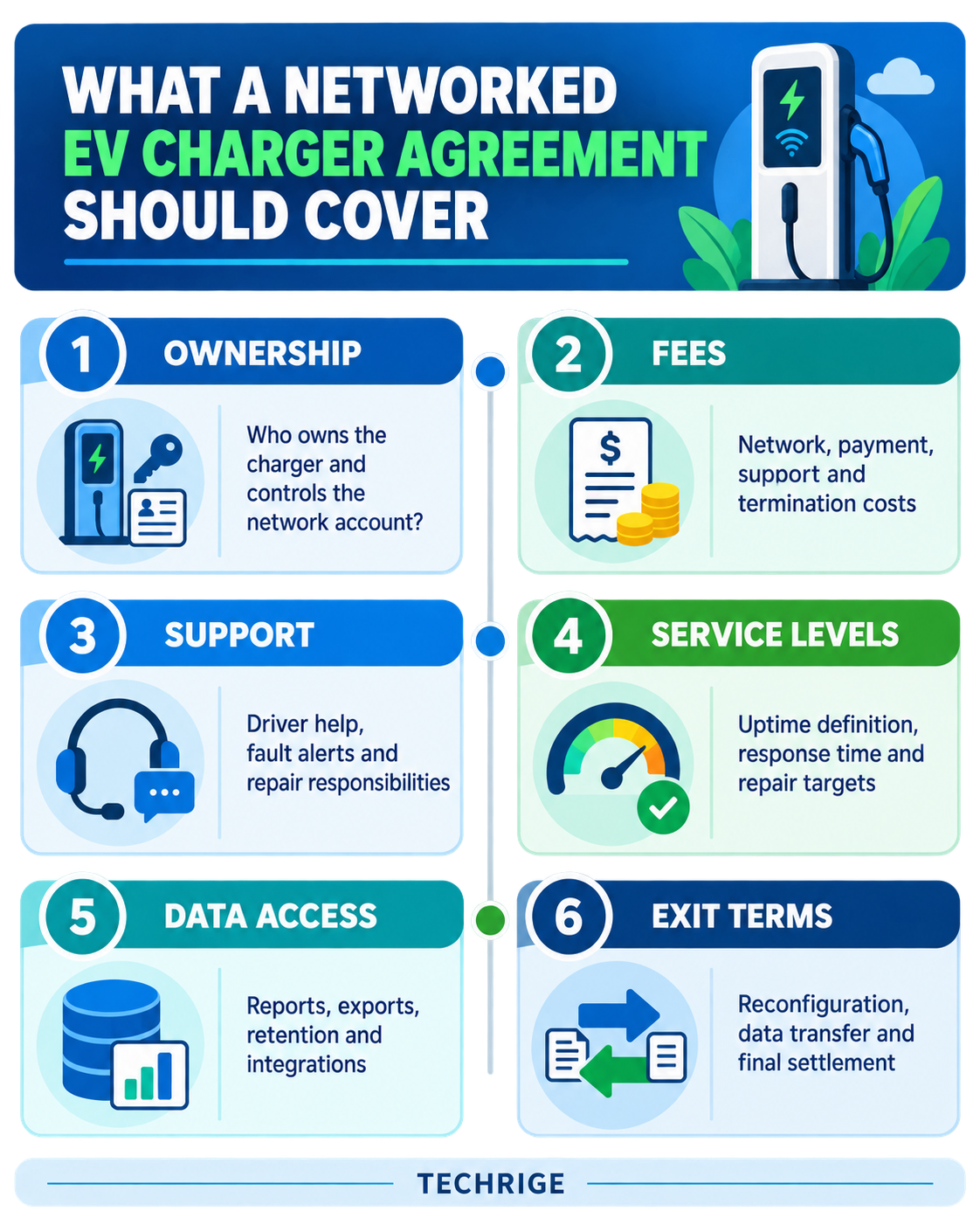
Broad labels such as “managed service” are not enough unless the agreement explains what the service includes.
Equipment ownership also deserves special attention because it may affect the host’s options later. The AFDC’s EV charging procurement and installation guidance recommends considering networking requirements, utilization data, payment capabilities, and equipment-ownership options during planning.
Ask for the complete commercial structure, including:
- Who owns the equipment
- Whether any part of it is leased
- The minimum service term
- Renewal and price-increase rules
- Early-termination conditions
- Equipment-removal rights
- Buyout options
- What happens if the network service ends
2. Decide whether networking fits the site’s needs
Networking can be valuable, but it should solve an identifiable operational need.
According to the AFDC’s networked charging infrastructure guidance, networked equipment may support payments, utilization monitoring, analysis, and customer service. Non-networked equipment generally provides basic charging without the same advanced monitoring or payment capabilities.
Different sites may have different priorities:
- A workplace offering free employee charging may prioritize access control and utilization reporting.
- A multifamily property may need resident accounts, cost allocation, and parking rules.
- A retail site may need public visibility, payment processing, and driver support.
- A private fleet may value energy and operational data more than public payment features.
- A hotel may need a simple way to distinguish guest charging from public use.
Before treating networking as a default requirement, ask:
- Will drivers pay for charging?
- Does the site need to restrict charging to specific users?
- Are reservations, waitlists, or time limits required?
- Does the host need real-time station-status information?
- Is remote session support important?
- Does the site need automated fault alerts?
- Are utilization and energy reports required?
- Will chargers need load management?
- Does the site need integration with parking, building, fleet, or property-management systems?
- Should the chargers appear in public station directories?
- Is round-the-clock driver support necessary?
- Could the site’s access or pricing model change later?
Turn the answers into written procurement requirements. Avoid paying for functions the site is unlikely to use, but do not select a basic arrangement that cannot support a foreseeable need.
3. Request a complete service and fee schedule
Recurring network fees are only one part of the total cost.
Ask each provider for a written schedule identifying every recurring, one-time, conditional, and pass-through charge. If a price may change, ask what causes it to change and how much notice the host will receive.
Questions for a networked EV charging service agreement should cover:
Network and software fees
- Is the network fee charged by charger, port, site, account, or charging session?
- Is there an activation or commissioning fee?
- Are administrator accounts included?
- Are software and mobile-app updates included?
- Are reporting tools included?
- Is API or integration access included?
- Are remote configuration changes included?
- Is cellular connectivity included?
- Is there a minimum monthly charge?
Payment-related fees
- What payment-processing fee applies?
- Are transaction fees added to or deducted from driver payments?
- Are there separate fees for refunds or chargebacks?
- Are roaming transactions priced differently?
- How frequently are host funds paid out?
- Is a minimum payout balance required?
- Who is responsible for payment disputes?
- How are taxes and applicable regulatory charges handled?
Support and maintenance fees
- Is driver support included?
- What hours and languages are supported?
- Is remote troubleshooting included?
- Are technician visits billed separately?
- Are travel charges included?
- Who pays for replacement components?
- Is preventive maintenance included?
- What happens when the equipment is outside its warranty?
- Are expedited repairs available, and at what cost?
Transition and termination fees
- Is there an early-termination fee?
- Is data export included?
- Is charger reconfiguration included?
- Is there a fee to transfer equipment to another network?
- Must modems, SIM cards, payment terminals, or other components be replaced?
- Is removal or site restoration included?
- How is the final payment settlement handled?
Maintenance and uptime requirements
The AFDC’s EV charging operation and maintenance guidance explains that chargers require routine care and may need intermittent repairs and troubleshooting. Maintenance plans, warranties, and repair responsibilities can vary.
Ask the provider to define:
- How station health is monitored
- How often the system checks station status
- What events create an incident
- Who receives an outage alert
- Available support hours and communication channels
- The target time for acknowledging an incident
- The target time for remote diagnosis
- The target time for an onsite visit
- The target time for restoring service
- Who dispatches and supervises technicians
- Whether spare parts are maintained locally
- How recurring faults are escalated
- How planned maintenance is scheduled
- How uptime is calculated
- Which events are excluded from the calculation
- What reports the host receives
- Whether service credits or other remedies apply
An uptime percentage without a definition is difficult to compare. The agreement should explain the measurement period, the starting and ending point for downtime, excluded events, and whether a partly functioning station counts as available.
4. Specify the data the host needs
Data requirements should follow the site’s operating model.
The AFDC states that capturing and analyzing charger uptime and utilization data is an important part of station management. Its operations guidance explains that utilization data can help hosts evaluate pricing, monitor energy goals, and determine whether more charging capacity may be needed.
Before signing, ask to see sample dashboards, reports, and exported files. Confirm whether the host can access the underlying data instead of receiving only summaries.
A practical data schedule may include:
- Site, charger, and connector identifiers
- Charging-session start and end times
- Session duration
- Energy delivered in kilowatt-hours
- Charger availability and outage history
- Fault codes and resolution records
- Utilization by day and time
- Charging-session price
- Applicable fees, refunds, and adjustments
- Payment settlement status
- Estimated energy cost, if supported
- Average session length
- Connector occupancy or idle time, if available
- Maintenance activity
- Firmware and configuration history
Then address the questions that are often overlooked:
- Who owns or controls the operational data?
- Which administrators can view or export it?
- Which export formats are available?
- Can reports be delivered automatically?
- Is an API or another integration method available?
- Are API access and documentation included?
- How long is the data retained?
- Can retention periods be adjusted?
- What information remains available after termination?
- How long does the host have to download it?
- Is historical data included when moving to another provider?
- How are personal and payment-related data protected or removed?
The agreement should also identify account roles and credentials. The host needs to know who controls the primary organization account, who can administer stations, and how access is transferred when employees, contractors, or suppliers change.
Handling personal or payment information should be reviewed against the host’s legal, privacy, security, and operational requirements in each applicable jurisdiction.
5. Test OCPP and interoperability claims carefully
Terms such as “open,” “network agnostic,” and “OCPP-compatible” can be helpful starting points. They do not, by themselves, explain whether a particular charger can be moved to another charging-management system easily or without additional costs.
The Open Charge Alliance defines the Open Charge Point Protocol, or OCPP, as an open communication protocol between charging stations and charging-management systems.
The organization currently lists OCPP 1.6, OCPP 2.0.1, and OCPP 2.1. Importantly, OCPP 1.6 and OCPP 2.0.1 are not compatible. OCPP 2.1 builds on OCPP 2.0.1, but hosts should still confirm which version, functions, and certification profiles each product supports.
Ask both the equipment seller and network provider:
- Which exact OCPP version does the charger support?
- Does it support OCPP over JSON, SOAP, or both where relevant?
- Is OCPP enabled in the equipment being quoted?
- Is it included in the standard price?
- Is the charger officially OCPP-certified?
- Can the provider supply the certificate number?
- Can the certification be confirmed in the Open Charge Alliance’s certified products listing?
- Which certification profiles or functional blocks are supported?
- Does the implementation use proprietary extensions?
- Who controls the network endpoint configuration?
- Can the host or an authorized technician change that configuration?
- Are credentials or security certificates required for migration?
- Will moving networks affect the equipment warranty?
- Does the modem, payment terminal, or other hardware depend on the current provider?
- Is a firmware update required before migration?
- Has this charger model been connected successfully to the proposed management platform?
- Has the provider previously migrated this model to or from another network?
- What functions might be lost after migration?
- What would the migration cost?
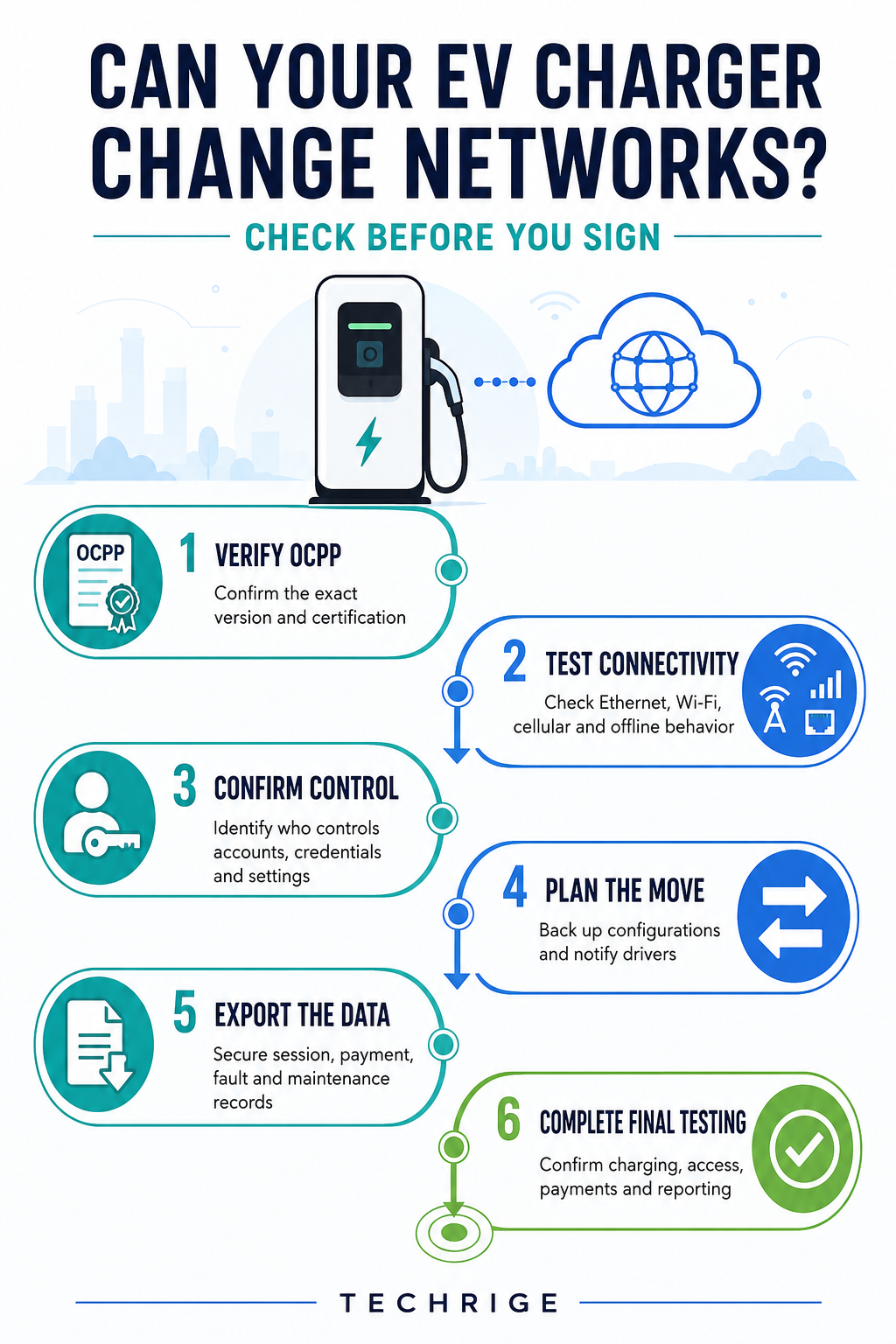
Request a practical transition plan instead of accepting a general assurance of interoperability.
The plan should explain:
- What information and credentials the host must provide
- Who authorizes the change
- How existing configurations are backed up
- Whether historical data will transfer
- How payment and driver accounts will be handled
- Who communicates the change to drivers
- How chargers will be tested after migration
- What rollback process applies if the transition fails
A provider may have legitimate technical or commercial constraints. The host’s objective is to understand those constraints before choosing the equipment.
6. Confirm connectivity and outage behavior
Networked chargers require a communications path. The AFDC advises that a networked installation needs access to a wired or wireless internet connection or cellular service. Connectivity should therefore be reviewed during site planning and procurement, not after the equipment has been selected.
Ask:
- Will the site use Ethernet, Wi-Fi, cellular service, or a combination?
- Who supplies and configures the connection?
- Who pays the recurring connectivity cost?
- How will signal strength be tested at each charger location?
- Is a network extension, antenna, or cellular booster required?
- Does the equipment automatically reconnect after an interruption?
- Who receives a connectivity-loss alert?
- Can drivers begin a session while the charger is offline?
- Can authorized users still charge?
- Are prices and access lists stored locally?
- Are offline sessions uploaded when connectivity returns?
- Can staff perform a local restart safely?
- What happens if the provider’s cloud platform is unavailable?
Offline behavior can materially affect the driver experience. The answer should be tested during commissioning rather than left as an assumption.
7. Plan the exit before signing
Exit planning does not predict that the provider relationship will fail. It is a normal part of operational resilience.
A practical exit checklist should address:
- Contract-expiration and renewal dates
- Required termination notice
- Early-termination fees
- Ownership of every equipment component
- Lease-return or equipment-buyout requirements
- Charger unlocking or reprovisioning
- Access to administrator accounts
- Export of session, payment, fault, and maintenance data
- Final payment settlement
- Outstanding driver refunds or disputes
- Removal of provider branding
- Removal or transfer of SIM cards and modems
- Transfer of payment-terminal arrangements
- Warranty implications
- Station-directory updates
- Driver communications
- Transition assistance
- Final testing with the replacement provider
- Removal and site-restoration responsibilities if the equipment will not remain
Ask bidders to price the expected transition activities during procurement. This makes proposals easier to compare and reduces uncertainty if the operating model changes later.
Turn the checklist into a decision-ready procurement document
Before committing, convert the answers into a short requirements document and score every proposal against the same criteria.
The comparison should cover:
- Equipment ownership
- Operational responsibilities
- Required network functions
- Driver-support responsibilities
- Service levels and uptime definitions
- One-time and recurring fees
- Payment processing and settlement
- Maintenance and warranty coverage
- Data access and retention
- Connectivity
- OCPP version and certification
- Evidence of interoperability
- Contract-renewal and exit terms
Ask each provider to identify every assumption, exclusion, and optional cost clearly.
Individual charger owners considering a simpler shared-charging model can also review how hosting on Techrige works. Always confirm that the charger, electrical installation, insurance arrangements, access rules, and proposed use are appropriate before making a charger available to other drivers.
The central principle is straightforward: treat the charging equipment and network service as one operating system while identifying who owns, manages, supports, and controls every part of that system.
Clear questions before purchase can reduce operational surprises once the chargers are in daily use.
Sources
- Alternative Fuels Data Center: Electric Vehicle Charging Networks
- Alternative Fuels Data Center: Procurement and Installation for EV Charging Infrastructure
- Alternative Fuels Data Center: Operation and Maintenance for EV Charging Infrastructure
- Open Charge Alliance: Open Charge Point Protocol
- Open Charge Alliance: Certified Products