

A charger-host procurement can involve several connected systems: the physical charging station, a charging-management system, payment and support workflows, public station data, and sometimes relationships with other charging networks. OCPP and OCPI are often mentioned in the same sales conversation, but they address different connections in that system.
For a workplace, multifamily, retail, hospitality, or public charging site, the practical question is not simply whether a supplier says it is “open.” It is what product, software version, functions, integrations, and contractual rights are actually included.
OCPP and OCPI: different connections, different decisions
OCPP, or Open Charge Point Protocol, is the communications standard between a charging station and a charging-management system. The Open Charge Alliance describes OCPP as a protocol for that charger-to-management-system connection and lists OCPP 1.6, 2.0.1, and 2.1 among its available versions.
In plain language, OCPP is mainly relevant to the relationship between the equipment installed in the parking area and the software service used to operate it.
OCPI is different. The U.S. Department of Energy’s Alternative Fuels Data Center identifies OCPI as a protocol charging networks use to provide station data through API connections for the Alternative Fueling Station Locator. In practical terms, OCPI concerns information exchange between charging-network systems rather than the direct connection between one charger and its management platform.
That distinction matters before procurement:
OCPP and OCPI are therefore not substitutes. Buying OCPP-capable equipment does not by itself establish a station-data exchange with other networks. Likewise, an OCPI-related integration does not establish charger-to-backend interoperability.
What OCPP affects for a charger host
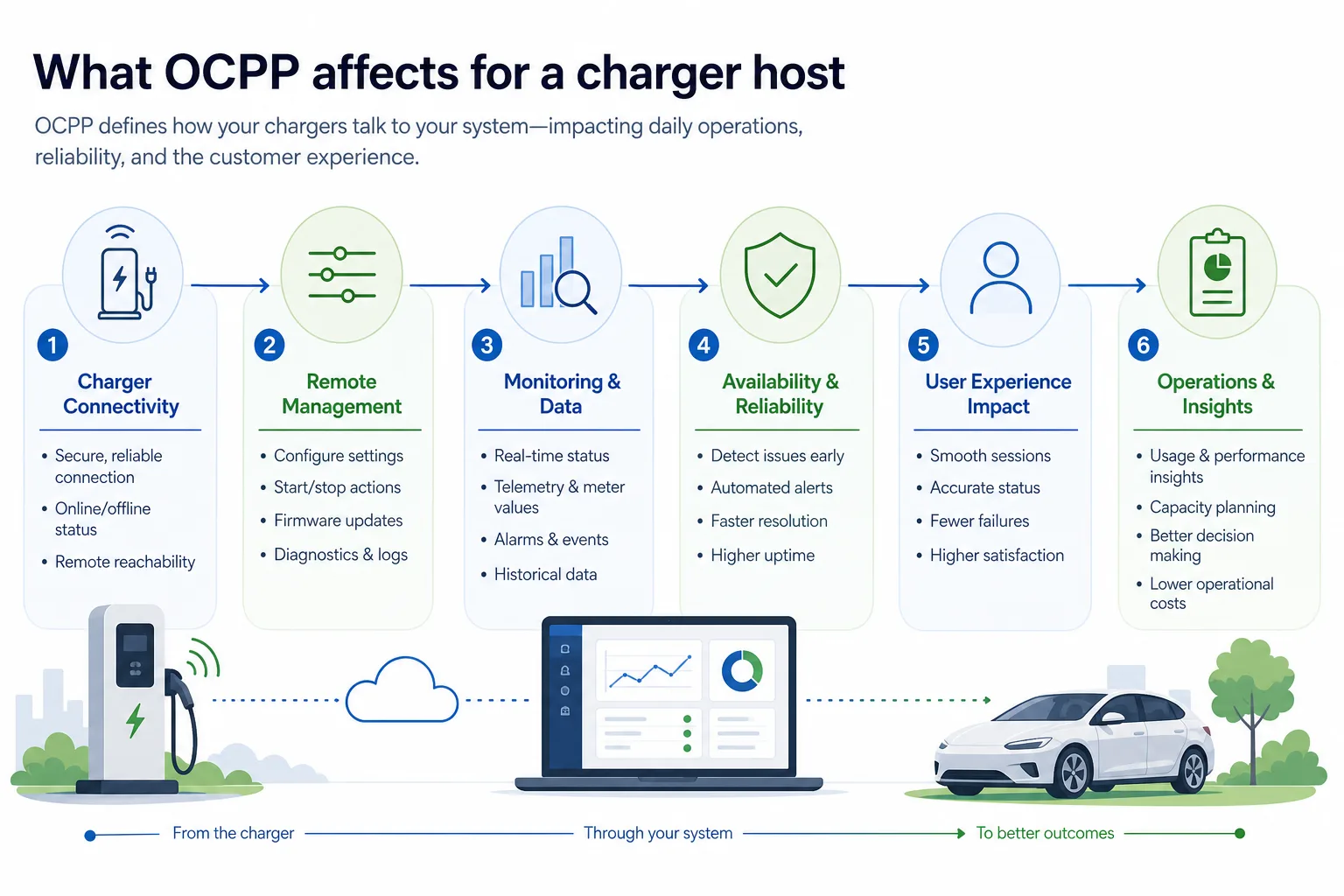
OCPP is an important procurement topic because it concerns the operating link between a charger and its charging-management system. Networked charging infrastructure can provide hosts with use data and support payment methods, utilization monitoring, and customer support, while non-networked equipment does not offer the same advanced monitoring or payment capabilities, according to the U.S. Department of Energy’s procurement guidance.
That does not mean every OCPP implementation provides every operational capability a host may want. A supplier may support a protocol version while offering only certain functions in a particular configuration. The charging-management provider may also have its own onboarding, support, payment, reporting, or integration requirements.
For that reason, turn broad operational goals into documented requirements. Depending on the site’s operating model, those requirements could include:
These are planning questions, not a claim that a particular standard automatically delivers each outcome.
“OCPP compatible” is not enough
A particularly important detail is the OCPP version. The Open Charge Alliance states that OCPP 1.6 and OCPP 2.0.1 are not compatible. A generic statement such as “OCPP compatible” therefore leaves a material procurement question unanswered.
Ask both the charger supplier and management-system provider to identify the exact version they support for the proposed deployment. If a supplier refers to future support, ask whether it is available for the exact product and software version being quoted, whether an upgrade is required, who performs it, and whether it is included in the commercial offer.
The Department of Energy notes that choosing hardware using OCPP 1.6 or higher can help a host change charging-network backends without expensive equipment upgrades. But that is a potential benefit, not a guarantee of an easy migration. The real outcome can depend on the equipment, integrations, configuration, data portability, and contract terms.
A useful procurement position is: treat OCPP as one part of an exit and continuity plan, not the whole plan.
Certification is evidence, not a shortcut
When certification is relevant, request evidence for the exact item being offered. The Open Charge Alliance certification program is intended to test conformance with the OCPP specification, and its certified-products listing can help buyers check a certification claim.
However, hosts should avoid treating a vendor-level statement as sufficient proof. Check the specific product, software version, and applicable profile. Certification does not by itself answer every host question about configured features, service levels, data ownership, payment workflows, integration scope, or migration obligations.
What OCPI affects for a charger host
OCPI is more relevant when the host’s operating model includes exchanging station information with other charging-network systems. The Department of Energy example—network data shared through API connections for a station locator—illustrates the basic purpose: systems can exchange charging-station information.
For a host, this can relate to questions such as:
OCPI support should not be confused with a promise that a station will be listed everywhere, that data will appear immediately, or that roaming access is automatically available. Public listing and roaming can depend on the parties involved, their agreements, implementation choices, and ongoing operating processes.
This is especially relevant for publicly accessible sites. A retail or hospitality host may prioritize accurate public information and a predictable driver experience. A workplace or private multifamily site may have less need for broad external visibility. Neither choice is inherently better; the appropriate requirement follows from the site’s intended access policy and operating model.
A practical pre-procurement checklist
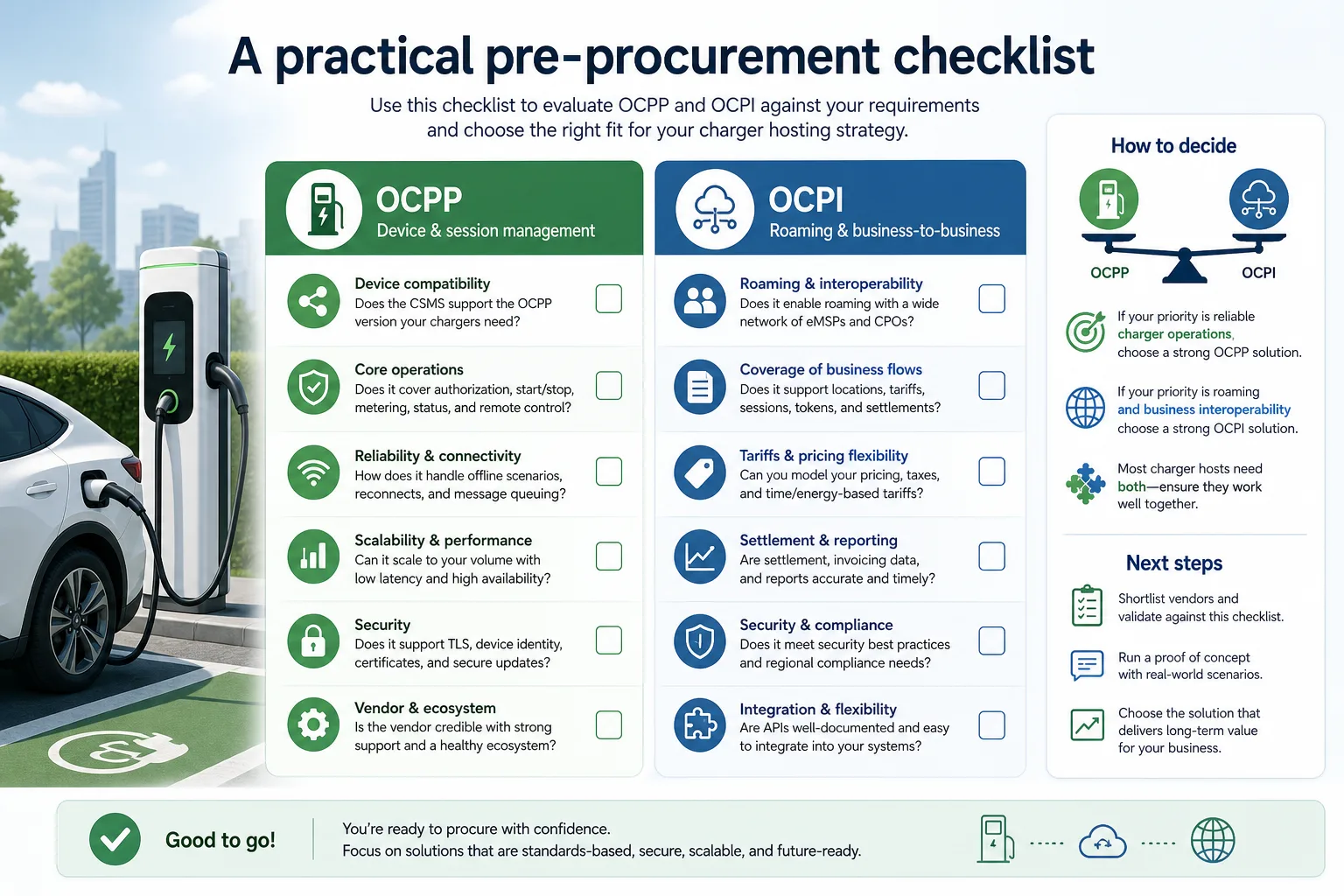
Include the following items in requests for proposal, supplier demonstrations, technical schedules, or implementation plans.
Start with the operating model, then document the evidence
Before comparing protocol labels, define how the site will operate. Is access private, employee-only, resident-focused, customer-facing, or broadly public? Does the host need payments, support coverage, utilization reporting, or external station visibility? Is a future backend change an important commercial risk?
Those answers determine which technical and contractual questions deserve the most weight.
A sound decision framework is to require suppliers to separate four statements clearly:
OCPP can be an important foundation for charger-to-management-system communications and may improve future options when it is properly specified. OCPI can matter when a host needs network-to-network station-data exchange or is evaluating arrangements that depend on it. Neither acronym, on its own, replaces technical validation, implementation planning, or careful contract review.
For a significant deployment, consider involving qualified technical, procurement, legal, electrical, and utility advisers as appropriate to the site and agreement. The aim is not to buy the longest standards checklist. It is to obtain clear evidence that the proposed charging system can support the operating model the host intends to run.
Sources
- U.S. Department of Energy, Alternative Fuels Data Center. Procurement and Installation for Electric Vehicle Charging Infrastructure
- U.S. Department of Energy, Alternative Fuels Data Center. Electric Vehicle Charging Networks
- Open Charge Alliance. OCPP Certification Program
- Open Charge Alliance. Discover our open standards for future-ready EV charging