
Commercial EV Charging and Demand Charges: What Charger Hosts Should Review Before Installation
Adding EV charging changes more than a site’s energy use. At many commercial properties, it can also change the site’s highest measured electrical demand. Before selecting equipment, setting driver prices or forecasting operating costs, charger hosts should understand how their utility bill measures both electricity consumption and peak load.
This matters across workplaces, apartments, retail locations, hotels and publicly accessible sites. The exact impact depends on the serving utility’s tariff, the building’s load profile, charger configuration and how drivers use the site. It is not safe to assume that all commercial accounts have demand charges—or that a charger’s nameplate power will translate directly into a bill increase.
A disciplined bill-and-load review gives hosts a better starting point for discussions with the utility, qualified electrical professionals and charging providers.
Start with the three main bill components
Commercial electricity bills commonly combine several types of charges. The U.S. Department of Energy’s guidance on evaluating utility rates identifies three broad components commonly found on utility bills:
- Energy charges: Based on the amount of electricity consumed, usually measured in kilowatt-hours (kWh). Rates may vary by time of use or season.
- Demand charges: Based on the site’s maximum electrical demand, measured in kilowatts (kW), during a defined billing period or demand window.
- Fixed charges: Recurring charges determined by the applicable rate schedule rather than by the amount of electricity consumed.
A useful distinction is that kWh describes how much electricity was used over time, while kW describes how quickly electricity was being used at a particular moment or interval.
A charging session can add a modest amount of monthly energy yet create a meaningful demand event if it overlaps with an existing building peak. Conversely, charging energy spread across lower-load periods may have a different bill outcome under the same tariff.
Demand charges are not universal, and their design varies. Read the actual tariff rather than relying on a generic explanation or a neighbouring property’s bill.
Why coincident charging and building load matter
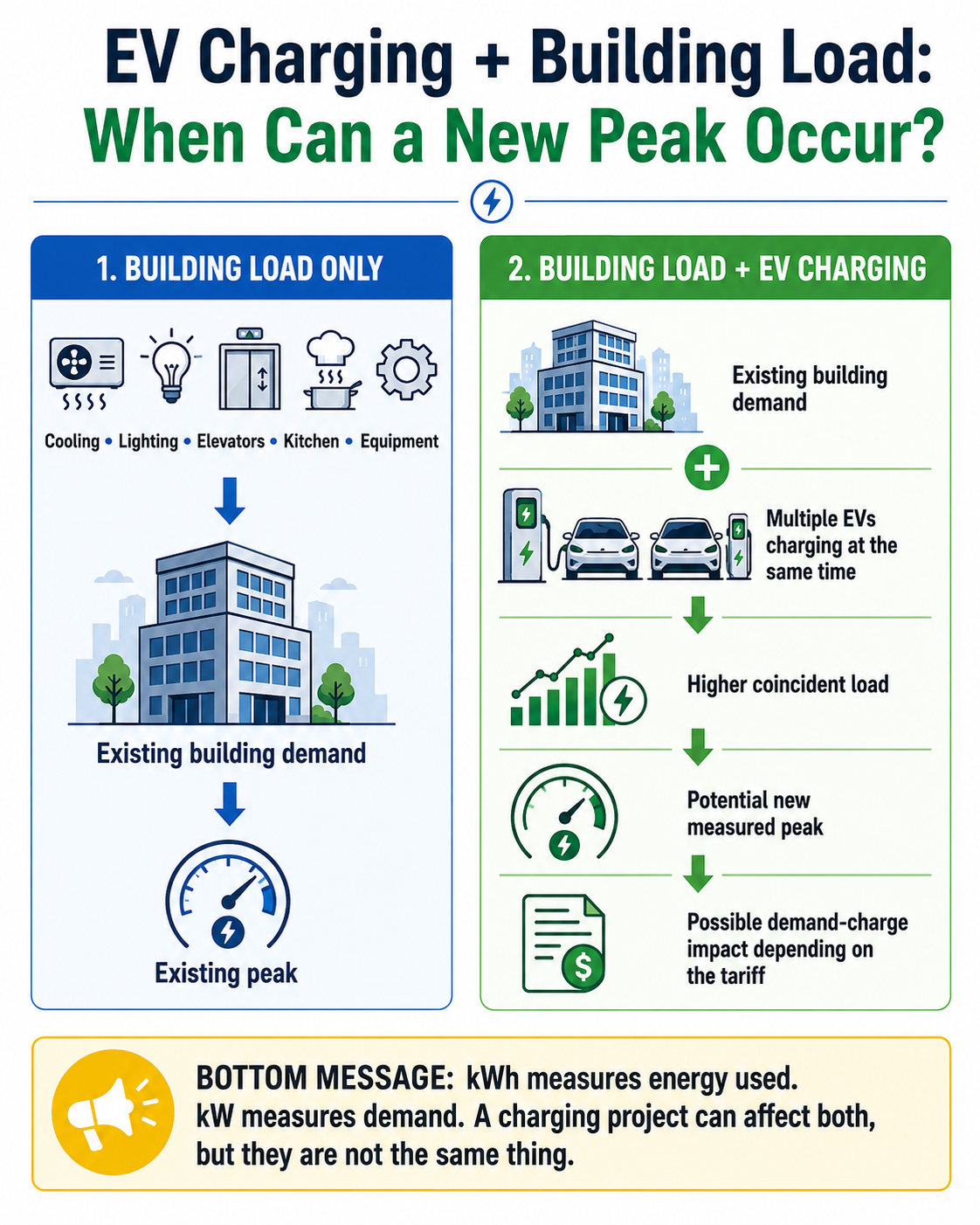
A site’s demand may be highest when several loads operate together: cooling equipment, kitchen equipment, elevators, industrial processes, lighting or other building systems. EV charging added during that same period can increase the measured peak.
For example, a hotel may already reach its peak during a busy afternoon. If multiple guests begin charging at that time, the combined site load could exceed the previous maximum.
The key planning question is not simply:
“How much electricity will the chargers use this month?”
It is:
“When will the chargers operate relative to the building’s highest-load periods, and how many chargers may operate simultaneously?”
This is especially relevant when considering high-power charging. The U.S. Department of Energy Alternative Fuels Data Center’s guidance on EV charging infrastructure operation and maintenance notes that DC fast-charging equipment is more likely to trigger demand charges than Level 1 or Level 2 equipment.
That does not mean DC fast charging is unsuitable, nor does it predict a particular bill result. It means the load and tariff review should be particularly careful when high charger power or simultaneous sessions are part of the plan.
The billing interval also matters. A tariff may measure demand using a specified interval, but the applicable interval and calculation rules are utility- and tariff-specific. Ask the utility how demand is measured at the account rather than assuming a brief spike will be treated in a particular way.
A practical pre-installation bill-and-load checklist
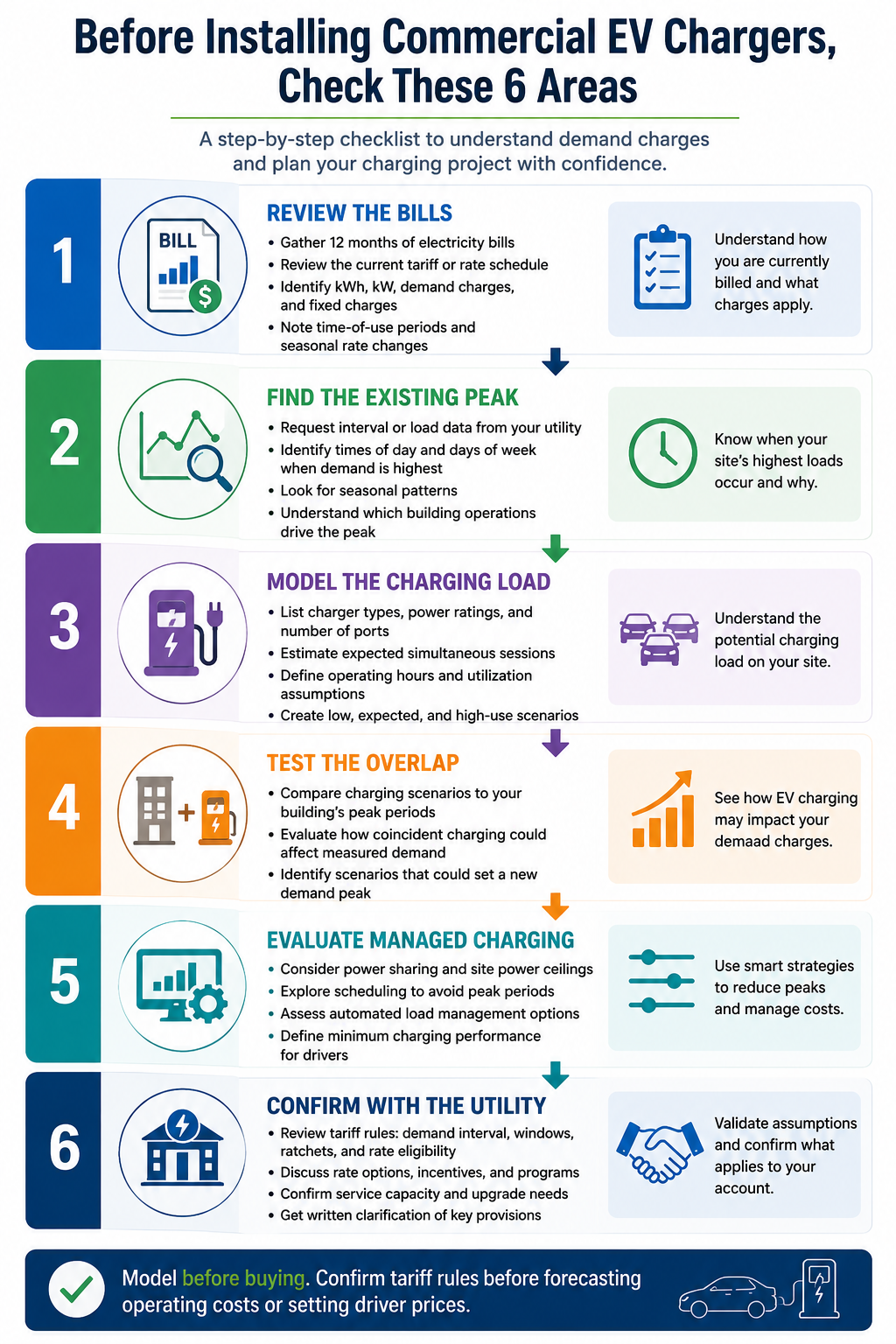
Before making an equipment commitment, assemble a small site review package. It does not need to be a final electrical design. Its purpose is to identify questions early and make a utility rate review more productive.
1. Obtain the current tariff and recent bills
Collect the account’s current tariff or rate schedule and at least 12 months of electricity bills where possible. A full year can reveal seasonal changes in building demand, energy use and rate periods.
On each bill, identify:
- The applicable rate or tariff name
- Monthly electricity consumption in kWh
- Recorded peak demand in kW, where applicable
- Billed demand and demand-related charges
- Fixed or customer charges
- Time-of-use periods, if applicable
- Seasonal rate changes
- Any unusual high-demand months
DOE recommends reviewing current and historical consumption and peak-demand information, checking rate options and contacting the utility about a rate review. See its utility-rate evaluation guidance for the underlying approach.
2. Request interval data when available
Monthly bills show the outcome, but interval data can show the pattern behind it.
Ask the utility what interval data are available for the site and what each field means. Depending on the account and utility, the data may help reveal when the existing peak occurs, whether it is seasonal and how sharply the building load rises.
Review at least these questions:
- At what time of day do the highest loads normally occur?
- Are the highest-demand events recurring or unusual one-time events?
- Are weekday and weekend patterns different?
- How does demand change by season?
- How long do high-load periods typically last?
- Which building operations contribute to the existing peak?
- When are EV charging sessions most likely to overlap with those periods?
If interval data are unavailable, document that limitation. Bills, facility schedules and operational knowledge can still support an initial scenario review, though with more uncertainty.
3. Define the proposed charging load realistically
Create a simple table for each proposed charger type. Include rated power, number of ports, expected simultaneous sessions and intended operating hours.
Distinguish between installed equipment capacity and the site’s expected operating policy.
A plan for six ports does not automatically mean six vehicles will charge at full power at the same moment, but maximum or near-maximum simultaneous charging may still be a prudent scenario to test.
For each scenario, state the assumption plainly. For example:
ScenarioBuilding conditionCharging conditionQuestion to testLow useTypical loadOne active sessionDoes this materially change normal demand?Expected busy periodHigh routine loadLikely simultaneous sessionsCould charging overlap with the usual peak?High-use caseExisting peak conditionMaximum planned simultaneous chargingWhat operational or infrastructure questions does this raise?
This is a planning model, not a bill forecast. Do not convert it into a cost estimate until the utility confirms the tariff rules and relevant site data have been reviewed.
4. Include utilization assumptions, but keep them separate from peak assumptions
Utilization data can help hosts evaluate charging operations, infrastructure needs and pricing structures, according to the Alternative Fuels Data Center’s EV charging operations guidance.
However, average utilization is not the same as coincident peak demand.
A site can have relatively low average utilization and still experience a high-demand event if several charging sessions occur during an existing building peak.
Model both:
- Expected daily and monthly charging activity
- Credible simultaneous-use cases that could affect site demand
Read the tariff details that change the analysis
The tariff is more than a demand-charge rate. Several provisions can materially change the question a host needs to answer.
Time-of-use and demand windows
Some tariffs apply demand charges only during defined hours or seasons. Others use different charges for different periods.
Compare those periods with the site’s building peaks and likely charging behaviour. A retail site, for instance, may have different charging patterns from a workplace or multifamily property.
Non-coincident demand
A non-coincident demand charge may be based on the highest demand during the billing period regardless of time.
In that case, a peak outside a preferred charging window could still matter. Confirm the utility’s definition rather than assuming that overnight or off-peak charging avoids all demand-related charges.
Look-back provisions and ratchets
Some tariffs use a look-back method that considers prior peaks when determining billed demand.
DOE notes that tariffs may apply demand charges within specified windows, use the highest monthly demand regardless of time, or use look-back methods. These provisions are often called demand ratchets, although terminology and calculation methods vary.
Ask exactly:
- How long can a previous peak influence billed demand?
- What percentage or demand value is carried forward?
- Which months are included?
- Are seasonal rules different?
A single high-demand month may have effects beyond that month under some tariffs. Whether it does so at a particular site depends entirely on the applicable rate.
Rate eligibility and changes
A new charging project may prompt questions about service capacity, equipment, customer class or rate options.
Do not assume an alternative rate is available or beneficial.
The Alternative Fuels Data Center’s EV charging procurement and installation guidance recommends involving the serving utility during project planning to identify installation requirements, electrical-service needs, equipment upgrades, pricing implications and potential rate impacts.
Evaluate managed charging as an operating option
Managed charging is coordinated control of charging in response to site conditions, schedules or other objectives.
DOE describes smart charge management as an approach that can coordinate EV charging with building loads, operational requirements and electricity rates. It can potentially reduce coincident peaks between charging and facility operations when the site, tariff, equipment and operating conditions support it.
See DOE’s smart charge management applications and benefits guidance.
For general charger hosts, the fleet-focused examples are best treated as planning principles rather than proof of identical results at a workplace, hotel, apartment building or public charging site.
Managed charging may be worth evaluating where charging can be delayed, reduced or sequenced without undermining the driver experience the site intends to provide.
Questions to evaluate include:
- Can the site establish a maximum total charging-power ceiling?
- Can available power be shared dynamically between multiple ports?
- Can charging be scheduled away from known building peaks?
- Can charging power respond automatically to changes in building load?
- What minimum charging performance should drivers still receive?
- What happens if network connectivity or the control system becomes unavailable?
- Can the system provide charging and power data for future analysis?
- Can operating policies be changed as utilization grows?
Managed charging is not a guaranteed saving. Its value depends on actual tariff mechanics, building load, utilization and the capabilities of the selected equipment and service arrangements.
Get a rate review before setting prices or buying equipment
Before setting driver prices, selecting final charger power or committing to an operating model, request a utility rate review.
Provide the utility with:
- Current account and tariff information
- Recent electricity bills
- Available interval data
- Proposed charger quantities and power levels
- Expected operating hours
- Simultaneous-charging scenarios
- Planned load-management capabilities, if any
Ask for written clarification of the tariff provisions that apply to the account.
Then model several operating scenarios with the utility, qualified electrical professionals and charging provider as appropriate.
The objective is not to manufacture a precise forecast from incomplete data. It is to identify the conditions that could require a different charger configuration, operating policy, service arrangement or financial assumption.
This sequencing is important.
Electricity is only one charging-site operating cost category. Maintenance and applicable charging-network fees may also be relevant. Review the full operating model before treating a posted driver price as settled.
Questions to take to each stakeholder
Ask the utility:
- Which tariff currently applies to this account?
- Does it include demand charges?
- How is peak demand measured?
- What demand interval applies?
- Are there time-of-use or seasonal demand windows?
- Is there a non-coincident demand charge?
- Does the tariff include a look-back or demand ratchet?
- Could the proposed EV charging project affect rate eligibility?
- Is additional electrical-service capacity likely to be required?
- Are EV-specific rates, incentives or managed-charging programs available?
Ask the installer or qualified electrical professional:
- What is the site's existing electrical capacity?
- How much capacity is available for EV charging?
- What would maximum simultaneous charging look like?
- Can chargers share available power?
- Can a site-wide charging-power ceiling be implemented?
- Would service, panel or transformer upgrades be required?
- What metering or monitoring should be included?
- How should future charger expansion be planned?
Ask the charging-network provider or equipment provider:
- Does the system support dynamic power sharing?
- Can total site charging power be capped?
- Can charging schedules or load-management rules be configured?
- What utilization and power data are available to the host?
- Can data be exported for analysis?
- What networking, software and transaction fees apply?
- What maintenance and support responsibilities are included?
- What happens to charging if network connectivity or management controls fail?
A careful demand-charge review does not eliminate uncertainty. It gives hosts a clearer picture of the decisions that need evidence before the project moves from concept to commitment.
Sources
- U.S. Department of Energy — Evaluating Your Utility Rate Options
- Alternative Fuels Data Center — Operation and Maintenance for Electric Vehicle Charging Infrastructure
- Alternative Fuels Data Center — Procurement and Installation for Electric Vehicle Charging Infrastructure
- U.S. Department of Energy — Smart Charge Management Applications and Benefits for Federal Fleets