
A full battery can feel reassuring before a long drive, but charging an EV to 100% is not automatically the best choice for every road-trip stop.
A practical rule is simple: charge to 100% when you genuinely need that energy for the next leg, particularly before departure or before a long gap between reliable chargers. At a mid-trip DC fast charger, though, leaving around 80% is often the faster overall decision when that gives you enough range and a comfortable arrival buffer.
The reason is time. Many EVs reduce their charging power as the battery becomes fuller, so the final 20% can take disproportionately longer. The U.S. Department of Energy notes that DC fast charging commonly slows from 80% to 100%. Your own vehicle's charge screen, route planner and owner documentation should make the final call.
First, separate the two 100% decisions
“Should I charge to 100%?” can mean two very different things.
These situations have different trade-offs.
A planned 100% departure charge
A full charge can be sensible when it starts a long driving day, lets you skip an inconvenient stop or provides needed flexibility on a route with limited charging. If possible, time that charge to finish reasonably close to departure rather than filling the battery far in advance and leaving it full for an extended period.
Some manufacturer guidance explicitly supports this use case. Tesla's Model 3 documentation says that vehicles with an 80% recommended daily limit should generally remain around that level for everyday use, with 100% reserved for times when a long drive is ahead. It also advises avoiding leaving the battery near 0% or 100% for long periods when possible. Read the Tesla Model 3 high-voltage battery guidance as an example of vehicle-specific advice, not as a rule for every EV.
A 100% charge during the trip
At a DC fast charger, the question is usually not whether a full battery is possible. It is whether waiting for it improves the trip.
If 80% gives you enough energy to reach the next dependable charging location with a suitable buffer, continuing to 100% may add more waiting than useful driving distance. Tesla similarly says that reaching 100% at a Supercharger typically takes significantly longer than reaching 80%, and that navigation can recommend a charge level for the next Supercharger on its network (Tesla Supercharging support).
That does not make 100% wrong. It means the target should serve the next leg of your route rather than a habit of always filling the battery.
Why the last part of a fast charge can take longer
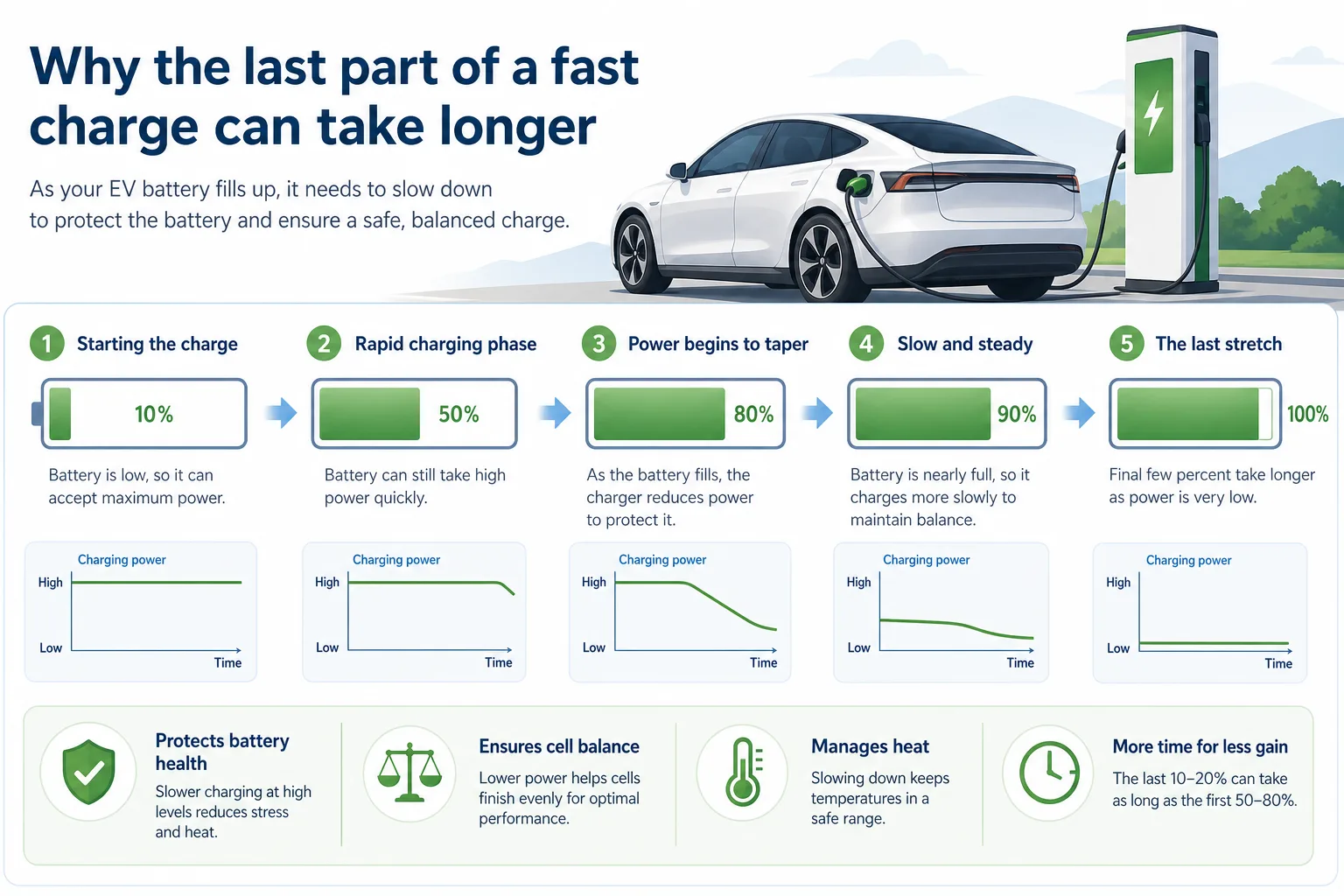
DC fast charging is not usually delivered at one constant power level from low battery to full battery. As the battery state of charge rises, the vehicle commonly reduces the rate at which it accepts power. The exact pattern depends on the vehicle and conditions, but the practical result is familiar: the percentage can climb quickly early in the session and more slowly near the top.
This matters because road-trip charging is a time-and-distance decision. The useful comparison is not simply “How much more charge can I add?” but:
For example, a driver who needs only enough energy for the next planned stop may save time by departing near 80% instead of waiting through the slowest portion of the session. Conversely, if the next reliable charger is far away, out of service, poorly located or uncertain, extra time at the current charger may be a sensible trade-off.
Start with your EV's own charge guidance
There is no universal “road-trip charge limit.” A recommendation that is appropriate for one make, battery or model year may not apply to another.
Ford's published 2023 Mustang Mach-E charging guidance and Chevrolet's public charging quick-start guide illustrate why model-specific guidance matters. The Chevrolet statement is specifically scoped to model-year 2027 and newer Bolt models.
Before travel, check the charge-limit setting shown in your vehicle and consult the owner documentation for your exact model year. If the vehicle offers route-based charging recommendations, treat them as useful inputs, then assess whether the plan reflects your actual route and comfort level.
A practical checklist for choosing a road-trip charge target
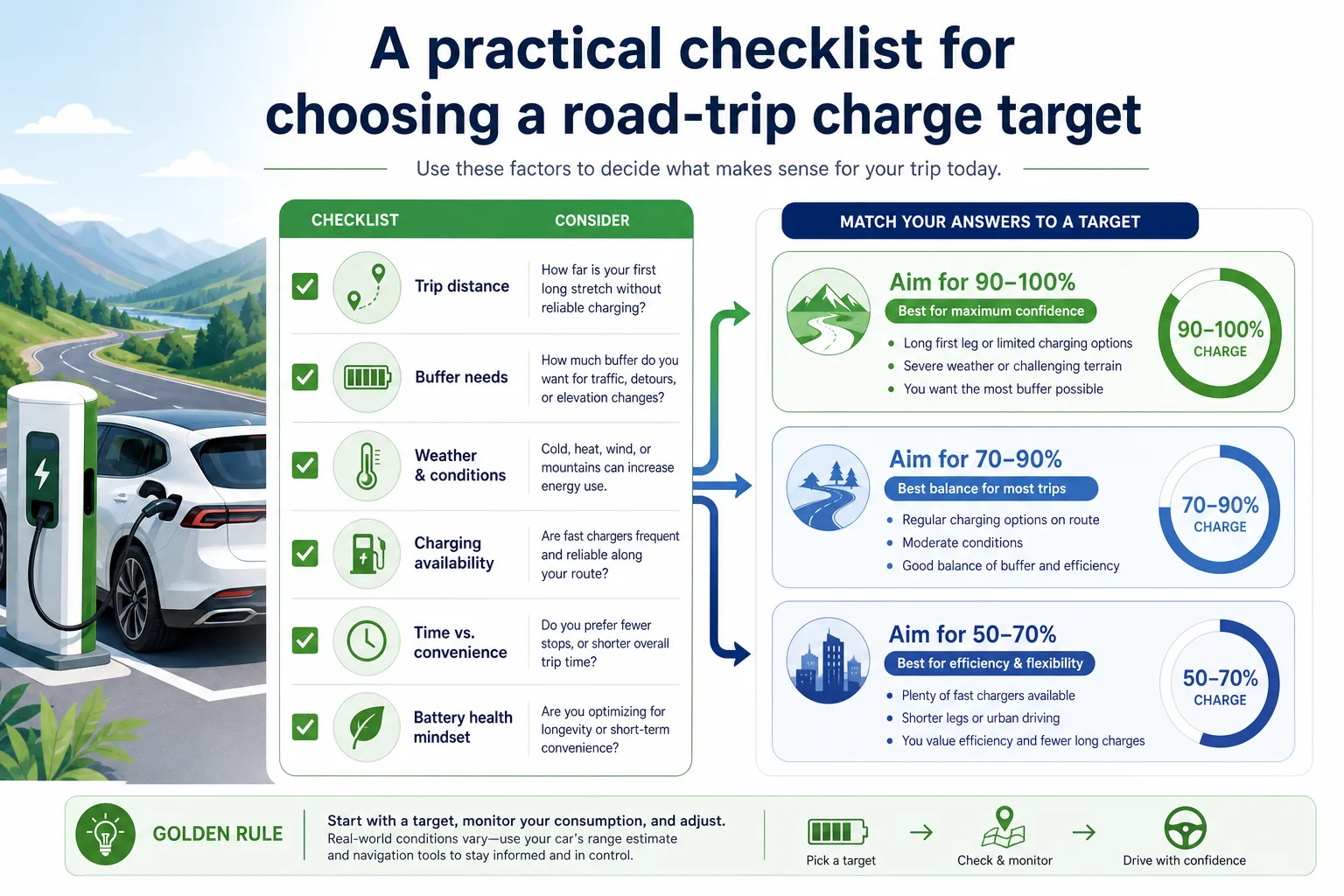
Use this checklist at departure and at each charging stop.
1. How far is the next reliable charging option?
Plan for the charger you expect to use next, but identify a backup where practical. A longer gap, fewer alternatives or an unfamiliar area can justify a higher charge target.
2. What arrival buffer feels appropriate for this leg?
Choose a buffer that gives you room for normal variation in real-world conditions and, where possible, a change of plan. There is no single percentage that suits every route. A short, well-served highway leg may call for a smaller buffer than a remote route with few charging choices.
3. What will the route demand?
Weather, sustained speed, traffic, elevation changes, headwinds and cargo can all affect the energy required for a particular drive. Mountain driving also has a different profile depending on whether the next leg is mostly uphill or downhill. Use current vehicle estimates where available, but leave room for conditions to differ from the forecast.
4. Is this a departure charge or a fast-charge stop?
If you can charge while you sleep, work or take a planned break, the time cost of charging higher may be less important. At a busy DC fast charger on a travel day, the additional time above 80% may be more consequential.
5. Is the station busy?
When other drivers are waiting, charging only to the level needed for your next leg is a practical consideration. This is not a fixed etiquette rule: a higher target can still be reasonable when route conditions genuinely require it.
Three simple road-trip examples
These are planning examples, not vehicle-specific instructions.
Example 1: Leave around 80% at a mid-trip stop
You are travelling on a corridor with several dependable charging options. Your vehicle estimates that an 80% charge will reach the next planned charger with your chosen buffer. The charger is busy, and the remaining charge to 100% is progressing slowly.
Practical choice: Leave around 80% and charge again later if needed. The additional energy is unlikely to justify the extra waiting time.
Example 2: Charge to 100% before an early departure
You are leaving from home before a long first leg, and the next convenient charger is far enough away that the extra energy removes stress or avoids an unnecessary stop. Your vehicle's guidance supports a full charge for long trips.
Practical choice: Charge to 100% and depart soon after the charge completes, consistent with your vehicle's instructions.
Example 3: Build a larger buffer
The next location has limited alternatives, difficult weather is expected or the route includes a lengthy uphill section. Even if charging above 80% is slow, the downside of arriving with too little energy may outweigh the time cost.
Practical choice: Stay longer, potentially to 90% or 100%, if that is what the route requires. Recheck the plan as conditions change.
Bottom line: charge for the next decision, not a fixed number
For many road trips, a useful approach is to begin with a high charge when a long first leg calls for it, then make mid-trip stops only as long as needed to reach the next reliable charger with a sensible buffer. Because fast charging commonly slows near the top of the battery range, this can reduce unnecessary waiting.
But 80% is not a universal rule, and neither is 100%. Follow the charge guidance for your specific EV and model year. A full battery can be the right choice before a long leg; it is simply not always the quickest or most useful target at every public fast-charging stop.
Sources
- Chevrolet. EV Public Charging Quick Start Guide
- U.S. Department of Energy. Winterizing Your Electric Vehicle
- Ford. 2023 Ford Mach-E: EV Charging
- Tesla. High Voltage Battery Information
- Tesla. Supercharging