
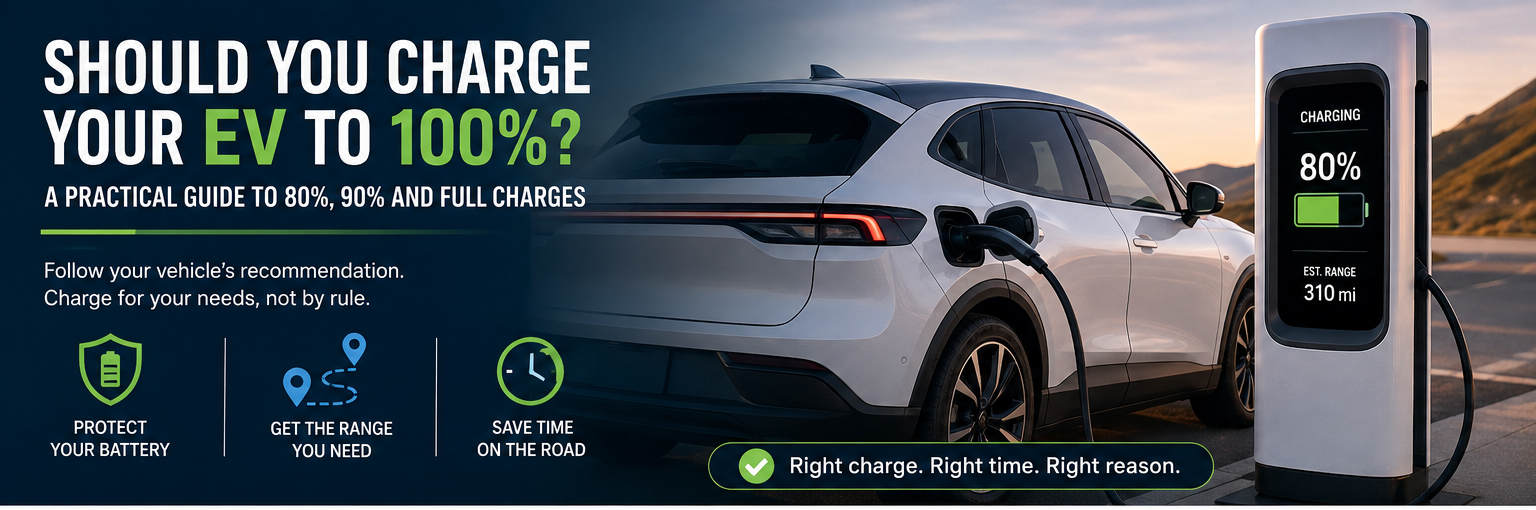
Charging an electric vehicle to 100% is not automatically good or bad. The better approach is to follow the charge limit recommended for your specific vehicle and temporarily adjust it when your driving plans require additional range.
Many EV owners will see a lower everyday charge target in their vehicle settings, often around 80% on certain models. But 80% is not a universal rule for every EV.
Battery design, model year, vehicle software and manufacturer recommendations can all affect the appropriate charging routine. Tesla, for example, states that different batteries can require different charging routines and that the vehicle touchscreen displays the recommended charge limit for the battery installed in that particular vehicle.
For everyday commuting, your manufacturer may recommend a lower charge limit. Before a long drive, charging to 100% may make more sense.
The goal is not to follow 80%, 90% or 100% out of habit. It is to have enough usable range for your driving needs while following the guidance designed for your EV.
Start with your vehicle’s recommended charge limit
Before changing your charging routine, check the charging screen in your vehicle, the manufacturer’s app if available, and the current owner’s manual.
This matters because recommendations can differ even between vehicles sold by the same manufacturer.
Tesla says vehicles with a recommended daily charge limit of 80% should normally remain at that limit for daily driving and can be increased to 100% when necessary, such as before a long road trip. Tesla also recommends avoiding leaving these vehicles near 0% or 100% for days or weeks at a time.
Tesla specifically tells owners to use the recommended charge limit displayed on the vehicle touchscreen because different batteries can require different charging routines.
A practical charging routine therefore begins with your vehicle—not with a generic percentage found online.
Why 80% is commonly recommended for daily EV charging
For many drivers, an EV's full available range simply is not necessary every day.
If your commute requires only a portion of the battery and you can regularly charge at home, at work or at another convenient location, there may be little benefit to charging to the maximum before every drive.
Chevrolet currently recommends capping most GM EVs at 80% for daily use. According to Chevrolet, doing so helps support battery health while also preserving optimal regenerative-braking performance. Drivers can increase the target above 80% when they need additional range for longer trips.
For daily driving, the more useful question is therefore not:
“Should every EV stop charging at 80%?”
It is:
“What charge level does my vehicle recommend, and does that provide enough range for the driving I actually do?”
Your routine should provide enough range for normal trips plus a reasonable buffer without making your charging habits unnecessarily restrictive.
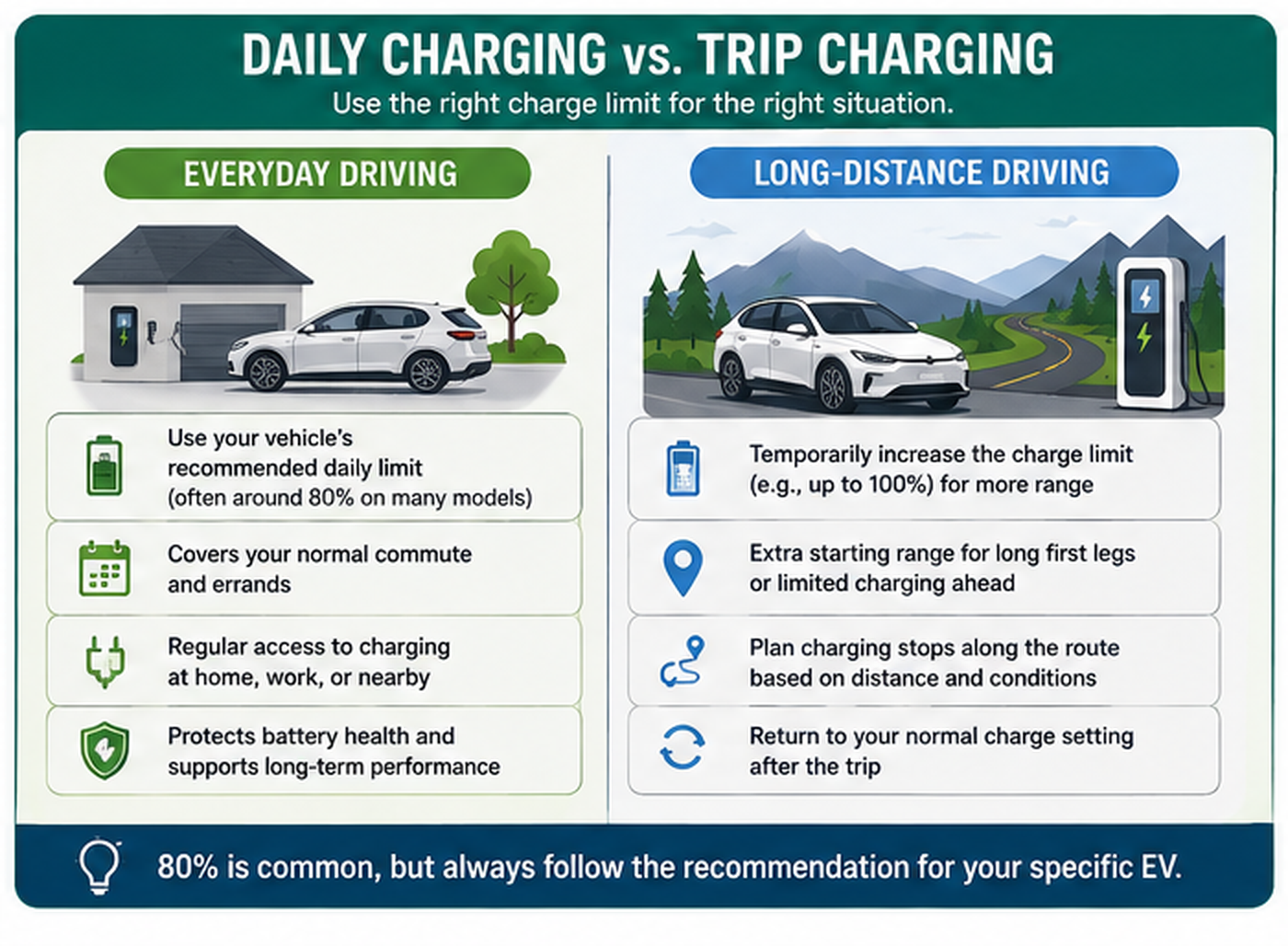
80% is common, but always follow the recommendation for your specific EV.
When charging an EV to 100% makes sense
A 100% charge can be useful when the additional range has a clear purpose.
For vehicles with an 80% recommended daily limit, Tesla specifically says owners can increase the charge limit to 100% when necessary, including before a long road trip.
That can be particularly useful when the first leg of a trip is long, when charging opportunities are limited, or when real-world conditions could reduce your expected range.
The U.S. Department of Energy’s Alternative Fuels Data Center advises EV drivers planning longer trips to consider whether compatible charging stations are available along the route and whether the vehicle can comfortably travel between them. It also recommends leaving extra range when conditions include hilly terrain, heavy loads or significant heating or air-conditioning use.
Weather matters as well. Cold or hot conditions can increase energy consumption, while elevation, highway speeds and heavier loads can reduce the distance available from a given state of charge.
In those situations, using more of the battery before departure can provide a useful planning buffer.
The important distinction is that charging to 100% for a specific trip is different from automatically charging to 100% every day.
If your vehicle allows scheduled charging or a departure time, you may also be able to arrange for the higher charge level to be reached closer to the time you leave. Always use the settings and instructions provided for your particular vehicle.
Do not assume the 80% recommendation applies to every EV
This is one of the most important points for EV owners.
The popular advice to “charge to 80%” is useful only when it matches the manufacturer’s current recommendation for that vehicle.
Chevrolet provides a particularly clear example.
For most GM EVs, Chevrolet recommends an 80% daily charging cap. But Chevrolet gives different instructions for model-year 2027 and newer Bolt models. For those vehicles, Chevrolet recommends regularly charging to 100%, stating that doing so once a week helps the vehicle accurately display available range and battery level and supports faster overall DC fast-charging performance while travelling.
That recommendation should not be applied to other Chevrolet EVs—or to vehicles from other manufacturers.
Instead, it demonstrates why model-specific information matters.
A charging recommendation can depend on the vehicle, battery, model year and manufacturer software. Always check the current instructions for the exact EV you drive.
Public DC fast charging changes the decision
During a road trip, there is another factor to consider: time.
The question at a DC fast charger is not simply whether the vehicle can reach 100%. It is whether waiting for 100% is useful for the next part of the trip.
DC fast charging generally becomes slower as the battery fills.
Chevrolet explains that the charging rate begins decreasing as the battery state of charge increases, with a significant reduction around 80%. Chevrolet therefore notes that stopping around 80% can make charging stops shorter and more efficient when additional range is unnecessary.
The U.S. Department of Energy similarly notes that many EV batteries reduce charging power between approximately 80% and 100% during fast charging, meaning the final portion of a charging session can take disproportionately longer. DOE also recognizes that longer trips or difficult conditions may justify charging beyond 80%.
Tesla takes a route-based approach with its Supercharger navigation. When navigation is active, the vehicle recommends the charge level needed to reach the next Supercharger rather than automatically telling the driver to remain until 100%.
That is a useful principle for EV road trips generally:
Charge for the next leg of the journey, not simply for a preferred percentage.
If the next reliable charger is relatively close, leaving before 80% may be perfectly reasonable.
If the next practical charger is considerably farther away—or weather, terrain or other conditions are reducing range—charging beyond 80% may be the better choice.
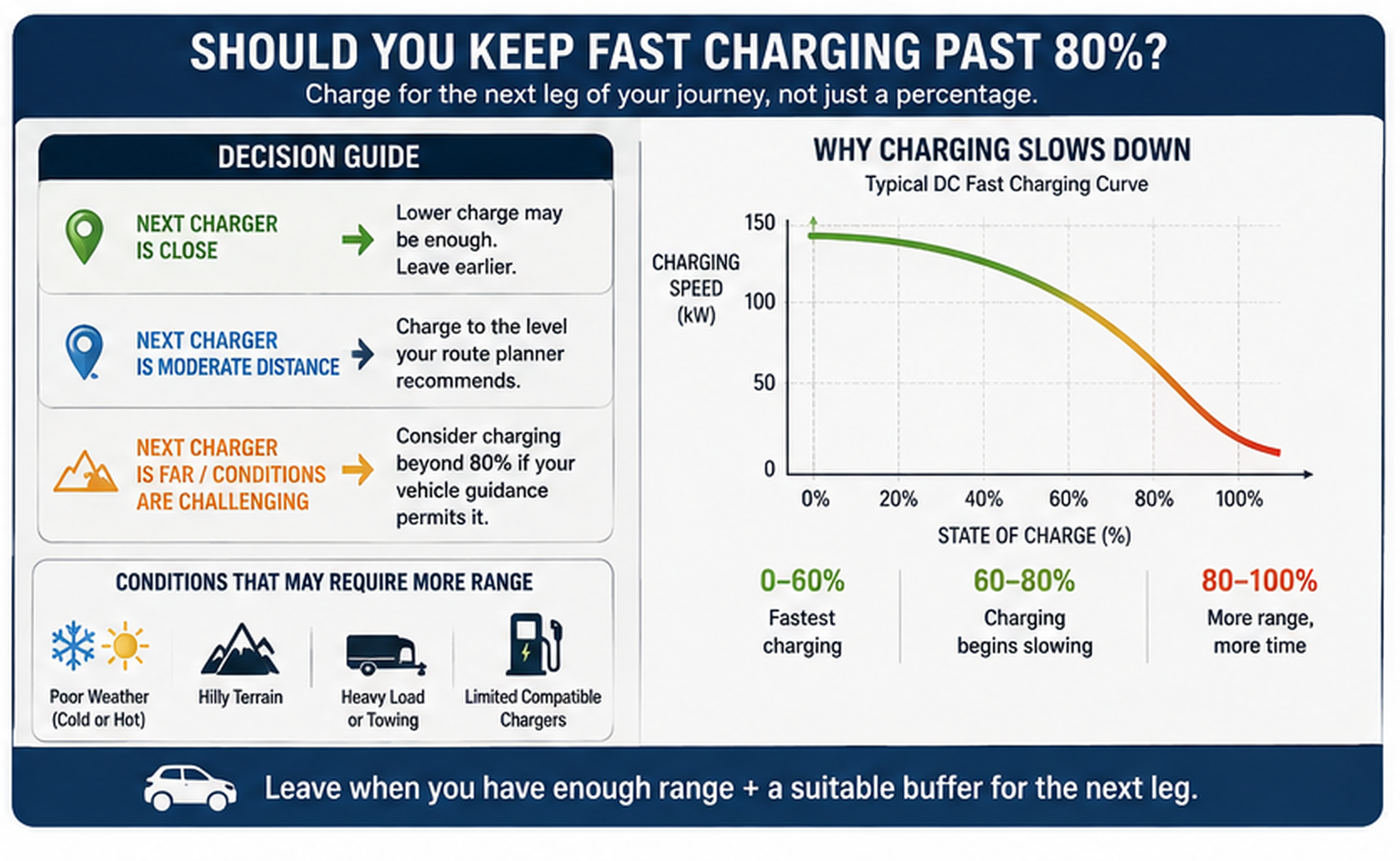
Leave when you have enough range + a suitable buffer for the next leg.
How much range buffer should you keep?
There is no single percentage that works for every route.
A suitable arrival buffer depends on the vehicle, distance, weather, terrain, traffic, charging availability and your comfort level.
DOE recommends accounting for reduced range when travelling through hilly terrain, carrying heavy loads or using substantial heating or air conditioning.
Your vehicle’s navigation system may also continually update its predicted arrival charge based on current consumption.
Instead of planning around the vehicle’s maximum advertised range alone, look at what is happening on the trip itself.
If conditions change, your charging plan can change with them.
A practical EV charging-limit checklist
1. Check the recommendation for your exact EV
Review your vehicle’s charging screen, current owner’s manual and manufacturer support information. Determine whether your vehicle specifies a recommended daily charge level or any battery-specific instructions.
2. Set a normal target for everyday driving
Use the manufacturer-recommended setting that comfortably covers your normal commute, errands and expected driving.
3. Increase the target when a trip requires it
Before a longer journey, determine whether additional starting range will make the route easier or reduce dependence on an early charging stop. Increase the limit only in accordance with your vehicle’s guidance.
4. Plan compatible charging stops
Before a long drive, identify charging locations compatible with your EV and confirm that the distances between stops fit comfortably within your expected range. DOE specifically recommends considering charger compatibility and spacing when evaluating longer EV trips.
5. Include real-world conditions
Consider weather, terrain, heating or air-conditioning use and heavier loads. These factors can affect EV range and may justify a larger buffer.
6. Reassess during the trip
Do not remain committed to a percentage chosen before departure. Weather, charger availability, energy consumption or route changes may justify leaving a charger earlier—or staying longer.
7. Restore your normal setting afterward
If you temporarily increased your charge limit for a trip, review the setting when you return to normal driving so future charging sessions follow your usual manufacturer-recommended routine.
So, should you charge your EV to 100%?
Sometimes, yes.
Charging to 100% can be appropriate when your manufacturer recommends it or when additional range is genuinely useful for a longer journey.
But there is no universal rule saying every EV should always stop at 80%, just as there is no universal rule saying every EV should regularly charge to 100%.
For certain Tesla vehicles, the current recommendation is 80% for daily use and 100% when additional range is needed.
For most current GM EVs, Chevrolet also recommends an 80% daily target while allowing drivers to increase it for longer trips.
At the same time, Chevrolet’s guidance for model-year 2027 and newer Bolt vehicles demonstrates that exceptions exist, including vehicles for which regular 100% charging is specifically recommended.
The best charging strategy is therefore vehicle-specific and trip-specific.
Follow your EV manufacturer’s current recommendation first. Then adjust your charging plan around the route, weather, terrain, compatible charging options and the range buffer you need to arrive comfortably.
That approach is far more useful than treating 80%, 90% or 100% as a rule for every electric vehicle.
Sources
Tesla — Range Tips: Tesla’s current guidance on battery health, recommended daily charge limits, charging to 100% for longer trips and vehicle-specific battery recommendations. Tesla Range Tips
Tesla — Supercharging: Tesla guidance on route-based charging recommendations, Supercharger use and charging levels during trips. Tesla Supercharging Support
Chevrolet — Charging Your EV at Home: Current guidance for most GM EVs and the separate recommendation for model-year 2027 and newer Bolt vehicles. Chevrolet EV Home Charging Guide
Chevrolet — Public EV Charging: Information about public charging and current GM battery charging recommendations. Chevrolet Public EV Charging Guide
Chevrolet — EV Battery Maintenance: Guidance on charge targets, DC fast-charging behaviour and charging speeds as battery state of charge increases. Chevrolet EV Battery Maintenance
U.S. Department of Energy, Alternative Fuels Data Center — Electric Vehicles for Consumers: Guidance on longer-distance EV travel, charging compatibility, expected range and buffers for terrain, loads and climate-control use. DOE Alternative Fuels Data Center — EVs for Consumers
U.S. Department of Energy — All-Electric Vehicles: Background on the effects of temperature, highway driving, acceleration, loads and terrain on EV range. DOE Alternative Fuels Data Center — All-Electric Vehicles
U.S. Department of Energy — Winterizing Your Electric Vehicle: Guidance on DC fast charging between 80% and 100% and circumstances where additional range may be worthwhile. DOE — Winterizing Your Electric Vehicle