
Tariff disputes, often called a “tariff war” in everyday discussion, can make EV charging projects harder to plan. But the effects are rarely as simple as “tariffs make EV chargers more expensive.”
An EV charging project can involve imported charging hardware, electrical distribution equipment, construction materials, labour, utility work, networking and ongoing software or service agreements. Each part of the project may have a different country of origin, customs classification, contract structure and delivery timeline.
For EV drivers, the effects may be less direct. A charging site could open later than expected, an operator might reconsider expansion plans, or pricing and access policies could change. None of these outcomes is automatic. They depend on equipment sourcing, existing inventory, local electrical constraints, demand and the host’s commercial decisions.
This guide explains how tariff uncertainty can affect EV charging equipment, charging-site costs and project timelines for charger hosts and EV drivers in the United States and Canada.
It is educational information, not customs, tax, legal or procurement advice.
What a tariff dispute means for EV charging
A tariff is a duty applied to certain imported goods. During a trade dispute, governments may impose, increase, reduce or remove tariffs on particular products from particular countries.
For an EV charging project, the important question is therefore not simply:
“Are tariffs increasing?”
It is:
“Is the specific equipment being imported subject to an additional tariff when it enters the country?”
That distinction matters because vehicle tariffs are not automatically EV charger tariffs.
In the United States, the Department of Commerce says that 25% Section 232 tariffs on imported automobile parts took effect on May 3, 2025, following a March 26 proclamation. That is an automotive-parts measure and should not be interpreted as a blanket 25% tariff on every EV charger, cable, transformer or piece of charging-site equipment.
Read the Department of Commerce announcement.
The same caution applies in Canada. Canada announced 25% counter-tariffs effective April 9, 2025 on non-CUSMA-compliant U.S.-made vehicles and on the non-Canadian and non-Mexican content of CUSMA-compliant U.S.-made vehicles.
Those announced measures concern vehicles. They should not be interpreted as a general tariff covering every component used in an EV charging installation.
See the Department of Finance Canada announcement.
For a charger host, the more useful questions are specific:
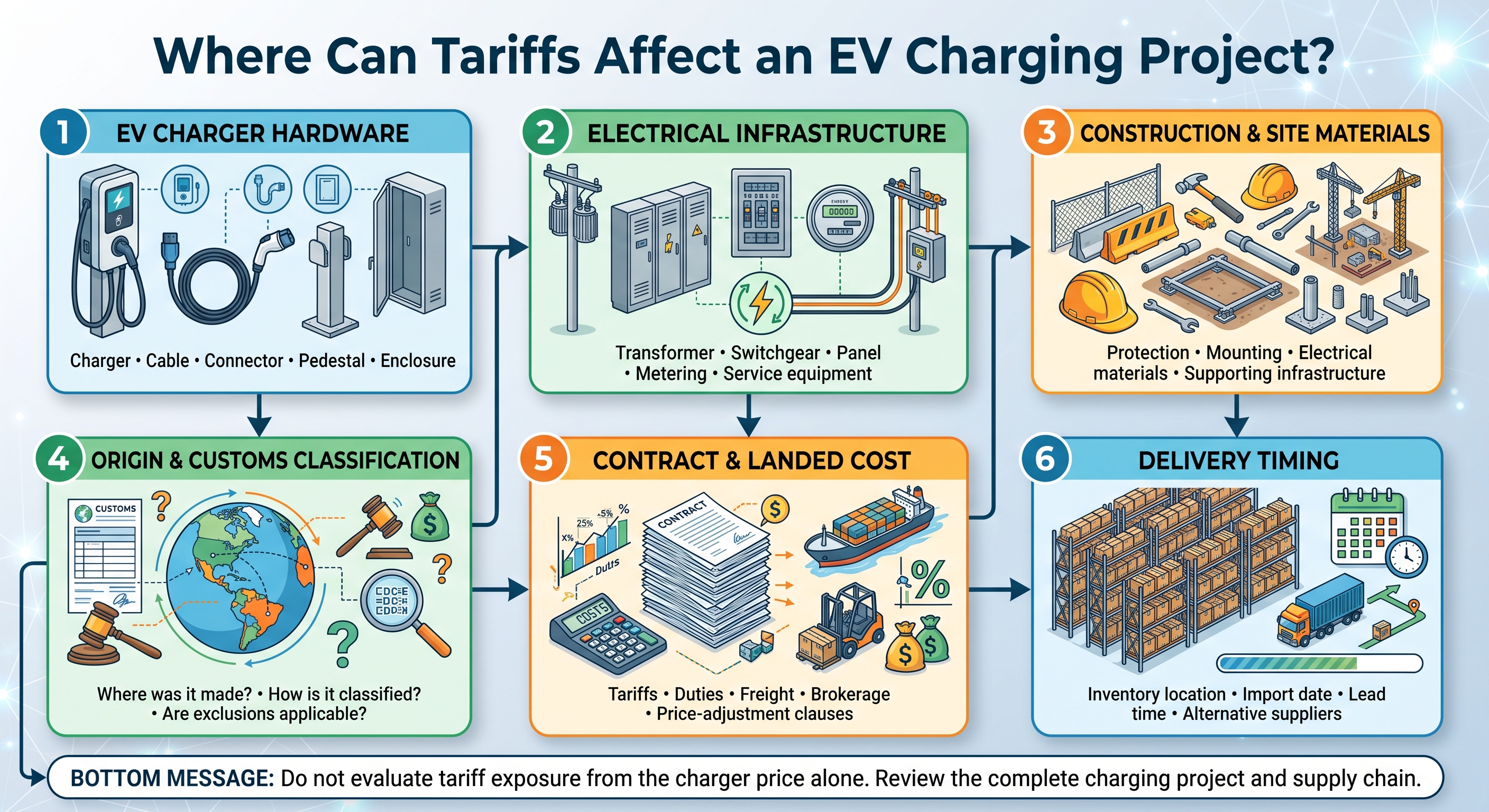
What is being imported? Where was it manufactured? How is it classified for customs purposes? When will it enter the country? And what costs are actually included in the supplier's quote?
Direct exposure: EV charger hardware, electrical equipment and origin
An EV charging site is much more than the charger mounted on a pedestal or wall.
Depending on the project, the bill of materials may include:
- EV charging equipment
- Charging cables and connectors
- Pedestals and enclosures
- Electrical panels
- Transformers
- Switchgear
- Metering equipment
- Communications hardware
- Protective equipment
- Service-upgrade components
Tariff exposure can differ between these products.
A charger manufactured in one country may also contain components produced in several other countries. Meanwhile, the transformer, panel or switchgear serving the charger may come from an entirely different supply chain.
EV chargers and U.S. Section 301 tariffs
EV chargers from China have a relevant historical connection to U.S. trade policy.
A U.S. International Trade Commission working paper explains that EV chargers were included in the third Section 301 product tranche for goods from China, effective September 24, 2018. The paper also highlights an important limitation: EV chargers were reported within a broader electrical-converter category, making charger-specific trade data difficult to isolate.
Read the USITC Electric Vehicle Supply Equipment working paper.
That history does not establish what duty is owed on a particular charger being imported today.
Tariff treatment is product-specific.
The Office of the U.S. Trade Representative explains that Section 301 applicability depends on the product's specific Harmonized Tariff Schedule subheading and any exclusions or modifications that apply.
Use USTR's Section 301 guidance and product search.
Before making a procurement decision, hosts should therefore avoid relying only on a broad statement such as “Made in the USA,” “Made in Canada” or “Imported from Asia.”
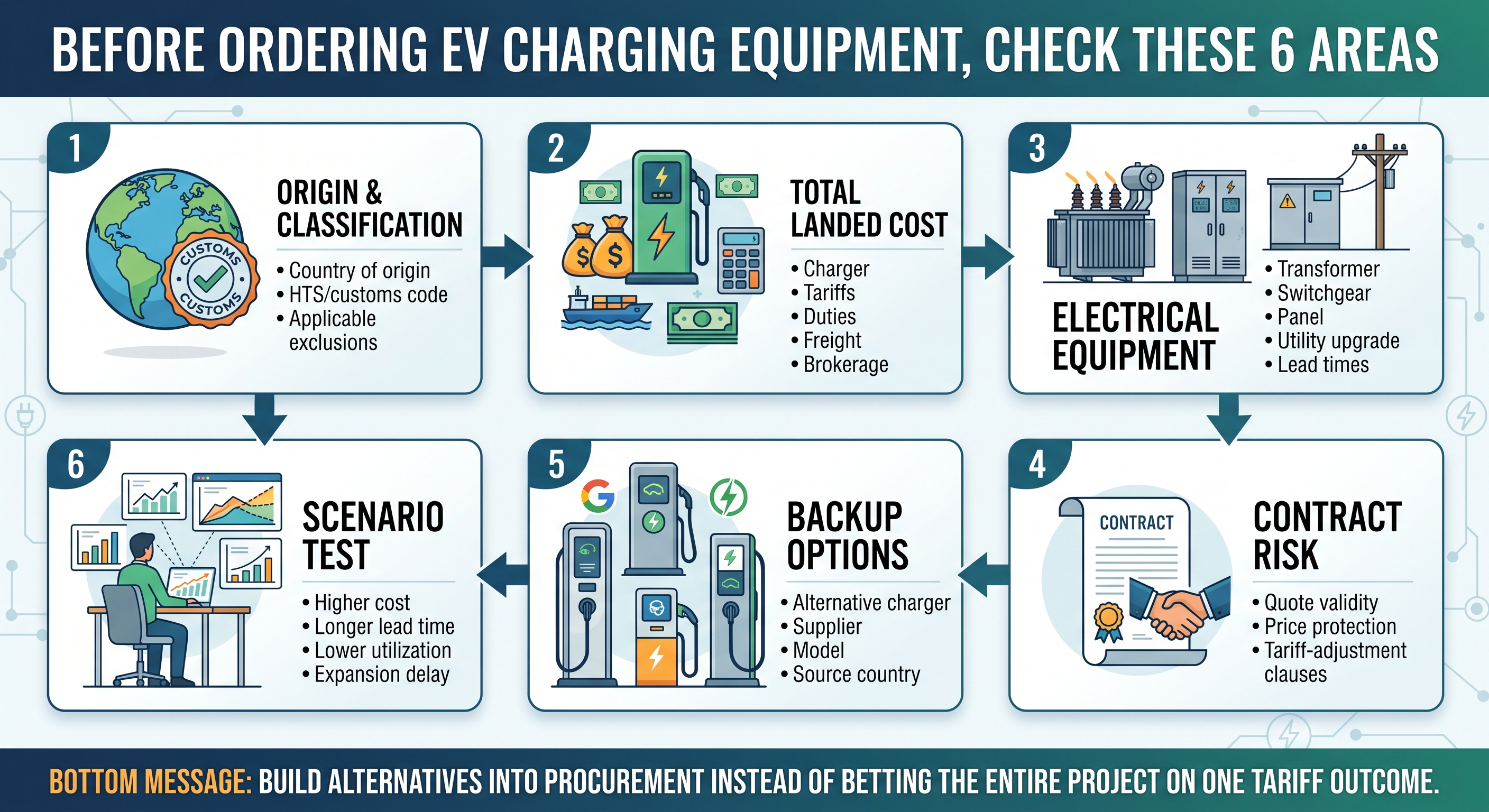
Instead, ask the supplier for information such as:
- Country of origin for the finished charger
- Country of origin of major components, where relevant
- HTS or customs classification being used for the product
- Whether the quoted price includes tariffs, duties, freight and brokerage
- How long the quoted price remains valid
- Whether the contract contains a tariff or duty adjustment clause
- Where the equipment is currently located or stocked
- Expected import and delivery dates
- Whether alternative models or sourcing locations are available
- Lead times for associated electrical equipment
The objective is not to turn a property owner or charger host into a customs specialist.
It is to identify where the project budget could change before a purchase order is signed.
When classification or country-of-origin rules could materially affect a project, a customs broker, qualified trade adviser or procurement professional may be appropriate.
Materials and site infrastructure need a separate review
It is tempting to focus only on the EV charger brand.
That can miss some of the biggest cost and schedule risks in the rest of the project.
A charging installation may be delayed by a transformer, switchgear, electrical panel or utility service upgrade even when the chargers themselves are sitting in a warehouse ready to ship.
The U.S. Department of Energy identifies dependence on imported components and materials, limited domestic manufacturing capacity and long lead times as continuing challenges for important grid equipment.
Read the Department of Energy's grid supply-chain overview.
For charging-site planning, that supports a practical approach:
Track charger lead times and electrical-infrastructure lead times separately.
A host could receive the charging stations on schedule while waiting months for another component required to energize them.
Domestic assembly does not necessarily mean every component is domestic
A domestic final-assembly claim should also not be treated as proof that every component in an EV charger was produced domestically.
For EV chargers covered by the Federal Highway Administration's Buy America implementation plan and manufactured on or after July 1, 2024, final assembly must occur in the United States and the cost of components manufactured in the United States must exceed 55% of the cost of all components.
FHWA's EV charger Buy America Q&As explain the requirements.
That guidance applies to the covered federally funded context described by FHWA. It should not be assumed to govern every privately funded EV charging installation.
Buy America eligibility and tariff treatment are also different questions.
A charger can satisfy one sourcing requirement without that automatically determining every customs obligation associated with the equipment.
Indirect exposure: EV demand and charging utilization
Tariffs affecting vehicles or automotive parts can also influence the wider EV market without directly applying to an EV charger.
Potential effects could include changes in:
- Vehicle prices
- Repair and replacement-part costs
- Fleet purchasing decisions
- Manufacturer sourcing strategies
- Consumer purchasing decisions
If EV adoption develops differently than originally forecast in a particular market, expected charging demand may change as well.
These are planning scenarios, not guaranteed outcomes.
A charger host should not assume that vehicle tariffs will necessarily reduce EV sales, lower charging utilization or make a planned site uneconomic.
Local factors may be more important, including:
- Apartment and condominium density
- Workplace charging demand
- Local EV ownership
- Fleet activity
- Highway traffic
- Tourism
- Utility capacity
- Nearby charging competition
- Parking patterns
Still, utilization uncertainty deserves a place in project planning.
Instead of relying on one forecast, a host can model several scenarios:
Conservative case: EV charging demand develops more slowly than expected.
Base case: Demand follows the property's expected growth pattern.
Higher-demand case: EV adoption and charger utilization grow faster than expected.
Then test what happens if equipment costs rise, installation is delayed or one key component becomes difficult to source.
A project that remains workable across several reasonable scenarios may be more resilient than one that depends on a single optimistic forecast.
What EV charger hosts can do now
Trying to predict every future tariff announcement is rarely a practical procurement strategy.
Building flexibility into the project is more useful.
Hosts can:
- Separate charger cost from total project cost. Track EVSE, electrical infrastructure, construction, networking and utility work independently.
- Request a landed-cost quote. Ask what freight, brokerage, duties and other import-related charges are included.
- Ask how long pricing is protected. A quote valid for 15 or 30 days may carry different risk from a fixed-price agreement tied to delivery.
- Review tariff-adjustment clauses. Determine who bears the cost if tariffs or duties change before importation.
- Confirm equipment origin and classification. Do not rely solely on brand headquarters or final assembly location.
- Check non-charger lead times. Transformers, switchgear and utility work can become the critical path.
- Identify acceptable alternatives before ordering. Consider substitute charger models, power levels or suppliers that could meet the same site requirements.
- Avoid unnecessary single-source dependency. Where practical, understand which parts of the project could be sourced elsewhere.
- Model multiple budget scenarios. Test how the project performs if hardware, infrastructure or construction costs increase.
- Keep documentation. Save supplier representations about origin, classification, delivery timing and included costs.
Where a project depends on a particular tariff treatment, grant condition, electrical approval or utility decision, confirm the requirement with the appropriate qualified professional or authority before committing funds.
What EV drivers may notice
Most EV drivers will not see a line labeled “tariff” on a charging receipt.
If tariffs or broader supply-chain pressures affect charging infrastructure, the effects are more likely to appear through project and operating decisions.
For example, a charging-site owner might:
- Phase a planned rollout
- Delay expansion
- Install fewer chargers initially
- Reconsider equipment choices
- Change pricing
- Modify access policies
But again, none of those outcomes is automatic.
A host with equipment already in inventory, a fixed-price contract or a different supply chain may experience little or no immediate effect.
Check current charging information before travelling
For EV drivers, the practical response is straightforward:
Plan using the charging network that exists today—not a station that is only expected to open.
Before depending on a charging location, check current:
- Operating status
- Access hours
- Charger availability
- Connector compatibility
- Pricing
- Parking restrictions
Opening dates can change for many reasons, including permitting, utility work, construction and equipment delivery.
On longer trips, keeping a practical backup charging stop can reduce reliance on a single newly announced or recently opened location.
Drivers can also provide useful feedback to charging-site hosts. Information about access problems, parking conditions, peak-time demand and gaps in local charging coverage may help a property owner prioritize future investment.
Where Techrige may fit
Periods of supply-chain or pricing uncertainty make communication between EV charger hosts and drivers more important.
Techrige may be considered as one way for drivers and charger hosts to connect around available charging opportunities, depending on the services and functionality available at the time.
Hosts should verify which platform features are actually supported rather than assuming that a service automatically provides listing, booking, payment, pricing, access control, charger verification, uptime reporting or compatibility checking.
Drivers should similarly confirm the current details of a charging opportunity before relying on it for a trip.
The broader principle remains useful regardless of platform:
Hosts need a way to communicate what charging is available, while drivers need current information they can use to make practical charging decisions.
In an uncertain procurement environment, making better use of charging capacity that already exists may also be worth considering alongside construction of new infrastructure.
Build options rather than betting on one tariff outcome
Tariff disputes can affect EV charging equipment and infrastructure decisions, but the exposure is neither universal nor static.
Vehicle tariffs are not automatically EV charger tariffs.
The treatment of a particular piece of charging equipment can depend on its customs classification, country of origin, import date and applicable exclusions or other trade measures.
Meanwhile, the schedule for an EV charging project may depend just as much on transformers, switchgear, utility upgrades and construction as it does on the charger itself.
For charger hosts, the strongest response is disciplined procurement:
Understand what is being purchased.
Request origin and classification information.
Separate landed equipment costs from construction costs.
Review contract terms.
Check electrical-equipment lead times.
Maintain practical alternatives.
For EV drivers, the most useful response is simpler:
Make charging decisions using current site information rather than assuming a planned charging location will open on a particular date.
Flexible planning cannot eliminate tariff or supply-chain uncertainty.
It can, however, make the next decision easier when equipment sourcing, project timing or market conditions change.
Sources
- U.S. Department of Commerce — The Department of Commerce Announces New Auto Tariff Offset Process
- Department of Finance Canada — Canada Announces Entry Into Force of Countermeasures Against Auto Imports From the United States
- U.S. International Trade Commission — Electric Vehicle Supply Equipment (EVSE) in the United States
- Office of the U.S. Trade Representative — How to Navigate the Section 301 Tariff Process
- U.S. Department of Energy — Strengthening America's Grid Supply Chain
- Federal Highway Administration — Buy America Q&As for Electric Vehicle Chargers