
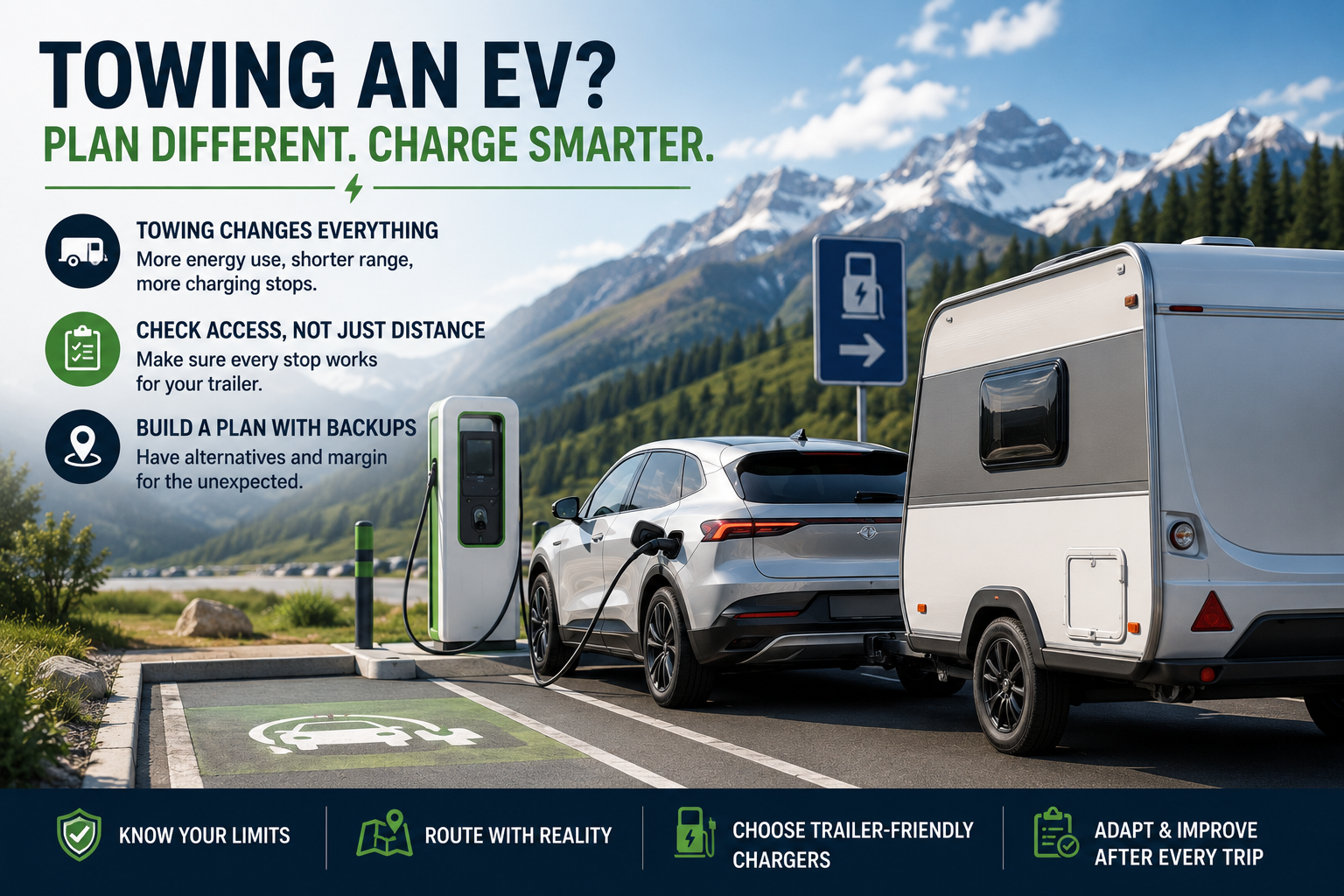
Towing with an EV can be a straightforward trip, but it needs a different charging plan than ordinary driving. A trailer adds mass and aerodynamic drag, which can raise energy use and shorten the distance available between charging stops.
A 2023 National Renewable Energy Laboratory (NREL) study examining fast-charging needs for long-distance EV travel specifically included towing trailers as an important factor affecting charging-infrastructure requirements. Read the NREL report.
The practical issue is not just whether a charger appears on the route. You also need to know whether you can approach it, turn into it, charge without obstructing others, and leave safely while connected to a trailer.
This checklist is designed for longer trips that may require public fast charging. It does not replace your vehicle manual, towing guidance, local towing laws or on-screen vehicle warnings. Treat all route and range estimates as planning inputs—not promises.
Why towing changes an EV charging plan
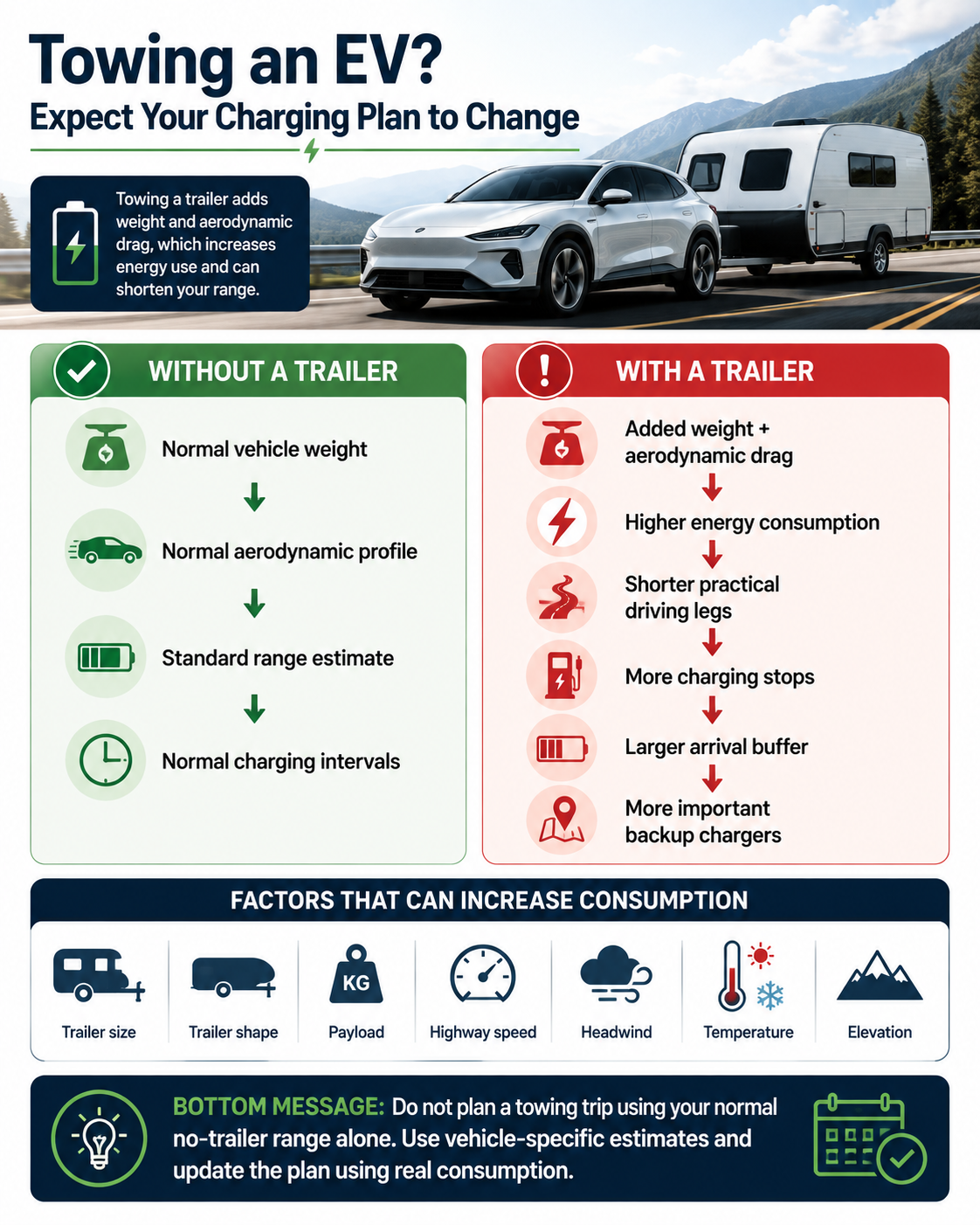
An EV towing a trailer may consume substantially more energy than the same vehicle driven without one. There is no useful universal percentage reduction in range: results depend on the vehicle, trailer size and shape, total mass, payload, road speed, wind, temperature, elevation changes and driving conditions.
That variability changes several decisions at once:
- You may need shorter driving legs between charging stops.
- You may want a larger battery reserve when arriving at a charger.
- Charging stops may need to be more frequent than during normal driving.
- A charger that works well without a trailer may be difficult to access while towing.
- Backup charging locations become more important.
- Weather and wind conditions deserve more attention before departure.
- Your first towing leg can provide useful real-world consumption data for adjusting the rest of the trip.
Aerodynamic drag is especially relevant on faster roads. In practical terms, a tall or broad trailer, headwinds and higher speeds can make actual energy use differ significantly from a plan built around calm-weather, no-trailer driving.
Start with a conservative mindset, particularly on your first towing trip with a new vehicle or trailer.
Start with the vehicle manual, towing limits and towing mode
Before choosing a route, confirm that your specific EV is approved and configured for the trailer you intend to tow.
Read the owner's manual and manufacturer towing guidance for the exact model year, drivetrain and equipment on your vehicle.
Check:
- Maximum permitted trailer weight
- Maximum tongue weight
- Vehicle payload limits
- Hitch requirements
- Trailer-brake requirements
- Recommended tire pressures while towing
- Trailer lighting and electrical connections
- Whether a towing or trailer mode must be activated
- Manufacturer-specific towing speed guidance
- Whether towing changes driver-assistance features
- Any restrictions associated with wheel, tire or vehicle configuration
Vehicle-specific towing modes can also affect range estimates.
For example, Tesla says towing increases vehicle weight and drag and can decrease Model Y driving range. Tesla also states that Trip Planner attempts to adjust estimates when Trailer Mode is being used, although actual energy consumption can still vary. See Tesla's Model Y towing guidance.
The broader lesson applies regardless of manufacturer: use the settings and limits specified for your exact vehicle and do not rely on an estimate generated for normal, unladen driving.
Use the vehicle's towing-aware route tools where available
Start planning with your vehicle's own navigation system if it offers towing-aware routing.
These systems can be particularly useful because they may combine vehicle information, battery level, charging locations and trailer-related data rather than simply plotting the shortest road distance.
Availability varies by vehicle, model year, equipment and connected-service configuration.
Ford, for example, says its Connected Navigation system on supported electric vehicles can use traffic and route conditions along with trailer-profile information such as size and drag when calculating its Intelligent Range estimate. Its navigation system can also route drivers toward public charging stations. See Ford Connected Navigation.
This is an example rather than a feature you should assume every EV provides.
Use towing-aware navigation as the first draft of your plan. Then ask questions that the routing software may not fully answer:
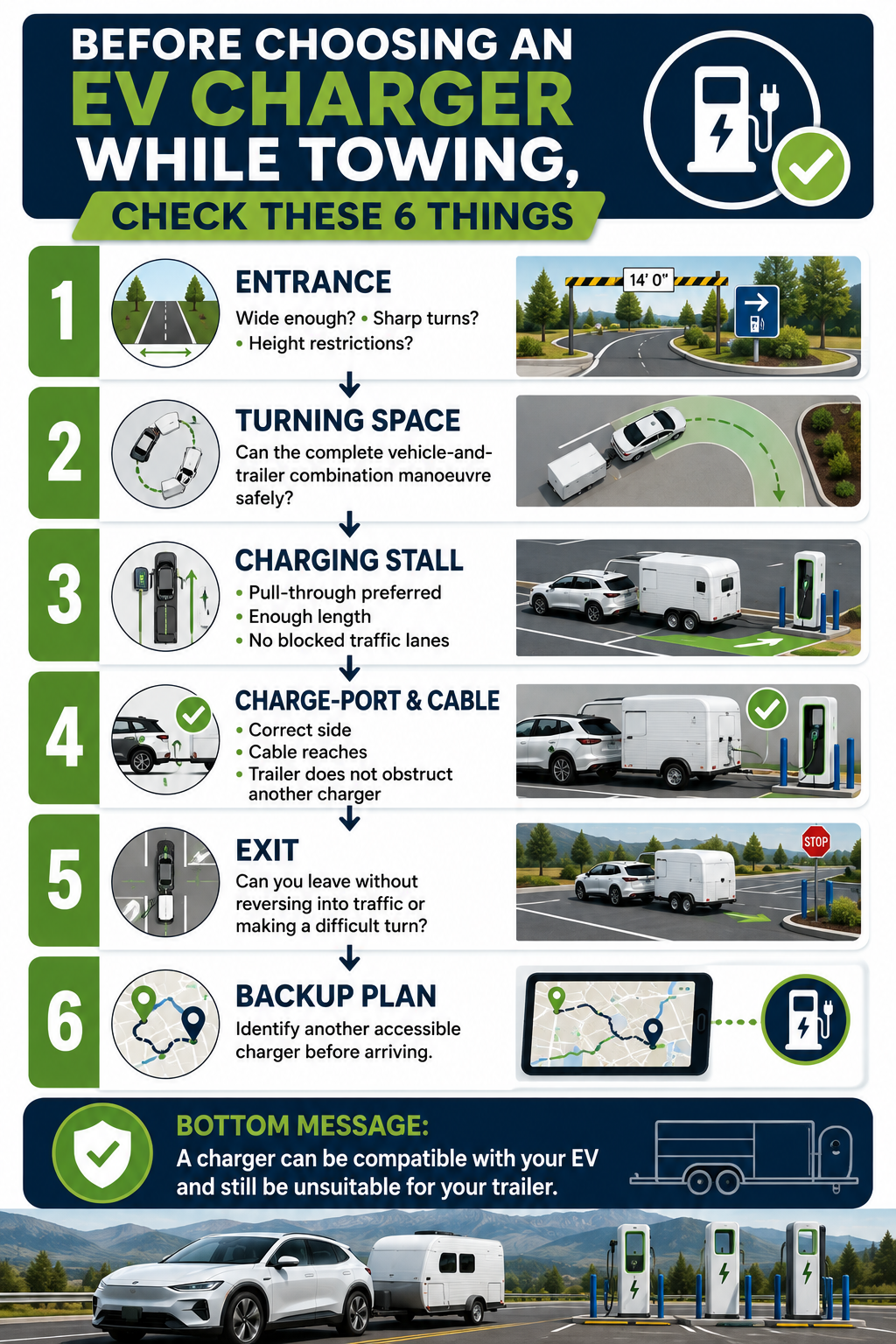
- Can your vehicle and trailer comfortably enter the charging property?
- Is the charger accessible without making a very tight turn?
- Are any stalls pull-through?
- Can your charging port reach the charger without blocking another stall?
- Will the trailer extend into a traffic lane or neighbouring parking space?
- Is there enough room to exit after charging?
- Is there somewhere safe and legal to reposition or temporarily detach the trailer if necessary?
- What charging location will you use if the preferred station is unavailable or inaccessible?
If your vehicle does not provide towing-specific route planning, you can still build a careful plan.
The U.S. Department of Energy's Alternative Fueling Station Locator allows users to search for EV charging stations by location and map charging options along a route. Explore the Alternative Fueling Station Locator.
Use a station locator to identify candidate stops, then independently assess whether each location is suitable for your vehicle-and-trailer combination.
Choose charging stops for access as well as distance
A charger marker on a map is not proof that the site is trailer-friendly.
Public charging layouts vary widely. Some sites have pull-through spaces or large open parking areas. Others require tight turns, reversing, sharp approaches or parking across multiple spaces.
Conditions can also change because of:
- Construction
- Parked vehicles
- Charging queues
- Snowbanks
- Temporary barriers
- Delivery vehicles
- Site-specific parking restrictions
For every important charging stop, inspect the site before leaving home.
Use recent mapping imagery, station photos, charging-network information and direct site information where practical.
Look specifically for:
- Pull-through charging stalls
- Wide entrances and exits
- Adequate turning space
- Charger orientation
- Your EV's charge-port location relative to the charger
- Cable reach
- Curbs, bollards and islands
- Parking-space dimensions
- Low-clearance restrictions
- One-way parking aisles
- Space behind or beside the vehicle
- Whether charging would require blocking another charger
- Safe locations for repositioning the trailer
- A straightforward exit path
Plan the access path, not merely the charger address.
It can help to record which entrance you expect to use, where you expect to turn and what you will do if the intended stalls are occupied.
Avoid treating a site as suitable solely because another driver reports using it with a trailer. Trailer lengths, turning characteristics, tow-vehicle dimensions, charge-port locations and traffic conditions differ.
Your own assessment is still necessary.
Build a conservative charging and backup-stop plan
A towing plan should include margin for uncertainty.
Rather than setting one fixed distance or battery percentage for every trip, use a process that reflects your vehicle, trailer, weather and route.
Create a simple stop-by-stop plan:
Plan itemWhat to recordPlanned charging stopLocation and preferred approachExpected arrival chargeConservative estimate based on towingCharging objectiveEnough energy for the next leg plus a bufferAccess assessmentTurning room, stall layout and exit planFirst backupA viable charger that can be reached if neededSecond contingencyAnother charger or a safe change to the itinerary
For the first leg, consider choosing an earlier charging opportunity than you would without the trailer.
Early real-world consumption provides useful evidence before the battery level becomes restrictive. If consumption is higher than expected, you can adjust the next charging stop while you still have several options.
It is also useful to distinguish between primary, backup and emergency-only charging locations.
Primary stop
A location you have inspected and intend to use.
Backup stop
A credible alternative with adequate range and a workable access plan.
Emergency-only stop
A charger that appears reachable but has uncertain trailer access, fewer charging options or a less convenient layout.
Keeping these categories separate can prevent a stressful last-minute decision based only on a charger pin on a map.
Before departure, review conditions likely to affect energy consumption, including:
- Strong headwinds
- Cold temperatures
- Extreme heat
- Mountain grades
- Heavy traffic
- Rain or snow
- Changes in trailer cargo or load
If conditions are less favourable than expected, consider shortening the first leg or increasing your planned battery reserve.
At the site: charge without blocking traffic or creating an unsafe manoeuvre
When you arrive, assess the site before committing to a charging stall.
Charging is not worth a rushed manoeuvre, damaged trailer or blocked traffic lane.
Use a practical arrival routine:
- Slow down before entering the charging area. Look at the complete layout rather than focusing only on the charger.
- Confirm your planned stall is actually usable. Parked vehicles or charging queues may have changed the situation.
- Check the path of the trailer. Remember that trailer wheels track inside the tow vehicle's path during turns.
- Avoid blocking active charging stalls, traffic lanes or pedestrian routes.
- Confirm that the charging cable reaches your port without excessive tension.
- If repositioning or unhitching is necessary, only do so somewhere safe and permitted. Secure the trailer according to its manufacturer's instructions.
- If the site cannot be used safely, leave and use your backup plan.
Courtesy matters, but the priority is safe, lawful operation and avoiding unnecessary disruption.
A carefully selected backup charger is generally better than trying to force an unsuitable location to work under pressure.
After the first trip: record real energy use and refine the plan
Your first few towing trips produce information that generic route estimates cannot provide.
You do not need a complicated logbook. Record enough information to improve your next trip.
After each major leg, note:
- Distance travelled
- Starting battery percentage
- Arrival battery percentage
- Energy consumption shown by the vehicle
- Approximate average speed
- Trailer type and load
- Temperature
- Wind conditions
- Major elevation changes
- Whether actual consumption was above or below the estimate
- Whether the charging location was easy to access
- Which stall or entrance worked best
- Any manoeuvres you would avoid next time
Over time, this record can help identify the conditions that tend to raise consumption for your particular vehicle-and-trailer combination.
It can also identify charging locations that are convenient, difficult or best avoided when towing.
Revise future plans based on what actually happened—not just what the navigation system predicted.
If the first trip used more energy than expected, do not assume the next trip will automatically be better. Build more margin, shorten the next planned leg or reconsider the route.
If a charging location required a complicated or unsafe manoeuvre, classify it as unsuitable for future towing unless you can verify a better setup.
The aim is not to eliminate uncertainty. It is to make uncertainty manageable through vehicle-specific guidance, conservative routing, independently checked charging-site access and credible backup options.
Sources
- National Renewable Energy Laboratory — Fast Charging Infrastructure for Electrifying Road Trips to and from National Parks in the Western United States
- Tesla — Model Y Tow Package and Trailer Mode
- Tesla — Model Y Owner's Manual: Towing and Accessories
- Ford — Connected Navigation and EV Intelligent Range
- U.S. Department of Energy Alternative Fuels Data Center — Alternative Fueling Station Locator