
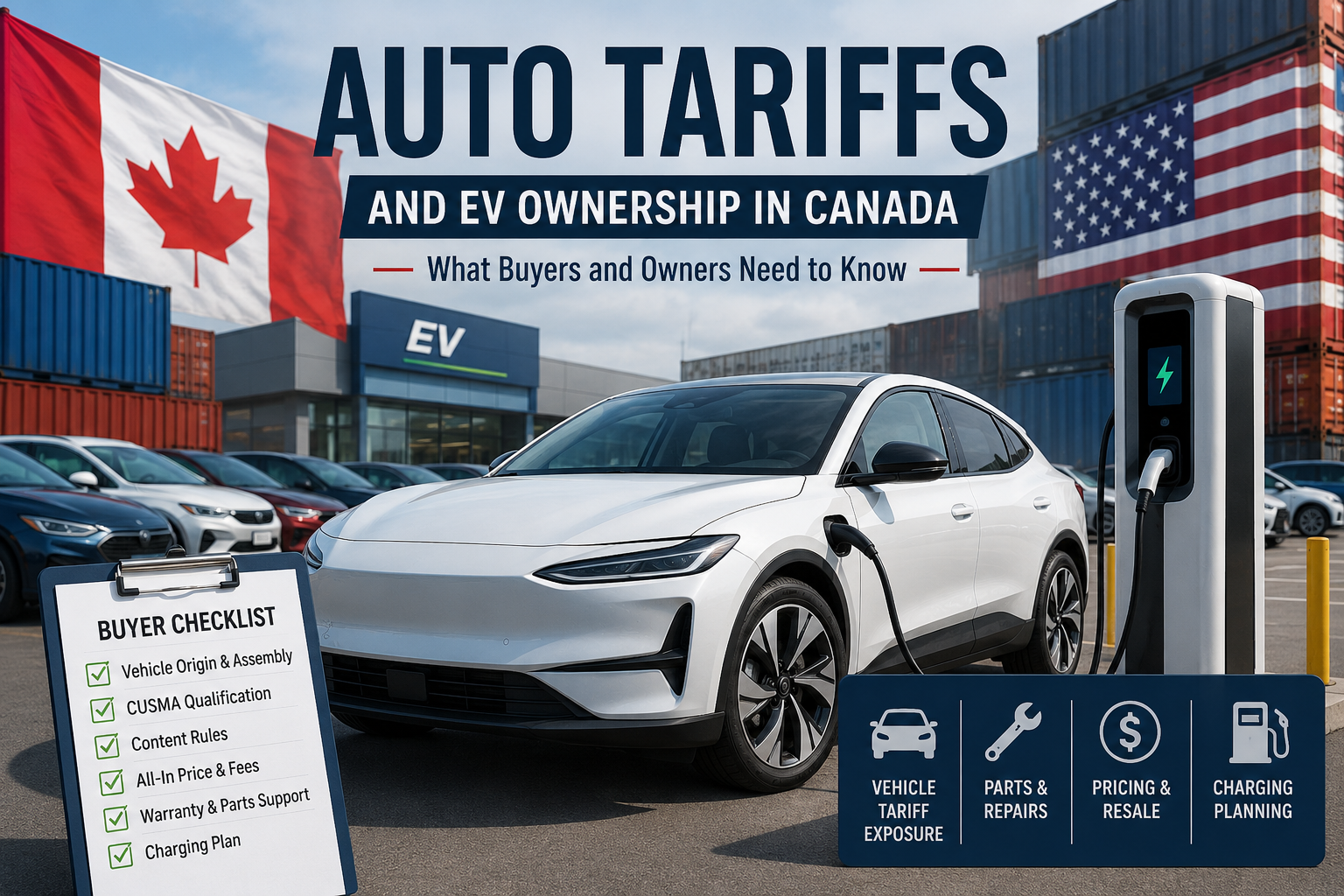
Canada’s auto counter-tariffs have applied since April 9, 2025. They arrived amid a shifting U.S. policy environment: a U.S. proclamation set a 25% tariff on covered imported automobiles beginning April 3, 2025, with covered auto-parts tariffs to begin no later than May 3, 2025. Canada’s Department of Finance explains the Canadian auto tariffs and their effective date, while the White House proclamation outlines the original U.S. automobile and auto-parts measures.
For Canadian EV drivers, the practical question is not simply whether a model is American, Canadian or electric. It is how a specific vehicle was imported, whether it qualifies under the Canada–United States–Mexico Agreement (CUSMA/USMCA), what content rules apply, and how the manufacturer, importer and dealer price that vehicle.
That makes this a planning issue rather than a reason to assume every EV price, repair bill or charging cost will move by the same amount.
The confirmed tariff picture
Canada says it applies a 25% tariff to non-CUSMA-compliant vehicles imported from the United States. For CUSMA-compliant vehicles imported from the United States, Canada says the measure applies to the non-Canadian and non-Mexican content.
Canada’s official product list includes tariff classification 8703.80.00, covering passenger vehicles propelled only by an electric motor, so fully electric passenger vehicles are among the listed categories. See the official list of vehicle products subject to Canada’s 25% tariffs for the applicable classifications.
On the U.S. side, the March 2025 proclamation says qualifying USMCA vehicles may receive treatment under which the 25% tariff is applied to their non-U.S. content, subject to documentation and approval. That is materially different from assuming the duty applies to the full value of every qualifying vehicle.
The policy environment continued to change in 2026. A White House proclamation dated July 20, 2026 announced additional 50% duties on certain Canadian products in connection with the motor-vehicle trade dispute. A subsequent August 18, 2026 proclamation temporarily delayed those additional duties, changing their effective date to August 22, 2026.
Canada subsequently confirmed that its existing auto counter-tariffs remain in place. Because the coverage of newer U.S. duties depends on the applicable product lists, tariff classifications, exclusions and other rules, these developments should not be used to conclude that every Canadian-built EV, battery, charger or vehicle component automatically faces the same tariff. Check the applicable current product classification before making a purchase or import decision.
Which EV purchases may face the most exposure?
The most direct area of potential exposure for a Canadian buyer is a vehicle imported from the United States. A model assembled in the United States may warrant closer questions, but assembly location alone does not settle tariff treatment. CUSMA qualification and the origin of relevant content can matter.
This is especially important because a vehicle nameplate is not a reliable tariff answer. The same model may be built in more than one plant, sold from different inventory pools or equipped differently. A seller should be able to help identify the specific vehicle being quoted, including its VIN and build origin.
A tariff is also not the same as a guaranteed matching increase in the final price paid by a consumer. The final transaction price can reflect existing inventory, manufacturer pricing decisions, importer costs, dealer pricing, trade-in value, financing terms and other factors.
Some vehicles may have been imported before a measure took effect; others may be ordered or allocated later. Those differences can matter more than a headline percentage.
For a cross-border purchase or direct import, the uncertainty is greater. Buyers should confirm the current treatment before committing funds with the seller, manufacturer, customs broker or a qualified trade professional.
This article provides general information and is not customs, tax, legal or purchase advice.
Likely owner impacts: separate the questions
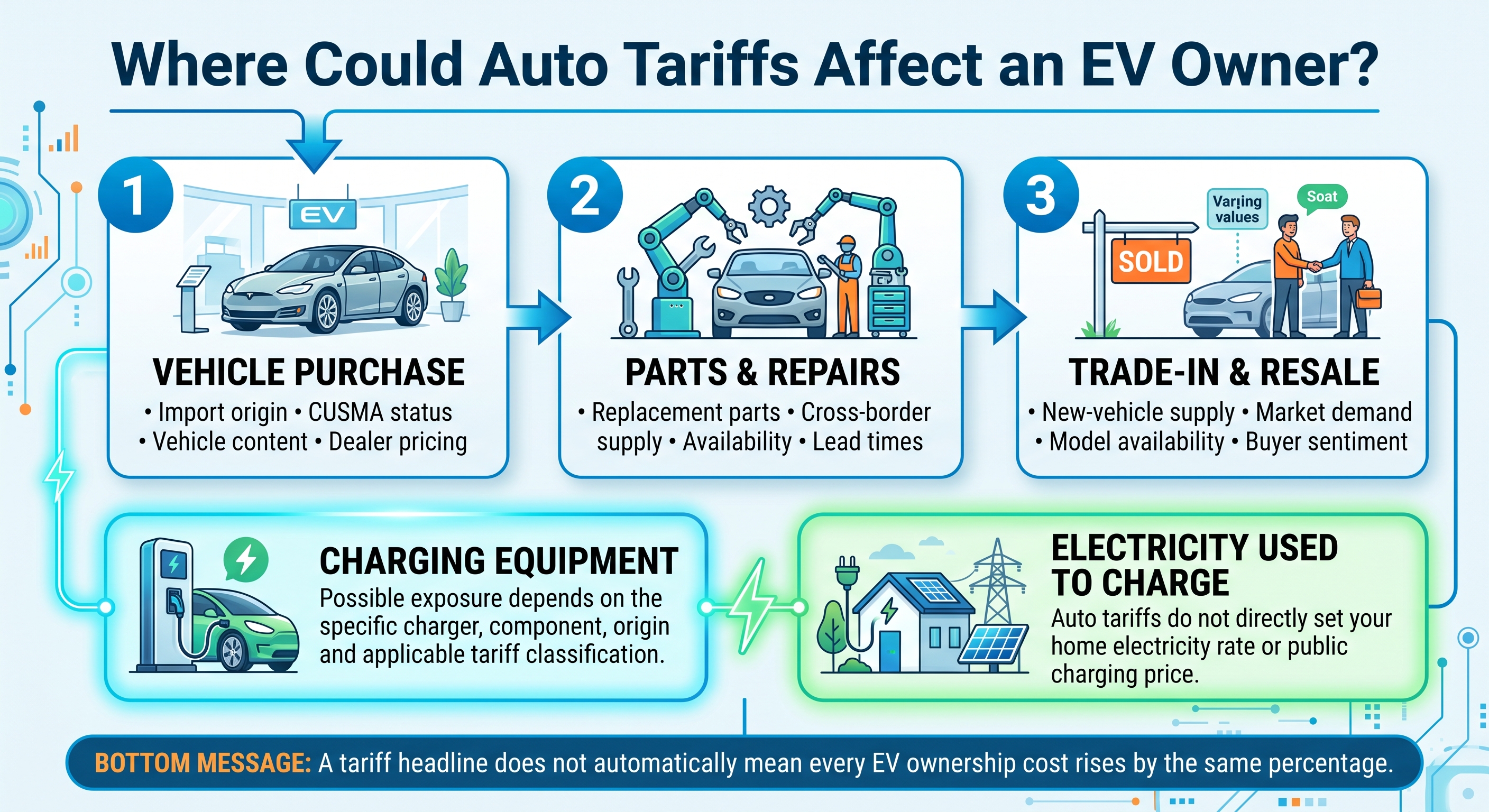
Tariffs can create uncertainty in several parts of EV ownership. It helps to treat them as separate decisions rather than as one blanket cost increase.
1. New-EV pricing and availability
For a shopper, the near-term effect may be less about a published MSRP change and more about the quote on a particular vehicle.
In-stock inventory and a factory order can have different pricing and delivery conditions. A dealer may have more certainty about a VIN already on its lot than about a vehicle arriving later.
This does not mean in-stock vehicles are automatically better value. It means shoppers should compare like with like:
- Trim and equipment
- Battery configuration
- Options
- Vehicle origin
- Delivery timing
- All-in price
- Financing terms
- Written pricing conditions
If two similar vehicles have different origins or supply paths, ask the seller to explain the difference rather than guessing from the badge.
2. Trade-in and resale uncertainty
Tariff headlines may influence how buyers and sellers view supply, but they do not establish a specific future resale value for any EV.
Used-vehicle values can also reflect:
- Model updates
- Battery condition
- Vehicle age and mileage
- Local demand
- Available incentives
- Financing conditions
- Availability and pricing of comparable new vehicles
If you are trading in an EV, obtain more than one appraisal where practical and compare the trade-in offer with the purchase quote. Keeping those negotiations distinct can make it easier to see the actual economics of the deal.
3. Parts and repair costs
Vehicle and parts tariffs may create upward cost pressure for some supply chains over time, particularly where replacement components cross the border. But a tariff announcement does not prove that any individual repair, insurance premium or collision estimate will increase.
For an EV you already own, the useful action is to ask practical questions before you need a repair:
- Are common replacement parts stocked in Canada?
- Are important components regularly imported from the United States?
- What are the typical lead times for collision and EV-specific parts?
- Are battery, drive-unit and charging-system components covered by warranty?
- Does the manufacturer have a strong Canadian parts and service network?
- Are there local technicians or collision centres qualified to repair the vehicle?
- Could a delayed component leave the vehicle off the road for an extended period?
The answers will vary by brand, vehicle, location and repair type. A service department, collision centre or manufacturer is better positioned than a tariff headline to answer availability questions for a particular part.
Charging an existing EV: what tariffs do and do not change
The electricity used to charge an EV you already own is not an imported automobile. The auto-tariff measures described above therefore do not directly establish your home electricity rate or the price displayed at a public charger.
That said, charging remains an important household-cost decision. If vehicle ownership or repair costs become less predictable, drivers may want clearer visibility into their charging routine and travel needs.
Home charging may suit drivers with access to it, while public charging can extend a vehicle’s useful daily range and support longer trips.
The U.S. Department of Energy’s Alternative Fuels Data Center notes that drivers can normally expect to pay more at public charging stations—particularly DC fast chargers—than for electricity used when charging at home. Read the Department of Energy’s consumer EV charging overview.
The best charging choice depends on your own:
- Electricity rates
- Parking arrangement
- Home-charging access
- Workplace-charging access
- Public-charging availability
- Driving pattern
- Typical trip distance
- Charging speed requirements
It is reasonable to compare the posted price, estimated dwell time, location and charging speed before relying on a public option.
It is not reasonable to assume public charging will always lower costs or that an automobile tariff will automatically raise charging prices.
A practical checklist before buying or replacing an EV
Use this checklist to turn a broad trade-policy story into vehicle-specific questions.
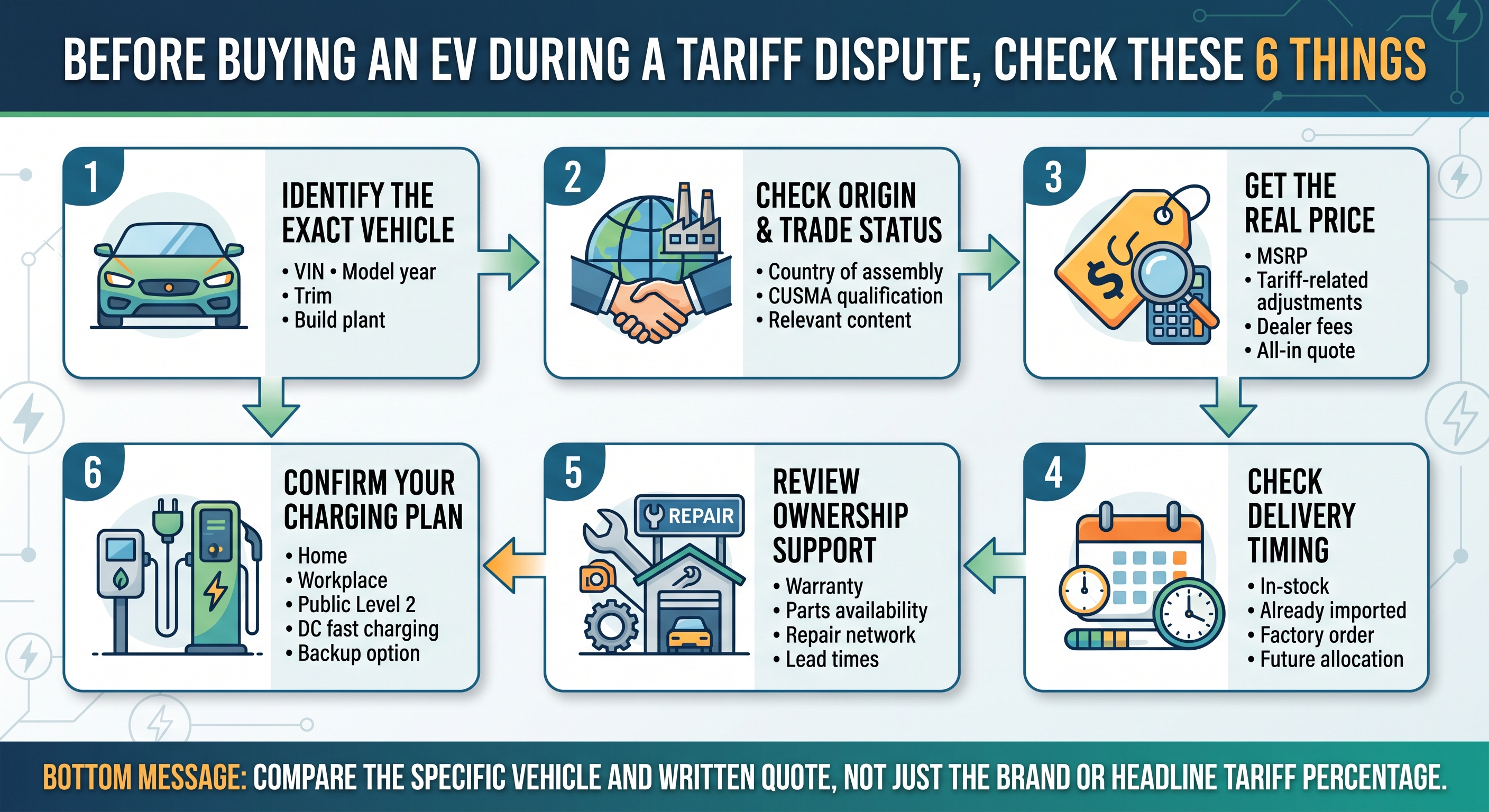
- Ask for the exact VIN of the vehicle you are considering.
- Confirm the country and plant of final assembly.
- Ask whether the specific vehicle qualifies under CUSMA.
- Ask whether tariff-related costs are already reflected in the quoted price.
- Obtain a written all-in price, not just the advertised MSRP.
- Ask whether the quote applies to the specific VIN or only to an estimated future order.
- Compare in-stock inventory with factory-order pricing.
- Check warranty coverage and Canadian service availability.
- Ask about availability and typical lead times for important EV-specific replacement parts.
- Get a separate trade-in valuation where practical.
- Review financing rates and total borrowing cost, not only monthly payments.
- Confirm your normal home, workplace or public charging plan.
- For a direct or cross-border import, verify current customs treatment before paying a deposit or completing the transaction.
Where Techrige may fit in charging planning
Tariffs do not change the need for a dependable charging routine.
As you compare EV choices, it can be useful to review nearby charging options and, where relevant, consider whether shared-charging arrangements could support your routine.
Techrige may be relevant as a planning or discovery layer where available features help drivers review charging options or shared-charging arrangements.
Before relying on any charging platform or location, confirm:
- Charging location
- Access requirements
- Connector compatibility
- Charging speed
- Pricing
- Operating hours
- Parking restrictions
- Availability
- Any host- or property-specific instructions
No charging tool should be treated as a substitute for checking those details for a specific stop. Likewise, tariff exposure is primarily a vehicle, component and import-classification question—not something a charging platform can remove.
Keep the decision vehicle-specific
The Canada–U.S. auto-tariff environment remains changeable.
Canada’s measures distinguish between non-CUSMA-compliant vehicles and the non-Canadian/non-Mexican content of CUSMA-compliant vehicles imported from the United States. U.S. treatment also contains qualification, content, documentation, product-classification and approval considerations.
The additional U.S. trade measures announced in 2026 reinforce why buyers should check current official information rather than relying on an older tariff headline.
For most drivers, the sensible response is measured:
- Verify the exact vehicle.
- Confirm its origin and applicable trade treatment.
- Get a written all-in quote.
- Assess warranty, parts and repair support.
- Compare financing and trade-in terms separately.
- Make a charging plan that works with your normal driving.
For cross-border purchases, unusual sourcing arrangements or material uncertainty about tariff treatment, confirm the current details with the seller, manufacturer, customs broker or qualified trade professional before proceeding.
Sources
- Department of Finance Canada — Canada’s Tariffs: Automobiles
- Department of Finance Canada — List of Vehicle Products Subject to 25% Tariffs Effective April 9, 2025
- Department of Finance Canada — August 25, 2026 Tariff Countermeasures Update
- White House — Adjusting Imports of Automobiles and Automobile Parts, March 26, 2025
- White House — Additional Duties Concerning Canadian Motor Vehicles, July 20, 2026
- White House — Temporary Suspension and Revised Effective Date, August 18, 2026
- U.S. Department of Energy Alternative Fuels Data Center — Electric Vehicles for Consumers