
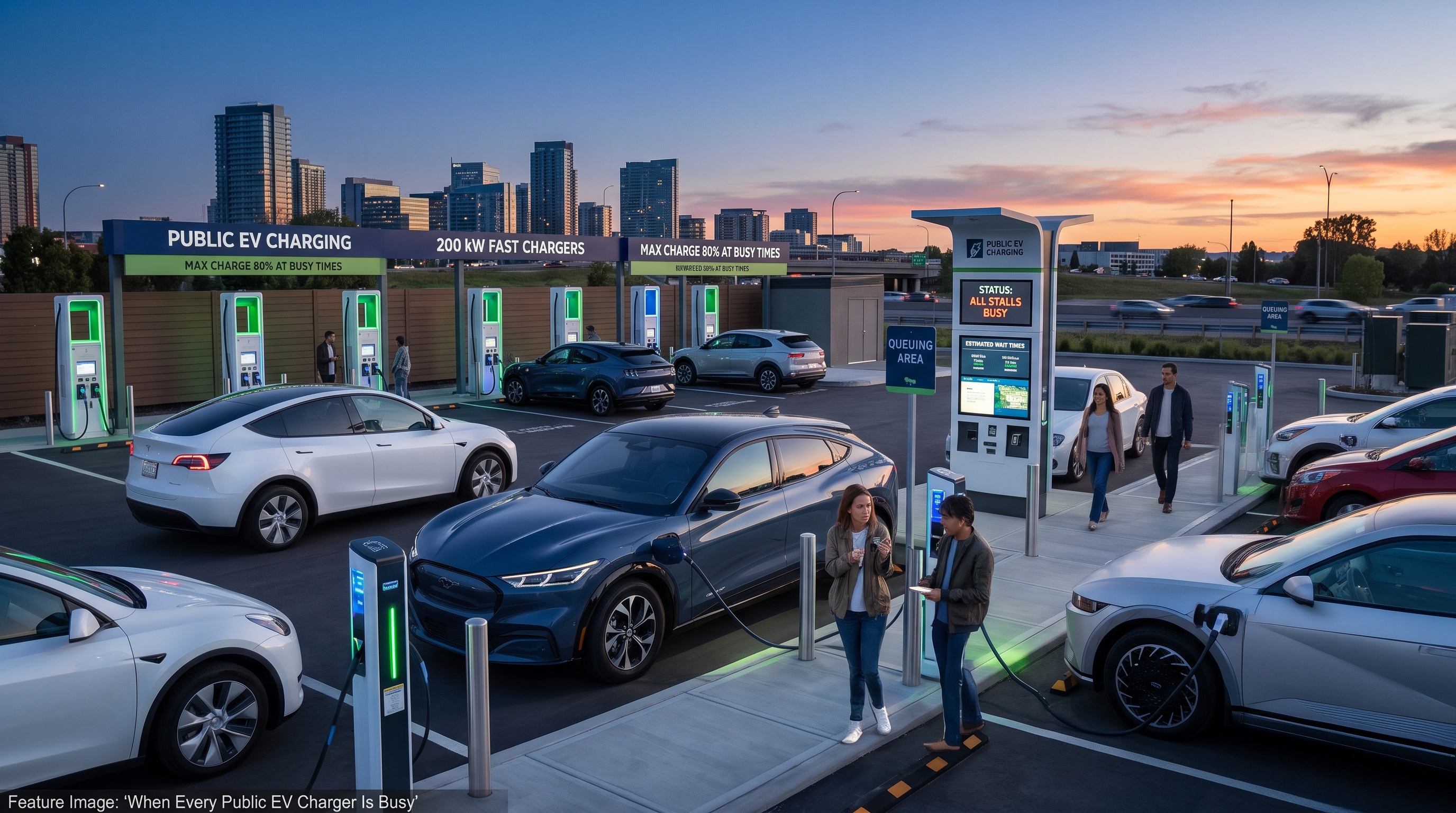
Arriving at a public EV charging location to find every usable stall occupied is undeniably frustrating—especially when your battery is running lower than you originally planned. However, the most useful response isn't to simply cross your fingers and assume a space will open immediately. Instead, it is to make a quick, deliberate decision: Can you wait safely? Should you pivot to another nearby charger? Or is it better to continue to your next planned stop?
This checklist is designed to help you navigate the immediate choices at a busy site. It assumes that you cannot guarantee a charger will be functional, that app status is perfectly updated, or that every network offers uniform reservations, alerts, queues, or payment options.
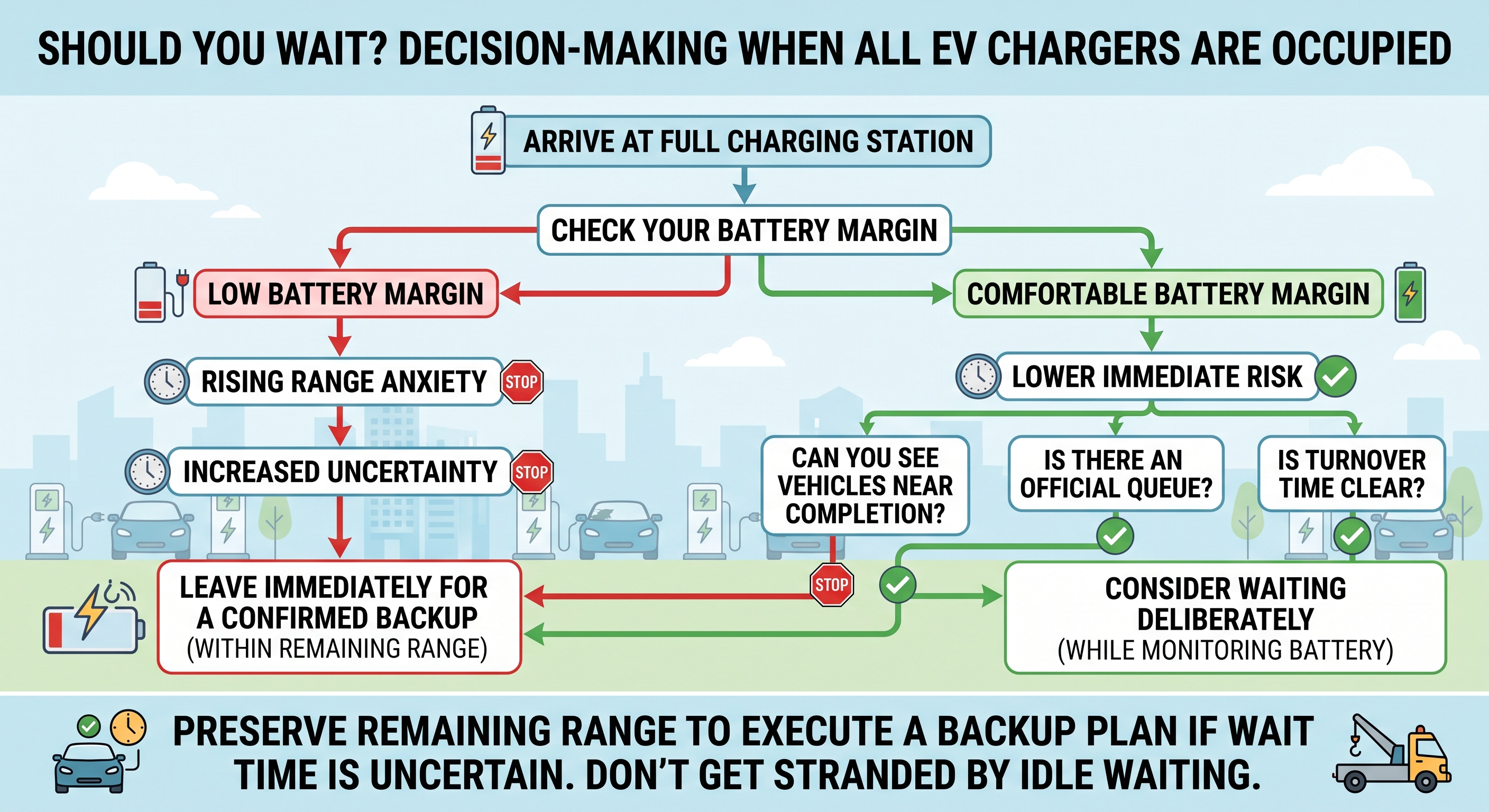
1. Start With Your Battery Margin, Not the Queue
Before you decide to sit and wait, evaluate the core metric that dictates your next move: your remaining battery margin.
- A short queue might be reasonable if you have a comfortable battery buffer and can physically see vehicles that are actively charging and likely to finish soon.
- Waiting is risky when your battery is critically low, the expected turnover time is unclear, or the location only has one or two stalls total.
Treat your vehicle’s range estimate as a planning tool, not an absolute promise. If driving to a backup charger would leave you with very little margin, favour the option that reduces your immediate uncertainty. That might mean settling for a lower-power Level 2 charger nearby, charging just enough to reach a better alternative, or altering the rest of your route rather than waiting for the ideal fast-charging stall.
The Golden Rule: Do not spend your remaining battery margin waiting for information you do not have. If you can’t tell when a stall will open, preserve enough charge to execute a backup plan.
2. Check the Site Before You Commit to Driving There
A charging app can help you discover options, but it cannot guarantee an open, functional stall upon arrival. Before heading to a charging site, verify these four basics:
- Network capabilities: Check if the network app provides real-time driver-facing information like station status and pricing.
- Compatibility: Ensure the site has the correct connector for your vehicle.
- Access: Confirm whether the parking area is open to the public and if a specific app or payment method is required.
- Alternatives: Look at the broader area to see if other sites are equally busy.
Tools like the U.S. Department of Energy’s Alternative Fueling Station Locator are excellent for searching public EV charging stations across the United States and Canada, allowing you to filter results to fit your exact needs.
When comparing backup stations, do not choose based on distance alone. A slightly farther charging site with eight stalls is often a more practical choice than the closest single-stall location that might also be occupied.
3. Read the Rules and Assess What Is Actually Happening
Once you pull into a full site, take a minute to observe the environment before joining an informal line or parking in an inconvenient spot.
Look for posted signs detailing:
- Time limits or loitering rules.
- Specific queuing instructions.
- Whether the spots are reserved for specific networks or vehicle types.
Do not assume a busy site has an organized queue. If an operator provides official waitlist tools, use them as directed. For example, ChargePoint’s Waitlist and Notify Me features can alert you when a station opens up, though these features are only available at eligible, enabled stations.
If there is no posted process or in-app queue, avoid conflict. You can politely ask another waiting driver if there is an established sequence, but do not rely on an informal arrangement if you are short on time. Your battery margin and backup plan should remain the deciding factors.
Distinguish between a full site and an unusable one: A site might look busy because all stalls are occupied, but it could also be due to an out-of-service unit, a vehicle blocking a space, or a car parked without charging. Each scenario requires a different response—none of which are solved by blocking access or confronting other drivers.
4. Choose to Wait, Backup, or Move On Deliberately
Use this quick on-site decision matrix to decide your next move.
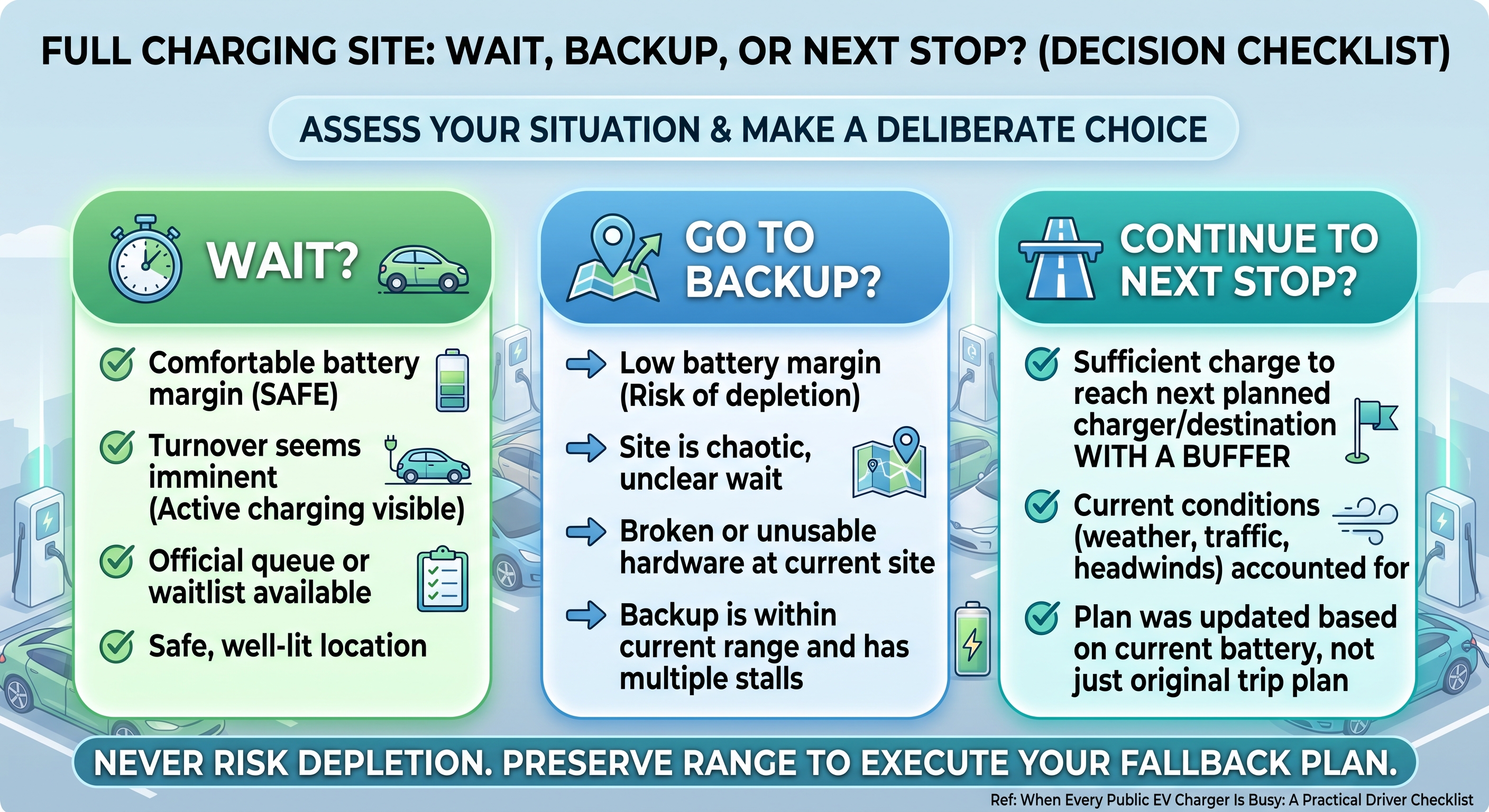
Wait When:
- You have a comfortable battery margin and are in a safe area.
- You can verify via an app (or visually) that a vehicle is nearing completion.
- There is an official, digital queuing system you can join.
Tip: Keep an eye on your battery level and recheck your backup options while you wait. Conditions (and app statuses) can change rapidly.
Leave for a Backup When:
- The current site is chaotic, heavily congested, or has broken hardware.
- You have enough battery to safely reach an alternative charger.
- The backup site has multiple stalls, reducing the likelihood of a second wait.
Tip: Confirm the backup is within your margin before putting your car in drive.
Continue to the Next Planned Stop When:
- You already possess enough charge to reach a subsequent charging location (or your final destination) with a comfortable buffer.
- Always recalculate based on current conditions. A plan made this morning may no longer be viable due to cold weather, detours, or strong headwinds.
5. Keep the Charging Area Usable for Everyone
At busy stations, small courtesies reduce delays for everyone and make it easier for you to pivot if your plans change.
- Charge what you need: Avoid sitting at a fast charger to hit 100% if you only need a top-up to safely reach your next stop (charging slows down significantly past 80% anyway).
- Move promptly: Avoid occupying a stall once your session is complete.
- Beware of fees: Many networks enforce penalties for lingering. Tesla Destination Charging, for example, implements idle fees if a vehicle remains parked past a full charge when the site is at 50% capacity or more. Always check the applicable site policy.
6. If a Charger is Faulty, Report the Right Problem
An occupied stall and a broken charger are two entirely different problems. If equipment appears damaged, inaccessible, or simply will not start a session, look for the operator’s contact information on the physical station.
Provide useful facts to the operator:
- The exact stall number or ID.
- Any error codes displayed on the screen.
- Visible physical damage (e.g., a broken connector latch or a blank screen).
Avoid guessing the cause; a factual description gives the operator a better starting point. You can also leave a helpful community update on charging apps. According to PlugShare’s Check-In Best Practices, checking in and leaving a factual, neutral comment helps inform other drivers before they arrive. A useful update states the stall number, the time, the observed issue, and whether you contacted the operator. Treat community reports as helpful context, but remember they may occasionally be outdated or subjective.
7. Build a Fallback Plan for the Next Busy Site
The absolute best time to prepare for a congested charging site is before your battery indicator turns red. For frequent routes and longer road trips, create a simple personal fallback plan:
- Identify a "Plan B" charger for every crucial stop on your route.
- Save these locations in your vehicle's navigation or preferred apps ahead of time.
This doesn't require a complex spreadsheet—a quick note in your phone or a saved pin is often enough to prevent making every decision at the curb with limited charge and incomplete information. If charging access is especially critical for a specific trip, consider arriving with more battery margin than the minimum navigation estimate suggests.
A Final Checklist Before You Act
When every public EV charger is busy, pause and ask yourself:
- Do I actually need to charge right now, or can I reach the next stop?
- Is there a clear, official waitlist or queuing system I should be using?
- Do I have enough remaining range to safely reach a backup station?
A calm, methodical decision sequence won't magically create an open stall, but it will protect your remaining range, minimize avoidable conflict, and keep your road trip moving forward smoothly.