
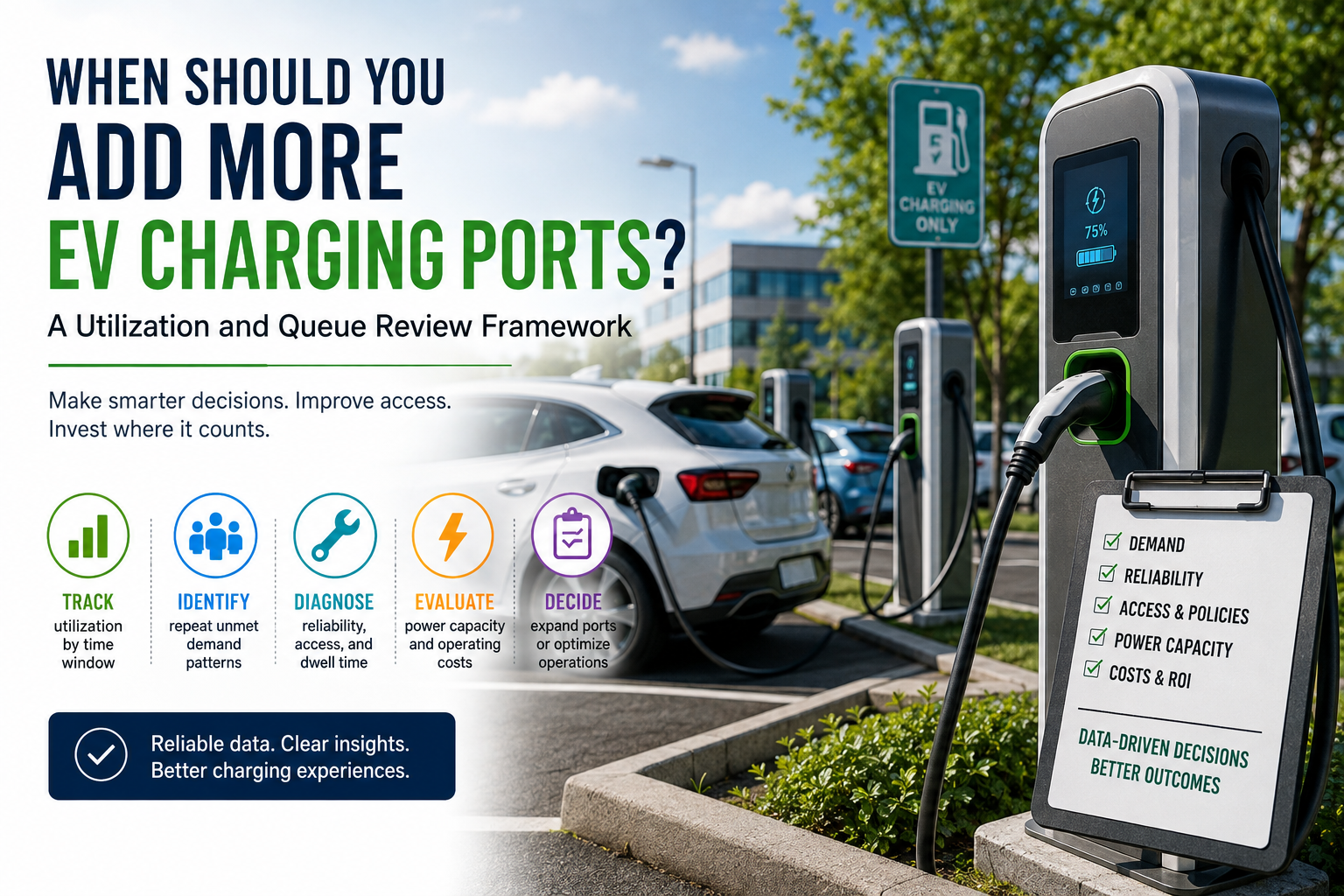
Adding more EV charging ports can improve the experience for employees, residents, hotel guests, customers, and other EV drivers—but only when port scarcity is actually the problem.
A crowded afternoon, a handful of complaints, or one unusually busy event may be worth investigating. It does not necessarily mean the site needs more charging hardware.
A better expansion decision starts with a more useful question:
Are reliable, usable charging ports repeatedly unable to meet demand during the charging windows that matter to your users?
Answering that question requires more than a single sitewide utilization percentage. Charger hosts should look at utilization, queues, session success, equipment uptime, dwell time, access policies, and electrical capacity together.
The U.S. Department of Energy’s Alternative Fuels Data Center (AFDC) identifies uptime and utilization data as important components of charging-station management. It specifically notes that utilization information can help hosts evaluate whether additional charging infrastructure is needed.
This article provides a practical framework for deciding when to add more EV charging ports—and when an operational change may solve the problem more effectively.
Start by separating a busy period from repeat unmet demand
Every EV charging site has peaks.
A workplace may experience its heaviest demand shortly after employees arrive. A retail location may see a rush around lunch or evening shopping periods. A hotel may experience concentrated demand after check-in. At a multifamily property, charging demand may rise sharply when residents return home.
Peak demand by itself is not necessarily a reason to expand.
A temporary spike might be caused by:
- a local event;
- unusual weather;
- temporary charger downtime;
- a change in building occupancy;
- a large meeting or conference;
- several EV drivers arriving at approximately the same time; or
- another short-term change in normal site activity.
Instead, look for a repeat pattern across comparable days or weeks.
A useful internal question is:
During the periods when our users reasonably expect charging access, how often are all usable ports occupied and another driver unable to charge within an acceptable period?
The phrase “acceptable period” is intentionally site-specific.
An employee parked for eight hours may not need immediate charger access. A hotel guest may only need access at some point during the overnight stay. A driver stopping at a retail location for 45 minutes may have a much shorter useful charging window.
The service promise should therefore come before the expansion trigger.
For example, one workplace might define success as giving employees a reasonable opportunity to charge during the workday rather than guaranteeing immediate access at arrival. A hotel might prioritize giving overnight guests access before departure. A customer-focused charging site may place greater importance on immediate availability.
These are operational choices—not universal EV charging industry thresholds.
Build a consistent EV charging operating record
A charger expansion review is only as reliable as the information behind it.
Create a recurring operating record for each EV charging port and for the site as a whole.
Networked charging stations commonly provide utilization and equipment-status information through an operator portal. For non-networked charging infrastructure, AFDC notes that hosts may need a separate meter, third-party analytics software, or other manufacturer-provided options to obtain comparable utilization information.
Depending on the equipment and site, useful fields can include:
- date and time;
- individual charging port;
- charging-session start and end;
- energy delivered;
- active charging duration;
- total vehicle dwell time, where available;
- port occupancy;
- successful and unsuccessful session starts;
- equipment faults;
- downtime;
- periods when all usable ports were occupied;
- observed or reported queues;
- drivers unable to charge;
- complaints or support requests; and
- unusual conditions such as events, construction, weather, or temporary parking restrictions.
You do not necessarily need a sophisticated analytics dashboard.
Consistency matters more than complexity.
Compare similar periods and preserve enough context to distinguish recurring charging demand from isolated anomalies.
Complaints should also be treated as useful signals rather than complete evidence.
A driver saying that “the chargers are always full” may identify a real access problem. But the complaint could also result from a failed charger, unclear parking rules, one particularly busy day, or uncertainty about who is permitted to use the equipment.
Pair qualitative feedback with session, occupancy, uptime, and queue information whenever possible.
Review EV charging demand by time window—not just average utilization
A sitewide utilization percentage can hide the exact problem drivers are experiencing.
Imagine a four-port workplace charging site.
The chargers may appear lightly utilized when averaged across 24 hours. Yet all four ports could be occupied between 8:00 a.m. and noon every weekday while additional employees are waiting.
From the driver's perspective, that site has a capacity problem during the period that matters—even though its daily utilization rate may look modest.
The reverse is also possible.
A charger can show high occupancy because employees, residents, or hotel guests naturally remain parked for long periods. That does not automatically mean drivers are being denied useful charging access.
Break the operating record into charging windows that reflect how the property actually operates.
Examples might include:
- morning employee arrival;
- midday workplace charging;
- afternoon retail traffic;
- evening residential demand;
- hotel check-in hours;
- overnight charging;
- weekend traffic; or
- special-event periods.
For each important window, review four questions:
- Were all usable EV charging ports occupied?
- Was another driver waiting or unable to charge?
- How long did that condition persist?
- Did it happen repeatedly across comparable periods?
The goal is not to discover a universal utilization percentage that automatically requires expansion.
Different locations have different vehicle dwell times, charger power levels, operating models, reliability levels, parking policies, and user expectations.
Instead, determine whether unmet charging demand is persistent and material to the site's own service objective.
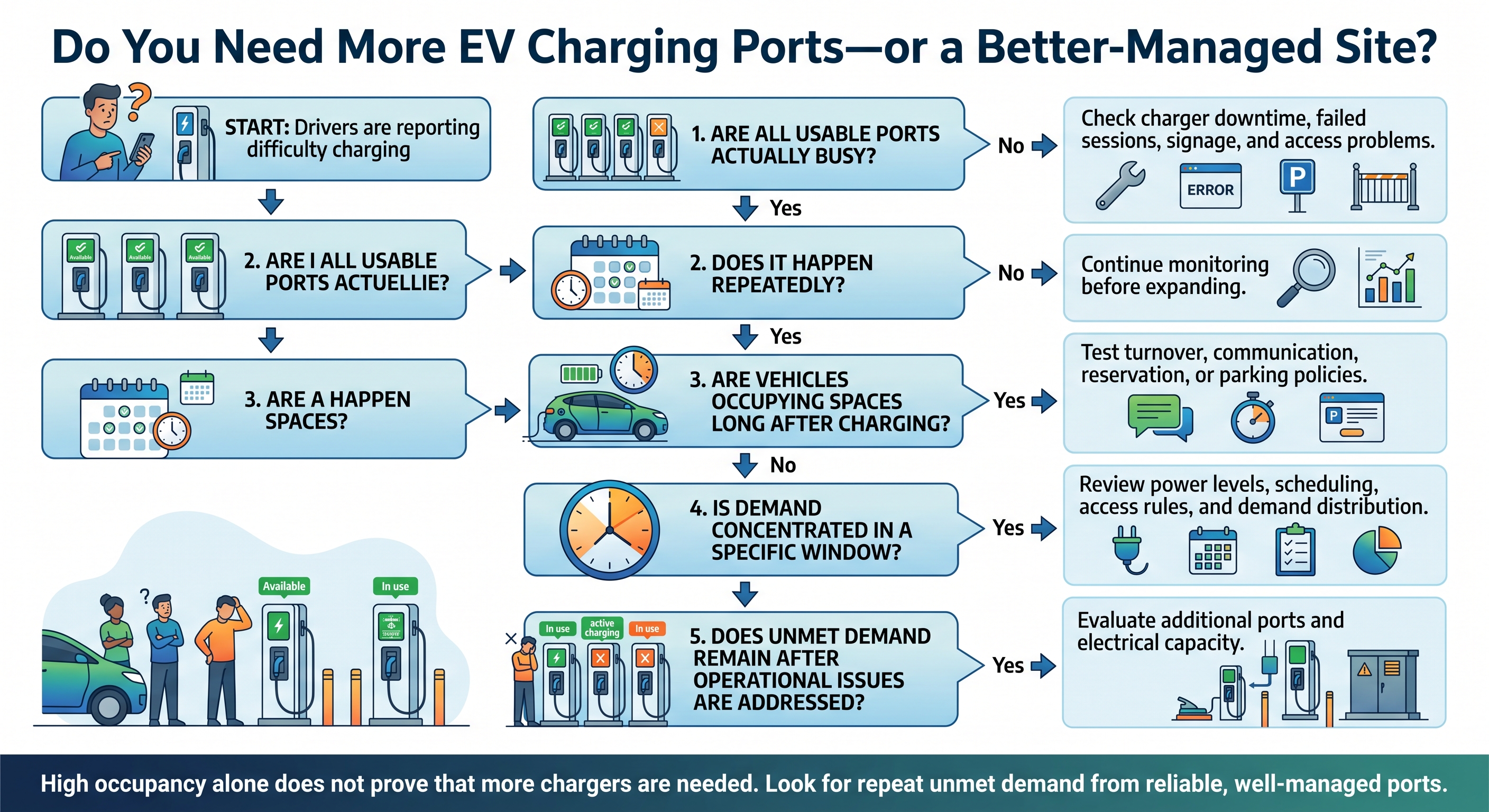
Diagnose the constraint before buying more EV chargers
Adding more ports is one possible solution.
It is not always the best one.
Before committing capital to additional charging infrastructure, determine what is actually restricting access.
1. Charger reliability and unsuccessful session starts
Suppose a property has six charging ports but one or two are frequently offline.
Drivers may experience the site as consistently full even though the underlying problem is not insufficient installed capacity—it is insufficient usable capacity.
Review:
- port uptime;
- equipment fault history;
- unsuccessful session starts;
- damaged connectors or cables;
- payment or authentication failures;
- communication or networking problems; and
- maintenance response times.
AFDC recommends collecting and analyzing uptime information as part of effective charging-station management and also emphasizes establishing clear responsibility for maintenance and repairs.
A useful operational metric is therefore:
Installed ports vs. usable ports during peak demand.
If downtime repeatedly reduces effective capacity, improve reliability before treating the issue solely as a port-count problem.
2. Parking access and vehicle dwell time
A charging space can remain unavailable even when another vehicle could benefit from the charger.
This is particularly relevant at workplaces, multifamily properties, hotels, airports, campuses, and other locations where vehicles remain parked much longer than the charging session itself.
Possible responses include:
- clearer EV charging signage;
- driver notifications;
- voluntary move-when-finished practices;
- reservation or scheduling systems;
- time limits; or
- site-specific parking policies.
DOE's workplace charging guidance discusses several charger-sharing approaches, including reservations, time limits, assigned charging periods, and employee-managed communication.
That does not mean every property should use these policies.
The right approach depends on the property, local regulations, user group, enforcement capabilities, accessibility requirements, and the experience the host wants to provide.
3. Access rules and concentrated demand
Sometimes the problem is not the total amount of charging capacity but who is using it and when.
For example, demand may be disproportionately concentrated:
- immediately after employees arrive;
- among long-dwell vehicles;
- during hotel check-in;
- around scheduled fleet activity; or
- among one user group sharing infrastructure with visitors or customers.
Review whether existing access rules are contributing to the peak.
Depending on the site, alternatives could include reservation windows, employee/visitor access periods, fleet scheduling, clearer charging priorities, or other operational arrangements.
Any policy should be practical, consistently administered, and aligned with the property's service objective.
4. Charger power and vehicle dwell time
A site may need a different charging configuration rather than simply more identical chargers.
The key question is:
Does the charging power fit the amount of time vehicles normally remain at the property?
A hotel where vehicles stay overnight has a very different charging profile from a highway travel stop.
Likewise, employees parked for an entire workday may not require the same charging power as customers who stay for less than an hour.
Scenario modelling can help when the answer is not obvious.
NREL's EVI-X modelling suite includes EVI-EnSite, which can evaluate charging-site configurations and metrics such as station peak and average power demand, energy delivered by port type, utilization, and vehicle queuing.
A host may use a suitable planning tool, engineering analysis, charging provider, or qualified adviser to compare:
- more ports at the existing power level;
- a different mix of charging power;
- load-managed charging;
- operational changes;
- phased expansion; or
- combinations of these approaches.
Test lower-cost options before committing to a full expansion
Once you understand the constraint, compare a short list of possible responses.
OptionBest suited toQuestion to testImprove uptime and session successFaults, downtime or failed charging attemptsAre existing ports consistently usable during peak demand?Improve driver communicationConfusion or vehicles remaining after chargingWill notifications or clearer expectations increase useful turnover?Introduce sharing or reservation practicesPredictable demand concentrationCan drivers share existing capacity more effectively?Adjust access or parking rulesDemand concentrated among certain groups or periodsCan the policy improve access fairly and consistently?Change charger-power mixExisting charging speed poorly matches dwell timeWould another charging configuration serve more vehicles?Add charging portsRepeat unmet demand despite reliable operationsWill additional ports relieve the documented bottleneck?Prepare infrastructure for future portsDemand is growing but final need remains uncertainCan enabling work reduce future construction cost or disruption?
A phased strategy can be particularly useful when EV adoption is clearly increasing but the property's long-term charging requirement remains uncertain.
For example, a project may investigate installing conduit, electrical infrastructure, or other enabling work for potential future expansion while initially installing only the number of ports supported by current demand.
DOE's charging infrastructure development guidance specifically recommends considering both near-term and long-term charger requirements, future expansion, utility requirements, equipment costs, electricity-rate implications, maintenance, permitting, and other site needs during planning.
The Joint Office of Energy and Transportation's Public EV Charging Infrastructure Playbook also provides resources for baseline assessments, estimating future charging needs, evaluating potential sites, ownership and operation, and infrastructure planning.
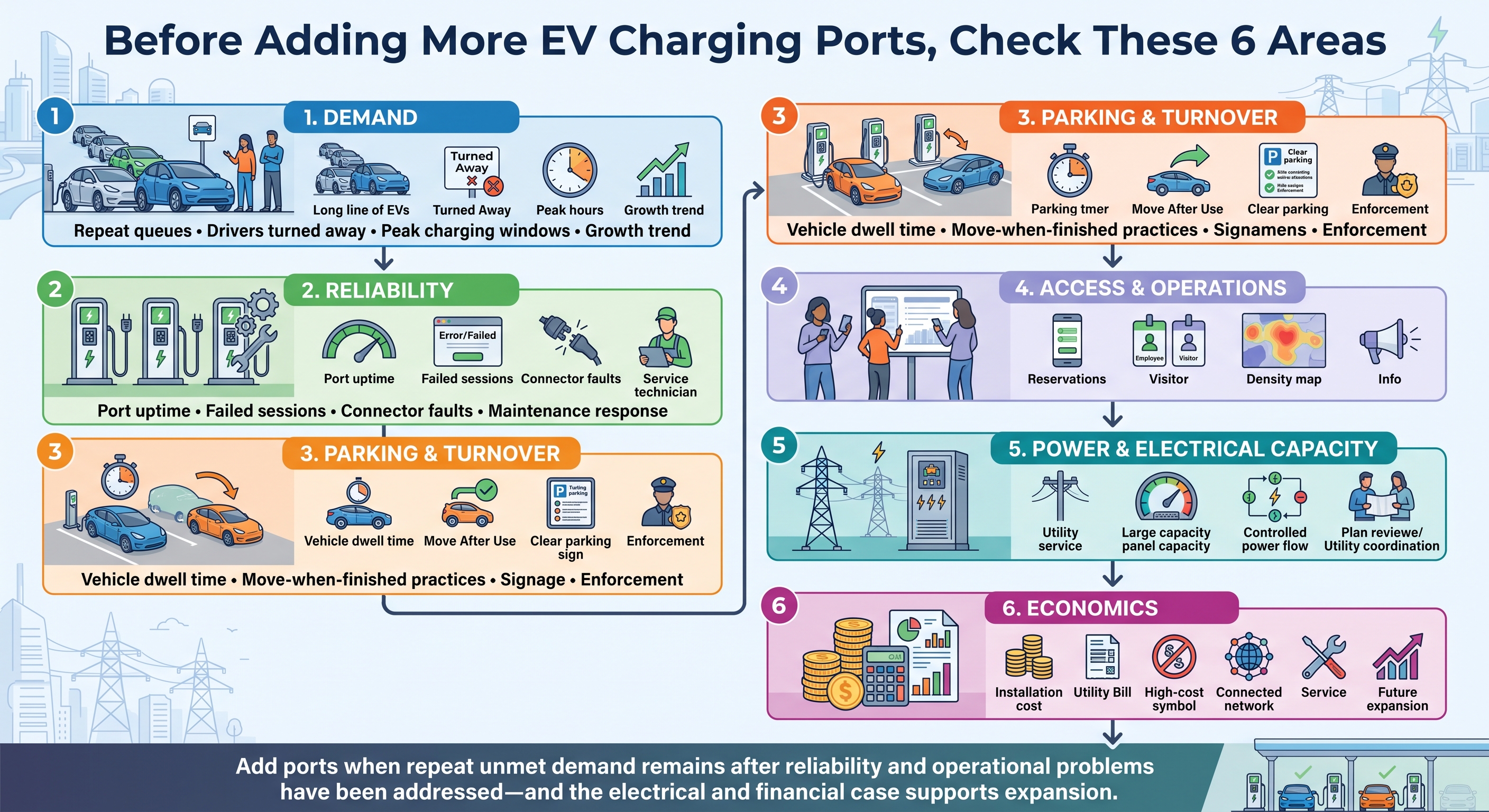
Validate electrical capacity before adding charging ports
Evidence of unmet demand establishes a charging need.
It does not establish that the property's electrical system can economically support additional charging equipment.
Before committing to an expansion, review the project with the relevant utility, qualified electrical professionals, charging-equipment provider, and applicable local authorities.
DOE and AFDC guidance recommends engaging the utility during EV charging infrastructure planning to identify electrical-service requirements, potential equipment upgrades, utility rates, costs, and both near- and long-term charging requirements.
At minimum, evaluate:
- existing electrical-service capacity;
- service panels and distribution equipment;
- transformer implications;
- required charging power;
- simultaneous maximum load;
- load-management options;
- trenching and conduit requirements;
- communications/networking requirements;
- permitting and inspections;
- construction costs;
- utility upgrade requirements;
- electricity-rate structure;
- potential demand charges;
- networking fees;
- maintenance costs; and
- future expansion requirements.
DOE's EVI-LOCATE guidance describes a planning process that considers the desired number and power level of charging ports as well as nearby electrical assets such as transformers and service panels. The tool can support preliminary analysis of charging power requirements, electrical infrastructure, site layout, and installation costs.
The results should still be validated for the actual project.
Do not ignore electricity rates and demand charges
Capital cost is only one part of an EV charging expansion decision.
Operating costs can change as charging load increases.
AFDC notes that electricity costs can vary according to equipment type, time of day, charging duration, and applicable utility rate structures. DC fast charging is particularly likely to create demand-charge considerations, although the actual impact depends on the site's tariff and load profile.
That means a proposal such as “add four chargers” should eventually become a more complete analysis:
What will four additional chargers do to peak site load, monthly electricity costs, equipment/network fees, and expected utilization?
For some properties, load management or a different power allocation may be worth comparing with unrestricted simultaneous charging.
Use hosting-capacity maps carefully
Some utilities publish electrical distribution hosting-capacity maps that can provide useful early planning context.
These tools may help identify areas where the distribution network appears to have more or less ability to accommodate new electrical loads.
However, they are not substitutes for site-specific utility coordination.
DOE explicitly notes that hosting-capacity maps do not answer site-specific interconnection questions and encourages project developers to work directly with utilities when evaluating charging sites.
Treat these maps as a planning signal—not an approval, capacity reservation, construction estimate, or engineering conclusion.
Set a documented EV charger expansion review cadence
Do not wait until charging complaints become severe before reviewing capacity.
Establish a simple recurring review process.
Depending on the site, this could occur monthly, quarterly, seasonally, or whenever occupancy or EV adoption changes materially.
During each review:
- Compare utilization by important charging window.
- Review periods when all usable ports were occupied.
- Record queues or unsuccessful attempts to obtain charging access.
- Review charger uptime and failed sessions.
- Check whether long vehicle dwell times are restricting turnover.
- Review complaints and user feedback.
- Identify changes in EV adoption or property occupancy.
- Reassess operational measures already attempted.
- Update the likely electrical and financial implications of expansion.
Then establish an internal expansion trigger tied to the site's service promise.
For example:
Reconsider additional charging ports when documented unmet demand continues through multiple comparable review periods after charger-reliability and operational constraints have been addressed.
The trigger could also require a preliminary electrical and financial review before capital approval.
This creates a more disciplined process than reacting to an isolated complaint or waiting until charging access becomes a persistent source of frustration.
A simple EV charging expansion decision framework
The decision can ultimately be reduced to four stages:
Step 1 — Verify the demand
Are drivers repeatedly unable to access charging during important charging windows?
Step 2 — Verify the existing capacity
Are the installed ports reliable, available, and successfully starting charging sessions?
Step 3 — Test operational alternatives
Can better turnover, reservations, access rules, communication, maintenance, or another charger-power mix solve the problem?
Step 4 — Evaluate expansion
If meaningful unmet demand remains, determine whether additional charging ports are electrically feasible and financially reasonable.
Only then does adding hardware become the obvious next question.
The practical decision
Add more EV charging ports when the evidence shows that reliable, well-managed existing ports repeatedly cannot meet charging demand during the periods that matter to users—and when the electrical capacity and operating economics support the project.
If the evidence instead points to:
- charger downtime;
- unsuccessful session starts;
- unclear access rules;
- poor parking turnover;
- vehicles remaining in charging spaces unnecessarily;
- concentrated demand that could be scheduled differently; or
- a charging-power configuration poorly matched to vehicle dwell time,
address those constraints before assuming the site simply needs more ports.
The strongest expansion decision is therefore not based on one utilization percentage.
It is based on a documented pattern of reliable capacity + repeat unmet demand + operational review + electrical feasibility + acceptable economics.
That gives EV charging hosts a much more defensible basis for choosing between operational improvements, phased electrical preparation, and a full charging-port expansion.
Sources
- U.S. Department of Energy Alternative Fuels Data Center — Operation and Maintenance for Electric Vehicle Charging Infrastructure.
- U.S. Department of Energy Alternative Fuels Data Center — Procurement and Installation for Electric Vehicle Charging Infrastructure.
- U.S. Department of Energy Alternative Fuels Data Center — Workplace Charging for Electric Vehicles.
- National Renewable Energy Laboratory — EVI-X Modeling Suite / EVI-EnSite.
- Joint Office of Energy and Transportation — Public EV Charging Infrastructure Playbook.
- U.S. Department of Energy — EVI-LOCATE guidance.
- U.S. Department of Energy — U.S. Atlas of Electric Distribution System Hosting Capacity Maps.