
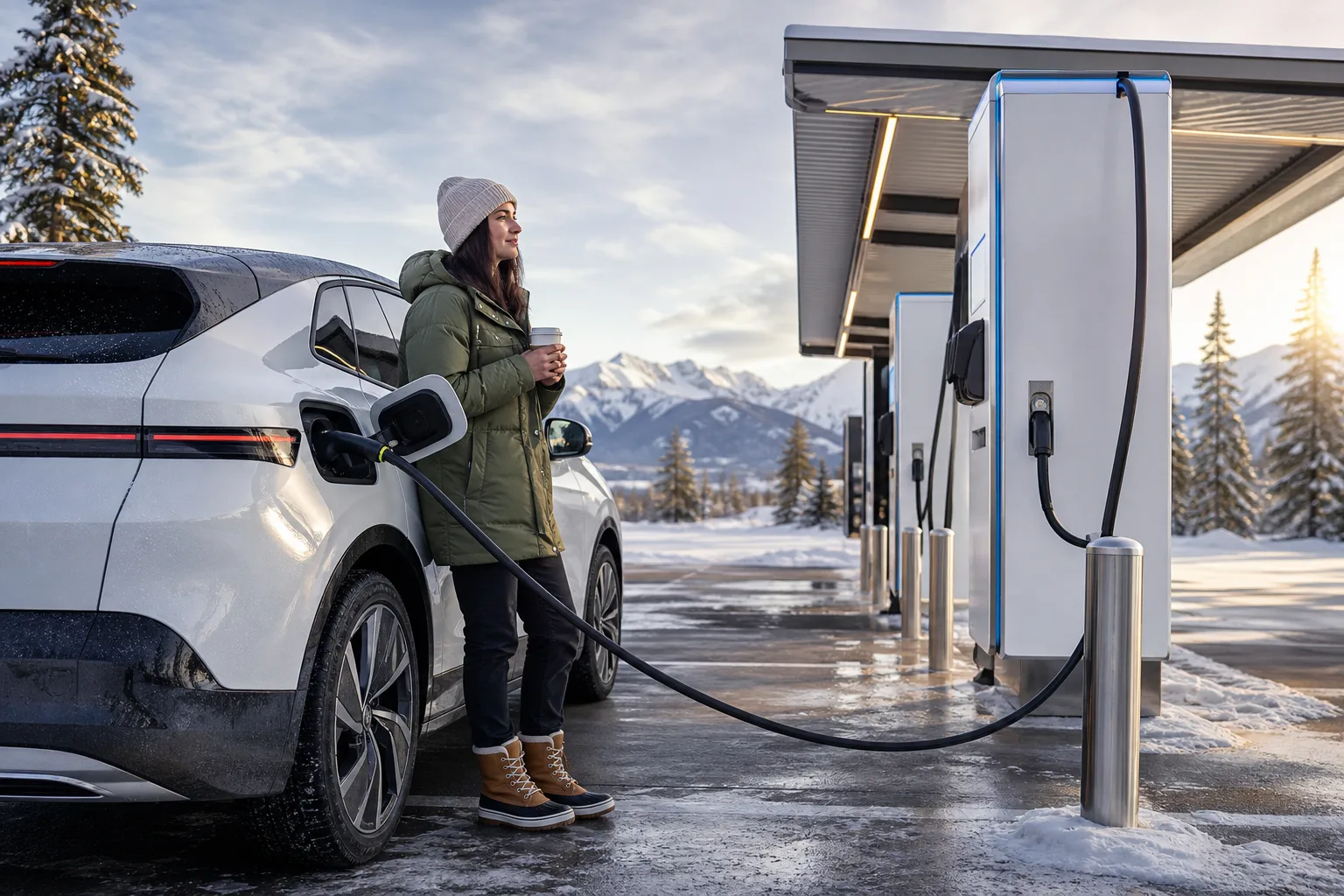
Winter driving can make an EV trip feel less predictable than the same journey in mild weather. You may use more energy to heat the cabin, arrive at a charger with a colder battery, and spend longer charging than the station’s advertised maximum power suggests.
That does not mean winter road trips are impractical. It means the plan needs more margin. A dependable winter fast-charge stop is based on your vehicle’s actual battery state, conditions on the route, the next-leg distance, and a backup option—not on a single expected charging-speed number.
What cold weather can change
Three connected factors can affect a winter EV trip:
The scale of the change is not the same for every vehicle or journey. It can depend on temperature, wind, precipitation, speed, elevation, traffic, road conditions, passenger comfort settings, battery condition, and how long the car was parked before departure.
As a useful illustration rather than a universal prediction, AAA’s testing found that the EVs it tested averaged a 39% driving-range reduction at 20°F compared with 75°F. Treat that as a reminder to plan conservatively, not as a number to apply directly to your own dashboard range estimate.
For winter commuting, a reduced buffer may simply mean charging a little more often at home or work. For longer trips, it can mean choosing charging stops closer together and allowing more time at each stop.
Why a cold battery may charge more slowly at a DC fast charger
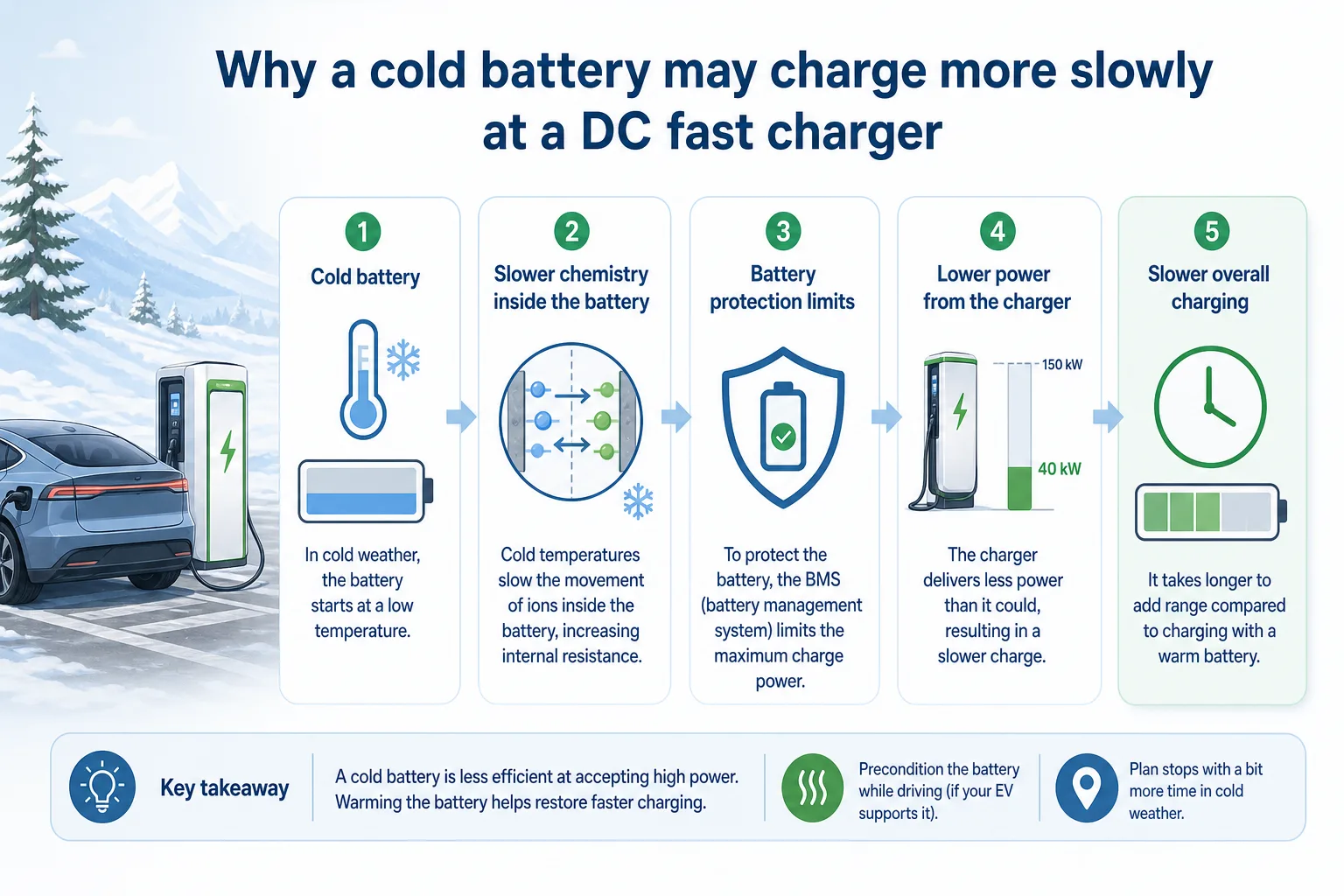
A DC fast charger can supply substantial power, but the vehicle ultimately manages how much power its battery will accept. In winter, the vehicle may limit charging while the battery is cold and use some energy or time to bring the pack closer to an appropriate operating temperature.
This is why a charger’s nameplate rating is not a promise that every compatible EV will receive that power throughout a session. Tesla, for example, notes that Supercharger rates vary with battery state of charge, ambient temperature, battery-pack characteristics, and vehicle configuration in its Supercharging guidance. The same practical principle applies broadly: the displayed charging rate is a result of both the charger and the vehicle’s current conditions.
A winter charging stop can therefore have two phases:
Do not judge a planned stop solely by whether the site has a high-power charger. Consider how you will arrive: after a long highway drive with battery conditioning active, or after a short cold trip from a parked vehicle. Those situations can produce very different results.
Before leaving: prepare the vehicle and route
The most useful winter preparation happens before the drive begins.
Warm the cabin while still connected, if practical
If your vehicle supports scheduled climate control or preconditioning, use it according to the owner’s manual. The U.S. Department of Energy recommends warming the cabin and battery before driving while the EV is still charging, allowing the vehicle to warm up while maintaining charge for the trip.
This can make departure more comfortable and preserve more stored battery energy for driving. Exact behaviour varies by model, settings, and whether the vehicle is plugged in, so treat your vehicle documentation and in-car prompts as the authority.
Use in-car navigation to the charging stop when supported
Some EVs can prepare the battery when the driver navigates to a DC fast charger using the vehicle’s built-in route planner. This is not universal. Ford says that, on supported vehicles with available navigation, routing to a DC fast-charging station can start warming the battery within 20 miles of the stop, as described in its winter EV driving guidance.
That example is feature- and manufacturer-specific, but it illustrates an important planning question: does your vehicle need the charger selected as a destination to prepare the battery? Check the manual and your current vehicle software guidance before relying on that behaviour.
Set a winter energy buffer
Rather than aiming to arrive at every charger with the smallest possible state of charge, choose a buffer that suits the weather and the consequences of a detour. A larger buffer may be sensible when:
A buffer is a planning choice, not a fixed percentage. Start with a conservative plan, then refine it as you learn how your EV performs on familiar winter routes.
At the charger: plan for the rate you get, not the rate you expected
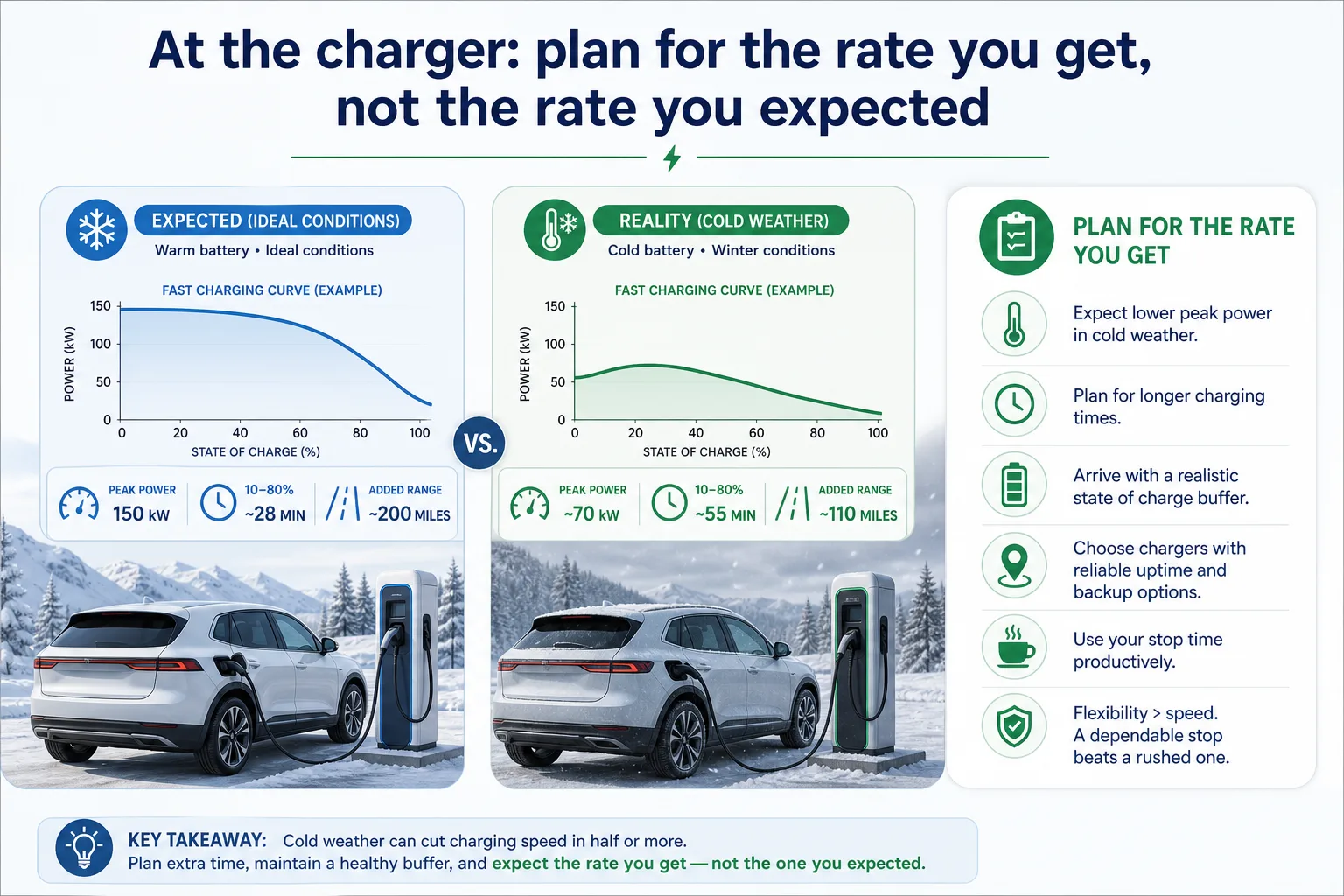
Once plugged in, monitor the vehicle and charger display. The useful question is not “Why am I below the charger’s maximum?” but “How long will it take to reach the charge I need for the next leg with a reasonable reserve?”
Use the session to make a few practical decisions:
If the charging rate is lower than expected, avoid making a rushed decision from a single number in the first minutes of the session. A cold battery may need time to warm, while a high state of charge may mean the vehicle is already tapering. Your vehicle’s charging screen, navigation estimate, and manual can help distinguish those situations.
Also inspect the connector and charge port before connecting. Clear loose snow or ice that interferes with a secure connection, without forcing equipment or using improvised tools. If the connector, port, cable, or enclosure appears damaged, choose another stall or contact the charging-network support number shown at the site.
When charging beyond 80% may be reasonable
On many trips, charging to roughly 80% and continuing to the next stop can be time-efficient because DC fast charging commonly slows at higher state of charge. The Department of Energy notes that fast charging generally slows in the 80% to 100% range.
But 80% is a rule of thumb, not a winter requirement. The same Department of Energy guidance recognizes that drivers may choose to charge between 80% and 100% in extreme cold or on longer trips, depending on conditions and driving distance.
Charging past 80% can be a sensible option when it meaningfully reduces risk on the next leg—for example, if the next reliable charger is distant, weather is deteriorating, or your route has few alternatives. The trade-off is time: the final portion of a fast-charge session can take substantially longer than the earlier portion.
A practical decision framework is:
Your goal is not to maximize charge at every stop. It is to leave with enough energy and enough options for the next part of the trip.
Winter-ready fast-charge checklist
Before a winter drive, use this checklist to make the plan more resilient:
Winter EV charging is mainly an exercise in using better margins. Start warm when possible, arrive with a buffer, use vehicle-specific route and preconditioning tools where available, and let real-time charging performance guide the next decision. That approach will not make every cold-weather stop identical, but it can make the trip more manageable and dependable.
Sources
- AAA Newsroom. AAA Study Reveals Temperature Impacts on EV and Hybrid Efficiencies and Costs
- U.S. Department of Energy. Winterizing Your Electric Vehicle
- Ford. Winter Ready: Ford's Guide to Cold Weather Electric Vehicle Confidence
- Tesla. Supercharging