
Workplace EV charging is not only an equipment decision. It is also an access decision: who can use the charging spaces, when they can use them and what happens when demand exceeds capacity.
Most workplaces can begin with one of three access models:
- Employee-only charging
- Visitor charging during defined hours
- Public charging after business hours
There is no universally best model. The appropriate choice depends on the number of available charging ports, the parking layout, building hours, security arrangements, staffing, expected driver demand and the organization’s objective.
The U.S. Department of Energy identifies several possible workplace approaches. Employers may restrict access to employees, allow visitors to charge during certain hours, use the equipment for fleet vehicles at night or permit public charging after business hours.
This article provides a practical framework for selecting an access model, creating fair rules and adjusting those rules as real usage patterns and driver feedback become available.
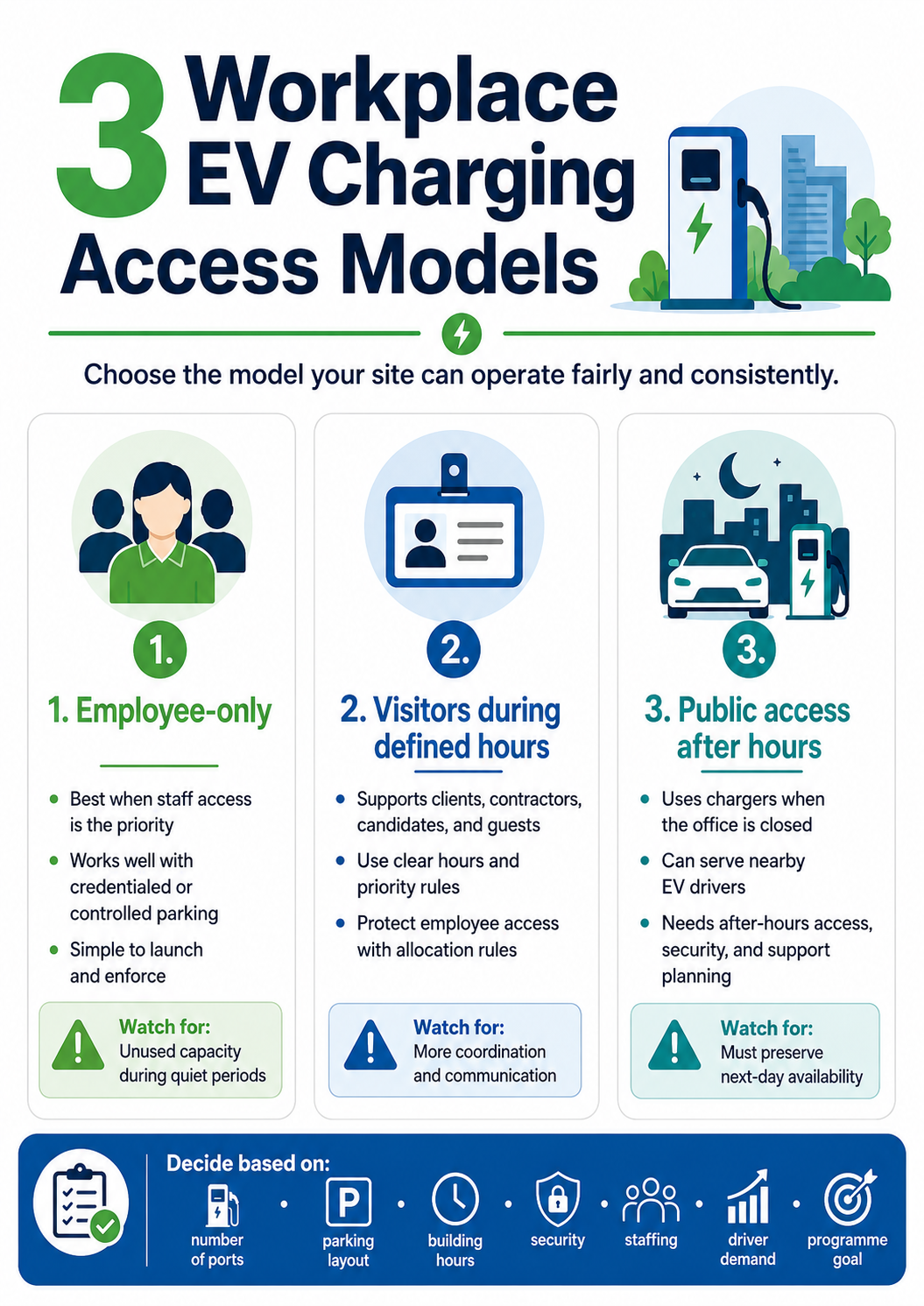
Comparison of employee-only, visitor and after-hours public workplace EV charging access models.
Start with the access decision
Before discussing reservations, pricing or time limits, determine who the workplace charging programme is intended to serve.
The three common models can also be combined. For example, a workplace may prioritize employees during the day, reserve one port for scheduled visitors and make selected chargers available to the public in the evening.
The important point is to define the access model clearly instead of allowing it to develop informally.
Option 1: Employee-only charging
Employee-only access is often the simplest starting point for a new workplace charging programme. Its purpose is easy to explain: the charging spaces are provided primarily for people who work at the site.
This model may be appropriate when:
- Supporting employees is the programme’s main objective.
- The parking area already requires staff credentials, permits or controlled entry.
- The workplace has only a small number of charging ports.
- Internal staff will be responsible for administration and enforcement.
- Predictable daytime access is more important than maximizing total charger use.
The main trade-off is that chargers may remain unused during evenings, weekends or periods of low office attendance. That may be acceptable when employee availability is the priority. It may become less attractive when chargers are frequently unoccupied or when visitors have legitimate charging needs.
Employee-only access does not have to mean unrestricted use by every employee at any time. The workplace can still establish:
- Employee registration requirements
- Eligibility criteria
- First-come, first-served access
- Reservations
- Maximum charging or parking periods
- Priority for employees who cannot complete their commute without workplace charging
- Requirements to move a vehicle after charging
The rules should be presented as a workplace policy rather than left for employees to interpret individually.
Option 2: Visitors during defined hours
Visitor access can provide a useful middle ground. It allows a workplace to support clients, contractors, job candidates and other guests without turning the parking area into a general public charging destination.
This model works best when visitor demand is reasonably predictable and the host can protect employee access.
For example, a workplace might:
- Reserve one charging port for visitors during reception hours.
- Permit visitor charging only through advance registration.
- Allow visitors to use employee chargers when unreserved spaces are available.
- Limit visitor access to designated parking areas.
- Provide charging instructions through reception or a visitor confirmation email.
Before offering visitor charging, determine:
- Who qualifies as a visitor?
- Must charging be requested in advance?
- Who confirms the visitor’s identity and parking access?
- Which charging spaces can visitors use?
- What hours are available?
- Do employees retain priority?
- What happens when all chargers are occupied?
- Who helps a visitor experiencing a charging or access problem?
- Are there parking, charging or idle fees?
Visitor charging can improve hospitality, but it adds coordination. Guests should know whether charging is reservable, first-come, first-served or unavailable when employee demand is high.
Option 3: Public access after hours
Making workplace chargers available to the public after the office closes can increase the use of equipment that would otherwise remain idle. It may also provide charging access to drivers living, working or visiting nearby.
However, public access changes the operating model. A charger located at an office building is not automatically public or private. The National Renewable Energy Laboratory distinguishes the location type from the access type, noting that charging at an office building can be either publicly or privately accessible.
Before opening chargers to the public after hours, confirm:
- Whether the parking area is physically accessible when the building is closed.
- Whether gates, permits or building-security procedures restrict entry.
- Which spaces can be used without interfering with overnight operations.
- When public access begins and ends.
- How drivers authenticate or begin a charging session.
- Whether payment is required and how pricing will be communicated.
- Who responds to equipment, parking or access problems.
- How overnight parking or vehicles remaining after public hours will be handled.
- How employee availability will be restored before the next workday.
Public access after hours may be appropriate where the lot is already accessible, daytime employee demand ends predictably and the organization has a realistic after-hours support process.
It may be a poor fit where the property is secured, early-morning parking demand is high or no one is responsible for public-driver support.
Compare the operational trade-offs
The best model is not necessarily the one offering the broadest access. It is the model the workplace can operate clearly, fairly and consistently.
| Decision area | Employee-only | Visitors during defined hours | Public after hours |
|---|---|---|---|
| Employee priority | Strongest and easiest to explain | Requires explicit employee-priority rules | Requires a plan to preserve next-day availability |
| Parking management | Often aligns with existing staff controls | Requires visitor instructions and space allocation | Requires after-hours parking and access planning |
| Enforcement | Usually simpler | Requires employee-facing and visitor-facing rules | Requires a defined after-hours response process |
| Security | Managed through existing workplace access | Depends on the visitor-management process | Requires review of site access and evening conditions |
| Support responsibility | Primarily internal users during work hours | Includes visitor questions during stated hours | Includes drivers who may arrive when staff are absent |
| Pricing | Determined through workplace policy | Requires a clear visitor policy | Requires a clearly communicated public-driver policy |
| Utilization | May leave equipment idle outside working hours | Can increase daytime use | Can increase evening and weekend use |
| Administrative effort | Usually lowest | Moderate | Usually highest |
This table is a planning aid rather than a legal, electrical or regulatory checklist. Before implementation, verify the conditions that apply to the property, lease, parking area, charging equipment and local jurisdiction.
The DOE also recommends involving relevant stakeholders—including the utility, electrical contractor, charging-equipment provider and building owner for leased properties—early in the planning process.
Match access rules to capacity and dwell time
Access policies are most likely to create frustration when they promise more availability than the site can realistically provide.
Begin with a simple capacity assessment:
- How many charging ports are available?
- How many employees currently drive an EV?
- How many additional employees are expected to adopt EVs?
- How frequently do visitors request charging?
- How long are vehicles normally parked?
- How much energy does a typical driver need?
- Can drivers move their vehicles during the workday?
- Are employees frequently in meetings, off-site or working shifts?
- Is demand concentrated on particular days or hours?
A charging port may be physically available for an entire workday but still be poorly shared when a fully charged vehicle remains in the space. Conversely, moving vehicles several times per day may increase the number of sessions but may not be realistic for every workplace.
DOE guidance notes that Level 2 charging can support more than one vehicle per day. Its federal workplace guide also states that, for some programmes, it may be reasonable to assume that a Level 2 port will be used once or twice during a workday. Actual results depend on charging power, energy requirements, parking duration and drivers’ ability to move their vehicles.
Do not advertise a fixed number of daily sessions unless the workplace has assessed its own operating conditions.
Choose one rule for each pressure point
A practical starting policy should address the situations most likely to create disputes.
Eligibility
Define who may use the chargers:
- All employees
- Registered employees
- Employees who cannot charge at home
- Authorized visitors
- Fleet vehicles
- Members of the public during specified hours
Allocation
Explain how an available port is assigned:
- First-come, first-served
- Advance reservation
- Assigned charging partners
- Morning and afternoon sessions
- Priority based on commuting need
- Separate employee and visitor allocations
Session completion
Explain what happens when charging is complete:
- The vehicle must be moved within a stated period.
- The driver receives a notification where supported.
- A waiting driver contacts the programme owner.
- Repeated misuse can result in temporary loss of access.
- An idle fee may apply where supported and appropriate.
Exceptions and support
Identify who handles:
- Equipment problems
- Reservation conflicts
- Accessibility requirements
- Visitor questions
- Unauthorized parking
- Vehicles left after permitted hours
- Requests for temporary priority
DOE workplace guidance identifies reservation systems, time limits, shared calendars and employee-managed communication as possible approaches when the number of drivers exceeds available charging spaces. It also gives examples of time-based fees as a possible congestion-management method, although each workplace must determine whether its equipment and operating arrangements support those policies.
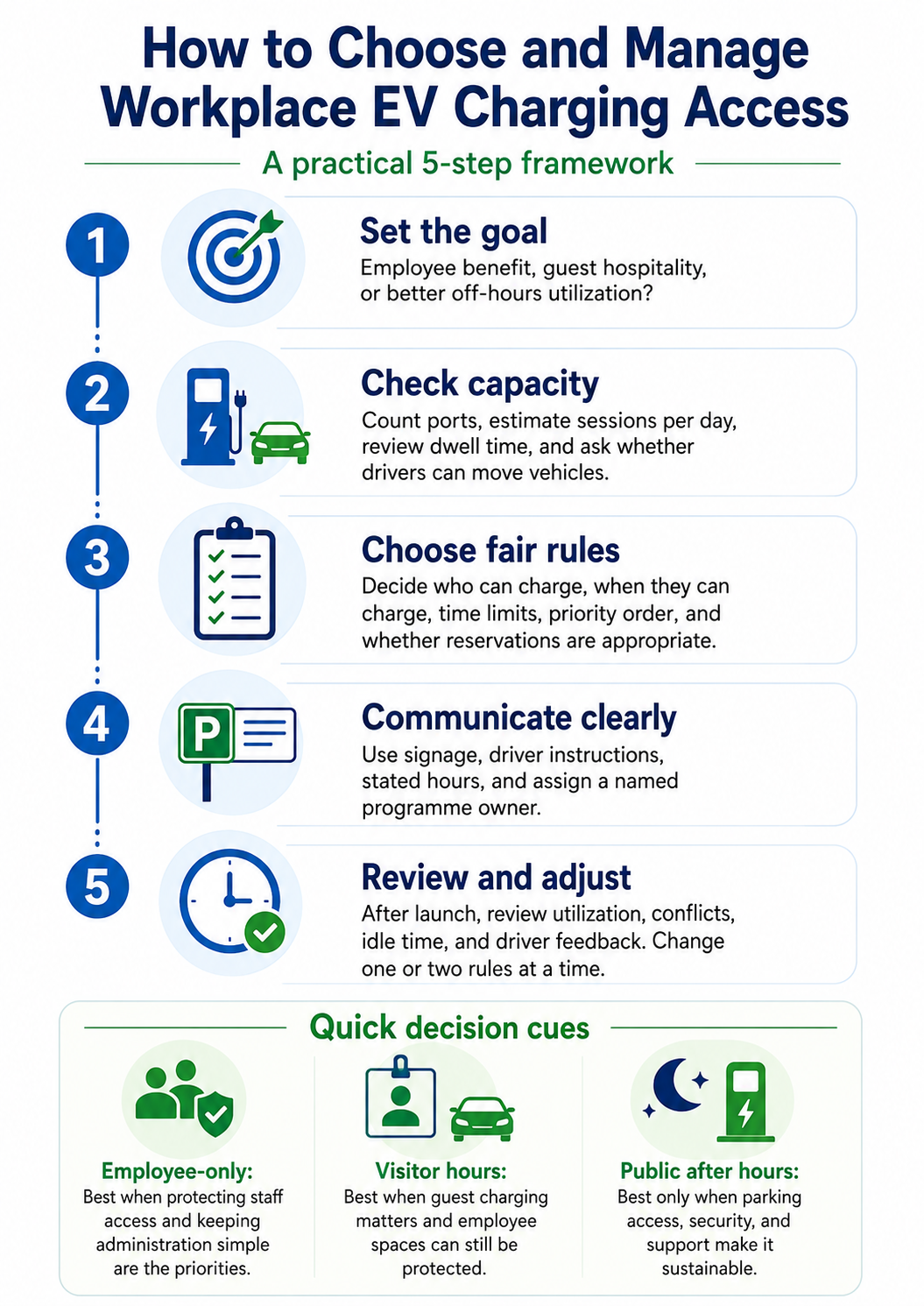
Five-step framework for choosing, communicating and reviewing workplace EV charging access.
Build a short written workplace EV charging policy
A workplace EV charging policy does not need to be long. It needs to answer the questions drivers are likely to ask.
The DOE groups workplace-charging guidance into administration, registration and liability, station sharing and pricing. It also recommends designating a person or group responsible for programme administration and enforcement.
At minimum, the policy should explain:
- Purpose
- Why is the workplace providing charging?
- Eligible users
- Who may use the chargers?
- Access hours
- When does employee, visitor or public access begin and end?
- Registration
- Must employees or visitors register their vehicle or charging account?
- Priority
- Who receives priority when demand exceeds capacity?
- Reservations
- Are reservations offered, required or unavailable?
- Time limits
- Is there a maximum charging or parking period?
- Vehicle movement
- Must the vehicle be moved when charging is complete?
- Pricing
- Is charging free, paid or subject to an idle fee?
- Misuse
- What happens when someone repeatedly ignores the rules?
- Support
- Who should drivers contact when something goes wrong?
- Policy review
- How and when will the workplace evaluate the programme?
Assign one team or role to own the programme. Depending on the organization, this may be facilities, workplace operations, security, property management, parking administration or another designated team.
The job owner should be able to:
- Update instructions.
- Resolve recurring access conflicts.
- Coordinate with equipment and service providers.
- Review usage patterns.
- Communicate policy changes.
- Escalate electrical, contractual, legal or security questions to the appropriate specialist.
Communicate the rules where drivers need them
A policy stored only in an internal document will not prevent confusion in the parking area.
Place essential information:
- At the charging station
- On parking signage
- In employee onboarding material
- On the internal workplace portal
- In visitor instructions
- In reservation confirmations
- In any public listing or driver-facing application used for the site
DOE guidance states that charging-station signage can communicate policies such as access, time limits and hours of use. It can also help charging hosts identify the spaces and reinforce rules concerning active charging and maximum parking periods. Requirements differ between public rights-of-way, private roads open to the public and private employee parking areas.
At minimum, driver-facing instructions should state:
- Who may use the charger
- Available hours
- Whether a reservation is required
- Maximum session or parking time
- Whether the vehicle must be actively charging
- Whether payment or an idle fee applies
- What to do when the charger is occupied
- Who to contact for assistance
Use precise language.
Clear:
“Employees only, Monday to Friday, 7 a.m.–6 p.m.”
Unclear:
“Restricted workplace access.”
When public charging begins after business hours, state the exact start and end times rather than expecting drivers to infer them.
Review the model after an initial operating period
Treat the first access policy as a starting point rather than a permanent solution.
After the programme has operated long enough to reveal regular patterns, review:
- How often are the chargers occupied?
- At what times does demand exceed capacity?
- How frequently do fully charged vehicles remain parked?
- Are employees able to move their vehicles when required?
- Are visitor instructions clear?
- Are reservations being used fairly?
- Are public drivers leaving before employee access resumes?
- Are certain rules producing repeated complaints?
- Are support requests concentrated around one recurring issue?
- Does the current access model still support the programme’s original goal?
A short driver survey can help distinguish between different problems.
For example:
- Insufficient capacity: too many drivers need the available ports.
- Poor communication: drivers do not understand the rules.
- Unrealistic movement requirements: employees cannot leave their work to move vehicles.
- Weak enforcement: the rules exist but are not consistently applied.
- Wrong access model: the policy does not match how the site is actually used.
Change one or two rules at a time where possible. This makes it easier to determine whether the adjustment improved the programme.
Planning workplace charging with Techrige
For workplace hosts using Techrige, decisions concerning eligibility, operating hours, pricing, reservations, communications and programme ownership should be aligned with the conditions of the specific property.
Before promising a particular access model, confirm:
- Which access controls are available.
- How drivers will receive instructions.
- How charging sessions are initiated.
- Whether reservations or pricing are supported by the selected arrangements.
- Who responds to driver questions.
- How employee, visitor and public access will be separated.
- How operational changes will be communicated.
Technology can help administer a workplace charging programme, but it does not replace the need for a clear and workable access policy.
The practical choice
Choose employee-only charging when protecting staff access and keeping administration simple are the main priorities.
Add visitor charging during defined hours when guest charging is valuable and the workplace can manage allocations without creating uncertainty for employees.
Consider public access after hours only when parking access, security, charger arrangements, signage and support coverage make it sustainable.
The most effective workplace charging policy is not necessarily the broadest one. It is the one the organization can explain clearly, operate fairly and adjust as demand changes.
Sources
- U.S. Department of Energy — Workplace Charging for Electric Vehicles
- U.S. Department of Energy — Signage for Electric Vehicle Charging Stations
- U.S. Department of Energy — Federal Workplace Charging Program Guide
- National Renewable Energy Laboratory — The 2030 National Charging Network