
A workplace EV charging pilot is a way to test real demand and operating choices before committing to a larger installation. The goal is not to predict every future need perfectly. It is to establish a bounded programme, learn from actual use, and make the next investment decision with better evidence.
For facilities, operations, HR, sustainability, and parking teams, the most useful starting point is a short pilot charter. It should answer who the charging is for, when it is available, who makes decisions, what the organisation is prepared to spend, and what results would justify a change.
This article is a planning framework, not electrical, legal, tax, accessibility, employment, or parking advice. Site requirements, utility tariffs, permits, lease terms, accessibility obligations, and rules affecting electricity resale can vary by location.
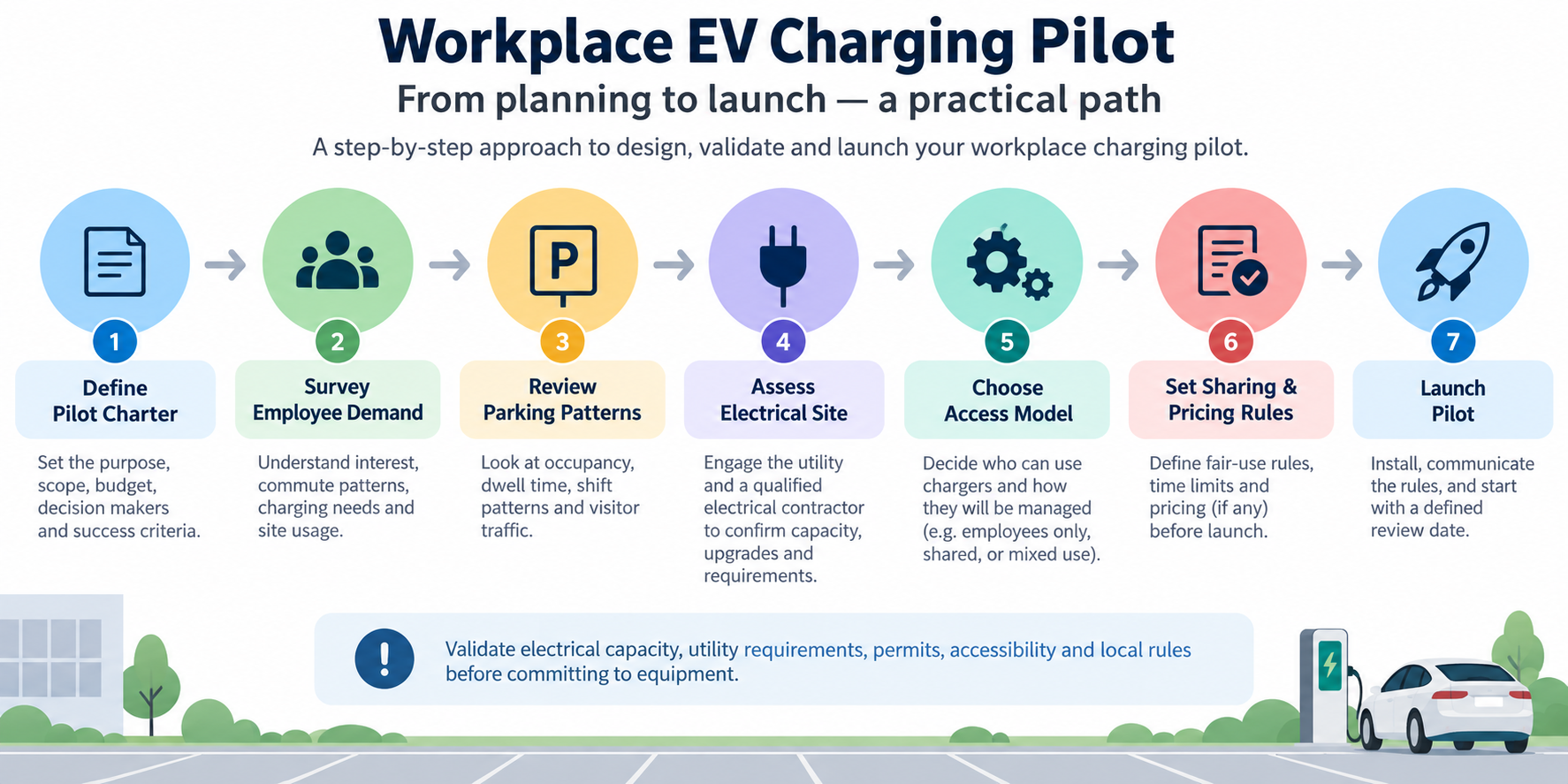
1. Start with a short pilot charter
Write the charter before choosing equipment or publishing a waiting list. A one-page document is often enough if it makes the main decisions visible.
Include the following:
Clear administration is not an afterthought. The U.S. Department of Energy (DOE) identifies administration, registration and liability, station sharing, and pricing as policy areas that benefit from clear guidelines, and recommends assigning responsibility for ongoing operation and maintenance in its workplace charging guidance.
A pilot charter also helps prevent a common problem: treating an initial amenity decision as an open-ended promise. Be clear that the pilot is being assessed, that access can be adjusted, and that capacity may remain limited.
2. Measure likely demand rather than guessing
Do not assume every employee who drives an EV needs a dedicated charging port every day. Workplace charging demand depends on commute distance, time spent at the site, charging access at home or elsewhere, shift patterns, visitor traffic, and how reliably drivers need to charge at work.
Start with an optional employee survey. DOE recommends gauging employee interest as part of workplace charging planning. Its workplace charging resource also encourages early consultation with the utility, electrical contractor, charging-equipment provider, and other stakeholders.
Keep the survey practical. Questions might cover:
Treat survey results as directional input, not a binding forecast. Pair them with observations of parking occupancy and dwell time. For example, a site where most cars remain parked all day may need clear sharing rules more urgently than a site with regular turnover. A site with multiple shifts should examine each shift separately so one group is not unintentionally excluded.
Avoid collecting more personal information than needed for planning. If registration will later be required, decide who can access that information, how long it is retained, and what workplace policy governs its use.
3. Complete site due diligence early
The physical site determines what a practical pilot can be. Engage the utility and a qualified electrical contractor before making public commitments about timing, capacity, or pricing.
DOE’s procurement and installation guidance identifies utility coordination, electrical-service upgrades, networking and payment needs, permits, inspection timing, signage, security, maintenance, and future expansion as planning considerations.
A useful due-diligence discussion should cover:
Accessibility and parking requirements should be reviewed with qualified local professionals. Do not assume that an approach used at another workplace will meet the needs or rules at this one.
4. Choose the service model deliberately
Access rules affect demand, staffing needs, parking management, payment design, and employee expectations. Select a model that the organisation can explain and operate consistently.
Common pilot models include:
For each model, name the programme owner and define the support path. Users should know where to ask about eligibility, report a fault, challenge an incorrect fee, or raise a parking issue. Internally, decide which team handles each category and when an issue is escalated to the equipment provider, contractor, utility, property manager, or security team.
Equipment choice should follow the operating model. DOE explains in its EV charging infrastructure procurement guidance that networked charging infrastructure can offer functions such as utilisation data, payment options, monitoring, and customer support, while non-networked equipment provides basic charging without those advanced capabilities. Use that distinction to define procurement requirements; do not buy connectivity simply because it is available.
5. Set fair-use rules before launch
A charging pilot can lose credibility quickly if a small number of drivers occupy spaces for long periods or if rules appear to be applied inconsistently. Publish the sharing approach before the first session.
DOE’s workplace charging guidance lists assignment, reservations, time limits, and employee self-management as possible ways to handle demand that exceeds available workplace stations. The right choice depends on parking duration, number of users, staff capacity, and the tools available through the selected equipment or provider.
Consider one of these approaches:
Write a short fair-use policy in plain language. It should state who may use the spaces, when vehicles should move, whether a vehicle may remain parked after charging ends, how exceptions are handled, and what happens if rules are repeatedly ignored. Enforcement should be proportionate and consistent with workplace and parking policies. Start with education and reminders where appropriate, then document the escalation route.
6. Choose a pricing approach with the full operating picture in mind
Pricing is a policy choice, not just a rate-setting exercise. Hosts may offer charging without a user fee, seek to recover selected costs, or charge for access. DOE identifies per-kilowatt-hour, per-session, time-based, and subscription structures as common approaches in its operations and maintenance guidance. That guidance also notes that rules affecting electricity resale can differ by state.
Before selecting a model, assess:
A free pilot may be easy for users to understand, but it still has a cost and may encourage longer stays if sharing rules are unclear. A cost-recovery model can make the expense visible, but may require more administration. Paid access can support a defined operating policy, but should not be adopted until the host understands local rules and payment obligations.
If pricing is being considered, seek location-specific advice from the appropriate utility, finance, tax, legal, and provider contacts. The DOE federal workplace guide can offer useful fee-recovery ideas, but its federal authorities and requirements do not automatically apply to private employers. See the Federal Workplace Charging Program Guide.
7. Procure for operations, not only installation
A charger is part of an operating service. Your procurement brief should describe how the pilot will be run after installation, not merely the hardware to be installed.
Document decisions on ownership, warranties, maintenance responsibilities, response procedures, and support contacts. Specify whether utilisation information, payment support, user authentication, remote monitoring, or managed charging are required for the pilot. These are equipment, network-provider, or internal-policy considerations; availability varies by solution.
Managed charging may help coordinate EV charging with building loads, charging demand, electricity rates, and operating schedules. DOE discusses these applications in a federal fleet context in its smart charge management resource. A workplace host should validate suitability with its utility, contractor, and provider rather than assume the federal examples apply directly.
Also define operational basics: how faults are reported, who contacts the provider, how an out-of-service unit is communicated to users, who maintains signs, and how user questions are answered. These details are often more important to the daily experience than the initial launch announcement.
8. Run a defined review and make a decision
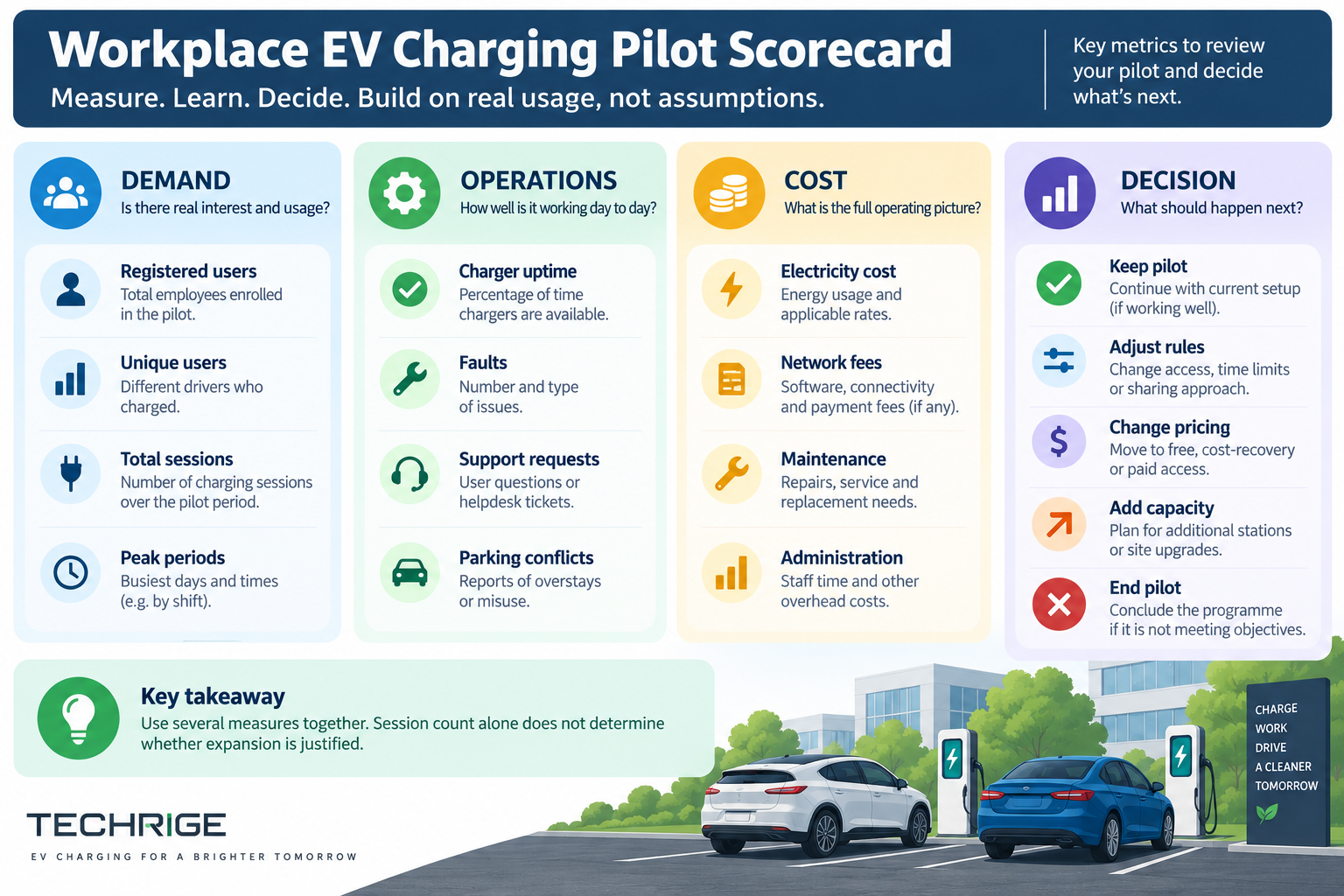
Set the review date in the charter. A pilot needs enough operating time to reveal real patterns, but it should not drift indefinitely without a decision.
At review, examine the available evidence:
DOE’s operations and maintenance guidance notes that collecting and analysing charging-infrastructure utilisation data can help site hosts assess usage, pricing approaches, and whether additional charging infrastructure may be needed.
Separate facts from interpretations. For example, a high number of sessions may indicate useful demand, but it does not alone prove that more stations are the best next step. Review dwell time, the timing of sessions, parking constraints, electrical capacity, cost exposure, and whether a rule change could address the issue first.
The outcome can be to keep the pilot, alter access or sharing rules, revise pricing, expand planning, add capacity, or end the programme. A documented decision—along with the evidence and unresolved questions—gives leadership a more defensible basis for the next stage than an initial forecast alone.
Sources
- U.S. Department of Energy — Workplace Charging for Electric Vehicles
- U.S. Department of Energy — Procurement and Installation for Electric Vehicle Charging Infrastructure
- U.S. Department of Energy — Operation and Maintenance for Electric Vehicle Charging Infrastructure
- U.S. Department of Energy — Federal Workplace Charging Program Guide
- U.S. Department of Energy — Smart Charge Management Applications and Benefits for Federal Fleets