
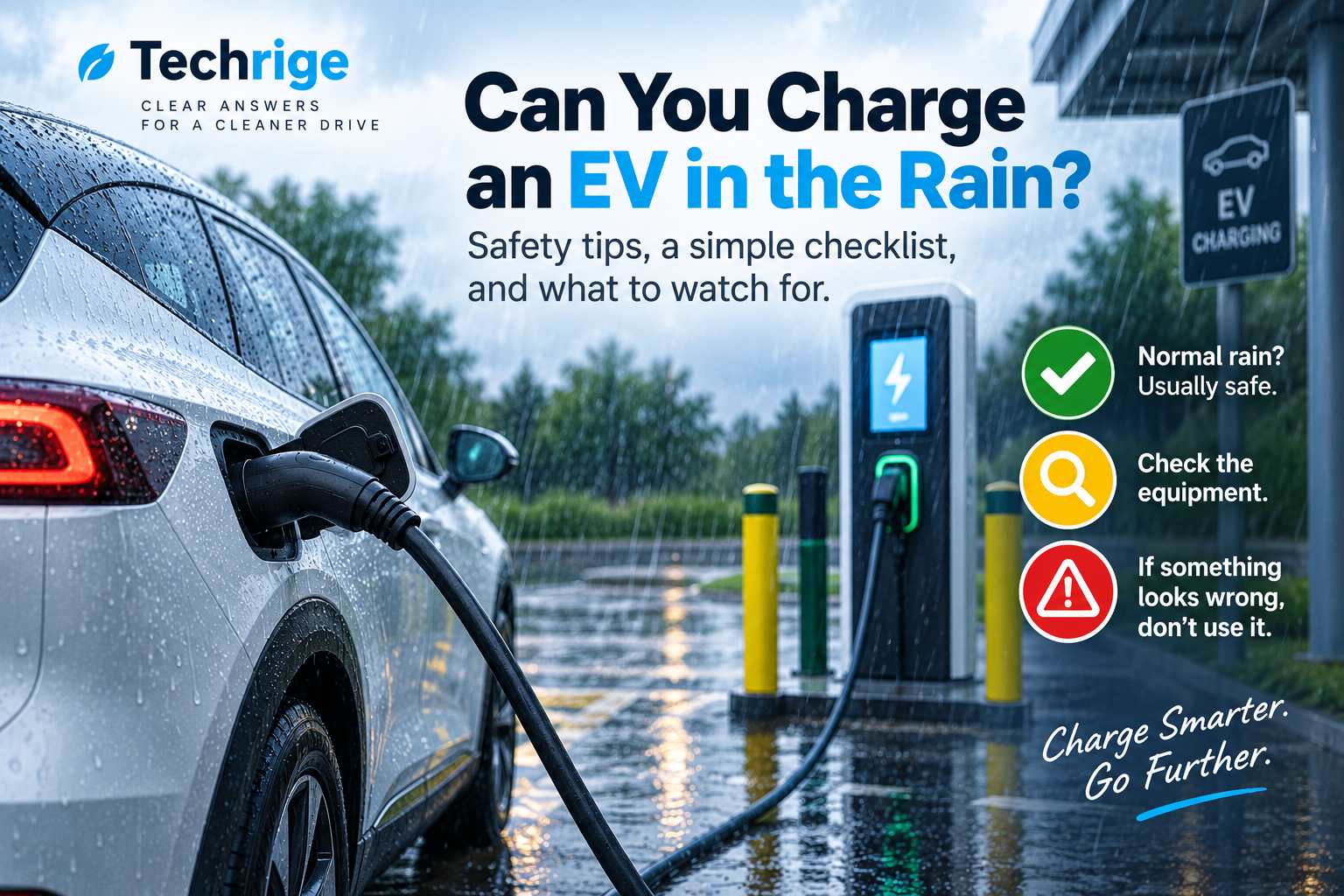
Yes, you can generally charge an EV in the rain when you are using properly installed charging equipment designed for outdoor use and the charger appears to be in normal condition.
Rain by itself is not usually a reason to avoid a public EV charger. The U.S. Department of Energy’s Alternative Fuels Data Center (AFDC) states that outdoor EV charging installations can be used safely in the rain when the equipment is rated for outdoor use (Charging Electric Vehicles at Home).
However, ordinary rain is different from damaged, flooded, contaminated, or faulted charging equipment.
Before plugging in during wet weather, take a few seconds to inspect the charger, cable, connector, charge-port area, and ground around the station. If something appears damaged or unusually unsafe, do not attempt to work around the problem. Use another charger when possible and report the affected unit to the charging-network operator.
This guide focuses on public Level 2 and DC fast charging in the rain. Always follow your vehicle owner’s manual, the charging station’s instructions, posted site rules, and directions from the charging-network operator.
Quick answer: Is it safe to charge an electric car in the rain?
For properly installed and outdoor-rated EV charging equipment, normal rain should not require you to change the basic charging procedure.
Before plugging in, check that:
- The charger enclosure appears intact.
- The cable is not cut, split, crushed, or severely damaged.
- The connector appears intact and free of obvious debris.
- The charger is not partly submerged or surrounded by unusual flooding.
- The station is not displaying a fault or out-of-service warning.
- The cable reaches your EV without being stretched or placed under excessive tension.
If everything appears normal, follow the charger and vehicle instructions as you normally would.
The DOE also explains that EV charging cords are designed for heavy use and that electricity does not flow simply because an unplugged connector is exposed. Power is supplied as part of the connected charging process (Electric Vehicles for Consumers).
Rain is not the same as a damaged or faulted EV charger
When deciding whether to use a public EV charger in wet weather, separate normal rain exposure from an equipment problem.
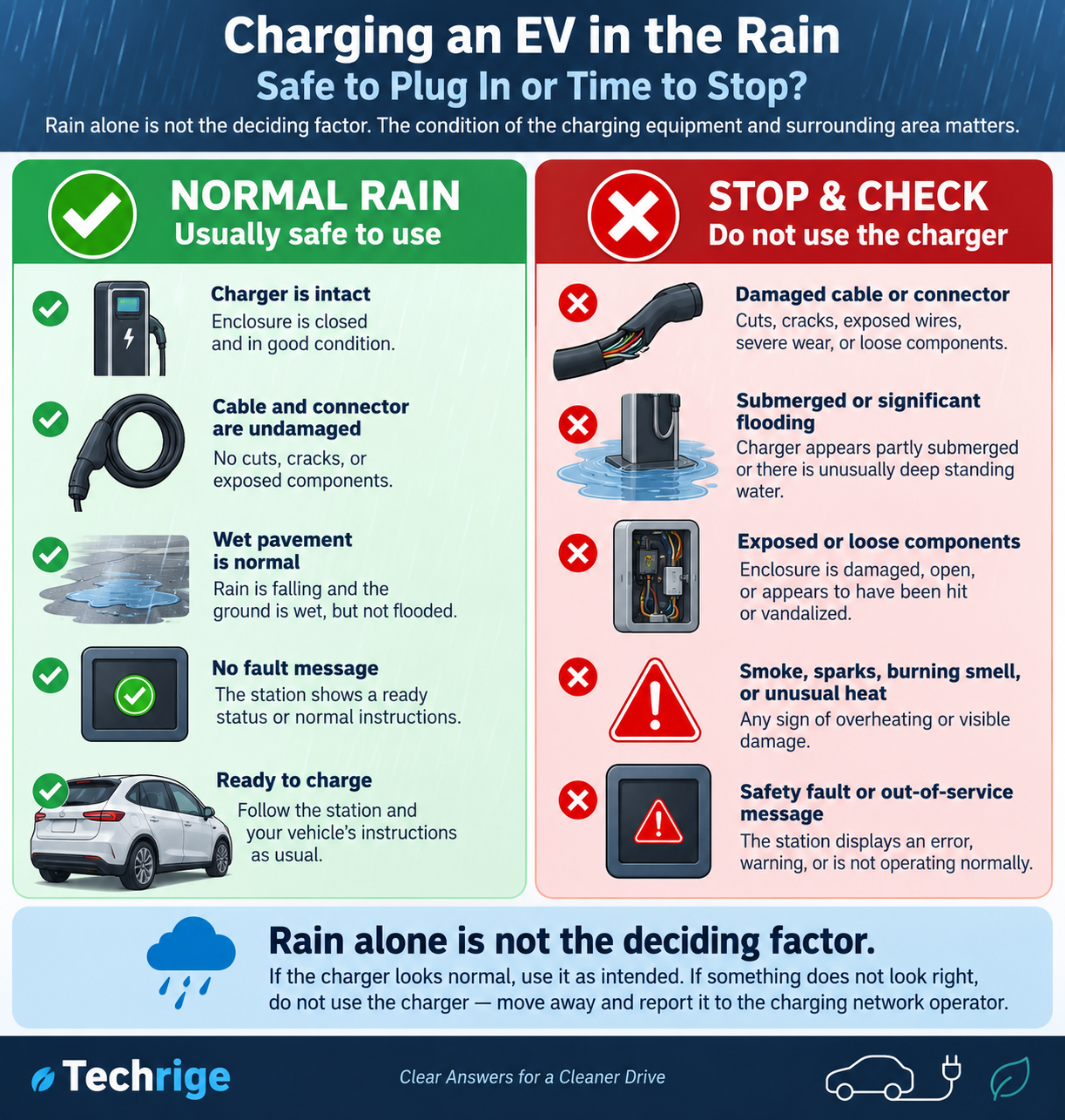
Usually a normal wet-weather charging situation
A public charger may still be appropriate to use when:
- Rain is falling normally.
- The pavement is wet but the equipment is not submerged.
- The charger enclosure appears closed and intact.
- The cable and connector appear undamaged.
- The station displays its normal ready or charging instructions.
- Your vehicle shows its expected connection or charging status.
In these conditions, use the station normally and follow the sequence shown by the charger and your EV.
There is usually no need for a special technique simply because it is raining.
Conditions that should make you stop
Do not assume that every problem at a wet charging site is caused by harmless rain.
Avoid using a charger if you notice:
- A split, cut, crushed, or severely worn cable.
- A cracked or broken connector housing.
- Loose or exposed internal components.
- Obvious scorching or burn damage.
- Smoke, sparks, unusual heat, or a strong burning smell.
- Significant standing water or flooding around the equipment.
- A charger or connector that appears partly submerged.
- A persistent safety warning or fault message.
- Equipment that appears to have been hit by a vehicle or physically displaced.
These are not conditions to troubleshoot with repeated plug-ins or improvised repairs.
Use another charging port or station when possible and report the affected charger using the operator’s support number, app, or instructions displayed at the site.
The DOE’s EV charging site guidance notes that charging equipment can be designed to operate in wet areas while also recommending that equipment be located away from areas where water pools or irrigation directly sprays the equipment (Electric Vehicles for Fleets).
For a driver, that distinction is useful: wet pavement is normal; unusual flooding deserves more caution.
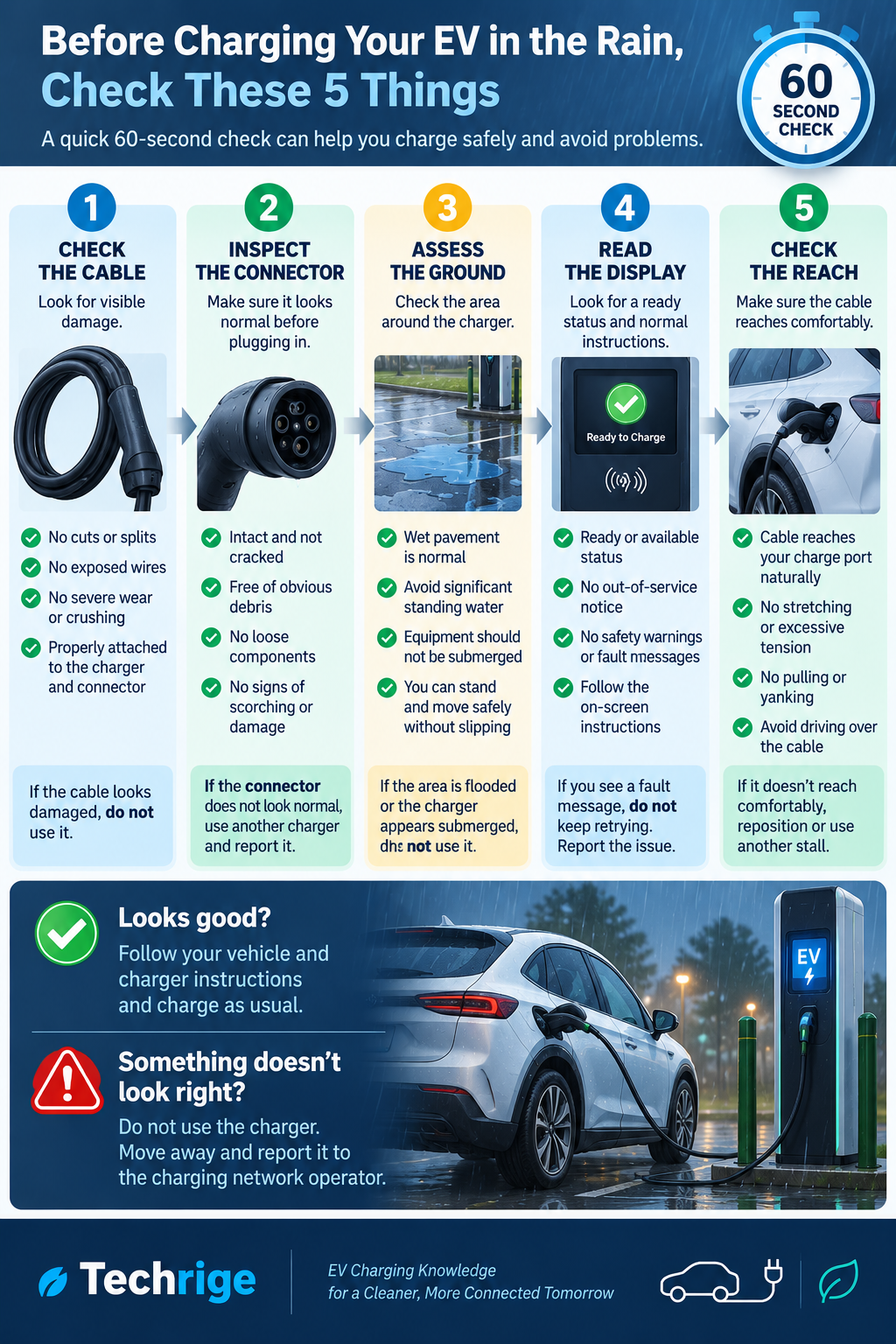
Public EV charger rain checklist: 5 things to check before plugging in
A quick visual inspection can help you decide whether a wet-weather charging stop appears normal.
1. Inspect the charging cable
Start with the cable running from the charger to the connector.
Look for obvious physical damage such as:
- Cuts
- Splits
- Severe abrasion
- Crushed sections
- Exposed internal material
- A cable partly detached from the charger or handle
If the cable appears damaged, do not use it.
Do not tape, wrap, reposition, or attempt to temporarily repair public charging equipment.
Tesla troubleshooting guidance, for example, tells drivers not to use charging equipment when a cable is damaged or deteriorated and recommends trying different charging equipment instead (Model Y Owner’s Manual).
Although that guidance is vehicle-specific, the practical principle is useful for any public charging stop: visible equipment damage should not be treated as something the driver needs to fix.
2. Look at the EV charging connector
Inspect the connector body before inserting it into your vehicle.
It should appear intact and reasonably free of foreign material.
Do not plug it in if you notice:
- A cracked connector housing
- Loose components
- Heavy contamination
- Obvious physical damage
- Scorching
- Foreign material that prevents a normal connection
Do not insert tools or other objects into a public charging connector or attempt to disassemble it.
If the connector does not appear normal, use another charger and report the problem.
3. Check the ground around the charging station
Wet pavement is expected when it rains.
What deserves more attention is unusual standing water or flooding.
Look at the area where you will stand and where the charging cable runs.
Avoid the charger if:
- Water is unusually deep around the charger.
- The charging equipment appears partly submerged.
- Floodwater is moving through the charging area.
- You cannot safely reach the equipment without entering substantial standing water.
Also consider basic physical safety. Wet pavement, painted surfaces, curbs, leaves, snow, and ice can all become slippery.
Move deliberately and avoid stepping over the charging cable where possible.
4. Read the charger screen and status lights
Before connecting, check whether the charger appears ready for use.
Look for:
- Normal start instructions
- An available or ready indication
- Out-of-service notices
- Fault messages
- Payment or authorization instructions
- Charger or stall identification
An ordinary payment, app, or authorization message does not necessarily indicate a safety problem.
However, if the charger displays a safety warning or repeatedly reports a fault, do not continue reconnecting the vehicle indefinitely.
If the problem appears to be a normal session-start issue rather than damaged equipment, see Techrige’s Public EV Charger Will Not Start? Driver Troubleshooting Checklist.
5. Make sure the cable reaches without strain
Position your vehicle so the connector reaches the charge port naturally.
Avoid:
- Pulling the cable tightly
- Yanking it from its cable-management system
- Stretching it across another parking space
- Twisting the connector to make it reach
- Driving over the cable
- Leaving the cable where it creates an unnecessary trip hazard
If the cable cannot comfortably reach your vehicle, reposition the vehicle or use another stall.
How to charge an EV in the rain
Once the charger passes your visual check, charging in ordinary rain is largely the same as charging on a dry day.
A simple routine is:
- Park so the charge cable can reach comfortably.
- Read the charger’s instructions and confirm the stall or charger number.
- Visually inspect the cable and connector.
- Open your vehicle’s charge port.
- Connect the charging cable according to the station and vehicle instructions.
- Start or authorize the session using the required payment method, app, RFID card, Plug & Charge process, or charger interface.
- Confirm that charging has actually started.
- When finished, stop the session using the normal procedure.
- Disconnect the connector as instructed by your vehicle and charging network.
- Return the connector to its holder or cable-management system.
Do not place bags, plastic covers, tape, towels, or makeshift weather protection around the connector while charging.
Outdoor charging equipment is intended to operate according to its own design and instructions. Improvised coverings could interfere with the connection or equipment operation.
If weather conditions appear to have created an abnormal situation, using another charger is a better option than trying to modify the equipment.
Can you use a DC fast charger in the rain?
Generally, DC fast charging in the rain follows the same basic principle: use charging equipment intended for its environment, inspect the unit for visible problems, and follow the charger and vehicle instructions.
You do not normally need a different connection process simply because rain is falling.
However, because DC fast-charging stops often happen during longer trips, it is especially useful to have a backup location in case a charger is unavailable, damaged, flooded, or faulted.
Before a road trip, you can use Techrige’s DC Fast-Charging Stop Checklist for EV Drivers to review connector compatibility, charger availability, payment, arrival battery level, and backup options.
What if the public charger will not start in the rain?
A charging session can fail for many reasons that have nothing to do with rain.
Possible causes can include:
- Payment authorization
- Network or app problems
- Selecting the wrong charging port
- Connector compatibility
- Adapter compatibility
- Vehicle settings
- Scheduled charging
- Communication between the charger and vehicle
- A charger fault
- An equipment problem
If the charger and connector appear physically normal, read the station and vehicle messages before deciding what to do next.
A single normal retry may be appropriate when the station’s instructions suggest reconnecting.
However, stop using the charger if:
- The equipment appears damaged.
- You see sparks, smoke, scorching, or exposed components.
- The charger reports a serious safety fault.
- The equipment appears submerged.
- The connector behaves abnormally.
- The same fault repeatedly returns.
Do not open the charging station, reset electrical equipment, modify an adapter, bypass a safety message, or attempt a temporary repair.
Record the charger or stall number and the displayed error message if possible, then contact the charging-network operator.
What about excessive water around the charge port?
Ordinary rain and unusual water exposure are not necessarily the same situation.
Some vehicle manufacturers include specific troubleshooting instructions for excessive moisture.
Tesla’s Model Y troubleshooting guidance, for example, advises checking the charge port and connector for pooled water or unusual moisture when certain charging faults occur and allowing excessive moisture to dry before retrying.
That does not mean every EV uses the same procedure.
If your vehicle displays a moisture-related warning, follow your specific vehicle manufacturer’s instructions rather than applying instructions from another EV model.
Vehicle and charging-network instructions come first
General charging guidance cannot account for every EV, charger, connector, adapter, software version, or charging network.
Your vehicle’s owner manual and the charging station’s instructions should therefore take priority.
Manufacturer guidance may also address situations that go beyond ordinary rainfall.
For example, Tesla’s Cybertruck documentation warns drivers not to direct high-pressure liquid, such as from a pressure washer, toward the charge port while the vehicle is charging (Cybertruck Charging Instructions).
That is very different from ordinary rain, but it illustrates why manufacturer-specific instructions matter when water exposure is unusual.
Frequently asked questions about EV charging in the rain
Can I plug my electric car in while it is raining?
Generally, yes. Properly installed outdoor-rated EV charging equipment is designed for outdoor conditions, including rain. Inspect the charger and connector first and follow the station and vehicle instructions.
Will an EV charger electrocute you in the rain?
Proper EV charging equipment incorporates electrical safety systems and is designed to operate according to applicable installation and equipment requirements. Normal rain alone is not a reason to expect electric shock from properly installed, undamaged outdoor-rated charging equipment.
Do not use equipment that appears damaged, submerged, or seriously faulted.
Should I dry an EV charging connector before plugging it in?
Do not assume that a connector exposed to ordinary rain needs to be manually dried.
Follow the charger and vehicle manufacturer’s instructions. If there is unusual moisture, pooled water inside a charge-port area, contamination, or a moisture-related vehicle warning, follow the manufacturer’s troubleshooting procedure rather than inserting tools or materials into the connector.
Should I cover an EV charger connector when it rains?
Do not add makeshift bags, tape, towels, or other coverings to public charging equipment.
Use the equipment as instructed. If you believe the connector or charger is not suitable to use because of its condition, choose another charger.
Can a Level 2 EV charger be used in the rain?
Outdoor-rated Level 2 charging equipment is designed for outdoor installation and use according to its specifications. Normal rain should not prevent use of a properly installed unit that appears to be in good condition.
Is DC fast charging safe during rain?
Normal rain alone does not generally prevent use of properly installed outdoor DC fast-charging equipment. Inspect the charger, cable, connector, and surrounding area and follow any station or vehicle warnings.
Bottom line
You can generally charge an EV in the rain when using properly installed, outdoor-rated charging equipment that appears to be in normal condition.
Rain itself is not usually the deciding factor.
Instead, check the:
- Charger
- Cable
- Connector
- Vehicle charge-port area
- Ground around the charger
- Charger display and status indicators
Normal rain and wet pavement can be expected at an outdoor charging station.
Visible damage, significant flooding, submerged equipment, smoke, sparks, burning smells, exposed components, or serious fault messages are different situations.
When something does not look right, do not improvise or attempt to repair public charging equipment. Stop the attempt, report the charger, and use another compatible station when possible.
Sources
- U.S. Department of Energy, Alternative Fuels Data Center — Charging Electric Vehicles at Home
- U.S. Department of Energy, Alternative Fuels Data Center — Electric Vehicles for Consumers
- U.S. Department of Energy, Alternative Fuels Data Center — Electric Vehicles for Fleets
- Tesla — Model Y Owner’s Manual
- Tesla — Cybertruck Charging Instructions