
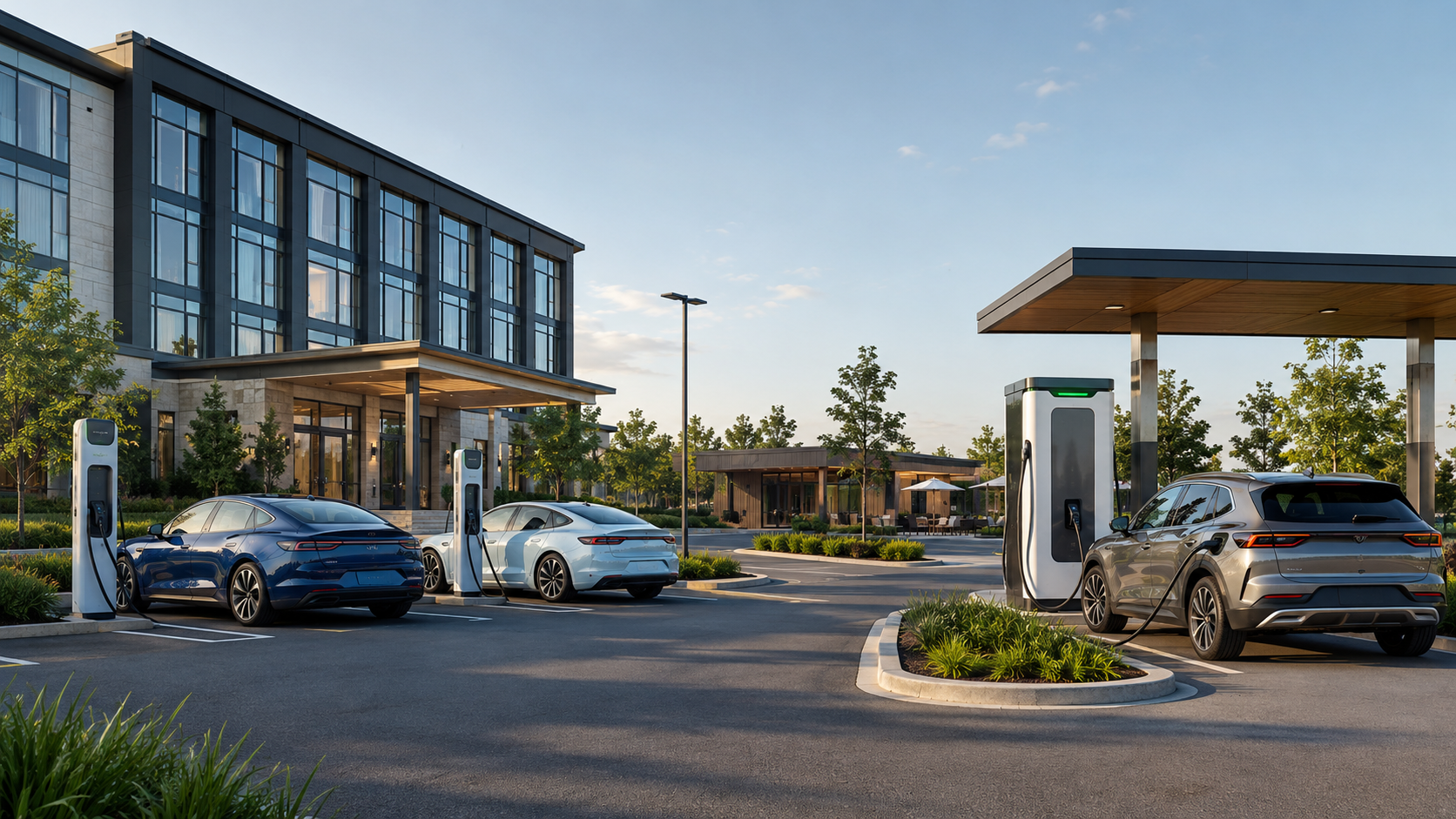
The fastest EV charger is not automatically the best charger for a commercial property. The better starting question is: How long do drivers normally park, and how much charging should they receive during that visit?
For hotels, workplaces and other long-stay destinations, AC destination charging—commonly called Level 2 charging in North America—often matches the way visitors already use the property. DC fast charging is more likely to suit locations where drivers arrive specifically to recharge and expect to leave relatively quickly. Some sites may benefit from a combination of both.
Charging speed is only the first part of the decision. Electrical capacity, parking layout, accessibility, connectivity, pricing, maintenance and future demand can all change what is practical.
This article is a planning framework, not an equipment specification, engineering design or compliance assessment. Terminology, voltage, connector standards, permitting, accessibility rules and utility processes differ by country and jurisdiction. Work with the applicable utility, qualified electrical professionals, charging providers and local authorities before choosing or installing equipment.
Start with the parking visit, not the charger catalogue
Before comparing charger models, describe the visit your property is designed to serve. Ask:
- Who will use the chargers: employees, hotel guests, residents, customers, fleet vehicles or the public?
- How long does a typical vehicle remain parked?
- Is charging the main reason for the stop, or an amenity during another activity?
- How much energy would a typical driver reasonably need during that visit?
- How many vehicles may need to charge at the same time?
- Will drivers be able and willing to move their vehicles after charging?
- What access hours, parking rules, payment methods and support will be required?
- How might demand change over the next several years?
This parking period is often called dwell time. It is one of the clearest early indicators of whether AC destination charging or DC fast charging is likely to fit the site.
The U.S. Department of Energy's Alternative Fuels Data Center guidance on public charging associates Level 1 and Level 2 charging with places where vehicles remain parked for longer periods, including hotels, airports, shopping centres, government offices and other businesses. Although that guidance is written for the United States, the underlying planning principle is broadly useful: match charging to the way people use the location.
An office where employees park for most of the workday has a different charging need from a highway stop where drivers want to continue their trip quickly. A hotel may focus on overnight energy delivery, while a retail property may serve a mix of brief and extended visits.
Level 2 vs DC fast charging: the practical difference
Charging terminology and electrical standards vary by market, but the basic distinction is consistent:
- AC destination charging, often called Level 2 in North America, supplies AC power to the vehicle. The vehicle's onboard charger converts that power to DC for the battery.
- DC fast charging converts power outside the vehicle and delivers DC power to the battery at a much higher potential rate.
As a U.S. technical reference, the AFDC overview of EV charging stations describes Level 2 equipment as operating from 2.9 to 19.2 kW and notes that DC fast chargers may reach much higher outputs. Those figures should not be treated as worldwide product limits or as a guarantee of the power any vehicle will accept.
| Planning question | AC destination charging / Level 2 | DC fast charging |
|---|---|---|
| Best aligned with | Parking that lasts for hours | Shorter, charging-focused stops |
| Common property examples | Workplaces, hotels, long appointments, shared residential parking and destination venues | Highway or roadside locations, rapid-turnover charging hubs and sites serving time-sensitive drivers |
| Driver expectation | Add useful energy while doing something else | Receive a meaningful recharge before continuing the trip |
| Main site considerations | Number of ports, parking duration, fair access and available building capacity | Utility capacity, high-power equipment, vehicle circulation, queueing and rapid turnover |
| Operational focus | Sharing limited ports across longer stays | Reliability, payment, support and keeping charging bays moving |
The Joint Office of Energy and Transportation's Public EV Charging Station Site Selection Checklist uses locations where customers can spend two or more hours as examples for Level 2 charging and about 30 minutes as an example for DC fast charging. These are useful screening examples, not universal thresholds.
A medical clinic with one-hour appointments, a shopping centre with both quick visits and long stays, or a hotel next to a major travel corridor may not fit neatly into one category. In those cases, evaluate actual parking data and consider whether a mixed charging strategy would serve drivers more effectively.
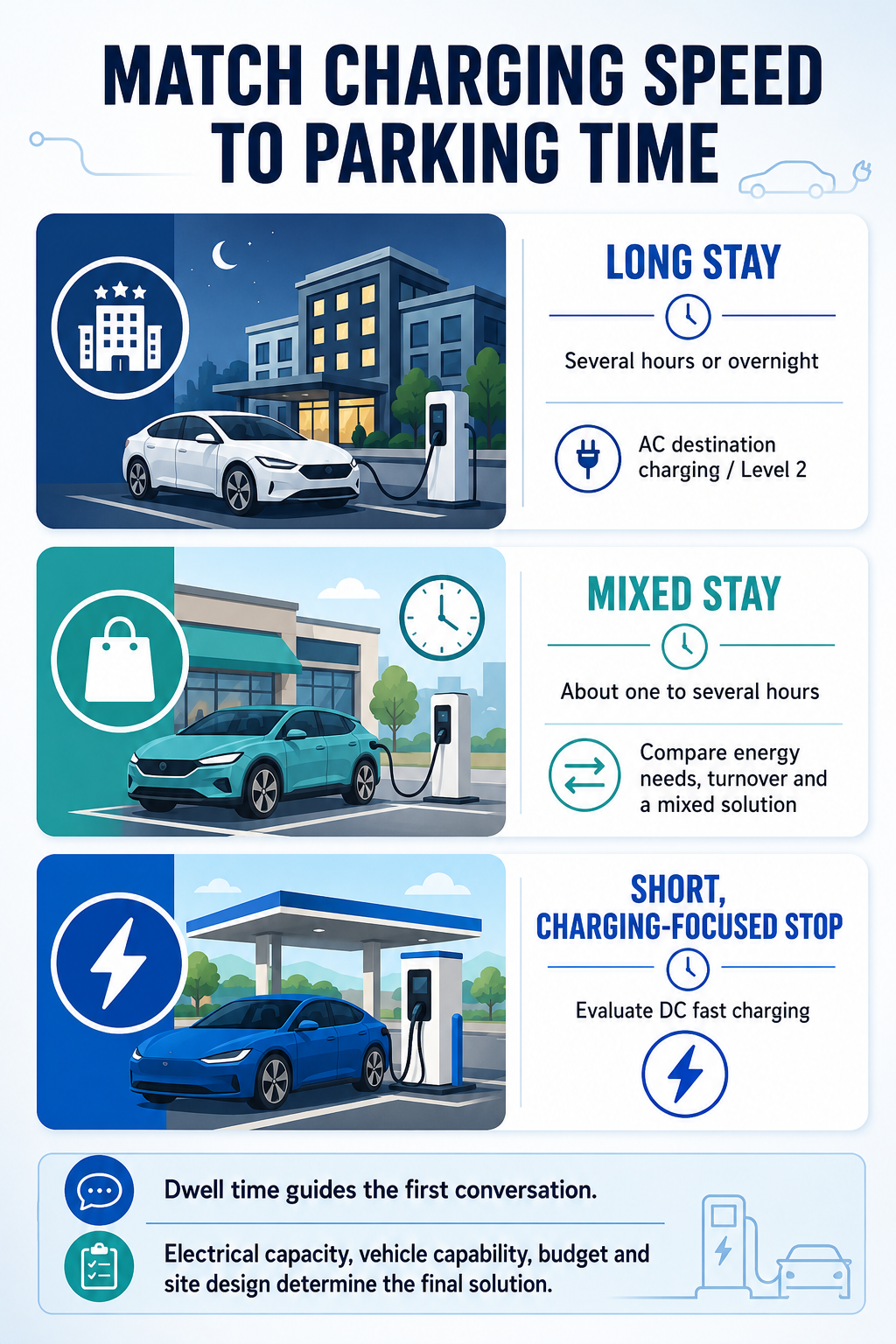
Dwell time guides the first conversation. Electrical capacity, vehicle capability, budget and site design determine the final solution.
Use dwell time and energy needs for an initial power estimate
A useful early calculation compares the energy a typical vehicle needs with the time it is expected to remain connected:
Preliminary average charging power = desired energy delivery ÷ available charging time
The National Renewable Energy Laboratory's zero-emission vehicle resource guide uses this energy-needed-divided-by-dwell-time relationship as an initial way to estimate charger power.
For example, if a commercial property wants a typical visitor to receive 20 kWh during a four-hour stay:
20 kWh ÷ 4 hours = 5 kW average power
That result does not mean the property should immediately purchase a 5 kW charger. It is a starting point for discussion with charging providers and electrical professionals. A complete design must consider simultaneous charging, electrical losses, power sharing, the site's peak load and the charging limits of the vehicles being served.
Document the assumptions behind the estimate:
- Typical energy required per vehicle
- Typical and minimum parking duration
- Number of vehicles expected at the same time
- Percentage of vehicles likely to plug in
- Vehicle AC or DC charging limits
- Whether power will be shared across multiple ports
- Seasonal temperatures and other conditions that may affect charging
- Desired operating margin and plans for future demand
Real charging power can change during a session. The vehicle controls how much power it accepts, and battery temperature, state of charge, battery condition, equipment settings and site-level power management may all affect the result. Use the calculation to frame a proposal—not to promise a charging time or range increase.
Check the property's electrical capacity early
The desired driver experience must fit the property's electrical system and the local grid connection. Before selecting equipment, ask qualified professionals to assess:
- The building's existing electrical service and peak demand
- Available capacity in panels, switchgear and transformers
- Other large electrical loads and planned building upgrades
- The distance between the electrical supply and proposed charging spaces
- Conduit, trenching, civil work and equipment-protection requirements
- Whether managed charging or load sharing could reduce coincident demand
- Utility rate structures and possible demand charges
- The capacity needed for later phases
- Utility, permitting and construction lead times
The AFDC's charging-infrastructure procurement and installation guidance recommends engaging the utility early because it can assess power availability, identify constraints and explain relevant programs or requirements.
Where a utility publishes a hosting-capacity map, the map may help with early screening. However, the U.S. Department of Energy's hosting-capacity map overview cautions that these maps do not answer site-specific interconnection questions. Treat any such map as background information, not as approval or a reservation of capacity.
Do not wait until a charger model has been selected to investigate these issues. A site that appears ideal based on dwell time may require a lower-power first phase, load management, a utility upgrade or a different location after the electrical assessment.
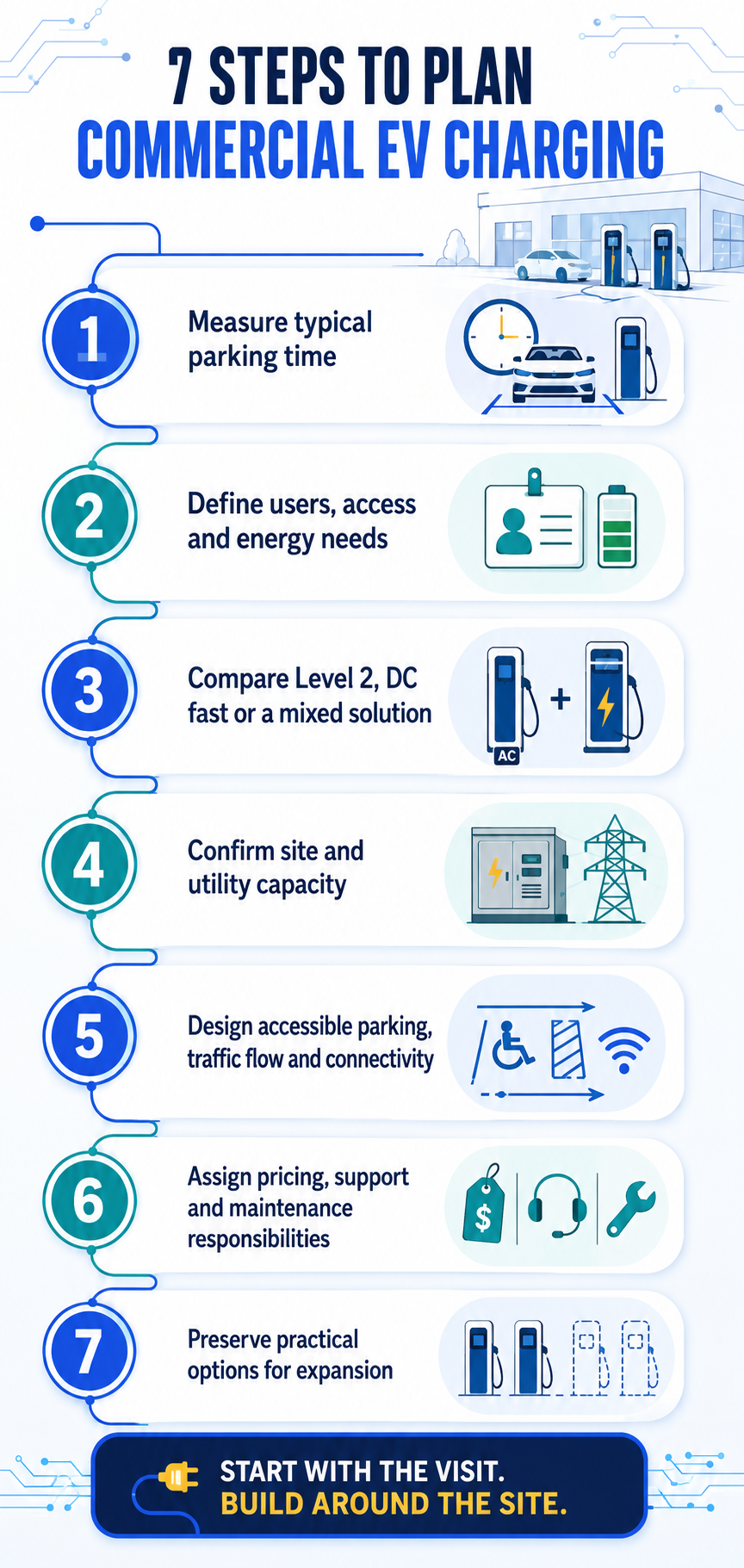
Design the whole charging experience
The charger is only one part of the service. A workable commercial charging site also needs a safe, understandable and accessible route from arrival to departure.
Review:
- Traffic flow: Can drivers enter, find a charger, queue if necessary and leave without blocking other vehicles?
- Cable reach: Can the equipment serve vehicles with charging inlets in different locations without creating trip hazards?
- Accessibility: Are charging controls, spaces, access aisles and routes usable by people with disabilities and compliant with local requirements?
- Signage and instructions: Can drivers identify the charging spaces, access rules, time limits, price and support contact?
- Lighting and security: Does the site feel safe during every hour it will be available?
- Weather and drainage: Is equipment appropriately located and protected for local conditions?
- Connectivity: Does the exact charger location have the wired, wireless or cellular service required by the network?
- Amenities: Do nearby restrooms, food, seating or other services match the expected dwell time?
- Support: Is it clear who helps a driver when a charger, app or payment method does not work?
Accessibility should be considered at the beginning, not added after the parking layout is fixed. The U.S. Access Board's EV charging design recommendations illustrate how charger placement, access aisles, cable length, vehicle inlet locations, controls and accessible routes interact. Use the accessibility rules and professional guidance applicable to the project's actual jurisdiction.
Plan operations before installation
A charger can be technically suitable and still deliver a poor experience if no one is responsible for operating it. Before signing an agreement or approving equipment, define:
- Who owns the chargers and supporting electrical equipment
- Who monitors station status and receives fault notifications
- Who provides driver support and during which hours
- Who dispatches repairs and pays for parts, labour and network fees
- What response, repair and uptime targets apply
- How access, pricing, payment and refunds will work
- How parking limits will be communicated and enforced
- Who controls station data and how it can be exported
- What happens during a network, cellular or power outage
- How the site can change providers or equipment in the future
The AFDC's operation and maintenance guidance recommends clearly assigning maintenance responsibilities and defining response time, repair time and uptime expectations in service agreements.
If the site will charge drivers a fee, review Techrige's guide to EV charging pricing by kWh, time or session. Workplaces should also define who can use the chargers and when; Techrige's workplace EV charging access guide compares employee, visitor and after-hours public access models.
Preserve options for phased expansion
Demand may grow after the first chargers open, but that does not always justify building the largest possible project immediately. A phased plan can align the first investment with near-term demand while preserving practical expansion options.
During initial design, ask whether it is reasonable to reserve:
- Electrical capacity or space for future electrical equipment
- Conduit, cable pathways or trench routes
- Additional charging spaces and accessible routes
- Network capacity and communications coverage
- A modular equipment arrangement
- The ability to add load management, on-site generation or storage if later justified
Advance work is not automatically cost-effective. Its value depends on the site, construction schedule, utility assessment, budget and expected demand. Ask providers to price the first phase separately from optional future-ready work so the trade-off is visible.
Create a decision brief before requesting quotes
A concise decision brief helps installers and charging providers respond to the same need instead of proposing fundamentally different projects.
Include:
- Property type, location and normal operating hours
- Intended users and access policy
- Typical, minimum and maximum parking duration
- Desired energy delivery or driver outcome
- Estimated simultaneous charging demand
- Preliminary preference for Level 2, DC fast charging or a mixed solution
- Known electrical-service information and planned building loads
- Proposed number of charging ports and expansion stages
- Parking layout, accessibility and traffic-flow requirements
- Connectivity, payment, pricing, data and support requirements
- Ownership and maintenance preferences
- Target budget, schedule and available incentives
- Assumptions that still require verification
Ask each bidder to identify its assumptions and separate:
- Charging hardware
- Network or software services
- Electrical work
- Civil and parking-lot work
- Utility upgrades
- Permitting and inspection
- Signage and accessibility work
- Ongoing support, maintenance and transaction fees
This structure makes it easier to compare proposals and spot exclusions before the project begins.
The practical choice: match charging speed to the stay
For an early commercial-property assessment:
- If vehicles normally remain for several hours or overnight, begin by evaluating AC destination charging or Level 2.
- If drivers make short, charging-focused stops and expect a substantial recharge, evaluate DC fast charging.
- If the property serves several visit patterns, consider whether a mixed solution or separate charging zones would better match demand.
Dwell time should guide the first conversation. Electrical capacity, vehicle needs, site design, accessibility, operations, budget and future growth determine whether the concept can become a reliable charging service.
By defining the visitor experience before choosing equipment, charger hosts can request proposals that are better aligned with the way their property actually works.
Sources
- Alternative Fuels Data Center — Charging Electric Vehicles in Public
- Alternative Fuels Data Center — Electric Vehicle Charging Stations
- Alternative Fuels Data Center — Procurement and Installation for EV Charging Infrastructure
- Joint Office of Energy and Transportation — Public EV Charging Station Site Selection Checklist
- National Renewable Energy Laboratory — Zero-Emission Vehicle Adoption Resource Guide
- U.S. Department of Energy — U.S. Atlas of Electric Distribution System Hosting Capacity Maps
- U.S. Access Board — Design Recommendations for Accessible EV Charging Stations
- Alternative Fuels Data Center — Operation and Maintenance for EV Charging Infrastructure