
EV Charging for Retail and Restaurants: A Pre-Purchase Planning Checklist
Electric vehicle charging can be a useful amenity or service for a retail centre, restaurant, or mixed-use property. But buying EV charging equipment should not be the first decision.
A better starting point is to define what the charging area needs to accomplish, who will use it, how long vehicles normally remain parked, and who will be responsible for operating it over time.
Shops, restaurants, hotels, and other businesses can act as EV charging site hosts, with charging made available to the public or restricted to particular users depending on the site's objectives, according to the U.S. Department of Transportation's EV site-host guidance.
That flexibility is useful, but it also means there is no single EV charger, pricing model, access policy, or operating arrangement that works for every commercial property.
Use this commercial EV charging pre-purchase checklist to develop a clear project brief before comparing equipment or vendor proposals.
It can support discussions with your electric utility, qualified electrical contractor, designer, property team, and prospective charging providers. It is not a substitute for site-specific electrical, accessibility, legal, engineering, insurance, or permitting advice.
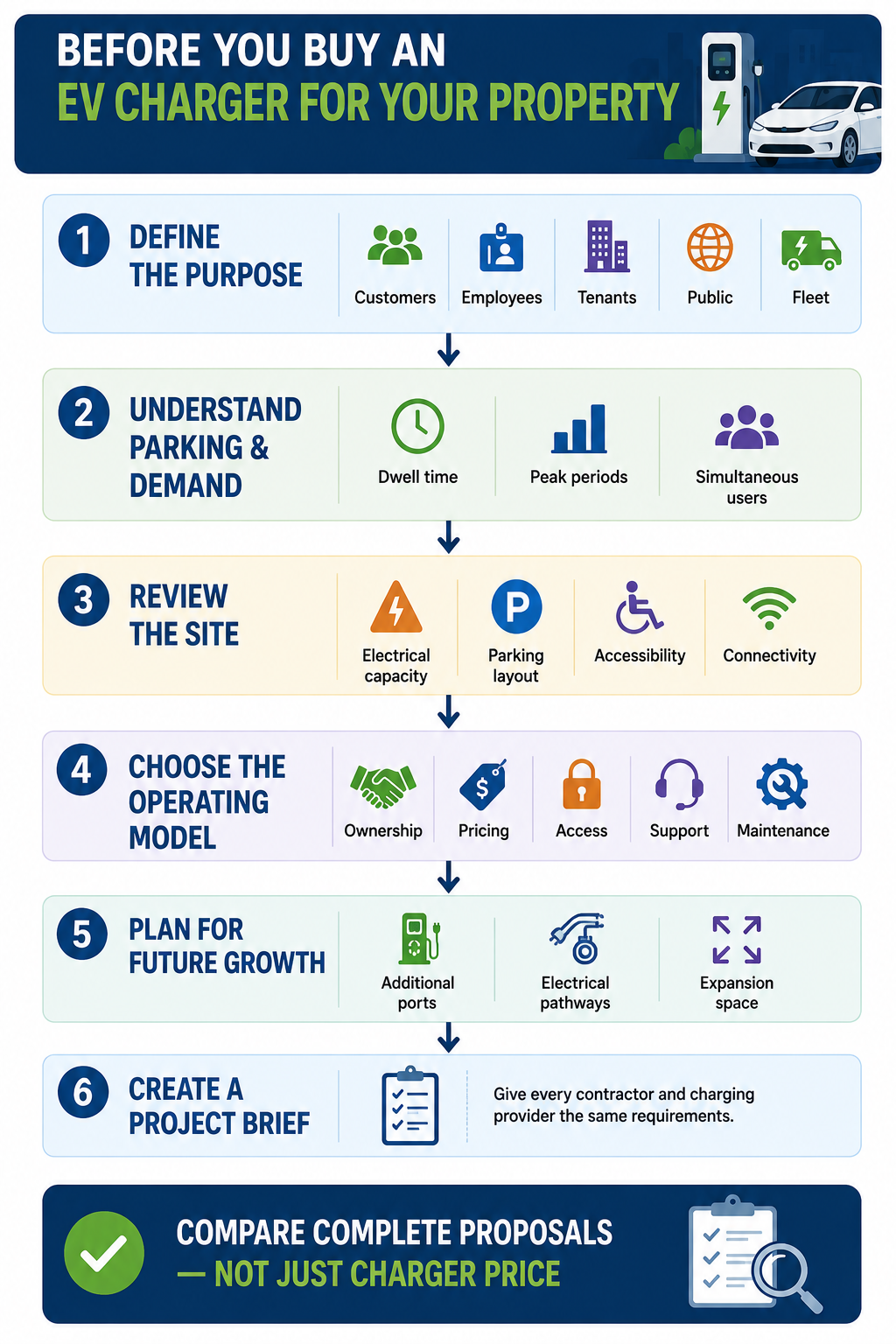
1. Define the Purpose of EV Charging at Your Property
Start with a simple question:
What job should EV charging perform at this location?
A commercial EV charging project can serve more than one purpose, but those priorities should be ranked before equipment is selected.
Otherwise, decisions can conflict. For example, a site could install equipment intended to support rapid customer turnover while creating an access policy designed around vehicles remaining parked for several hours.
Common purposes for retail and restaurant EV charging include:
- Providing an additional amenity for customers
- Supporting customers who already spend significant time at the property
- Offering public EV charging as a paid service
- Providing charging for employees
- Providing charging for tenants at a mixed-use property
- Supporting company or fleet vehicles
- Serving several user groups at different times
- Preparing the property for expected future EV charging demand
Write a one-sentence project objective.
For example:
“Provide visitor EV charging during store hours while preserving sufficient parking availability for customers.”
That is more useful than a broad objective such as “install EV chargers” because it gives the project team a basis for making later decisions about charging speed, quantity, access, pricing, and parking policies.
Then define what success would look like.
An amenity-focused site may prioritize a simple driver experience and orderly parking operations. A paid charging service may need stronger processes around pricing, payment, support, operating costs, and equipment downtime. Employee charging may require rules for fairly sharing a limited number of ports.
These are planning objectives—not guarantees of increased revenue, customer traffic, utilization, or spending.
2. Match Parking Duration and Demand to the Charging Approach
How long vehicles normally remain at your property is one of the most important early inputs when planning commercial EV charging.
A quick-service restaurant, full-service restaurant, grocery store, shopping centre, medical office, hotel, and mixed-use development can have very different parking patterns even when the properties are located close together.
Before selecting chargers, map how the parking area is actually used.
Review:
- Typical customer parking duration
- Shortest and longest common visits
- Employee parking duration
- Tenant or resident parking, if applicable
- Busy periods during the day or week
- Seasonal changes in parking demand
- Number of vehicles that could request charging simultaneously
- Areas where parking turnover is especially important
- Whether customers and employees would compete for the same charging spaces
- Whether overnight parking occurs
- Whether drivers could reasonably move their vehicle when charging is complete
The U.S. Department of Transportation's EV Infrastructure Project Planning Checklist recommends assessing both total expected charging demand and the demand profile, including whether demand will remain steady or peak at particular times.
Looking only at total daily charging demand can hide operational problems.
Two properties might expect a similar number of charging sessions per day, while one experiences those sessions gradually and another receives most of its demand during a narrow lunch or evening period.
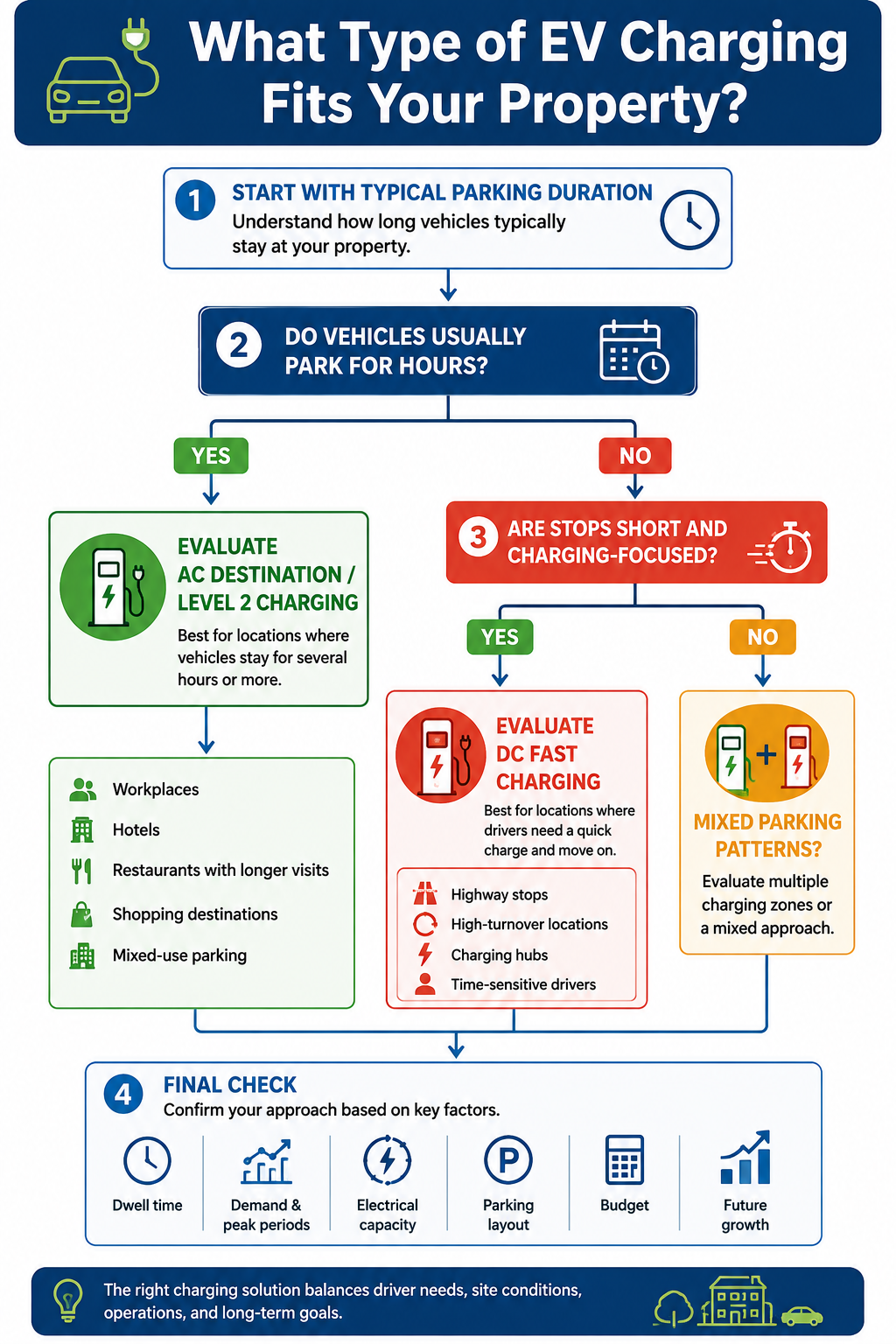
Consider Dwell Time Before Choosing Level 2 or DC Fast Charging
Parking duration—often called dwell time—can help guide the first discussion about charging speed.
Properties where vehicles remain parked for hours may begin by evaluating AC destination charging, commonly called Level 2 charging in North America. Locations serving shorter, charging-focused stops may need to evaluate DC fast charging.
For a deeper comparison, see Techrige's guide to Level 2 vs. DC fast charging based on dwell time.
Do not select a charging level, connector count, or electrical upgrade simply because a nearby competitor installed a particular system.
Instead, ask prospective providers to explain how their proposal fits your:
- Typical parking duration
- Expected energy needs
- Peak charging demand
- Available electrical capacity
- Customer experience
- Parking turnover requirements
- Budget
- Expansion plan
Useful questions include:
- How long will a typical vehicle remain connected?
- How much energy does the site reasonably want to provide during that visit?
- How many drivers may want to charge at the same time?
- Is charging the main reason for the stop or an amenity during another activity?
- Does the vehicle need a substantial recharge or simply useful additional range?
- Can drivers reasonably move their vehicles when charging is complete?
- Would multiple lower-power ports serve the property better than fewer higher-power ports?
- Could power sharing or load management help accommodate more charging ports?
- How might charging demand change over the next several years?
A practical parking and charging policy can be as important as equipment selection.
Before purchasing chargers, decide who can use the spaces, when they can use them, and how staff will respond to a non-charging vehicle occupying a charging space.
3. Review the Physical Site Before Requesting Final EV Charger Proposals
An EV charger is part of a larger property system.
The charging area interacts with:
- Parking
- Electrical distribution
- Customer circulation
- Lighting
- Drainage
- Accessibility
- Signs and pavement markings
- Communications and connectivity
- Snow or weather management
- Maintenance access
- Security
A proposal based only on a satellite image or brief site visit can leave important assumptions unresolved.
The U.S. Department of Energy's Alternative Fuels Data Center EV infrastructure guidance recommends considering project scope, budget, equipment type, utility engagement, networking and payment requirements, permitting, security, maintenance, ongoing costs, weather, connectivity, and future expansion during planning.
Build your site review around several key areas.
Electrical Service and Charger Location
Ask a qualified electrical contractor to review:
- Existing electrical service
- Electrical distribution equipment
- Available electrical capacity
- Existing building loads
- Proposed charger loads
- Distance between the electrical equipment and charging spaces
- Potential conduit or cable routes
- Trenching or civil-work requirements
- Potential future charging capacity
The distance and physical route between electrical infrastructure and the proposed EV charging area can materially affect installation complexity.
Do not assume that visible electrical equipment means enough capacity is available for the charging project you have in mind.
Engage the utility early enough to understand its information requirements, potential upgrades, and project timeline.
The utility and electrical contractor will need a clear picture of the proposed electrical load and expected usage pattern. Their feedback may also determine whether a phased installation is more practical than installing the full planned capacity immediately.
Parking Circulation and Daily Operations
Locate proposed charging spaces where drivers can enter, park, connect, and leave without unnecessarily disrupting the rest of the property.
Look for possible conflicts with:
- Delivery areas
- Pickup lanes
- Drive-through traffic
- Loading zones
- Fire routes
- Patios
- Pedestrian routes
- Accessible entrances
- Shopping-cart areas
- High-turnover customer parking
Consider how charging cables will sit while connected and whether drivers will be able to identify the charging area easily.
Also define how the spaces will operate.
Questions to resolve include:
- What signs or pavement markings will identify the spaces?
- Are the spaces reserved only while a vehicle is charging?
- What happens when charging is complete?
- How will the site handle non-charging vehicles occupying charging spaces?
- Who responds to a damaged cable or charger?
- Where will support information be displayed?
- How will snow removal, landscaping, cleaning, or maintenance affect charger access?
- Who checks the area for physical damage?
- Who is responsible for keeping access routes clear?
Lighting, Drainage, Weather, and Security
Review lighting around the charging area, especially if the property operates early in the morning, late at night, or around the clock.
Consider drainage and surface conditions so charger placement does not create unnecessary problems during rain, snow, ice, or routine property maintenance.
Depending on the layout and applicable requirements, the project team may also need to consider physical protection against vehicle impacts.
Security needs should be discussed with the property team and charging provider as appropriate.
These considerations do not automatically make a location unsuitable. The objective is to identify them before the charging layout and electrical design become difficult or expensive to change.
Plan for Future EV Charging Expansion
The first charger installation does not have to represent the property's final buildout.
However, early planning should preserve reasonable options for future expansion.
The Department of Energy includes future expansion among the considerations for selecting an EV charging location.
Ask the project team to separate:
What are we installing now?
from:
What should we prepare for now so expansion is easier later?
Depending on the property, that may involve:
- Reserving physical space
- Planning electrical pathways
- Installing additional conduit
- Preserving panel or equipment space
- Documenting underground infrastructure
- Considering future transformer or service requirements
- Designing the parking layout so additional charging spaces can be added later
The appropriate approach depends on the property and should be reviewed by qualified professionals.
4. Choose the EV Charging Operating Model Before Comparing Vendors
A charging proposal should answer more than:
“What EV chargers will be installed?”
It should also explain who will own, operate, monitor, support, and maintain the charging equipment and related infrastructure.
Federal EV infrastructure planning guidance recognizes several potential arrangements involving the property host, utility, or third-party charging provider.
Define those responsibilities in writing before comparing price alone.
Decision areaQuestions to resolveOwnershipWho owns the charging equipment and related electrical infrastructure?Capital costsWho pays for the chargers, electrical work, civil work, utility upgrades, and future changes?AccessIs charging public, customer-only, employee-only, tenant-only, fleet-only, or time-limited?PricingWill charging be free, paid, validated, subsidized, or handled through another arrangement?OperationsWho sets charging rules and handles parking or access issues?Network managementWho manages charger accounts, configuration, connectivity, and software?MaintenanceWho monitors faults, dispatches repairs, and pays for service or replacement parts?Customer supportWho handles driver questions, failed sessions, refunds, or payment disputes?Data and reportingWhat utilization or operational information does the host need, and who can access it?End of termWhat happens if the property is sold, redeveloped, or the charging-provider relationship ends?
A low upfront equipment price does not answer these questions.
Compare proposals based on their complete operating model, recurring fees, service obligations, exclusions, contract terms, equipment specifications, and assumptions.
If you are considering networked charging equipment, Techrige's networked EV charging service agreement checklist covers questions related to fees, connectivity, monitoring, data, customer support, maintenance, and provider responsibilities.
Decide the Pricing Model Early
If drivers will pay to charge, decide what the pricing policy is intended to achieve before choosing the network and payment system.
Depending on local rules and equipment capabilities, charging may potentially be priced based on energy, time, a session fee, or another arrangement.
See Techrige's guide to EV charging pricing by kWh, time, or session for a more detailed comparison.
For a mixed-use property, also define decision rights.
The property owner, property manager, tenant, restaurant operator, parking operator, and charging provider may have different priorities.
Identifying the accountable party for each decision reduces the risk of installing chargers without a workable day-to-day operating process.
5. Include Accessibility in the EV Charging Layout From the Start
Accessibility should be part of the initial layout and user-experience discussion—not a final equipment-selection task.
The U.S. Access Board's Design Recommendations for Accessible Electric Vehicle Charging Stations discusses accessibility considerations including ground surfaces, clear floor or ground space, reach ranges, operable parts, accessible routes, and signage.
The guidance is not a substitute for a site-specific compliance review, and accessibility requirements differ by jurisdiction and project.
Consult qualified local design, electrical, accessibility, and legal professionals where appropriate.
Early questions for the design team include:
- Can a driver reach and operate the charging equipment from an appropriate clear space?
- Is there a practical accessible route between the charging area and the destination?
- Are curbs, slopes, wheel stops, landscaping, or other elements creating barriers?
- Can cables be positioned and handled without unnecessarily blocking the access route?
- Are charger controls, screens, payment interfaces, and connectors positioned appropriately?
- Does the selected charging-space layout provide adequate maneuvering room?
- Are signs and pavement markings clear?
- Will snow, temporary equipment, deliveries, or routine property operations obstruct accessible routes?
An early accessibility review can prevent the site from reaching a point where charger locations, electrical routes, curbs, or pavement work have already been finalized and become difficult to revise.
6. Create an EV Charging Decision Brief Before Requesting Final Proposals
A concise project brief helps the utility, contractor, property team, and prospective charging providers work from the same assumptions.
It also makes vendor proposals significantly easier to compare.
Your EV charging decision brief can be one or two pages and should include:
- Property type and location
- Primary reason for installing EV charging
- Intended users
- Charging access hours
- Typical parking or dwell time
- Estimated current charging demand
- Expected peak periods
- Expected future demand
- Preliminary charging approach
- Desired number of charging ports
- Known electrical-service information
- Proposed charging locations
- Parking and traffic-flow requirements
- Accessibility considerations
- Networking requirements
- Payment or pricing requirements
- Ownership preference
- Maintenance responsibilities
- Driver-support requirements
- Reporting or data needs
- Preliminary budget
- Target timeline
- Known permitting or approval requirements
- Future expansion objectives
- Important assumptions that vendors must confirm
Treat this as a working document.
Update it after utility feedback, electrical investigation, site review, stakeholder discussions, and vendor conversations.
The objective is not to eliminate every uncertainty before speaking with charging providers. It is to ensure that important uncertainties are visible instead of becoming hidden assumptions inside a proposal.
Before Buying EV Chargers, Answer These Five Questions
EV charging may be a good fit for a restaurant, retail site, or mixed-use property when the project has a clear purpose, a reasonable match between parking patterns and charging strategy, a workable physical site, and an operating model that someone is prepared to manage.
Before committing to equipment, make sure your team can answer five questions:
- Why are we installing EV charging?
- Who will use the chargers, and how long will they normally park?
- Can the electrical system and physical site support the proposed charging plan?
- Who will own, operate, maintain, support, and pay for the charging service?
- How could the charging installation expand if demand increases?
Answering those questions will not guarantee utilization, revenue, project approval, or a particular customer outcome.
It will give the property team a more disciplined basis for deciding whether to proceed, revise the concept, phase the installation, or pause before purchasing equipment.
The goal is not simply to buy EV chargers.
It is to create a commercial EV charging setup that fits how the property, parking area, customers, and operating team actually work.
Sources
- U.S. Department of Transportation — EV Charging Site Hosts
- U.S. Department of Transportation — EV Infrastructure Project Planning Checklist
- U.S. Department of Energy Alternative Fuels Data Center — Procurement and Installation for EV Charging Infrastructure
- U.S. Access Board — Design Recommendations for Accessible Electric Vehicle Charging Stations