
One of the pleasures of a road trip is having the freedom to explore.
You might take a quieter road, stop in a small town, spend extra time at an unexpected viewpoint, or change your destination halfway through the day.
Driving an electric vehicle does not remove that freedom, but it does add another part to the planning process: where and when you will charge.
For longer trips, EV drivers need to know that compatible charging options are available within the vehicle's practical range. The U.S. Department of Energy's Alternative Fuels Data Center recommends considering whether compatible chargers are available along a longer route and whether the vehicle can comfortably travel between them.
That does not mean every EV road trip has to be built entirely around charging stations.
A better approach is to understand the charging options available around your route, leave yourself a reasonable battery buffer, and build flexibility into the journey.
Plan around the journey, not just the chargers
Traditional EV trip planning can sometimes become a sequence of charging stops:
Drive → charge → drive → charge → destination.
That approach may be necessary on some routes, especially where charging infrastructure is limited, but charging can also be incorporated into places you already intend to visit.
For example, you might charge while:
- eating lunch;
- visiting an attraction;
- spending time in a town;
- staying overnight;
- shopping;
- visiting friends or family; or
- taking a longer break from driving.
The objective is not necessarily to find the fastest charger every time.
It is to find a compatible and accessible charging option that works with the amount of energy you need and the time you expect to spend there.
This distinction can make road-trip planning much more flexible.
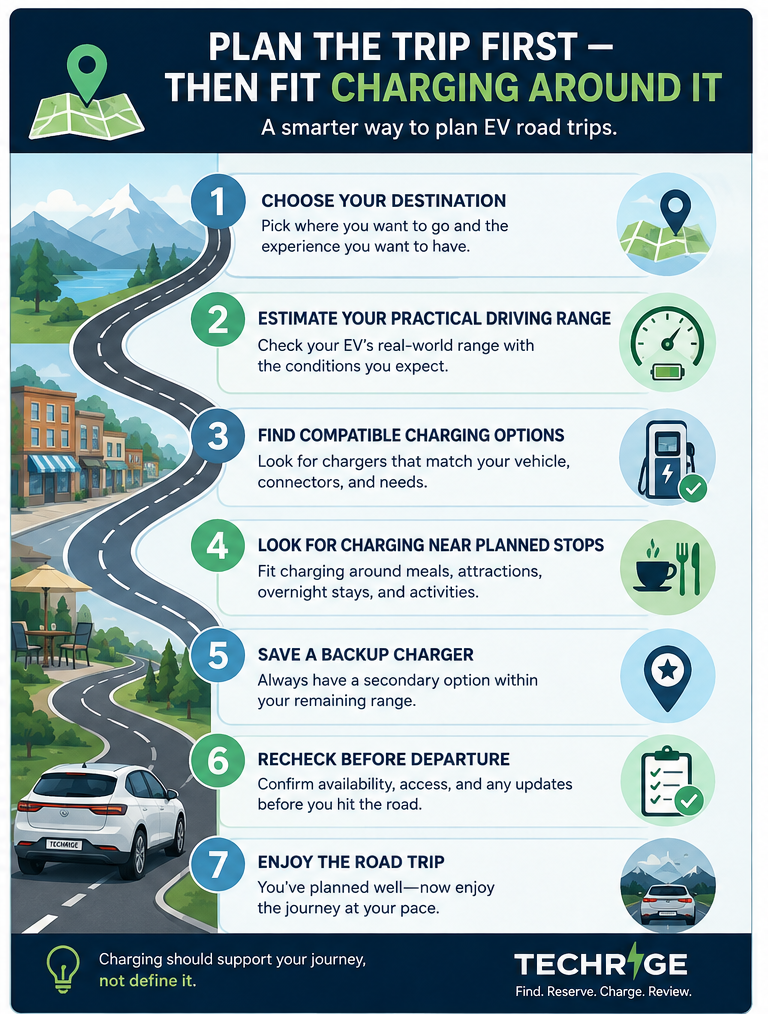
EV road-trip planning works best when charging supports the journey instead of becoming the entire journey.
Give yourself a realistic battery buffer
Your dashboard range estimate should not be treated as a guarantee that the vehicle will travel exactly that distance.
Energy consumption can change with driving conditions.
The Alternative Fuels Data Center recommends accounting for reduced range when a trip involves factors such as hilly terrain, heavy loads, or substantial heating or air-conditioning use.
For a road trip, that means you should avoid planning every leg around using nearly every kilometre or mile of the vehicle's estimated remaining range.
Instead, leave enough flexibility to handle:
- unexpected detours;
- changing weather;
- higher energy consumption;
- traffic;
- unavailable chargers; or
- a change in your planned destination.
The right buffer depends on your vehicle, route and conditions. There is no single percentage that works for every trip.
Check more than the charger location
Seeing a charging-station pin near your route is only the beginning.
Before depending on a charger, check whether it actually works for your vehicle and your plans.
Look at:
- connector compatibility;
- charging type;
- charging power;
- access hours;
- parking restrictions;
- availability information;
- payment requirements;
- whether an adapter is needed; and
- whether you can reach another charger if your first option becomes unavailable.
The Alternative Fueling Station Locator is one resource for locating EV charging stations in the United States and Canada.
The broader principle applies wherever you travel: use reliable, current charging information and check the details for the specific station you intend to use.
Techrige also has a detailed guide on how to read a public EV charger listing before you drive there.
Charger compatibility matters
Not every charger works with every EV.
Your vehicle needs to support the charging method and connector available at the station. In some circumstances an adapter may expand your charging options, but an adapter is not automatically compatible with every vehicle, network or charger.
If your road-trip plan depends on an adapter, verify the combination before departure.
See Techrige's EV charging adapter compatibility and safety checklist for a more detailed pre-trip review.
The important point is simple:
Do not choose an important charging stop based only on its location.
Make sure it is a charging stop your vehicle can actually use.
Use Techrige to explore additional charging options
Public fast-charging networks are an important part of EV road-trip planning, particularly for longer-distance travel.
But they do not have to be the only charging option you consider.
Techrige is designed to connect EV drivers with charging stations made available through the platform.
Drivers can search by location, review available charging-station information and select a station and time for a reservation. Techrige's current platform also allows users to rate their charging experience after a completed visit.
For a road trip, shared charging can potentially add another type of stop to your planning.
Instead of asking only:
“Where is the next highway fast charger?”
you can also ask:
“Are there charging opportunities near the places I actually want to visit?”
That could be useful when exploring smaller communities, staying somewhere for several hours, visiting a destination away from a major charging corridor, or simply looking for another charging option.
Availability will naturally depend on the chargers listed in the area.
A reservation improves certainty — but keep a backup
There is an important difference between finding a charger on a map and reserving an available charging opportunity.
Techrige currently allows a driver to select a charging station, choose a time and make a reservation through the platform.
That can provide more planning certainty than simply hoping a charger will be available when you arrive.
However, no road-trip charging plan should depend on the assumption that nothing can change.
Equipment problems, travel delays, access issues and other unexpected circumstances can still occur.
A reservation should therefore be part of a good charging plan — not a replacement for a backup plan.
Build a simple primary-and-backup charging plan
For important road-trip charging stops, identify at least:
Primary charging option:
The charger you expect to use.
Backup charging option:
A separate compatible charger that you can reach with the battery level you expect to have.
Before departing, confirm that both options still make sense.
If the primary stop changes or becomes unavailable, you already know where you can go next instead of searching for another charger with a low battery.
Never make an essential charging stop your only charging option.
Should you charge to 100% before a road trip?
Sometimes.
There is no universal charge percentage that is appropriate for every EV.
Follow the charging recommendation for your specific vehicle and battery. Some manufacturers recommend lower limits for everyday charging while allowing or recommending a higher charge level when additional range is useful for a long journey.
Techrige covers this in detail in Should You Charge Your EV to 100%?.
For road-trip planning, think about the energy needed for the next part of the journey rather than automatically aiming for the same percentage at every stop.
If additional range provides a useful buffer before a long section with fewer charging opportunities, a higher starting charge may make sense when it is consistent with your vehicle manufacturer's guidance.
Is shared EV charging cheaper?
Do not assume that it will be.
Charging prices can differ between charging locations, hosts, networks and pricing structures.
A shared charger may sometimes be attractive because of its location, availability, convenience or price. In another situation, a public fast charger may be the better option.
Instead of assuming one type of charging will always cost less, compare the information available for your actual trip.
Consider:
- the charging price;
- parking or access costs;
- charging speed;
- how long you expect to stay;
- distance from your route; and
- whether the location fits something you already planned to do.
The cheapest charger is not automatically the most useful one.
A slightly different charging option that fits naturally into a meal, overnight stay or planned activity may be more convenient for the overall trip.
A practical EV road-trip checklist
Before leaving on a longer EV journey:
- Check your vehicle's starting charge.
- Follow the charge-limit guidance for your specific EV.
- Estimate the first realistic driving leg.
- Leave additional range for conditions and unexpected changes.
- Identify compatible charging opportunities.
- Check connector type, access and charging characteristics.
- Fit charging around your itinerary where practical.
- Look for charging near meals, overnight stops and destinations you want to visit.
- Reserve charging when that option is available.
- A planned reservation can add useful certainty.
- Save a backup station.
- Make sure you can reach it without depending on the primary charger.
- Recheck important stops shortly before departure.
- Availability and access conditions can change.
- Adjust during the trip.
- Your actual energy consumption gives you better information than the plan you created before leaving.
Discover more charging possibilities with Techrige
The goal of EV road-trip planning should not be to eliminate spontaneity.
It should be to create enough confidence and flexibility that charging does not dominate every decision you make along the way.
Public charging networks remain an important part of long-distance EV travel. Shared charging can complement those networks by creating additional charging opportunities closer to homes, communities and destinations.
With Techrige, you can search for charging stations made available through the platform, review their details and reserve an available charging opportunity for your trip.
Plan the important charging stops.
Keep a realistic backup.
Then leave some room in the itinerary for the road you did not expect to take.
Sources
- TECHRIGE — Find and Book Nearby EV Charging Stations
- U.S. Department of Energy Alternative Fuels Data Center — Electric Vehicles for Consumers
- U.S. Department of Energy Alternative Fueling Station Locator
- TECHRIGE — How to Read a Public EV Charger Listing Before You Drive There
- TECHRIGE — EV Charging Adapter Compatibility and Safety Checklist
- TECHRIGE — Should You Charge Your EV to 100%?